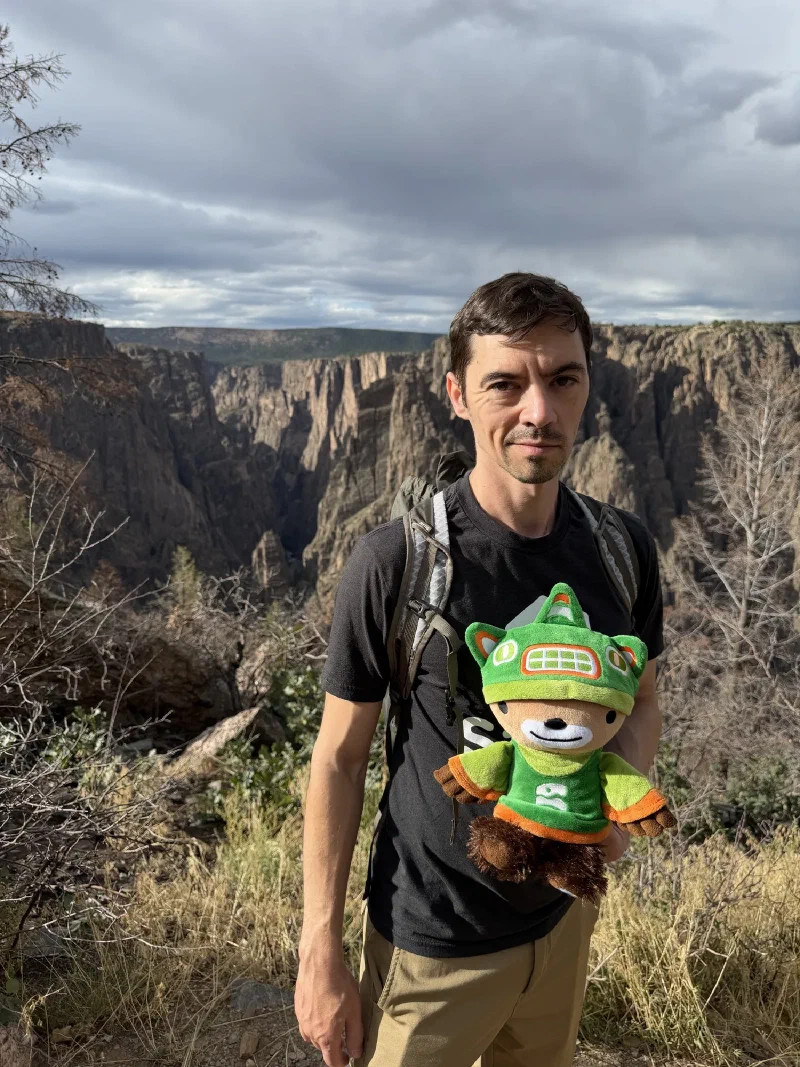
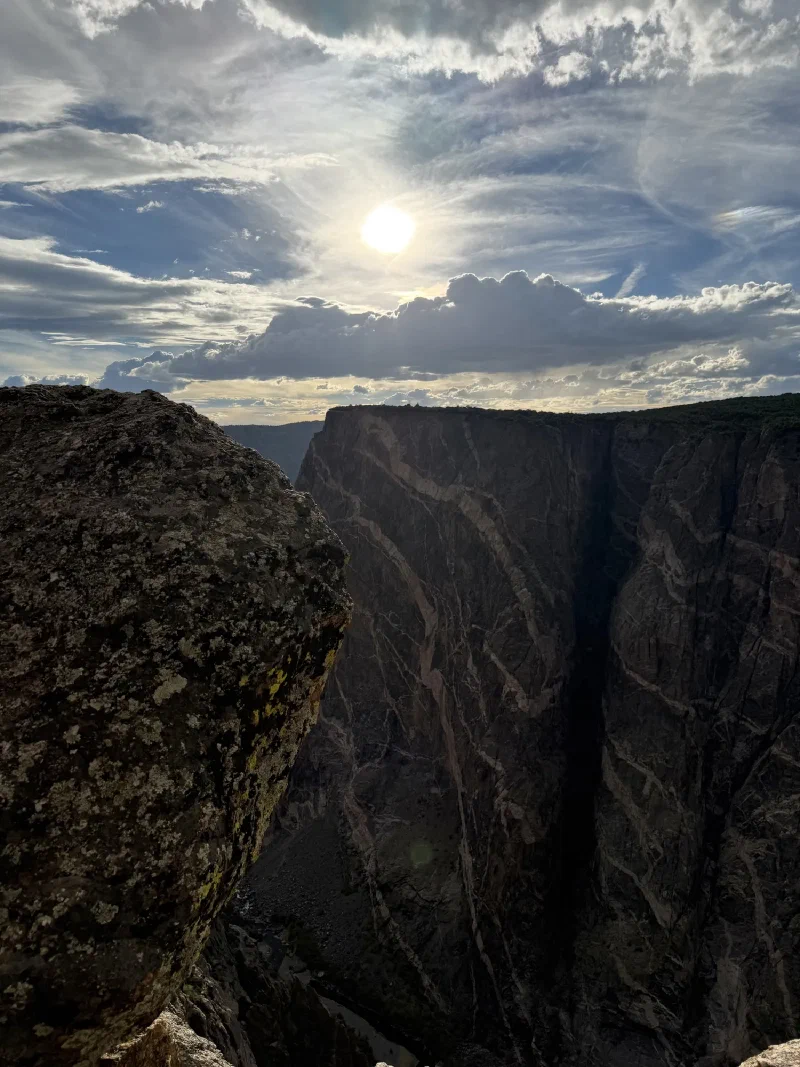
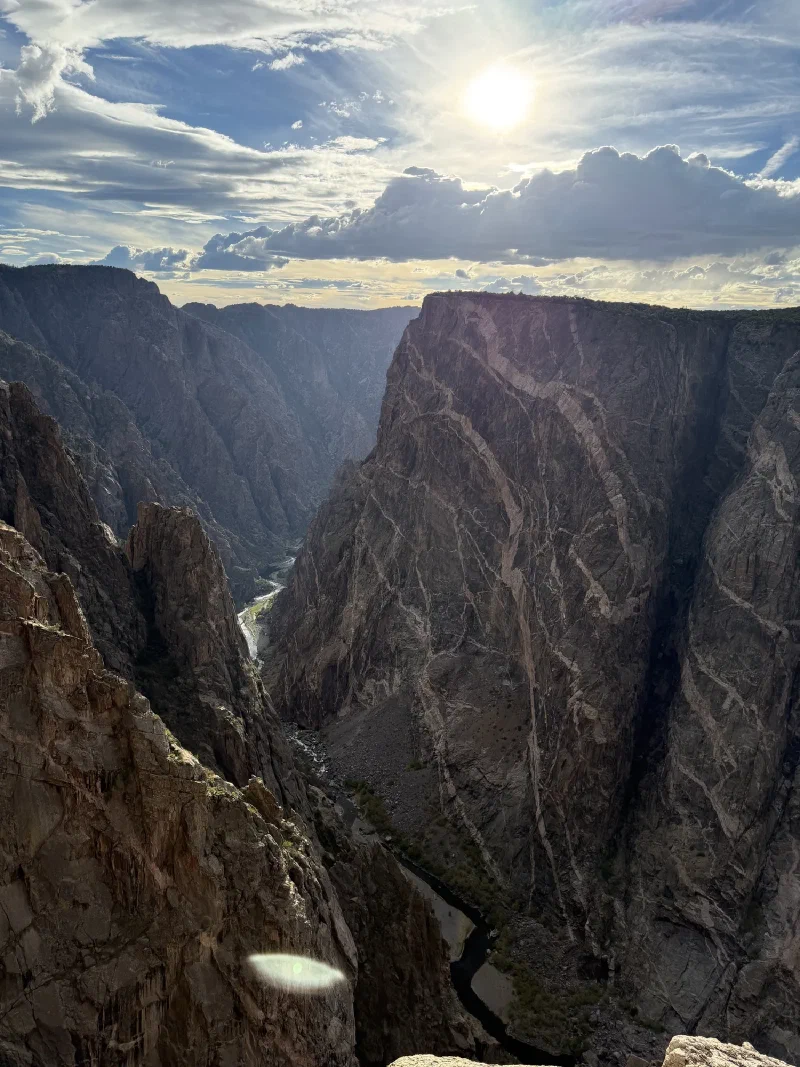
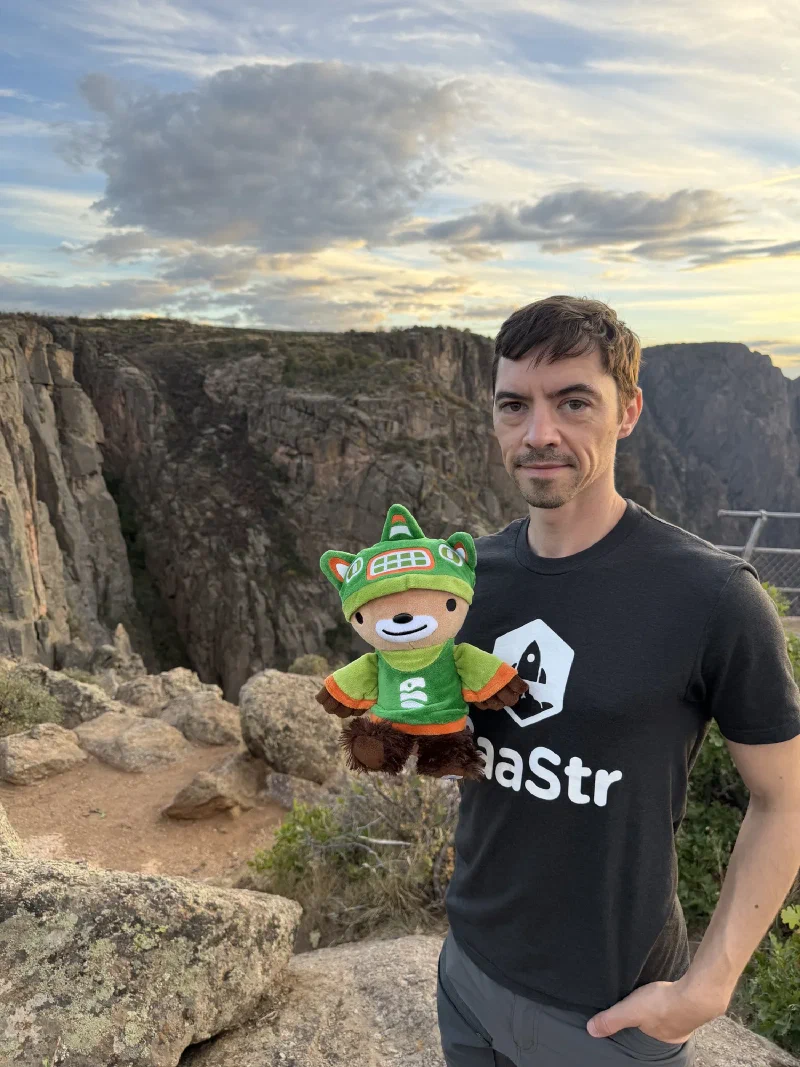
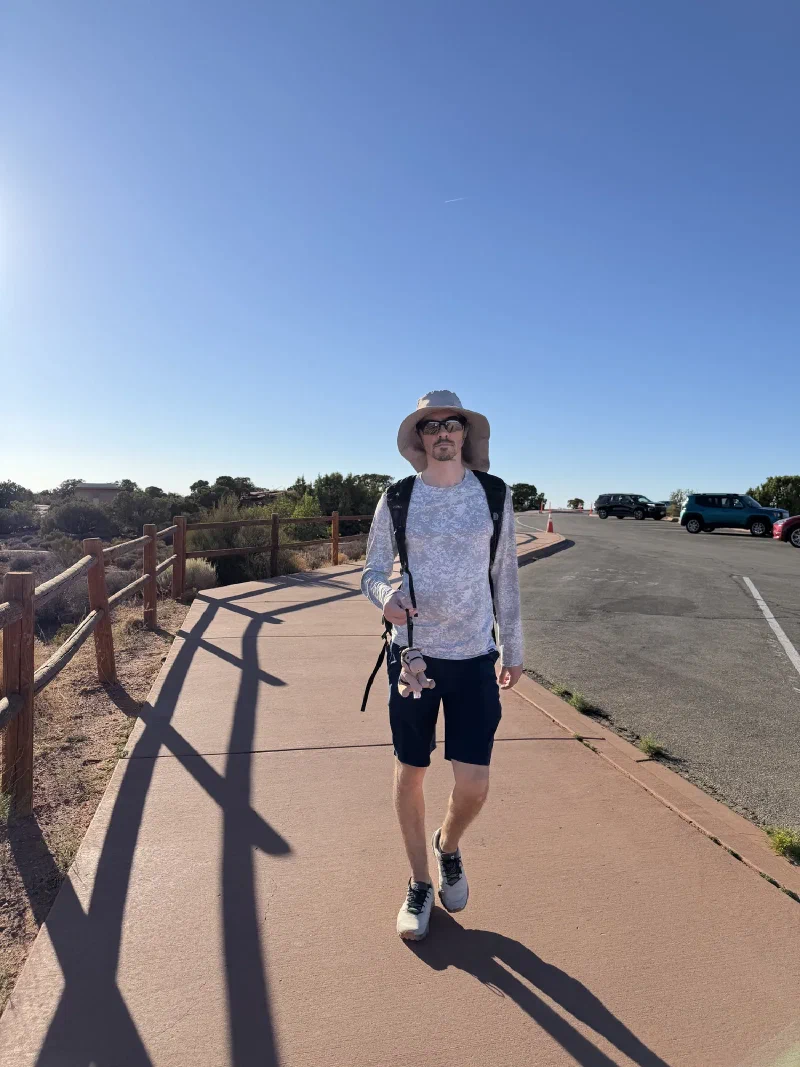
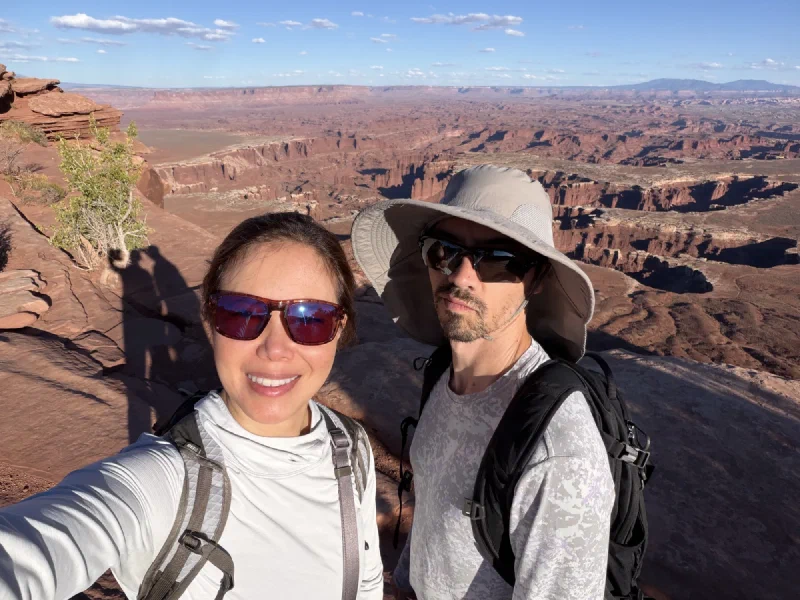
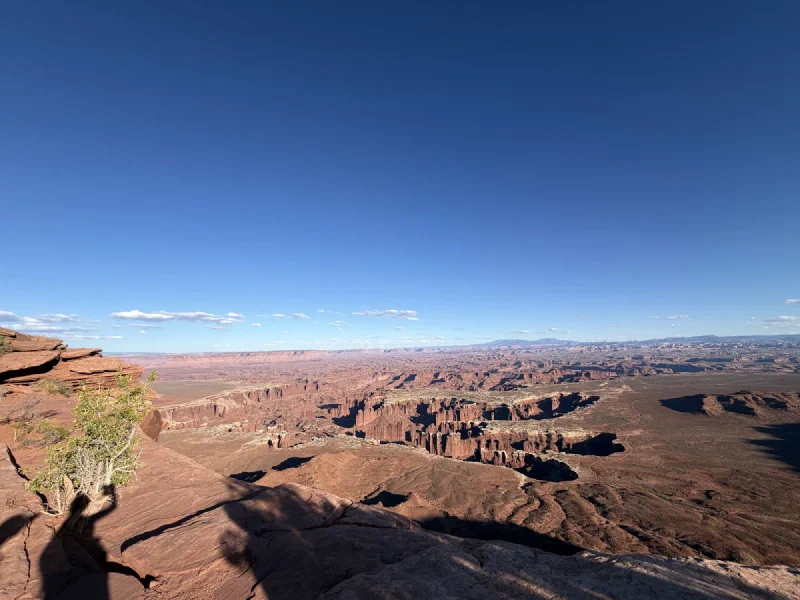
First stop was the visitor centre, and it was the nicest visitor centre any of us had ever been in.
That is not a small claim. We have been in a lot of visitor centres on this trip. It is where the mugs live.
It turns out there is a reason. It is not really a visitor centre. It is the Mesa Verde Visitor and Research Center, it opened in 2012, and the back of the building is where the park keeps its archives and its museum collection. More than three million objects. They built the whole thing to LEED Platinum, which is the top grade you can get for a green building.
So the lobby is nice because it is the front door to a vault. I approve of this. Every building with a vault in it should have a lobby like that.
Mesa Verde is the cliff dwelling park. The point is going down into them with a ranger, and you are meant to book that ahead, and we had decided to come here that morning.
Point Lookout again. It is very hard to get away from.
So, a debate. The museum is an hour’s drive in from the entrance. Without a tour, there would be nothing to do at the end of it except look.
We went anyway, for the same reason we came at all. When are we ever going to be back here?
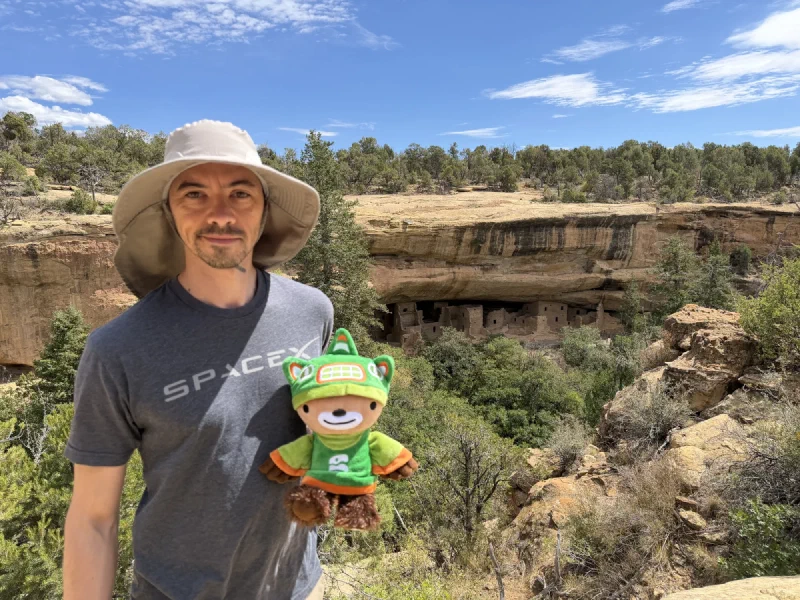
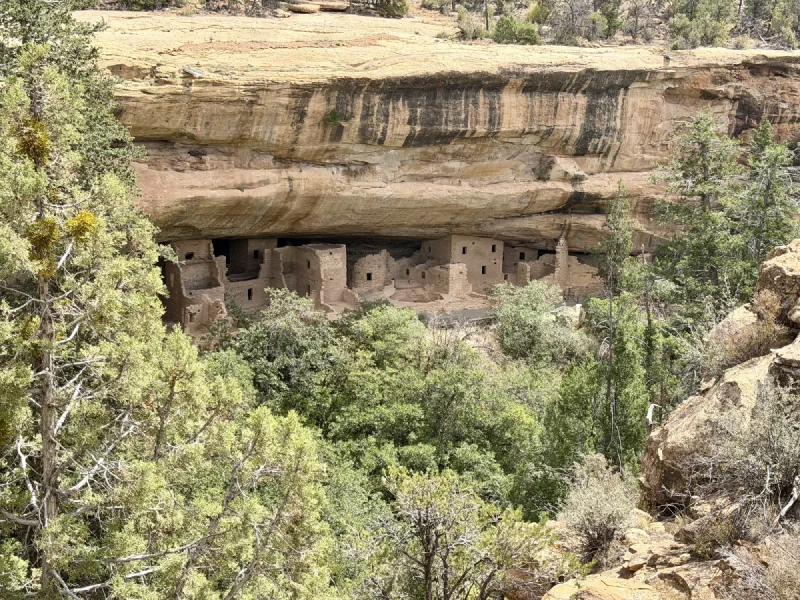
At the end of the drive is the Chapin Mesa museum, and below it, tucked under a cliff, is Spruce Tree House.
It was built somewhere between 1200 and 1280. Around 130 rooms and eight kivas, stacked into an alcove in the canyon wall, with the cliff itself for a roof.
Front row. Also the back row. There is only one row.
The roof is the problem. Rock keeps falling off it, so Spruce Tree House has been closed since 2015. Nobody goes in. Not with a ticket, not with a ranger, not at all.
Which means all we could do was look down.
Which is also all anyone else could do. We had no tour booked, and it made no difference whatsoever. For once we were exactly as important as everybody else, and I would like that to never happen again.
A roof made of cliff. That was the selling point for eight hundred years, and now it is the reason for the fence.
It seemed interesting. It was a nice spot. It was also still too hot for a proper hike, and we were running behind.
So we did what we had actually come here to do. Nicholas bought a mug.
Then we drove off.
There is a postscript to this. According to his mom, Nicholas has been to Mesa Verde before. As a kid, on a family road trip. He drove in, looked down at the cliff dwellings from above, and left.
He has no memory of it whatsoever.
So all that worrying about when we would ever be back here, and the answer was that he already had been, and it did not take. This time he has a mug. That should help.
From here it was a race. Time for Nicholas to go to work.
We stopped in Kanab. The next day we drove through Zion, which we have done properly plenty of times already, so this time we were not there to see anything. We were there for the mug.
Zion did not care what we were there for. It was packed. There was not a single parking spot anywhere.
So Nicholas stayed at the wheel, Pokin hopped out, ran in, came back with the goods, and we kept going. We did not stop at Zion. Technically Pokin did.
Then home.
Seven mugs. The trip was over. The collection, it turns out, was not.
Every other astro night on this trip has had a trail in it. You park, you walk the trail for a while, you put the tripod down.
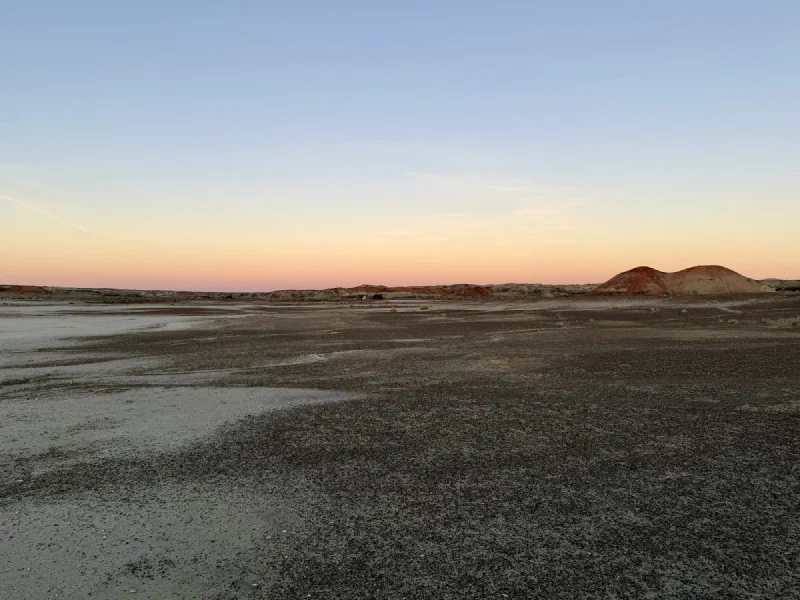
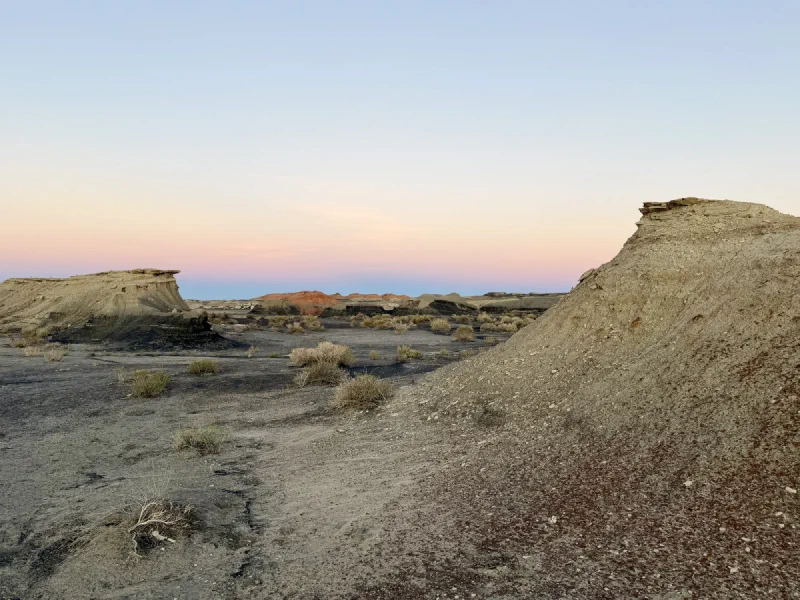
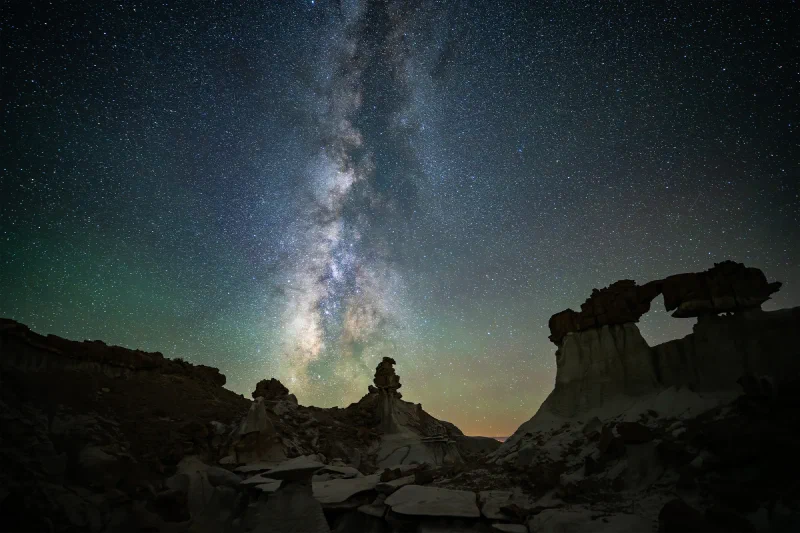
Bisti is not that. The car park is a patch of dirt, the rocks worth photographing are a couple of miles out, and there is no trail at all. You walk into the badlands and you find them.
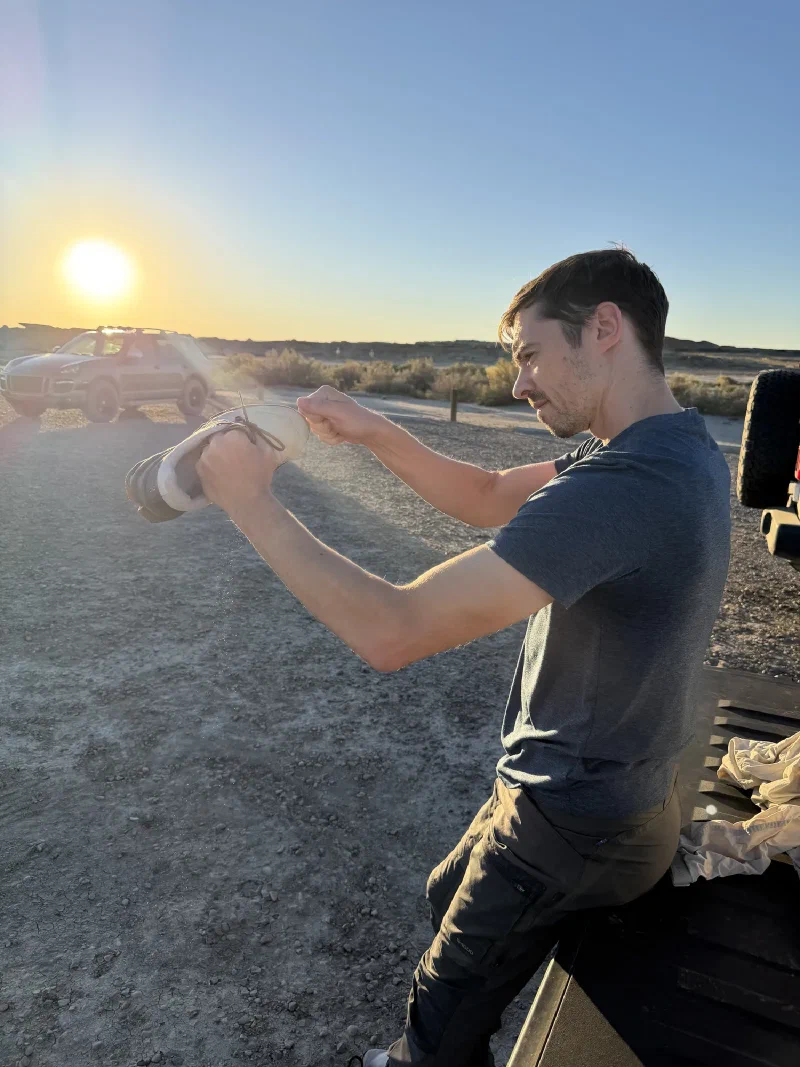
Still emptying the Great Sand Dunes out of his shoes, three days later.
So we went fast, into light that was already leaving.
Nicholas said we should have got here hours ago. He said it at the car park. He said it crossing the flats. He said it again about twenty minutes later, in case anybody had stopped thinking about it.
Nobody had stopped thinking about it.
The light doing the thing it does for about eleven more minutes.Riding up front, which is the correct arrangement.
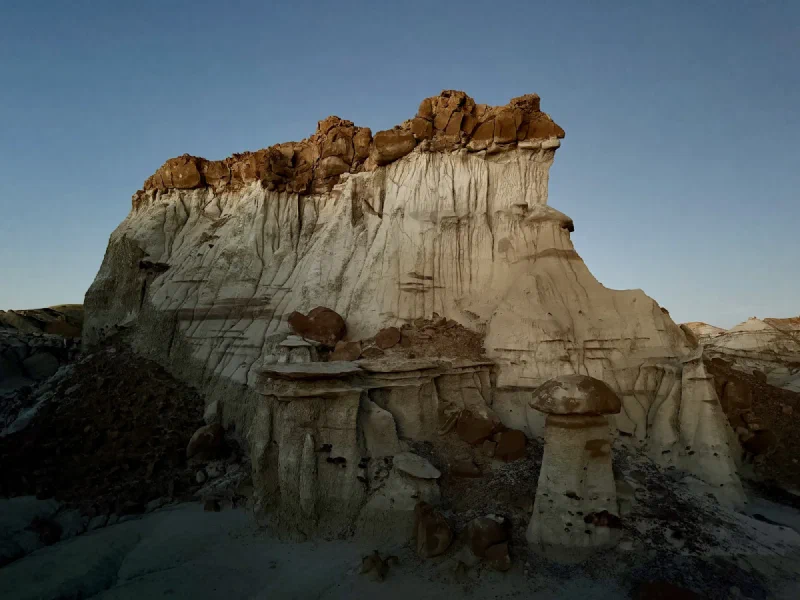
Bisti comes from the Navajo Bistahí, and it means “among the adobe formations,” which is a very calm name for what is actually out here.
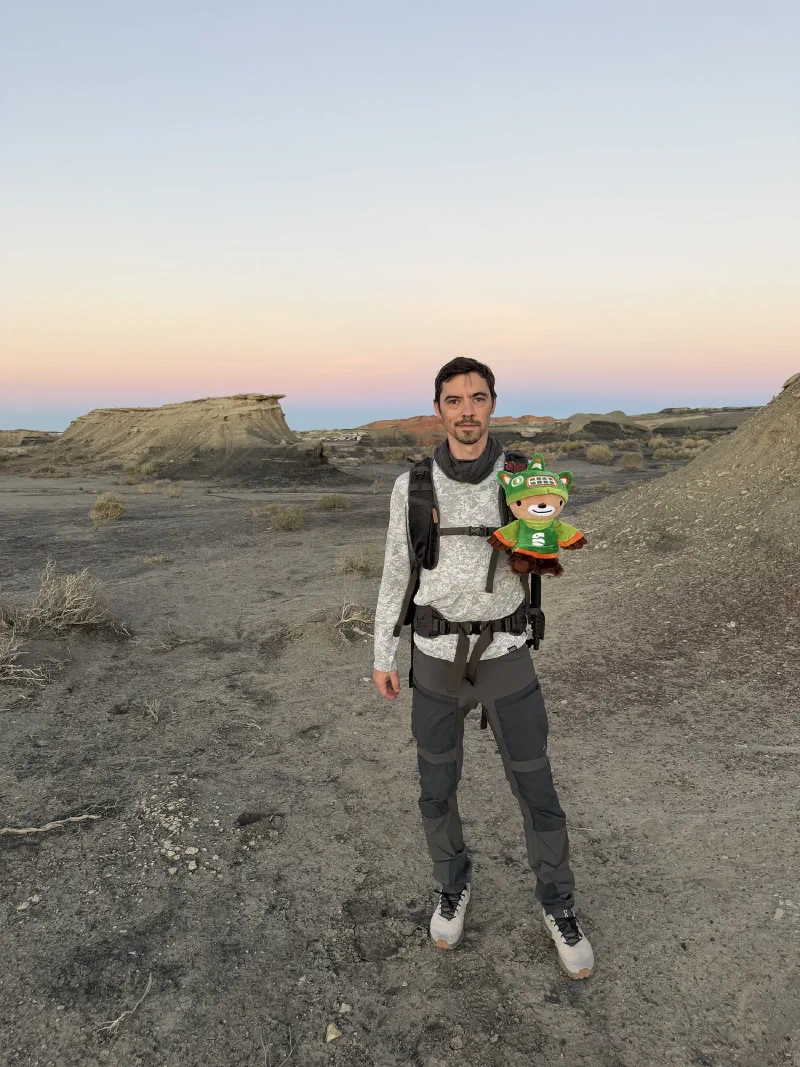
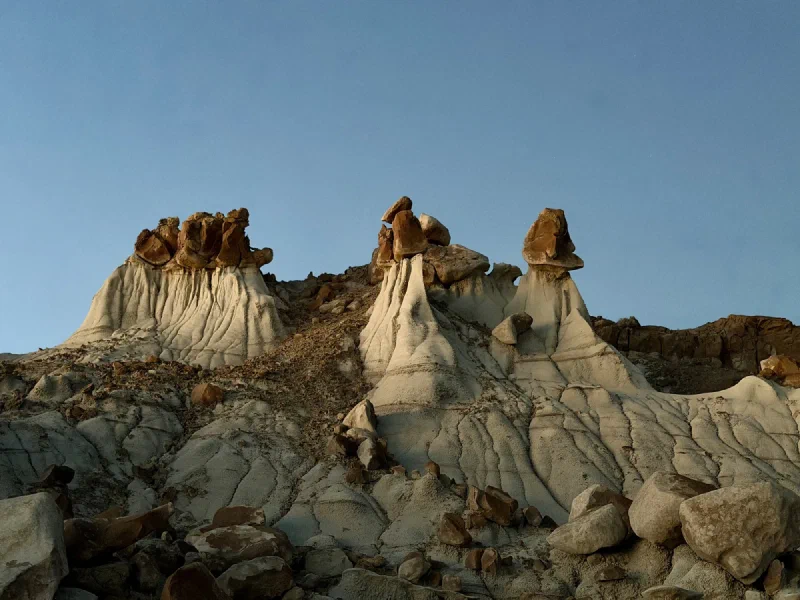
The rocks stand around in groups. Hard sandstone caps sitting on soft grey pedestals, worn down until the cap is the only thing holding the whole arrangement up, and they are everywhere, at every size, in every direction. It is a little unsettling. It looks like a film set from Starship Troopers, and I mean that as praise.
Seventy million years ago none of this was desert. It was swamp and river delta on the edge of an inland sea, and the things living in it were dinosaurs. The badlands here expose the most complete run of rock across the end of the Cretaceous of any single basin in the world, which is the sort of claim I would normally have objections to, except it holds up.
In 1997 a volunteer found a tyrannosaur out here. Nine metres of it, about thirty feet, and they flew it out by helicopter. It turned out to be a species nobody had named yet. It is Bistahieversor sealeyi on the label and the Bisti Beast to everyone else, and it lives in a museum in Albuquerque now.
Two days ago in Clayton there was a life-sized dinosaur on a museum lawn and I was left in the car for it.
Now I am standing on a landscape made out of the real ones. I consider the account settled.
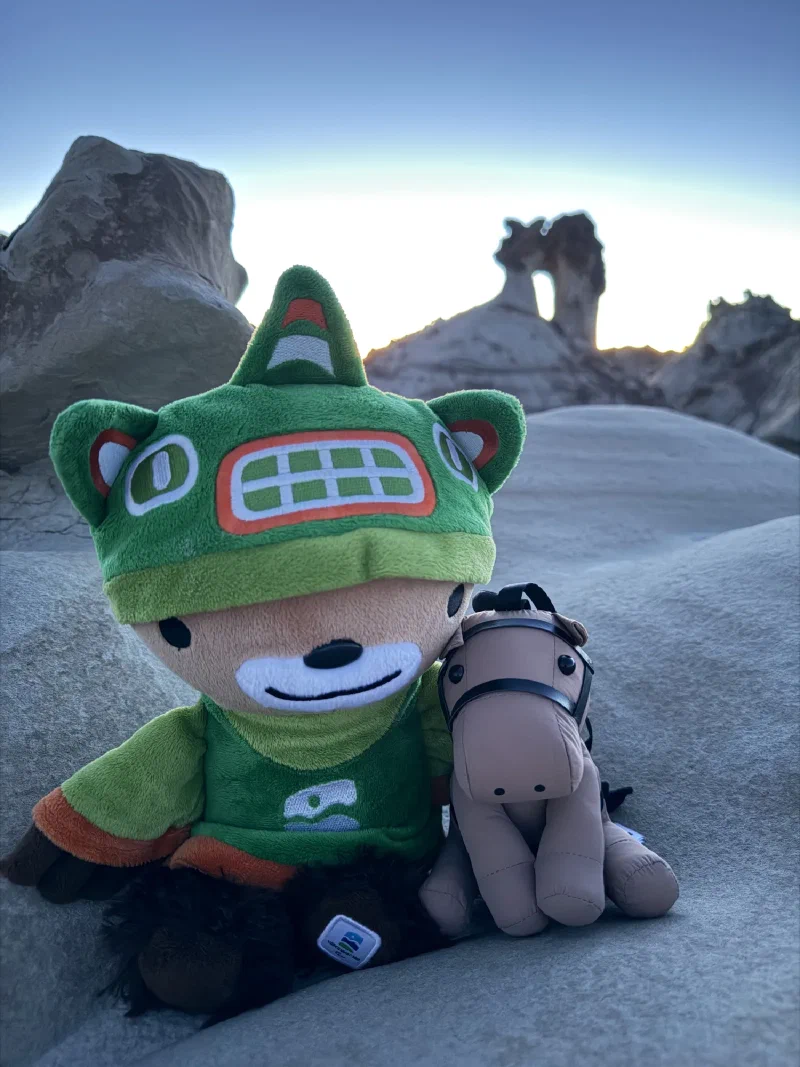
Me, the horse, and a rock that has been standing there since before there were people to be impressed by it.
It was properly dark by the time we were among the good ones, which caused a problem nobody had accounted for.
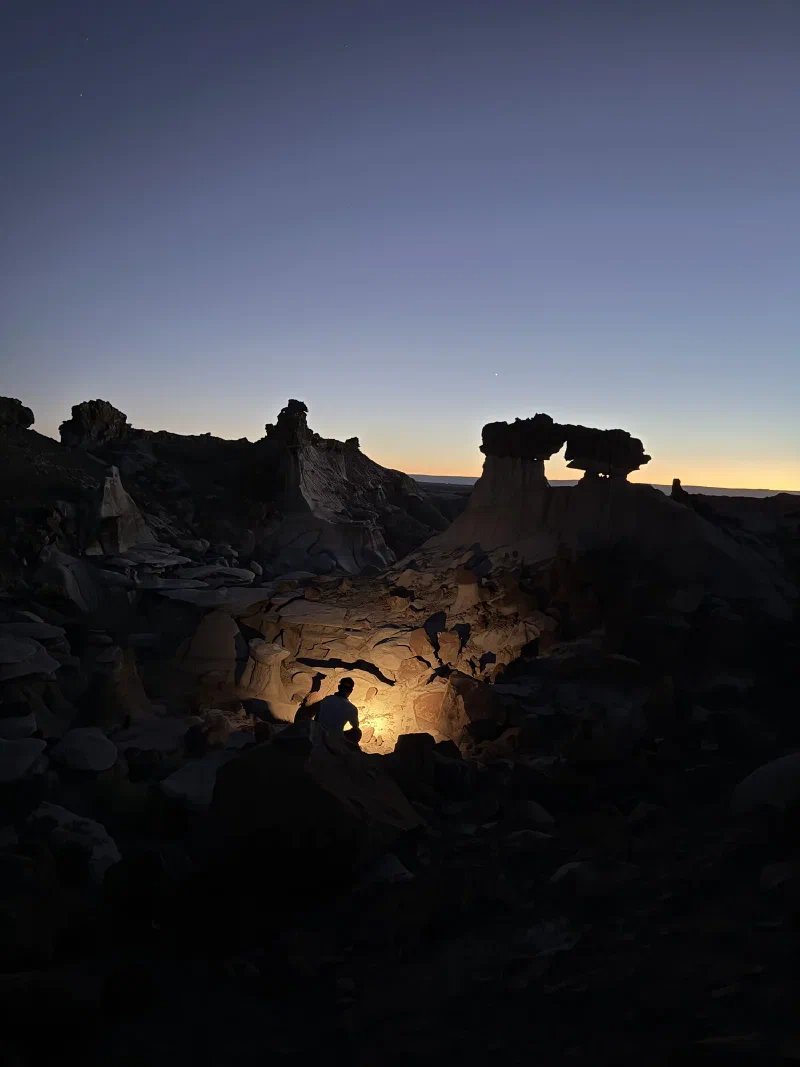
An astro shot needs a foreground. You cannot choose a foreground you cannot see. So Nicholas settled on one roughly over there, on the grounds that it was a rock, it was in front of him, and the light was not coming back.
Setting up by headlamp, in a spot chosen by process of elimination.
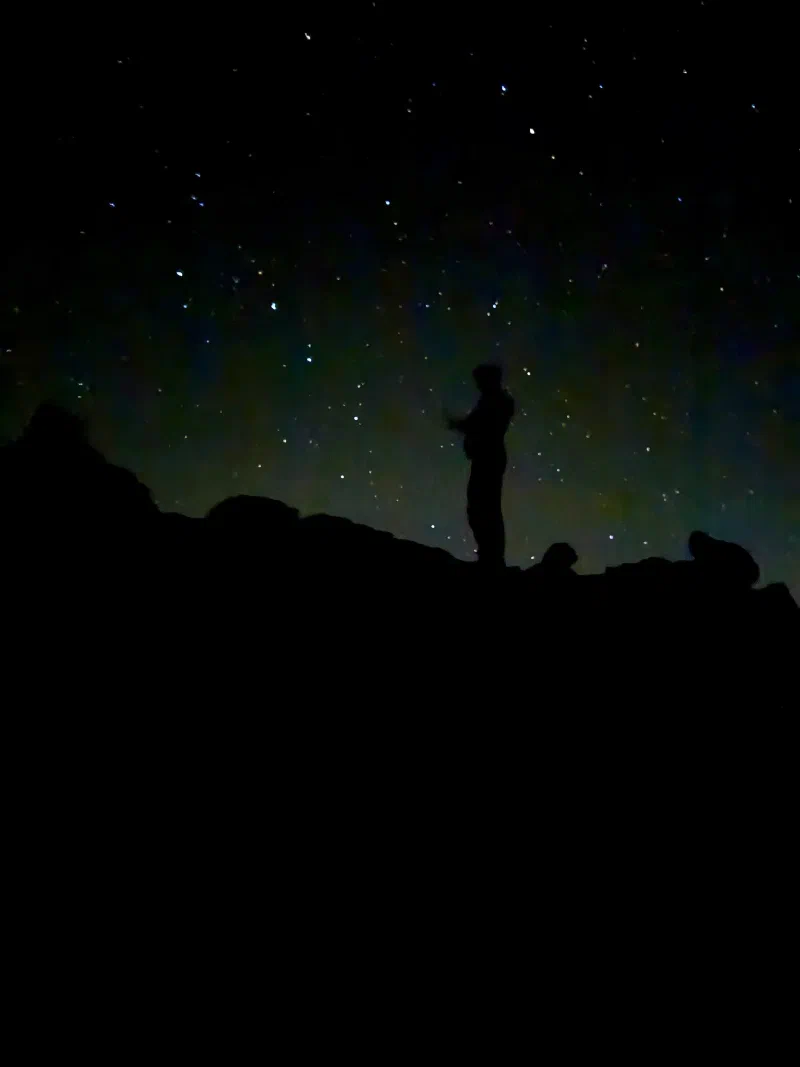
Then the question of how long we were staying, which had an annoying answer. It was a new moon. No moon at all, nothing washing out the sky, the best night you get. We could have stayed out until morning.
We were not equipped to stay out until morning.
So we gave it until about eleven.
Fine. It was worth the drive. I am not going to say it twice.
The walk back started well. Headlamps on, rocks close on both sides, light bouncing off things, everybody in good spirits.
Then the rocks ran out and we were on the open flats, and the headlamps stopped working. Not technically. A headlamp only shows you whatever it lands on, and out there it lands on nothing. The beam goes out and does not come back. You get a small circle of gravel around your boots, and past that the light just leaves, and you have no distance, no edges, and no way to tell whether the ground ahead of you continues for ten feet or ten miles.
Pokin did not enjoy that. Pokin got properly scared, which had not happened once on this trip, including the evening we followed a black bear down a road in the dark.
Nicholas seemed fine. I put that down to some sort of defect rather than actual bravery.
Reaching the car park did not fix it either. I think by that point Pokin had decided there was something in the dark, and that it was out to get us.
Because before we drove out, Nicholas went to use the washroom, came back, looked up, and said oh wow, this would be a cool photo, the car with the Milky Way behind it. Then he got the tripod out again and left the door hanging open.
Pokin reached across, pulled the door shut, and locked it.
He took the photos anyway. He took them from outside, on his own, with the door locked behind him, because she was not participating in any activity that happened outside the car and she was not leaving a door open for one either.
When he was finished, she let him back in.
“I feel so freaked out,” she said, once we were actually moving.
Yeah. We could all tell.
We got back to the hotel somewhere around one in the morning. Nothing was out to get us.
New question. What is worth seeing on the way back, and can it please not be hot.
Pokin came back with a place called Bisti, which she had found because she thought Nicholas would want to photograph it at night. She was not looking for something she wanted. She found the thing he would want, then did the routing.
Bisti was too far for one day. So the line home ran through a town called Taos instead.
Taos is what you would get if Santa Fe stopped trying quite so hard. Adobe everywhere, galleries, turquoise doors, and a general sense that the paint was applied a while ago and nobody has been nagged about it since.
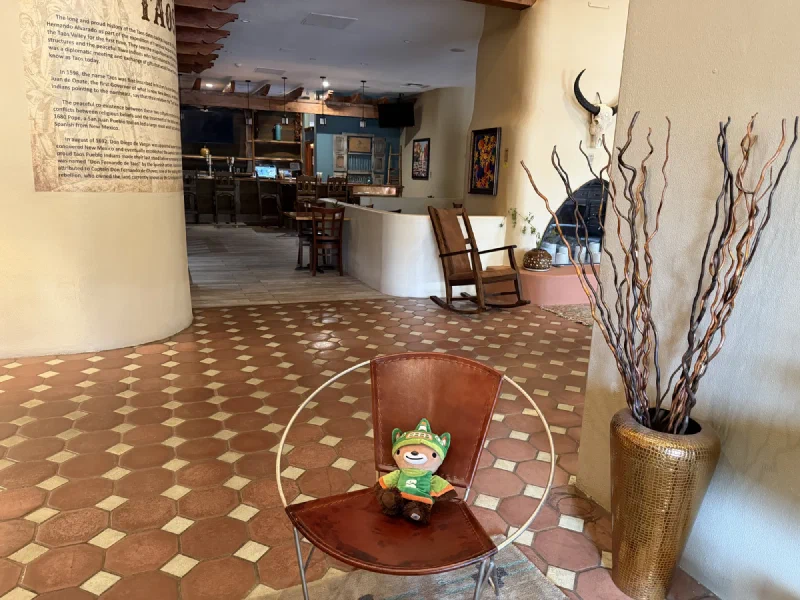
A curved wall of local history, a fireplace, a skull, and a chair the correct size for me. I claimed it immediately.
The hotel had a whole wall of Taos history printed on it, starting back in the fifteen hundreds, which I read in full because nobody else was going to.
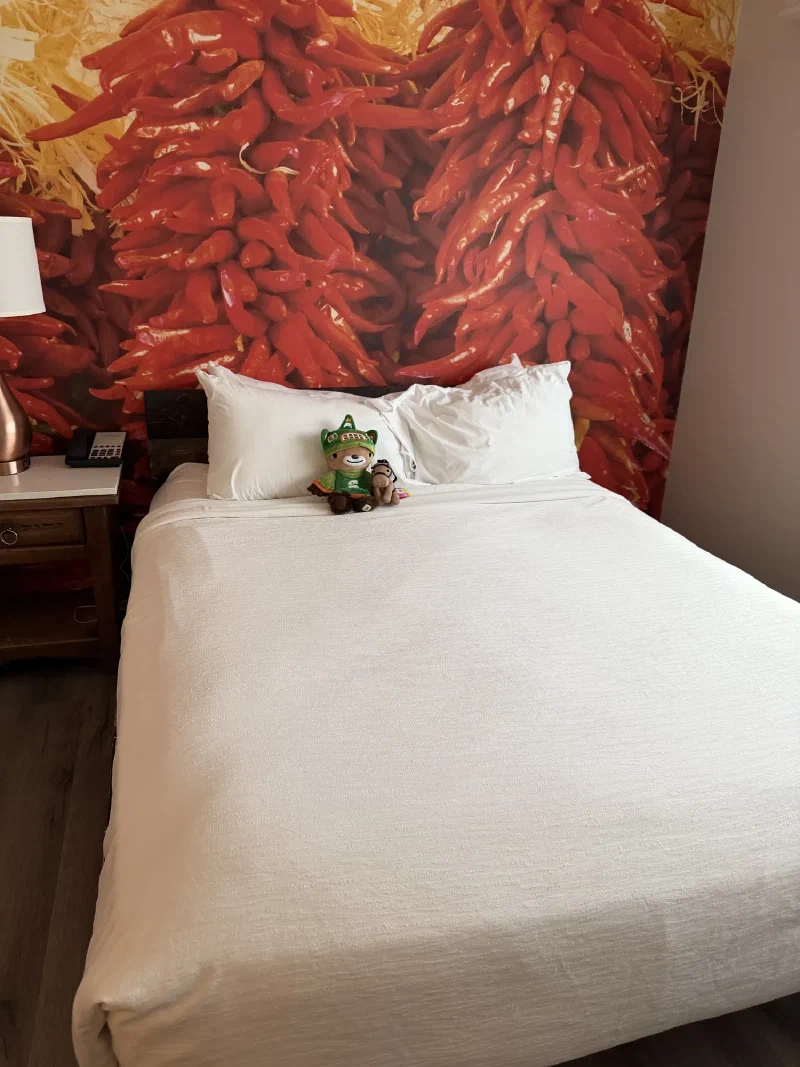
Chestnut and I took the bed. The wall is covered in chillies, which is a threat, but they were a painting so I let it go.
The condition about not being hot did not work out. Taos sits at about 7,000 feet, roughly 2,100 metres, which you would think buys you something. It did not. It was still really hot.
Nicholas had calls. He had a lot of calls. Being summoned back to work does not wait until you are actually back, so he took them from the hotel, and between them we walked around the town anyway.
Taos is named after Taos Pueblo, which is a separate place a couple of miles north of the town, and we decided to walk to it.
This was Nicholas’s plan and it lasted about as long as it deserved to. You cannot walk there. The land in between belongs to the Pueblo and you do not get to stroll across it because you felt like some exercise.
So we walked back.
As far as we got. In our defence the walk back had this in it.
Dinner was New Mexican, in New Mexico, which should have been the easy win of the entire trip.
Pokin said it was just ok.
Not bad. Just ok. She had spent the previous evening telling us that a taco place in Liberal, Kansas was the best meal of the trip, and twenty four hours later, in the state that is supposed to own this cuisine, the verdict was a shrug.
I did not have an opinion on the food. I had an opinion on the ranking, which is that Kansas is now undefeated and nobody in New Mexico knows it happened.
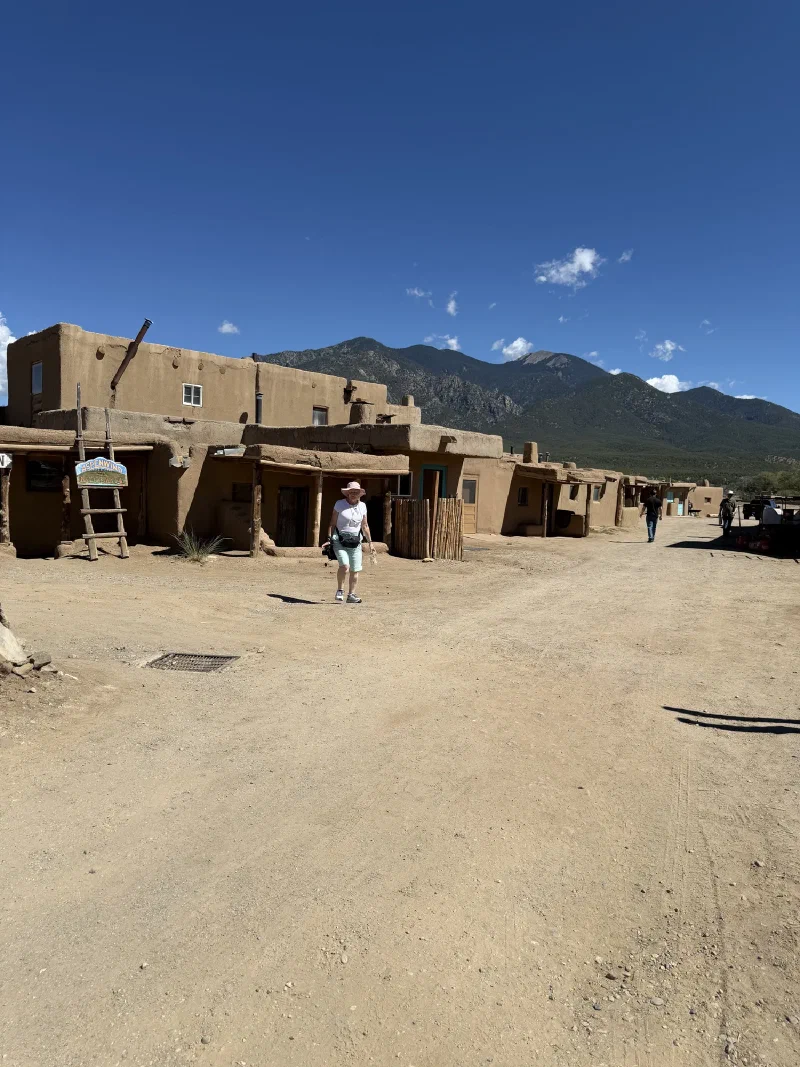
Dirt, adobe, ladders, and the Sangre de Cristos sitting behind the whole thing like they are supervising.
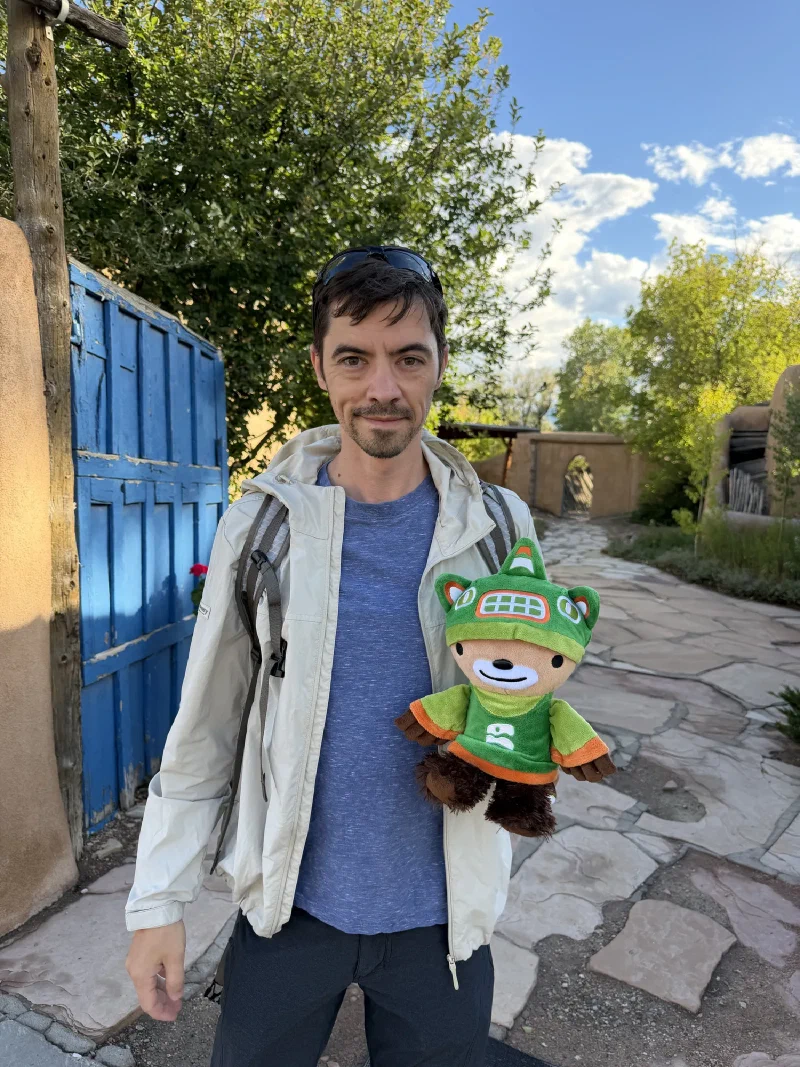
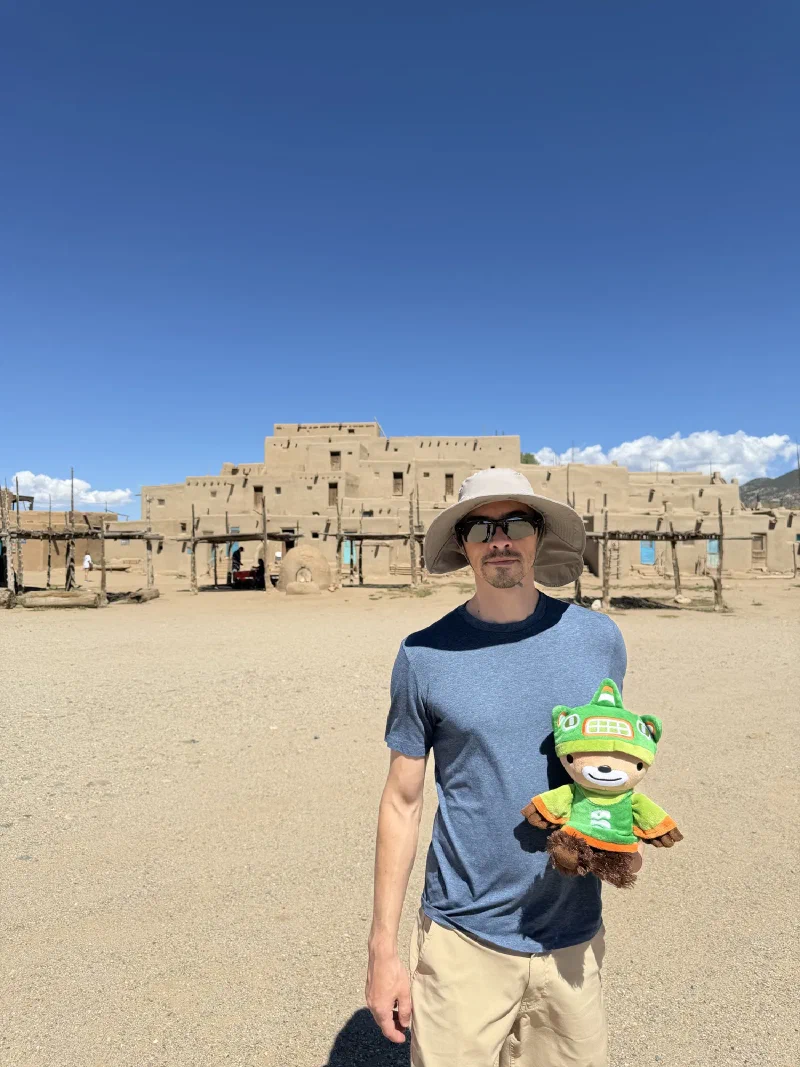
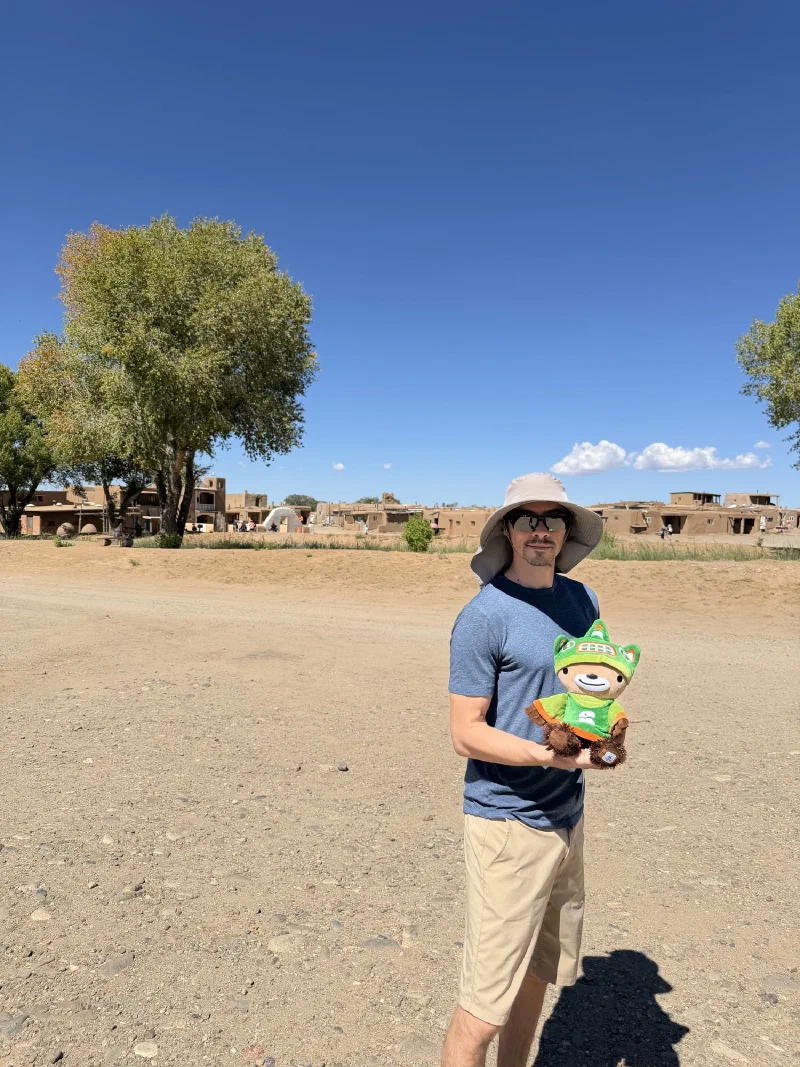
We got there early, walked the open part, and Nicholas carried me around for about ten minutes in front of the oldest building in the country.
Him, me, and about a thousand years of continuous occupancy.
Then the guided tour started at noon.
And at noon, Nicholas went back to the car to take a work call.
He handed me to Pokin and went to sit in a vehicle and talk to people in another time zone, and the rest of us went to look at the thing we had driven to.
So Pokin took me on the tour. She has now done this twice on this trip, in the sense that when there is something actually worth seeing and Nicholas is occupied, she is the one holding the bear.
The multi-storey adobe houses were built somewhere between 1000 and 1450 AD. People have been farming this valley since around 900. The two big structures have names, Hlauuma and Hlaukwima, the north house and the south house, and they are not ruins and they are not a reconstruction. They are houses. Roughly seventy five people live in the old village right now.
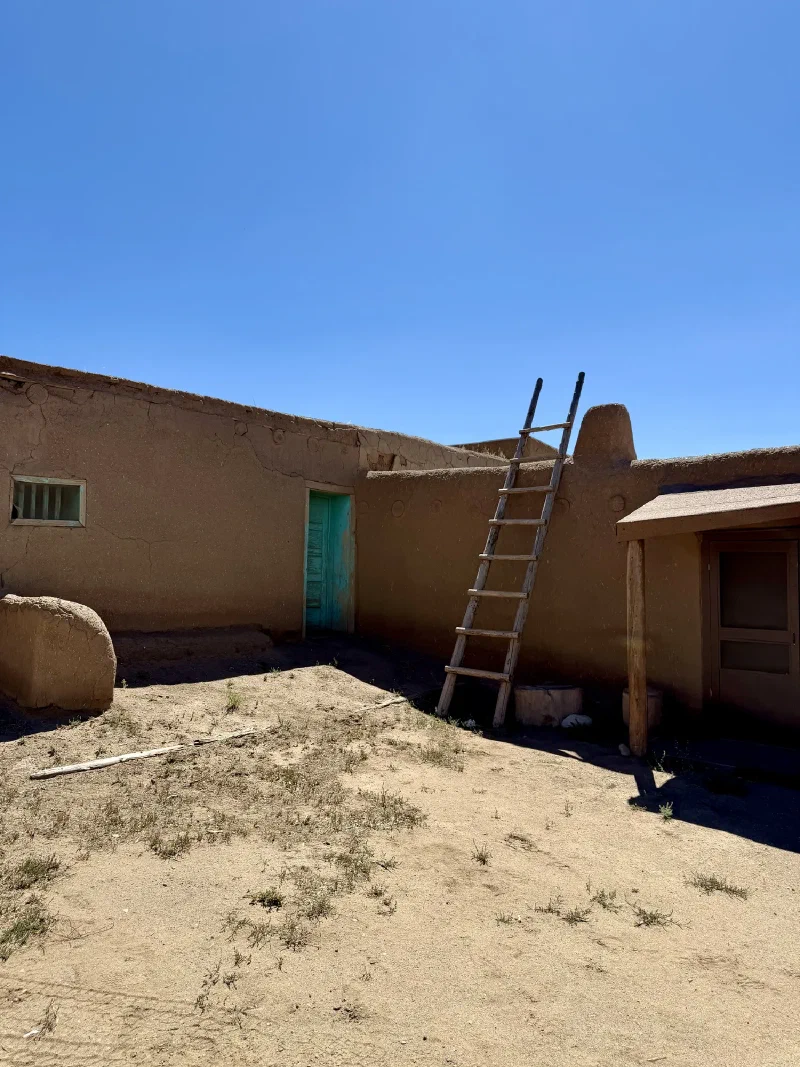
A door, a ladder, and an horno for baking bread. All three still in use.
The traditional village has no electricity and no running water. That is not a quirk of the budget. It is a rule, kept on purpose, because the alternative is the village slowly turning into a picture of itself.
The whole place is earth mixed with water and straw. The roofs sit on big timbers called vigas hauled down out of the mountains, with smaller pine and aspen latillas laid across them. The outside has to be re-plastered with mud and straw over and over, forever, and each family does their own house.
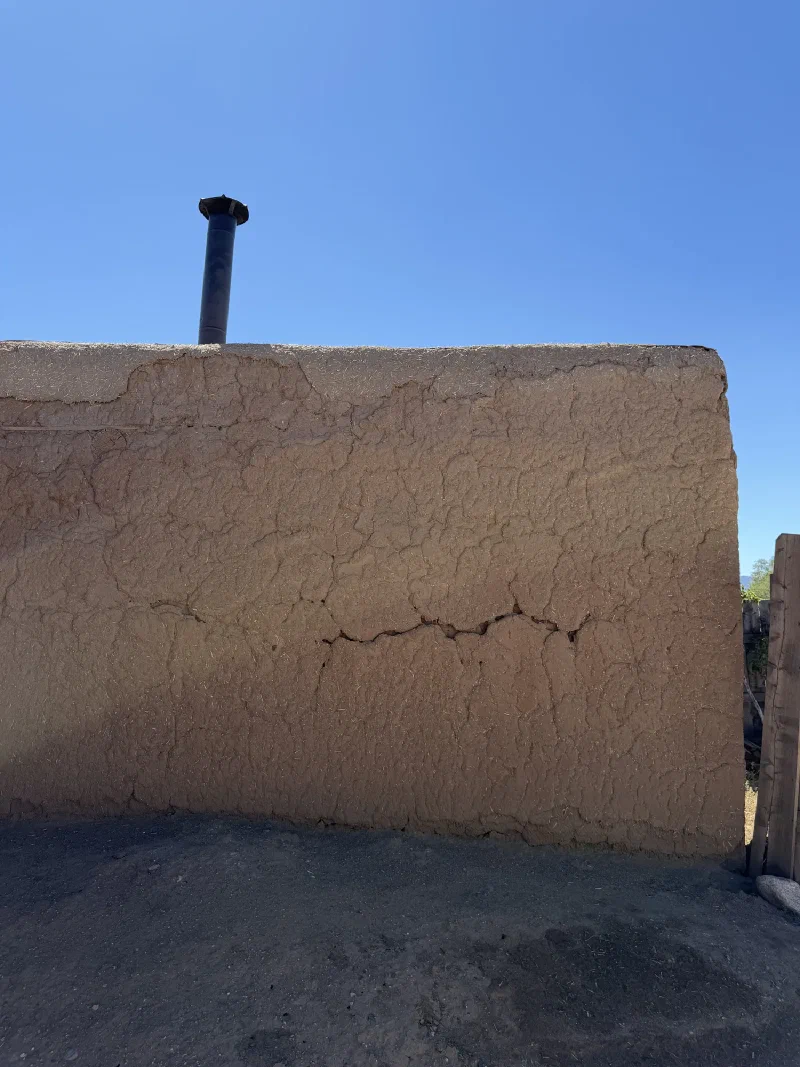
You can see the straw in it. Somebody has to re-mud that wall, and then somebody has to do it again, and that has been the arrangement since before England had a Parliament.
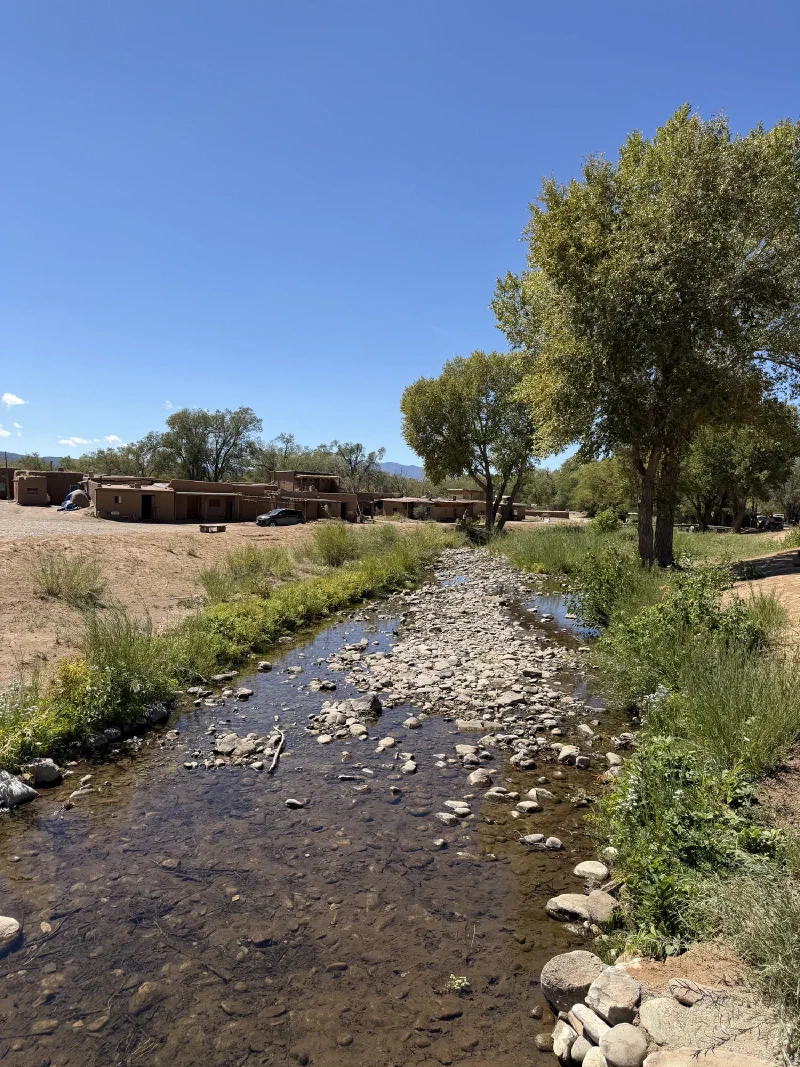
Red Willow Creek, which splits the village in half and has been the water supply the entire time.
Tour over. Pokin walked me back to the car and handed me to Nicholas, whose call had finished and who had now been to Taos Pueblo without seeing Taos Pueblo.
Which meant we were leaving immediately, because Bisti is the whole reason we came this way and Bisti is most of the way across the state. Drive straight there and we get to the badlands with the sky still worth pointing a camera at. Stop for lunch and we get a long drive to look at nothing.
That was the entire brief. Not a park. Not a view. Not a photograph. Just the question of how far east we could get before we had to turn around and start heading home.
Nicholas looked at the map and produced an answer, which was a town called Liberal, Kansas.
So we left Alamosa and drove. Colorado, then New Mexico, then Oklahoma, then Kansas. Four states in one day, aimed at a place none of us had heard of the week before.
We stopped in Clayton, New Mexico, to charge the car, which is twenty minutes of nothing, so they got out to walk around. That is how they found a dinosaur.
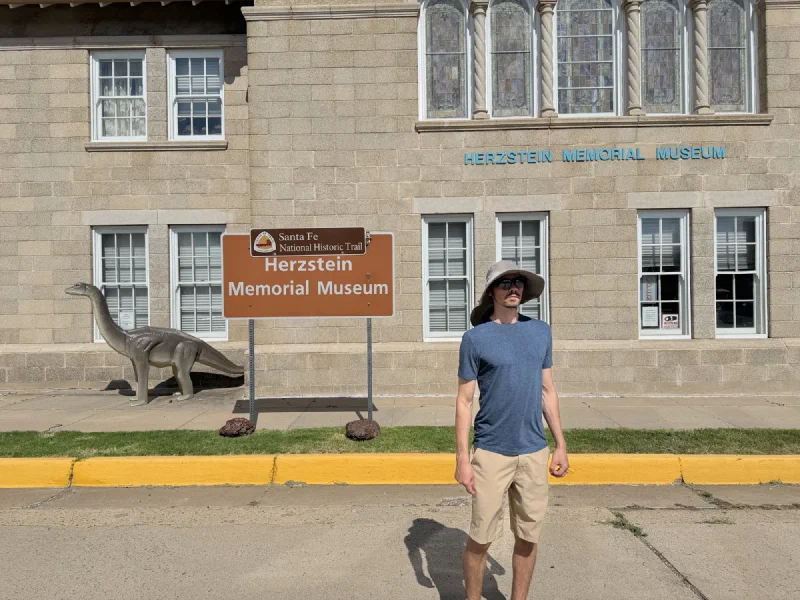
It was on the lawn of the Herzstein Memorial Museum. Life-sized. Standing there like it pays rent. Pokin decided this needed a photo of Nicholas.
Clayton, New Mexico. Small museum, Santa Fe Trail sign, one dinosaur.
Nicholas tells me he thought about coming back to the car to get me, because he knows I love dinosaurs, and then did not do that.
I was in the car. I stayed in the car. The dinosaur and I have never met.
Then the country flattened out and stayed that way for a very long time.
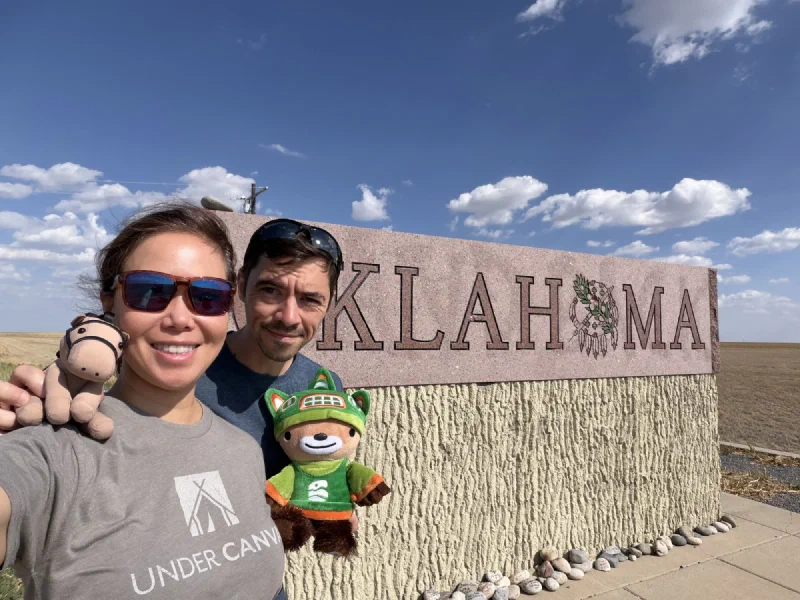
Oklahoma came first, at the exact corner where New Mexico runs out. Big stone sign, feathers worked into the lettering, nothing behind it in any direction.
New state number one of the afternoon. Chestnut, once again, front and centre.
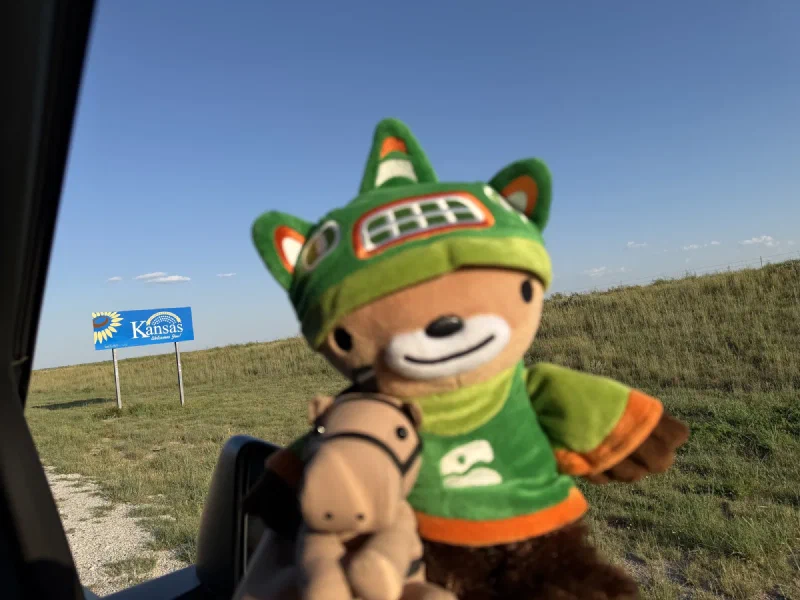
Kansas came about three hours later and got considerably less ceremony. Blue sign, sunflower, Kansas Welcomes You! We photographed it through the window without slowing down much.
Kansas got the window treatment. I want it noted that the sign has an exclamation mark and we still did not stop.
It is not Dorothy’s house. Dorothy is a fictional character from a film, and this is a farmhouse that was built in 1907 and lived in by real people who had nothing to do with any of it. In 1981 it was donated to the county historical society, moved onto the museum grounds, and furnished to match the inside of the 1939 movie.
The reasoning, as far as I can tell, was that nobody else had claimed it yet.
That is not a criticism. That is just how you get a landmark.
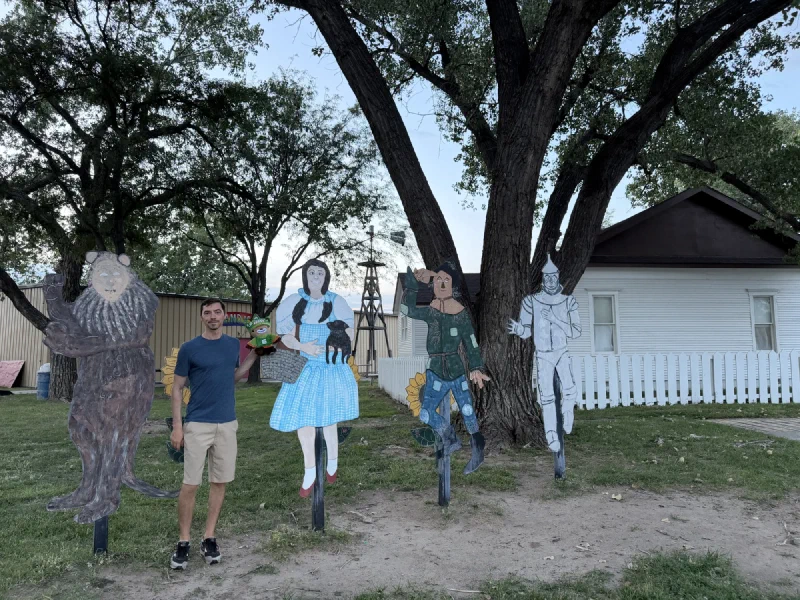
The house is real. The house is not hers. Everything else here is plywood.
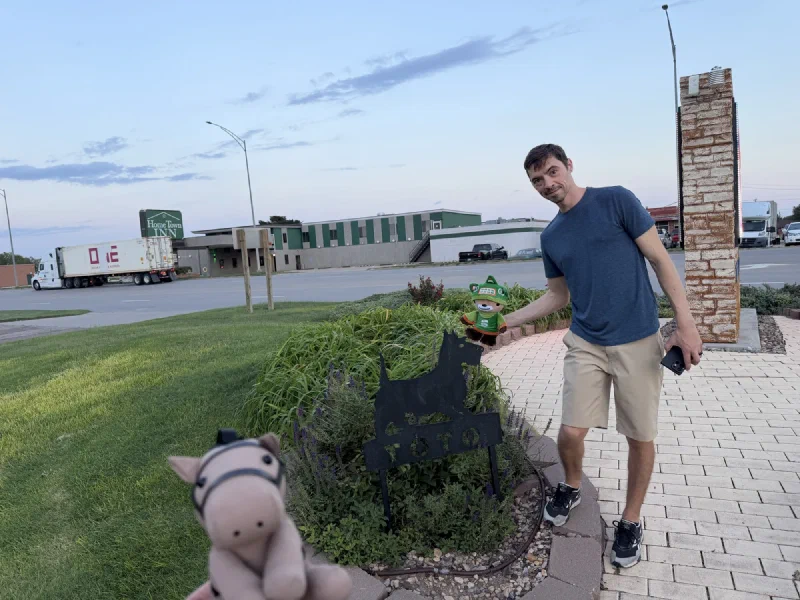
Behind the Land of Oz is a motel and a semi-truck. I liked that quite a lot. You spend a whole afternoon driving toward Oz and it turns out Oz backs onto a car park.
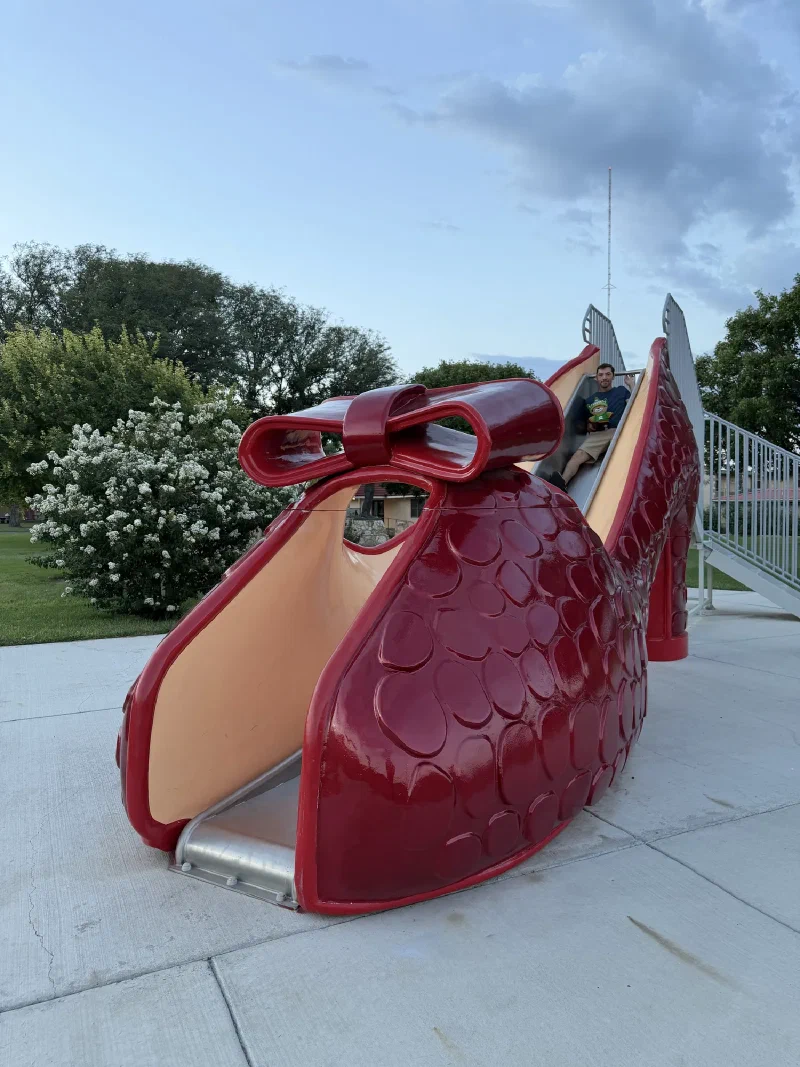
A grown man, on a slide shaped like a shoe, holding a bear. I was not asked.
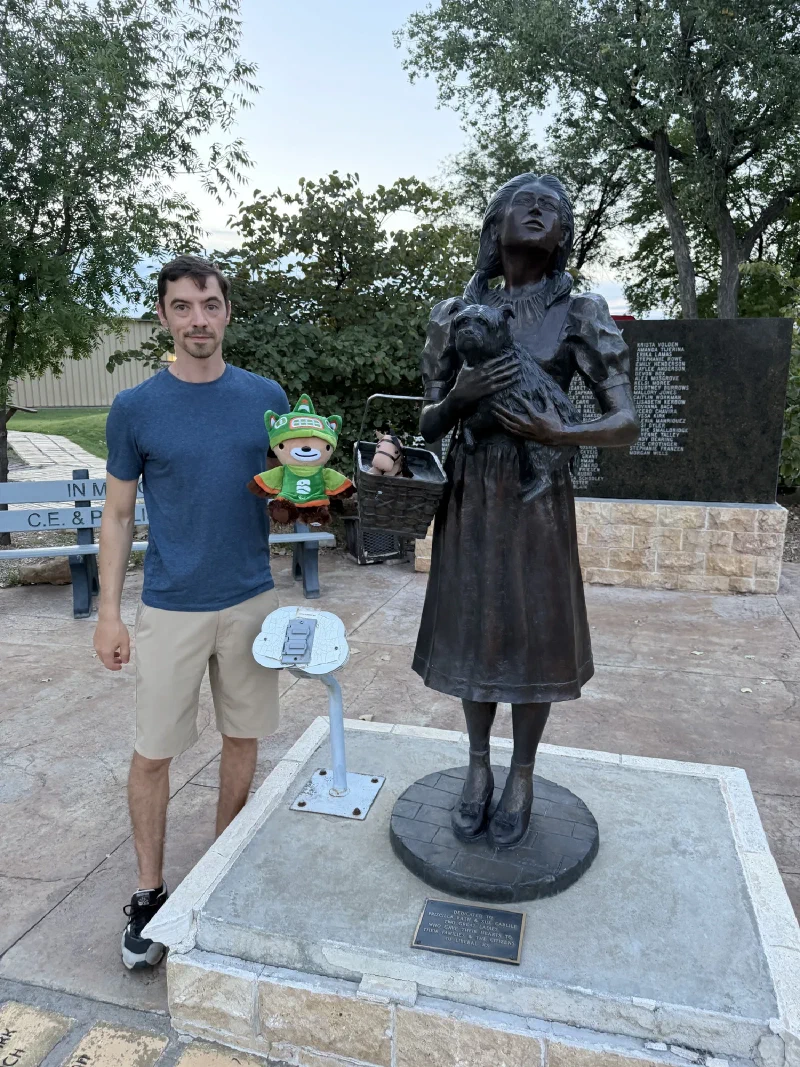
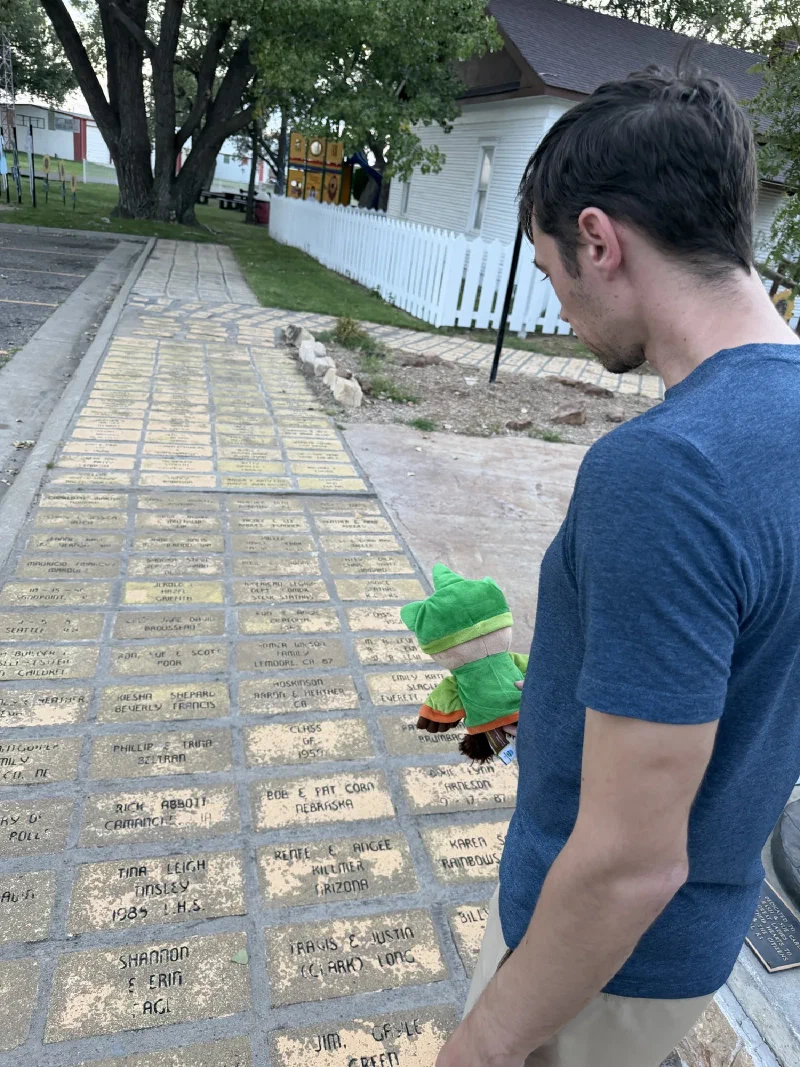
There is a bronze Dorothy, dedicated to two local ladies who, the plaque says, gave their hearts to their families and the citizens of Liberal. And there is a yellow brick road, which is made of bricks people paid for.
Every brick has a name on it. Camanche, Iowa. Nebraska. Arizona. The road to Oz is a fundraiser and I respect the operation.
Then we looked up from the plywood and looked at the town.
Grass. Pickup trucks. Mexican restaurants. A lot of Mexican restaurants, in a proportion that did not match anything either of us expected from southwest Kansas.
Pokin wondered about it out loud and then did what Pokin does, which is look it up properly.
Liberal is about 68% Hispanic. Not the county, not the region. The town. The largest employer by a distance is the National Beef plant, which runs somewhere around 3,500 people in a town of under twenty thousand, and is one of the two biggest beef plants in the country. The other one is an hour up the road in Dodge City. The company itself is headquartered in Kansas City, so Liberal does not get the offices. Liberal gets the plant.
Garden City, Dodge City and Liberal are apparently known as the Golden Triangle of Meat-packing, which is a real phrase that real people use.
The rest of Kansas does not look like this. This corner of it does, and the reason is beef.
While we were in there, one other thing surfaced. The town is named Liberal because a settler called Seymour Rogers used to give free water to travellers coming through, and people kept telling him that’s very liberal of you, and eventually it stuck.
So the entire town is named after a compliment about handing out water. I have several objections and nobody wanted to hear any of them.
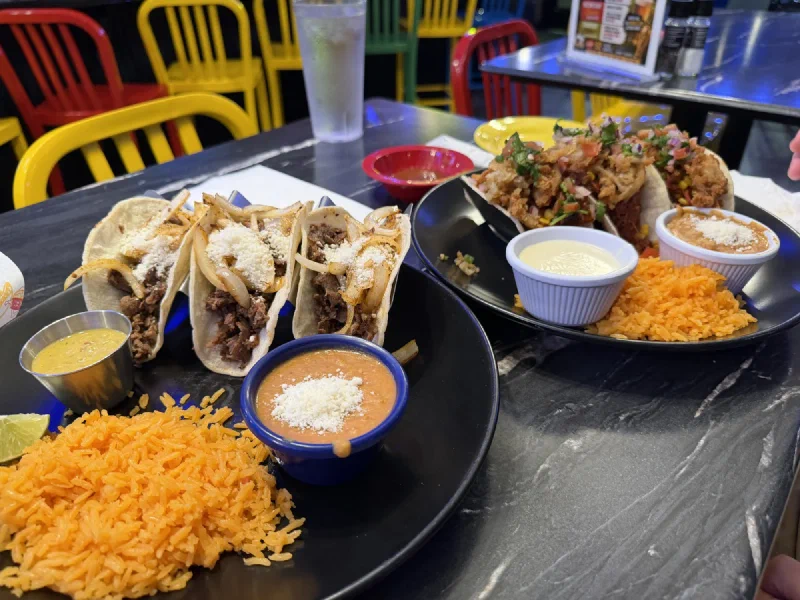
Pokin’s plate. And then, shortly afterwards, some of Nicholas’s plate.
Pokin declared it the best meal of the whole trip. Not the best meal in Kansas. The best meal of the trip, beating everything in Colorado and Utah, and she was especially serious about the chips and salsa, which she rated the best she has ever had.
She has been to Mexico. She said it anyway.
I did not eat any of it. Tacos are not my thing, and nobody was offering the alternative. Nobody in Liberal, Kansas is running a hot cocoa programme. I checked the situation and the situation was tacos.
The weather was not good enough for astro, which meant there was nothing left to stay out for, so we headed back to the hotel early. A rare and beautiful decision on this trip.
Liberal has two crossings that get you from one side of town to the other.
A train was sitting on both of them.
It stopped. Then it went backwards. Then it went forwards. Then it went backwards again. It did this, unhurried, for forty minutes, while we sat there and watched a town of twenty thousand people get cut cleanly in half by a slow decision.
Nicholas photographs lightning on purpose. He is not a patient man about trains.
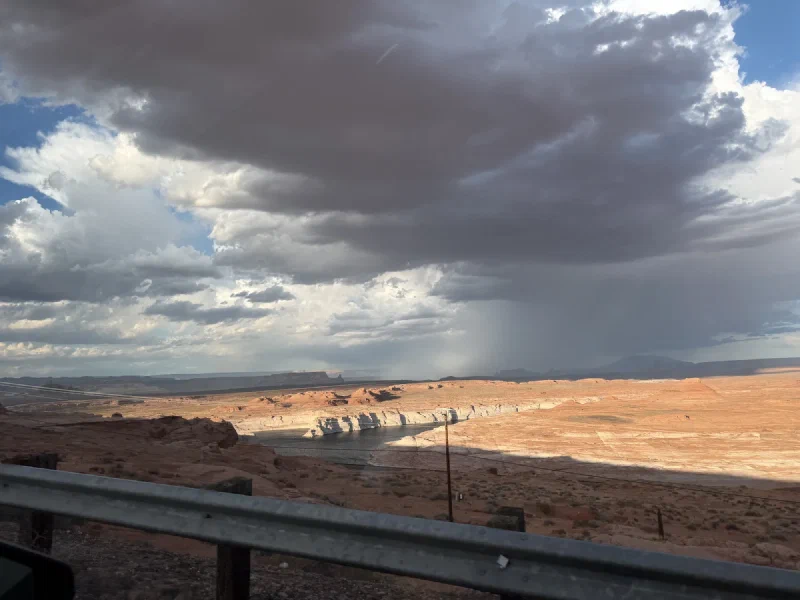
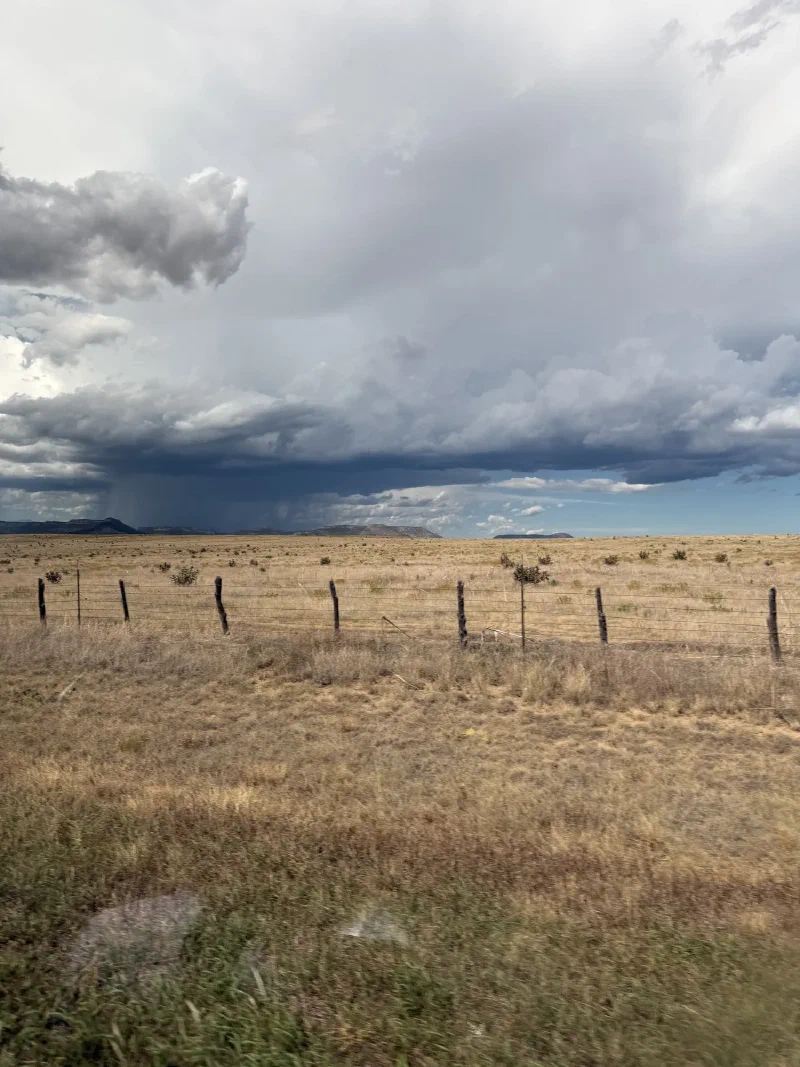
Leaving. The weather had opinions about that too.
Four states, one house that is not the house, one meal Pokin still brings up, and for the first time on this entire trip, not a single mug.
Then we got there, and my bud had second thoughts, which is his specialty.
Maybe the sky would break. Maybe there was an astro night in it after all. We could ask the rangers.
The rangers declined to have an opinion. They told us to download a weather app. They told us to get one that shows where the lightning is. They told us to make our own decisions.
I have since looked it up, and that is almost word for word what the park’s own safety page says. Use a lightning app to track the proximity of each strike. The rangers were not being cagey. They were quoting the manual.
It is just that the manual, read out loud by a calm person in a hat, sounds an awful lot like permission if you have already decided what you want to hear.
Nicholas heard yes.
“…where man himself is a visitor who does not remain.” Nothing about bears.
Bad weather is bad everywhere. It is worse on a dunefield, and it is worth knowing why before you walk out onto one.
The dunes cover about thirty square miles. There are no trees. There are no buildings. There is no rock to get under. The tallest of them stand around 750 feet (230 m) above a valley floor that is already sitting at 8,200 feet (2,499 m), and the official advice when lightning starts is to shelter in a building or a vehicle, both of which are back at the car park, which is a very long way behind you.
And you cannot hurry. That is the part nobody tells you properly. Sand takes about twice the effort of ground, so “get down quickly” is not a thing that is available to you. You get down at exactly the speed sand allows, which is the speed of a man wading.
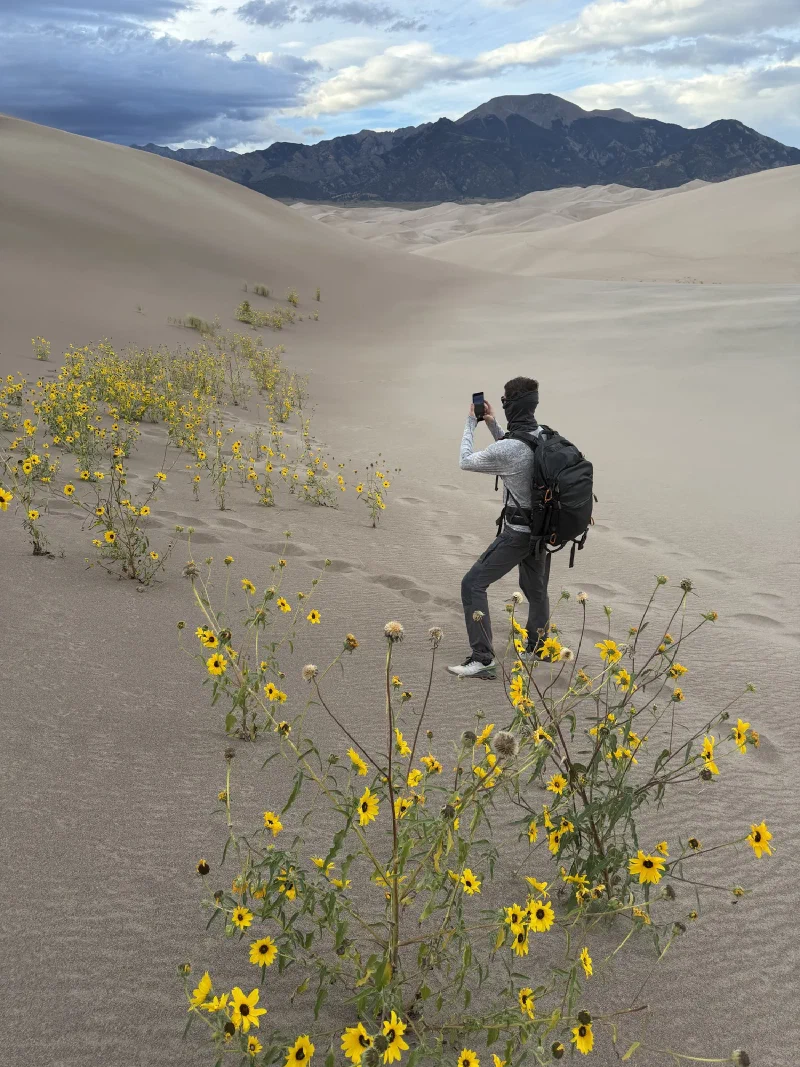
The other listed hazard is wind-blown sand, which the park describes as painful and prone to getting in your eyes. Remember that one. It becomes the whole second half of this post.
Thirty square miles of the stuff, and not one person suggesting we come back tomorrow.
We were warned the dunes were not far but the walking would be hard.
The dunes were not far. The walking was hard.
I rode in the bag, which I want on record was offered to me and not requested. Pokin was breathing like a person who had recently been at sea level. Nicholas was fine, because Nicholas is always fine, and has never once acknowledged that this is annoying.
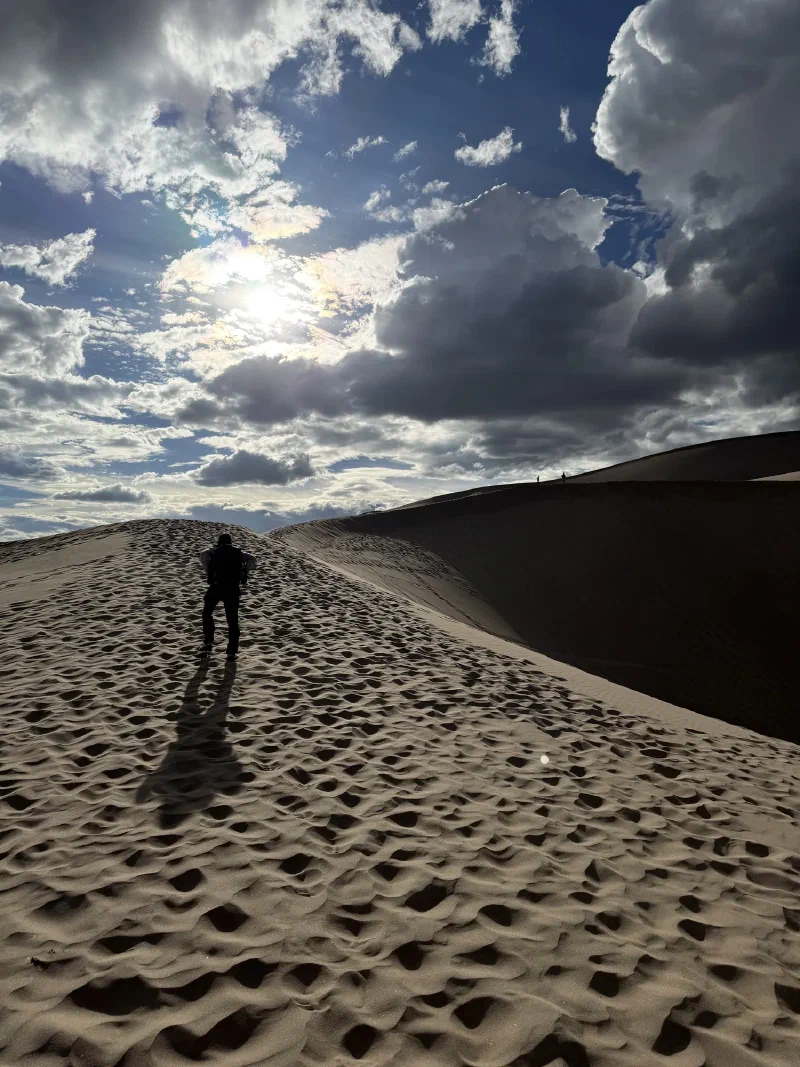
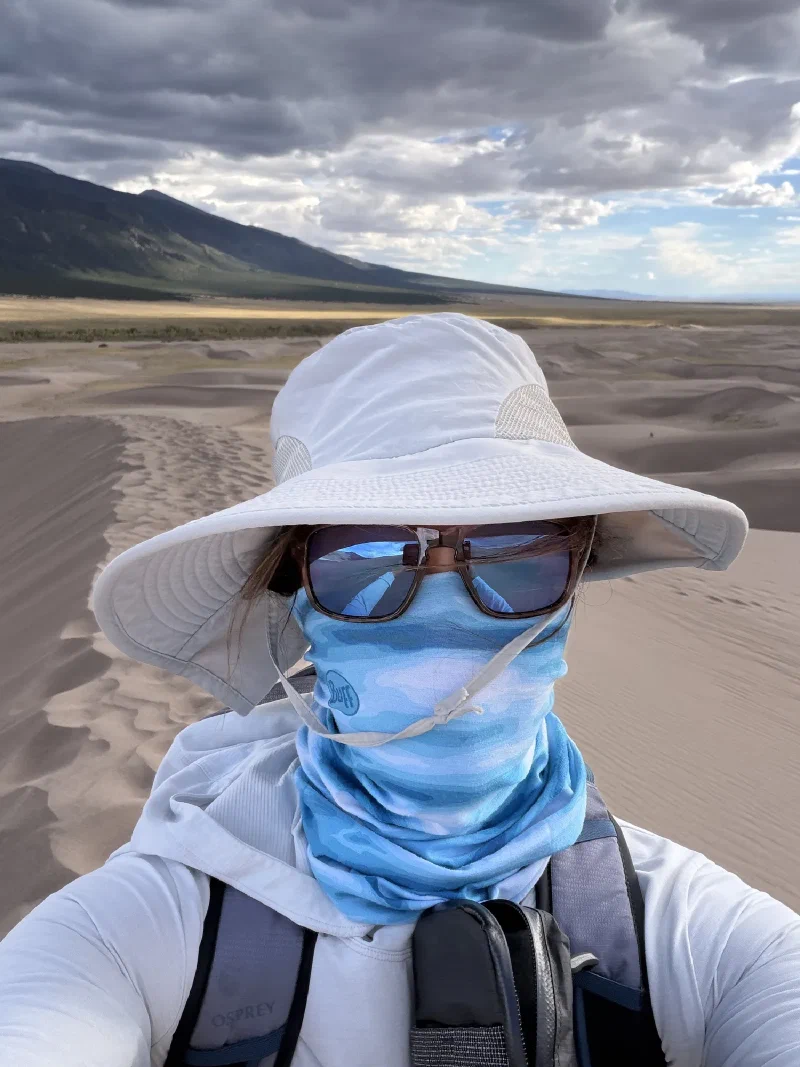
Up we went, into the weather we had been told to make our own decisions about.Dressed for it. This will not be enough.
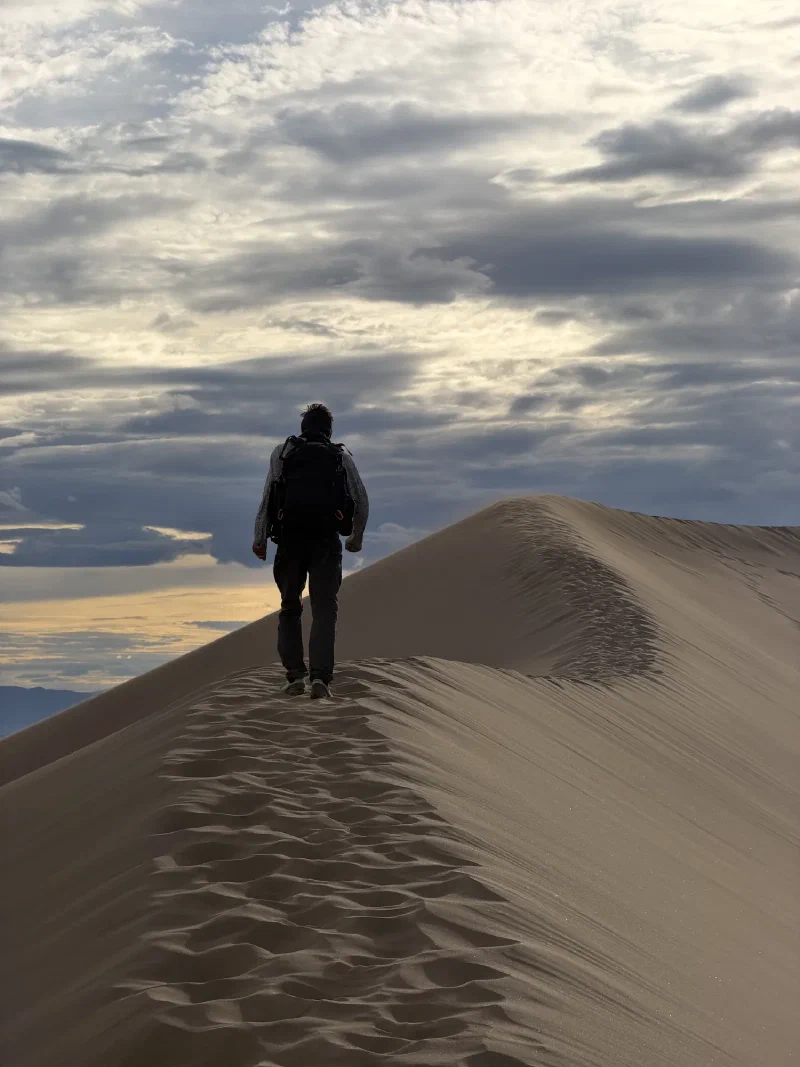
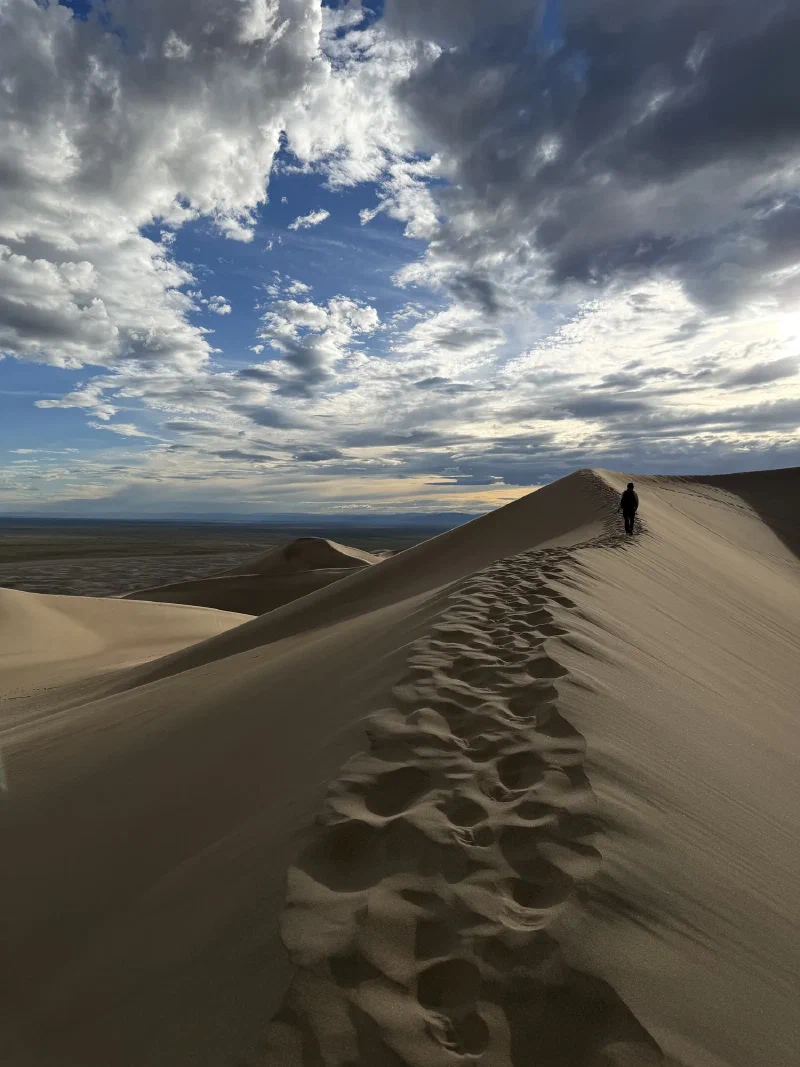
We hiked up along the ridge with the evening coming on and dark cloud moving in behind us. This could look really cool, said Nicholas, looking at the cloud.
Pokin also looked at the cloud, and said something quieter about there being no reception out here and therefore no alerts.
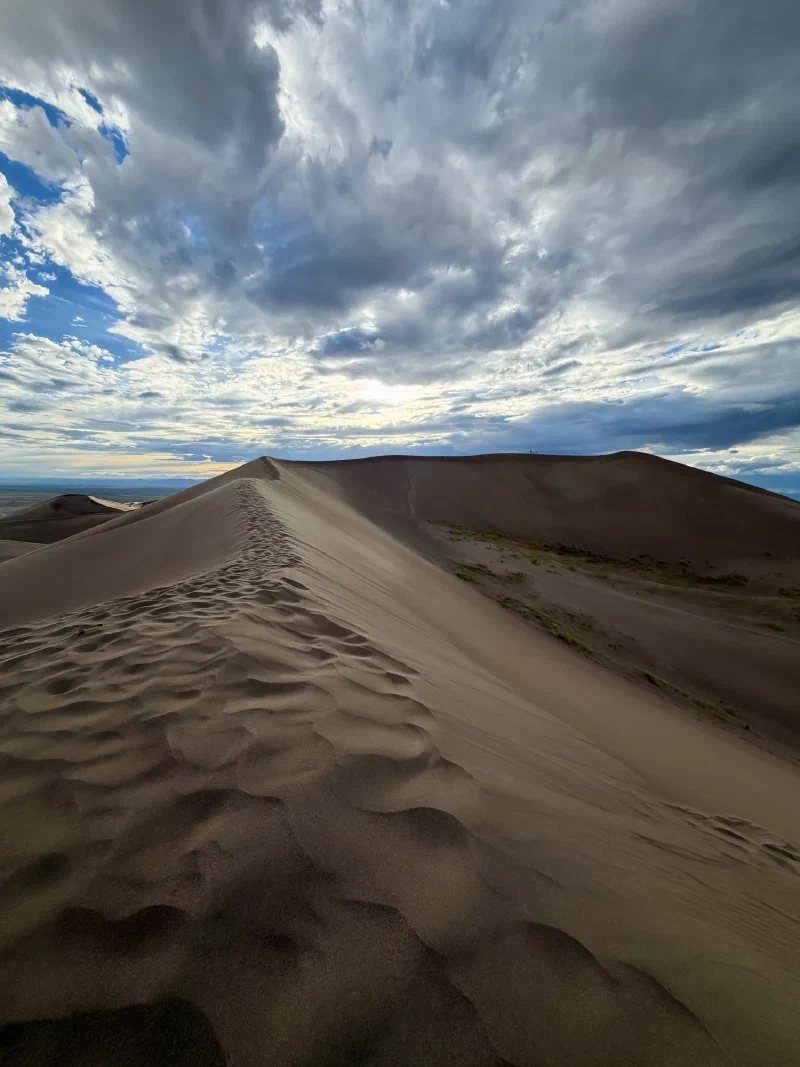
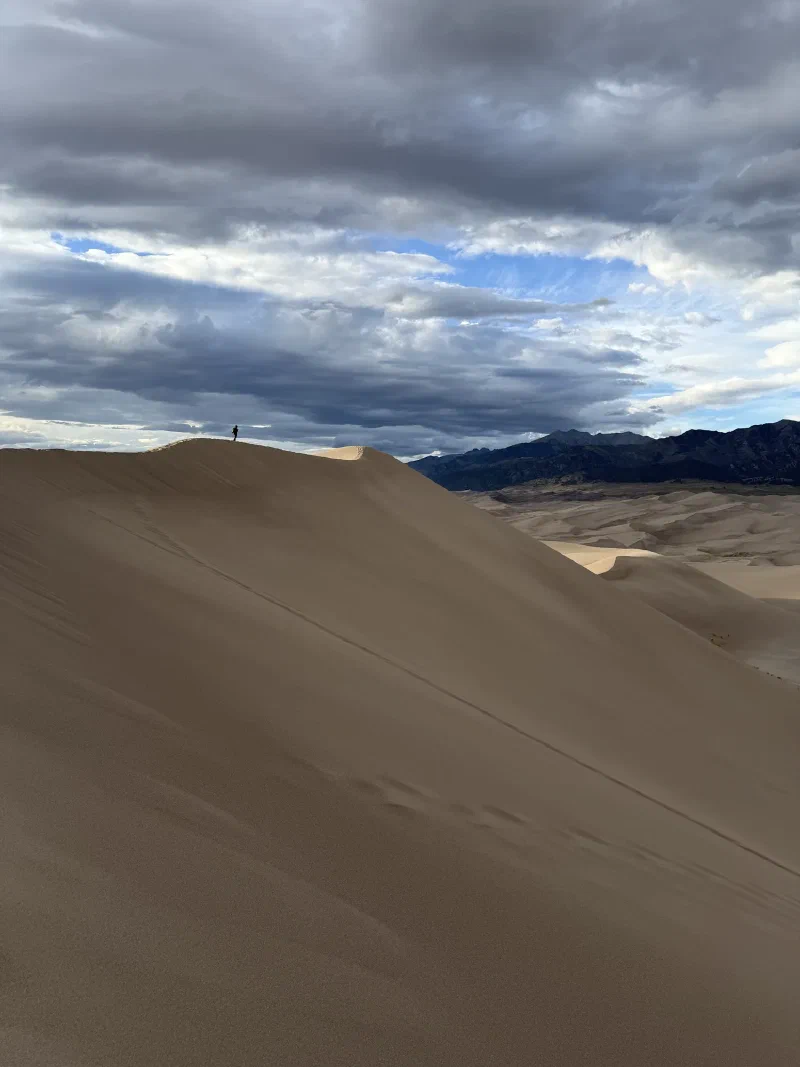
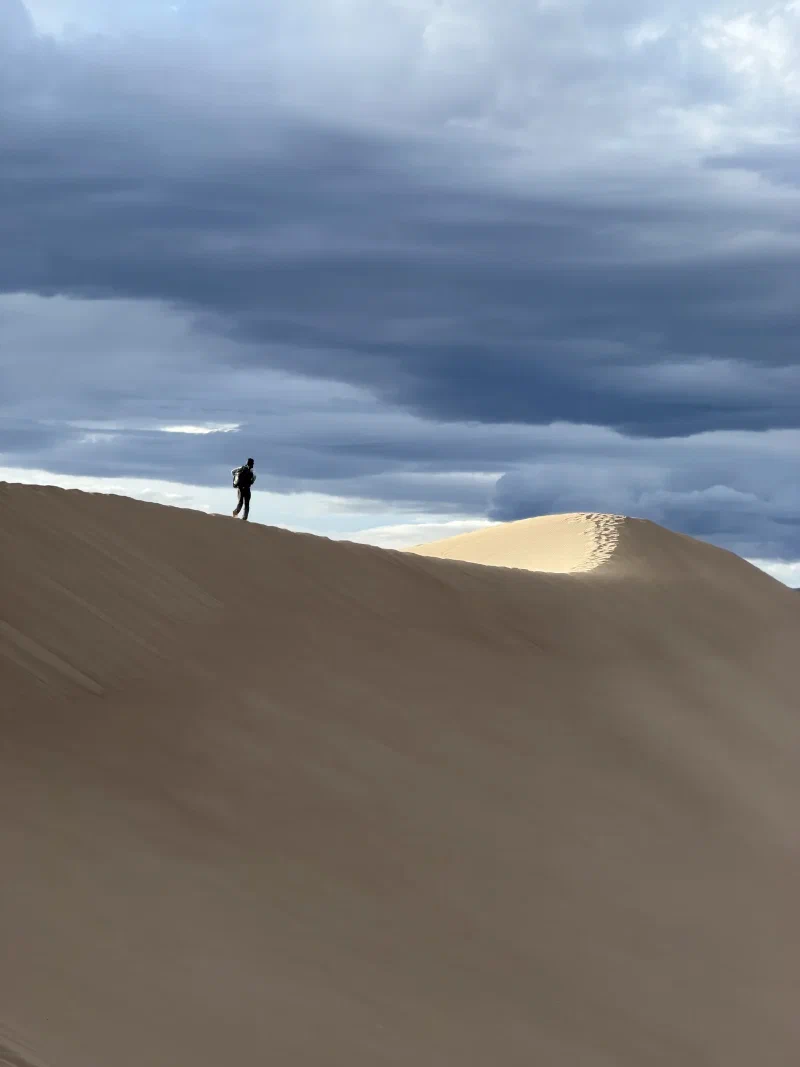
Several times we got to the top and discovered the top was somewhere else.
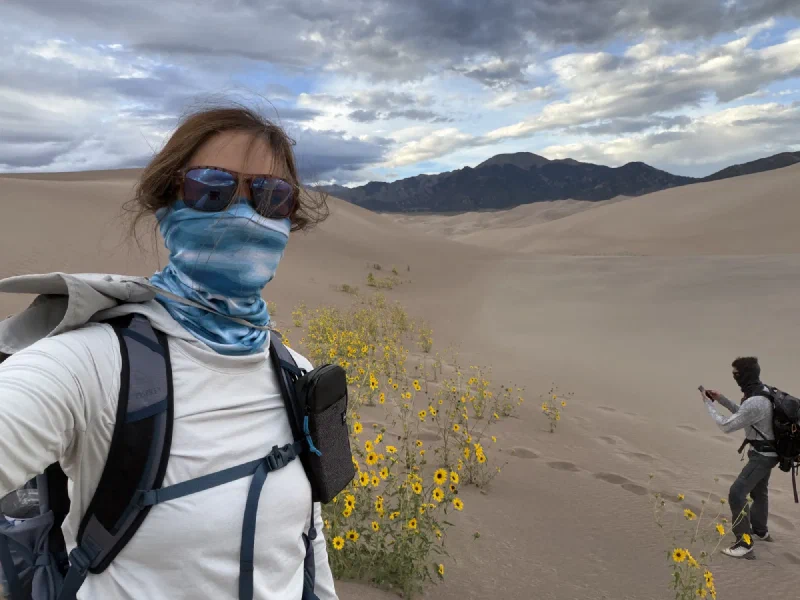
That is not the top. That has never been the top.Note the hair. The hair is the forecast.
Then we reached a top that really was the top, and Nicholas pointed at a completely different dune some distance away and said that would be a great place to take photos.
Pokin looked at it and did the maths that he had skipped, which is that getting to that dune involves going all the way down this one and all the way up that one.
She was not thrilled.
Come on, he said. You can run down. It’s fun. It’s like moonwalking.
Pokin sat down on her backside and slid, which was slow, and dignified in absolutely no way, and I respected it enormously.
The wind arrived properly then, and started throwing the dunefield at us.
Here is the thing Pokin learned the hard way. These are the tallest dunes in North America, and the reason they are tall is that the sand has nowhere to go. The prevailing winds come from the southwest and push sand across the valley floor until it piles against the Sangre de Cristos. Then storm winds come back down through the mountain passes and push it the other way. Sand that gets shoved from both directions does not travel. It stacks.
So the dunes look the way they do because of wind, and specifically because of the wind that was at that moment going directly into Pokin’s face at speed.
She received the lesson. I would say she received all of it.
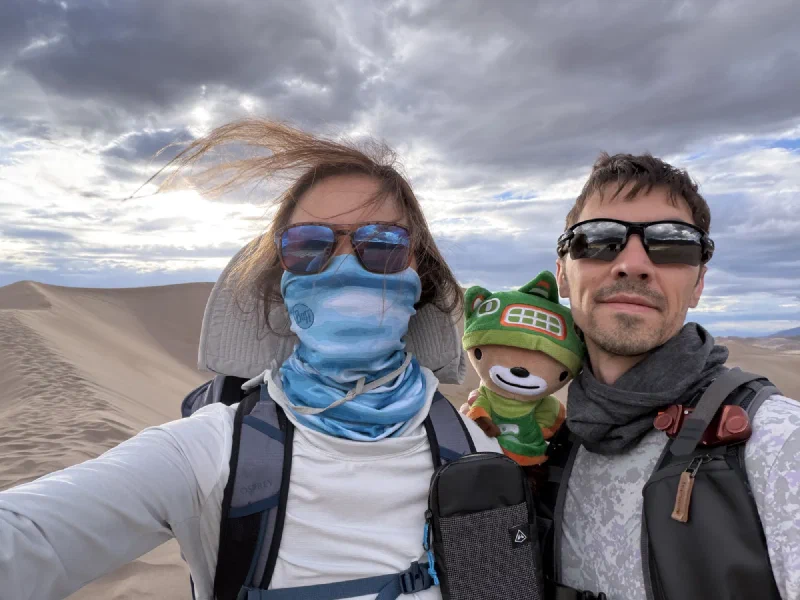
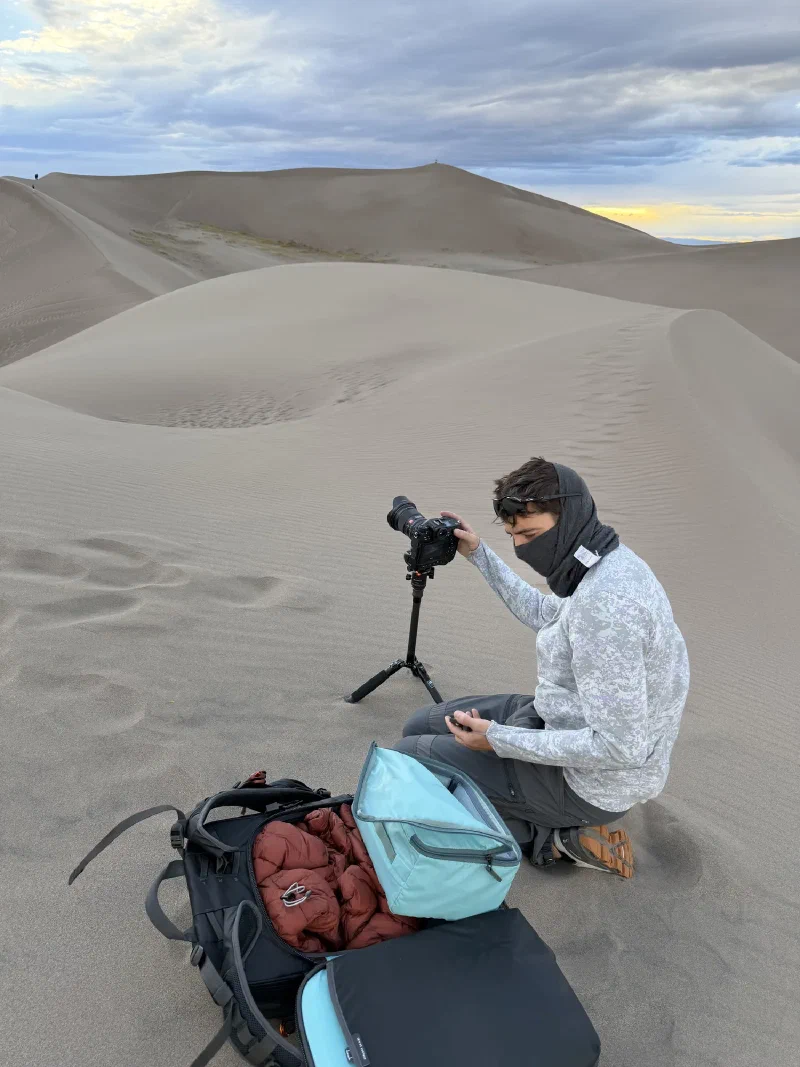
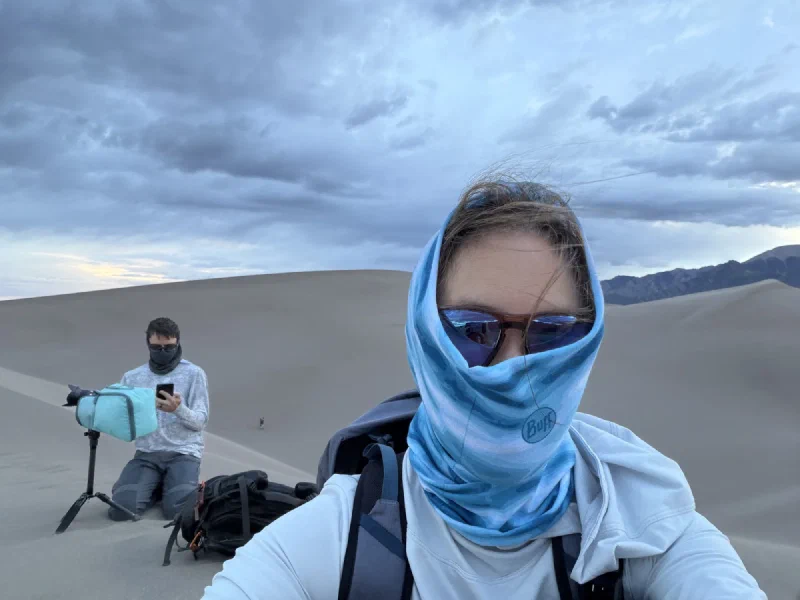
Setting up in it. Face covered, camera not.I put my head out for the view and then removed myself from the blast radius.
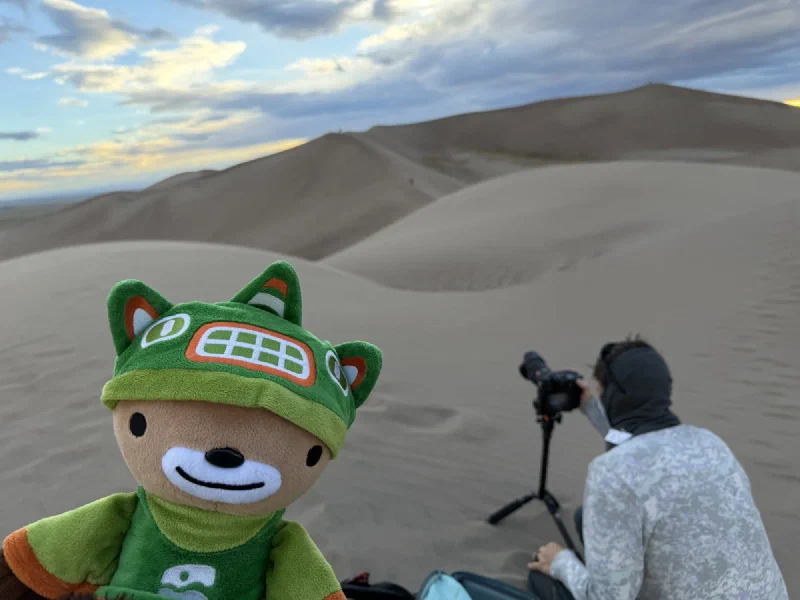
For the next while we simply sat there. Nicholas took photographs and appeared not to notice the weather in any way. Pokin huddled behind a patch of dune grass roughly the size of a dinner plate. I stayed low and out of it.
And then, in the middle of a sandstorm, on top of a dune, in a national park, my bud took a work video call.
He put the buff up, angled the phone, shouted into the microphone over the wind, and conducted the entire thing as though he were sitting at a desk, all while the camera kept clicking away beside him.
Pokin, mid-lesson. Nicholas, in the background, on a call.
Eventually the storm risk moved off and the forecast started improving, hour by hour, in exactly the direction he wanted.
But by then Pokin had had enough, and she was not enthusiastic about walking back down a dunefield in the dark, which is a fair position to hold. So we packed up not long after.
My bud came quietly. He did not come happily.
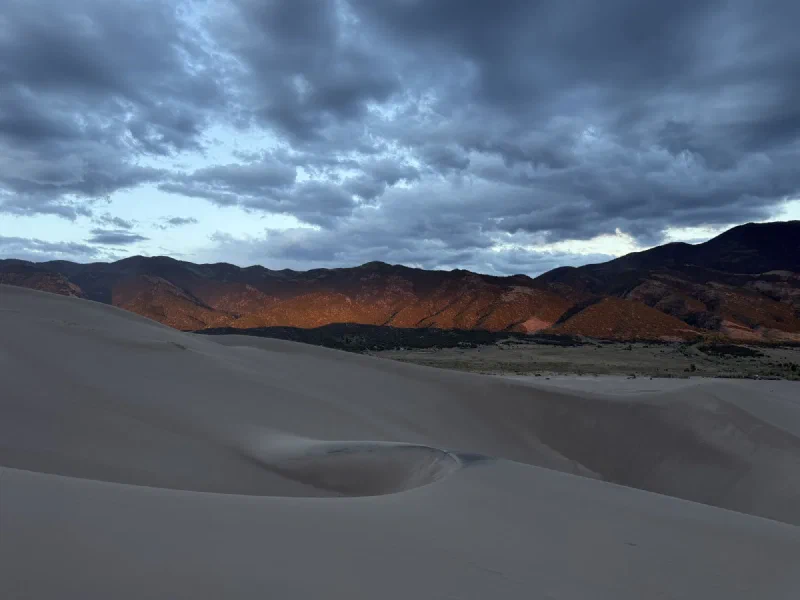
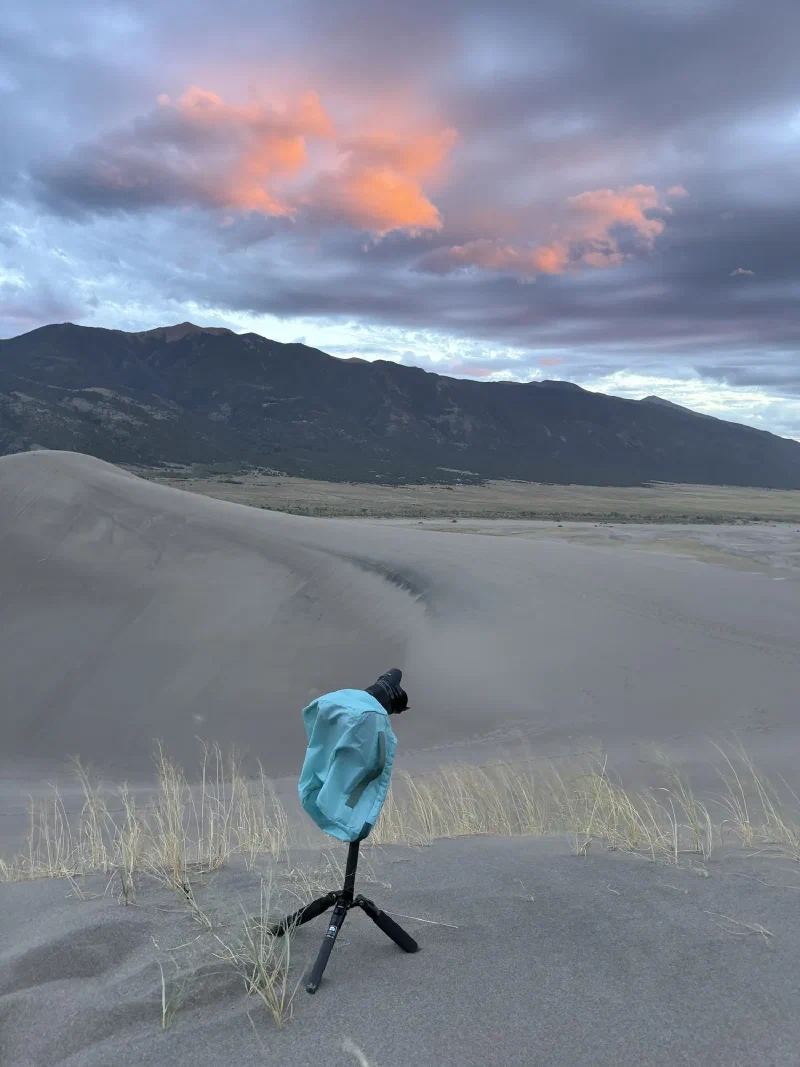
The mountains got some light. We got sand.The camera had a coat. Nobody else had a coat.
Back at the hotel, Pokin found sand in her eyes, in her ears, and up her nose, all of which had happened through a buff.
Also her pockets. Also her shoes. Also the backpack. Also the car.
Every photo you have just looked at was taken on a phone.
The camera, the tripod, the two bags of gear, the rain cover and the hour of sitting inside a sandstorm to use them produced a set of images that my bud has personally assessed as not even worth posting.
Day four had the same question as every other day. Where do we point a camera at the galaxy next?
Black Canyon of the Gunnison was the sensible answer. Two thousand feet of vertical foreground with dark skies sitting on top of it.
Then the weather said cloud, and Montrose said no. Long weekend plus a festival, and every room for miles belonged to people who plan ahead. We are not those people.
North into what my bud keeps calling “real” Colorado, where the fourteen thousand foot mountains live, was three more days of committing, and there were rumours he might get called back early for work. So: a cloudy canyon, or mountains we might never reach.
That thin silver thing at the bottom did all of this.
The Black Canyon is not the deepest canyon in North America. Not the narrowest, not the steepest. It is all three at once, and nothing else on the continent manages that.
2,722 feet (829 m) at its deepest. Forty feet (12 m) across at the river’s narrowest. The Painted Wall runs 2,250 feet (686 m) from water to rim, the tallest cliff in Colorado. Put the Empire State Building at the bottom of it and you would still have a thousand feet of rock above the roof.
The river did that, and the river is in a hurry.
The rock down there is 1.8 billion years old. Colorado lifted, volcanoes buried the lot in ash, and the Gunnison cut down through the soft stuff until about two million years ago, when it reached the ancient rock underneath and got stuck. Not stopped. Stuck in its own channel, with a gradient.
The gradient is the whole story. The Gunnison drops 43 feet per mile through here, up to 95 in places. The Colorado, doing its famous work over in the Grand Canyon, drops seven. Seven.
The Grand Canyon is wide because it had soft rock and time to sprawl. The Black Canyon went straight down like it had something to prove. I respect that enormously.
Cloud. For the record. Remember the cloud.
The walls are so tall and so close together that parts of the gorge get about thirty three minutes of direct sunlight a day. The rest is shadow. Hence Black.
Pokin had worked out that the visitor centre is always on the south side. Not just here. Every canyon. So she asked, and the man at the visitor centre had the answer ready, which tells you she is not the first.
The sun in the northern hemisphere always comes from the south. So the north wall of a canyon faces it and gets cooked, all day, for a couple of million years, and erodes into something stark and bare and worth driving to. The south wall sits in its own shade, keeps its water, and grows things.
So they build the visitor centre on the dull side and point it at the good one. The northern side gets to stay rugged.
Which is also why this rim has the paved road, the campground and the gift shop, and the north rim has seven miles of dirt and a ranger station that opens when it feels like it.
I have no way to check any of this and I have decided it is true.
One of the stated goals of this trip was to do some actual hiking. It kept not happening. We arrived too late, or it was too hot, or both, and walking kept getting quietly downgraded to standing near things and looking at them.
Then Pokin found a short loop that would, in her words, let us “experience the canyon better.” It is called the Oak Flat Loop.
The flat part is a lie. Pokin knew that. Pokin reads the elevation profile.
1.6 miles. Note the word doing all the damage.
What it actually is: the only maintained trail on this rim that takes you below the edge without committing you to the river. Straight down into designated wilderness, 1.6 miles (2.6 km), rated “moderately strenuous,” which is park service for “you will notice it on the way back up.”
It is a different canyon down there. From the overlooks you get the postcard, the whole gorge laid out, impressive, slightly unreal. Thirty seconds below the lip you are in trees, the view arrives in pieces through branches, and the canyon stops being a view and starts being a drop.
We went 280 feet (85 m) below the rim. Then we climbed 280 feet back up, which is the half of a loop nobody puts on the sign.
Hike achieved. Small hike, but the streak is broken.
The sky was still overcast and the evening was, by any sensible reading, a write off. We went anyway, because the alternative was sitting in the overpriced hotel knowing we had not tried. So we drove the rim road slowly, scanning, until Nicholas found a spot he liked.
Not the worst place to wait.
Those pale zigzags are molten rock that squeezed up through cracks in the older stone somewhere between 1.4 and 1.7 billion years ago, cooled, and set. It has been in there ever since, waiting for the river to expose it. That is what the Painted Wall is named for.
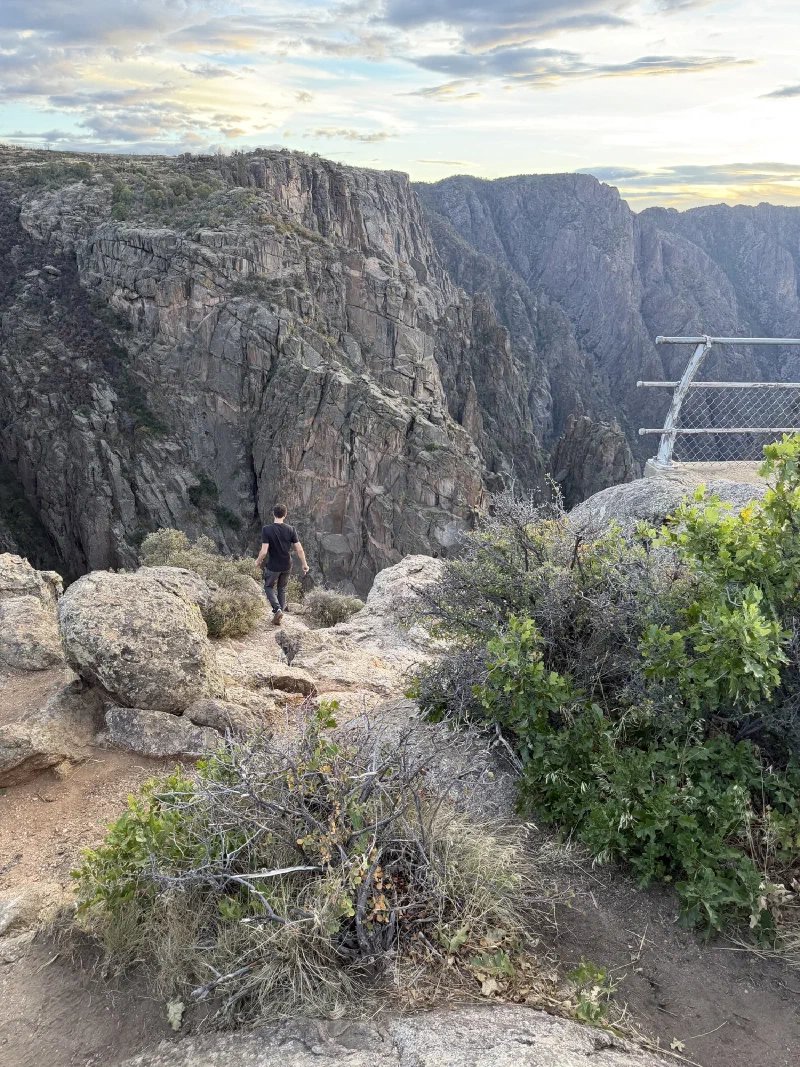
Railing on the right. Note its position. Note how briefly it stayed relevant.
Pokin was not a fan of where he chose to put the camera.
He had tucked it down the rock face, over the edge, on a ledge he was clearly not supposed to be on, with a couple of thousand feet of nothing underneath it and his own footing in charge of the whole arrangement.
She asked him to walk down carefully.
He channelled Peep and hopped.
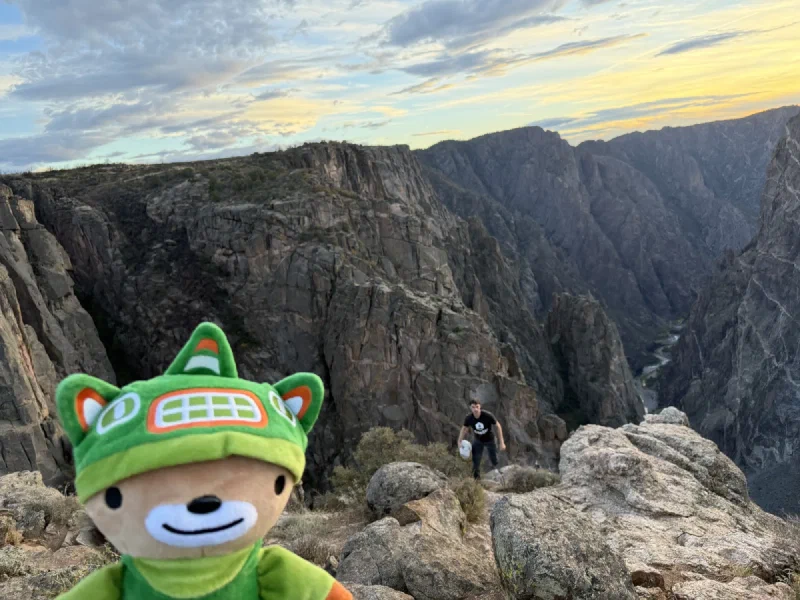
Pokin took this one. You can tell, because the subject is my bud not falling.
Then he made friends. There are always other photographers at a spot like this, and within four minutes he had his phone out and was showing them the Everest timelapses.
Twice in four days. Those Everest photos are putting on more mileage than the car is, and he only had to walk up the thing once.
The sky never opened. Cloud from one rim to the other, no core, nothing worth burning a night on. We gave it a while, agreed it was not happening, packed up and drove back to the hotel we were overpaying for.
Then we looked at the files.
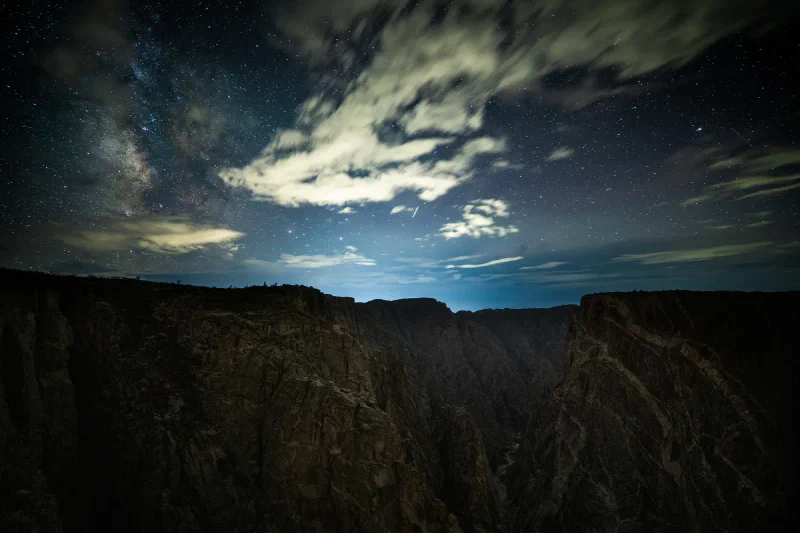
Not the best photo of the trip. Might have been, if we had stayed.
The clouds were the shot. Long lit streaks running across, the Milky Way coming through the gaps behind them, doing considerably more work than a clear sky would have.
We left early. The clouds did not.
The mug intelligence, meanwhile, was good. The mug was obtained.
Out of everything uncertain about that day, the ceramics were the only part that went exactly to plan.
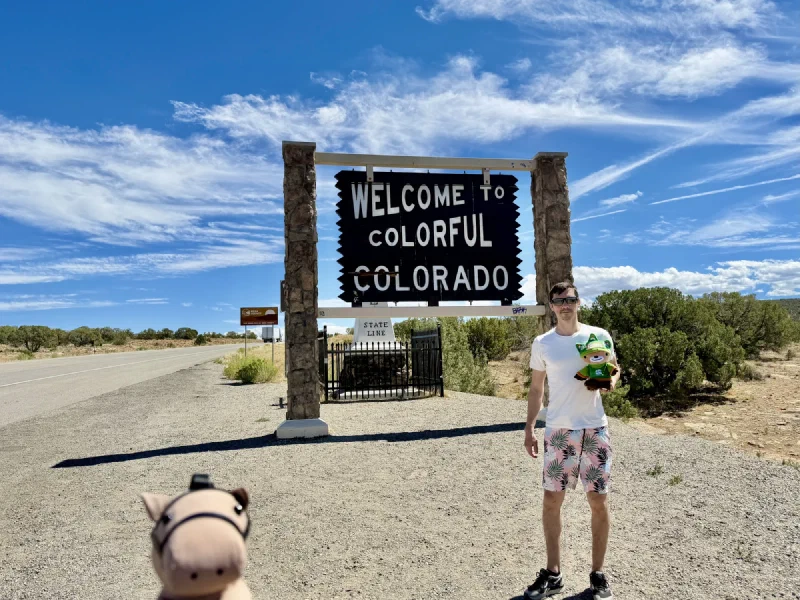
Nicholas has been to Colorado before. Pokin has not. Chestnut has not. I had not. So three quarters of the vehicle were about to unlock a new state, and that is the sort of thing you pull over for.
Utah, running out.
The sign is not subtle about it. WELCOME TO COLORFUL COLORADO, in white letters on black, bolted between two stone pillars in the middle of nothing.
Chestnut got his face nearest the camera.
Two states in three days. I am collecting them now, apparently. That makes two of us with a collection.
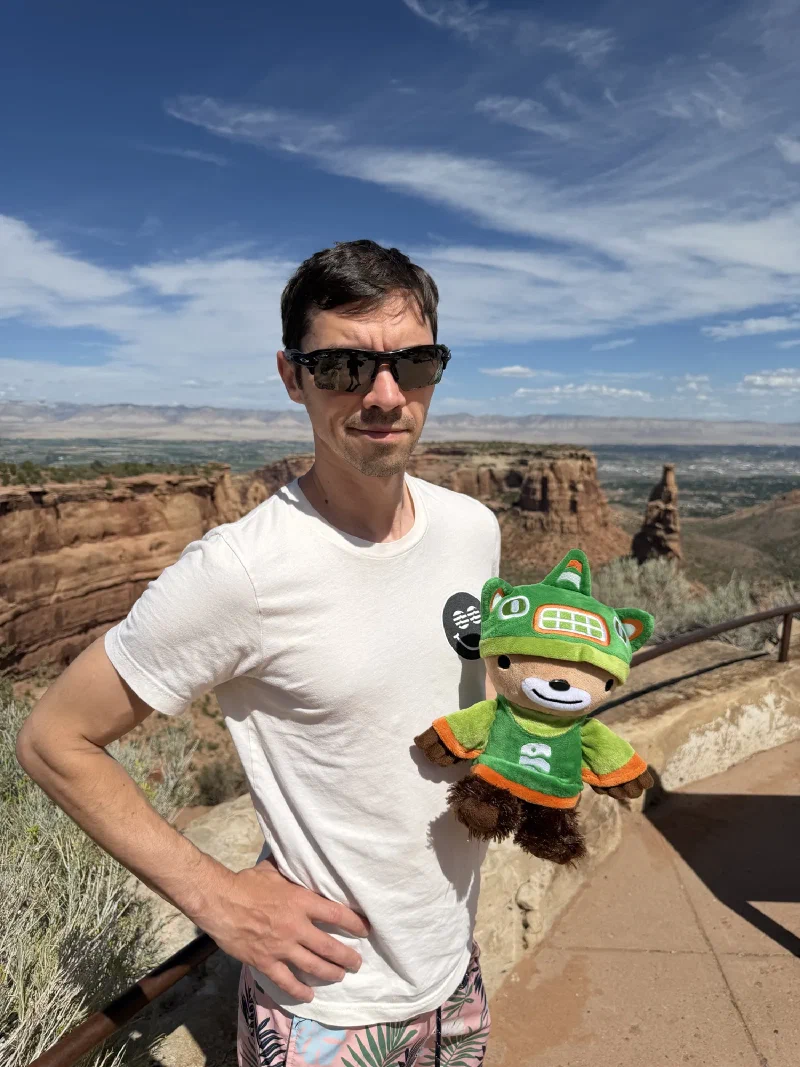
First stop in the new state was Colorado National Monument, and my bud walked into the visitor centre and bought a mug before he had looked at a single canyon.
I raised this in the last post as a possible one time event. It is not a one time event. It is a policy.
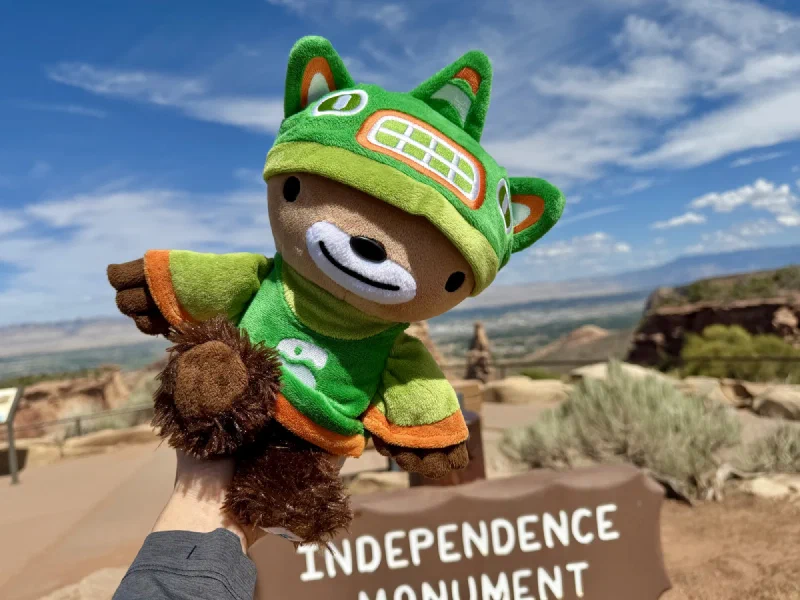
Independence Monument. The sign, at least, knows who the important one here is.
This place exists because of one deeply strange man. John Otto walked into these canyons in 1906, decided they were the heart of the world, and then stayed. He lived out there alone with two burros. He cut the trails himself, by hand, with a pick and a shovel, so that other people could come and see the thing he had found. He named the formations after patriots and historic events, which is why the big one is called Independence Monument and not something sensible about geology.
Then he wrote letters. Hundreds of them. To newspapers, to politicians, to the actual President of the United States, all of them saying the same thing, which was roughly you need to come and look at this.
It worked. On 24 May 1911 Taft signed it into being, and Otto was made the first custodian of the monument at a salary of one dollar a month. He did the job for sixteen years.
450 feet of freestanding sandstone, or 137 metres of rock attached to nothing whatsoever.
A month after the monument was created he married a Boston artist called Beatrice Farnham at the base of that tower. She lasted a few weeks. Her explanation on the way out is one of the best sentences ever written about a marriage:
I tried hard to live his way, but I could not do it, I could not live with a man to whom even a cabin was an encumbrance.
Otto climbed his 450 foot tower every Fourth of July to plant a flag on top of it. Climbers still go up and do it for him every year. He died broke in California with forty four dollars to his name and was buried in a pauper’s grave, and it took local people fifty years to get him a headstone.
A man who spent twenty years hand digging trails so strangers could enjoy a view, and got paid one dollar a month for it. I have opinions about monuments, mostly that I deserve one, but I will step aside for Otto.
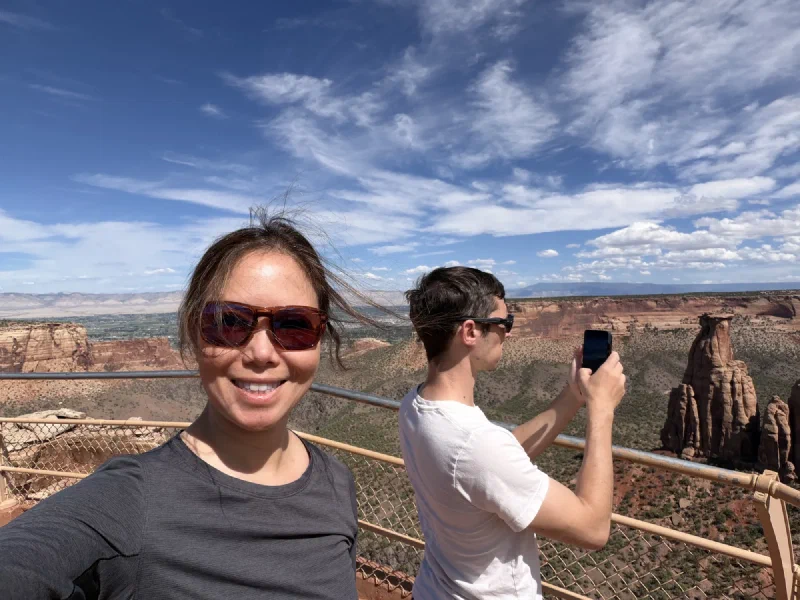
Pokin taking a photo of the view. Nicholas taking a photo of the view. Nobody taking a photo of the bear.
The plan was a hike that afternoon. The plan died.
We were up on the rim at nearly six thousand feet (1,800 m), which is meant to be where the heat gets better, and the heat did not get better. It sat on the whole valley like a hand. Nobody was hiking anywhere.
So the afternoon got written off, which made the night the only thing left. Unfortunately the monument faces the wrong way for astrophotography. The canyons open north over Grand Junction and its lights, and the Milky Way core sits low in the south. Beautiful in daylight, useless after dark.
So we looked at the map and found something forty minutes further out, on Glade Park, called Miracle Rock.
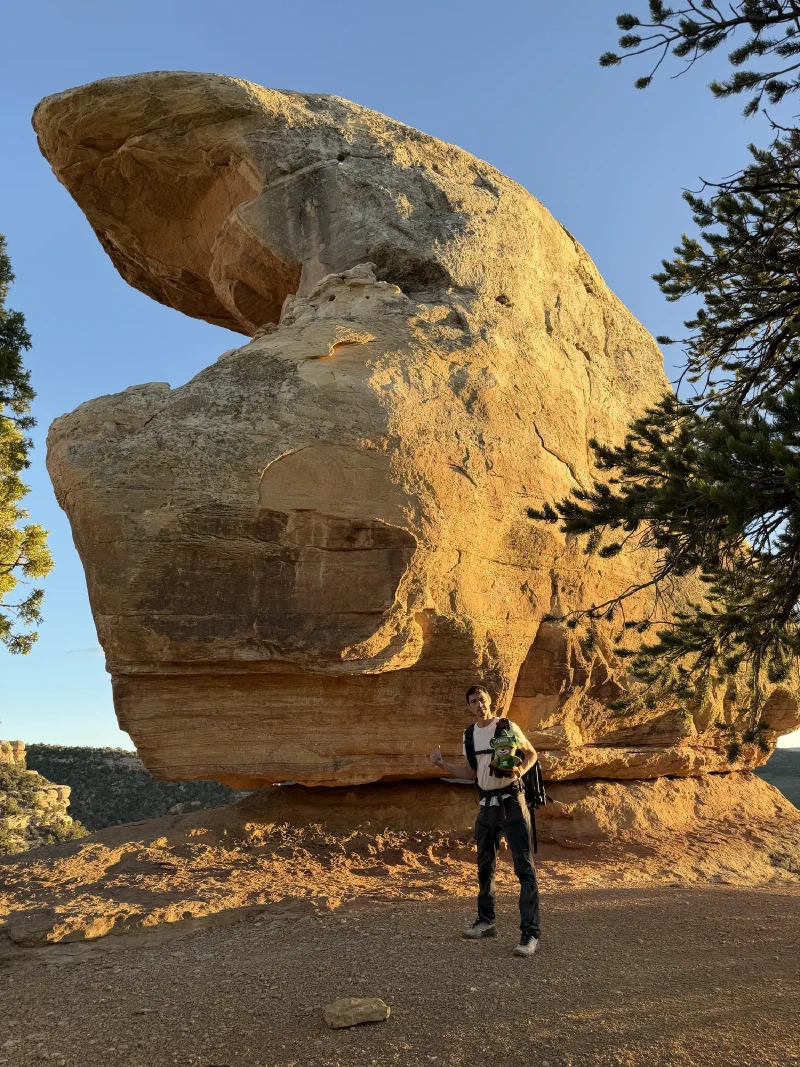
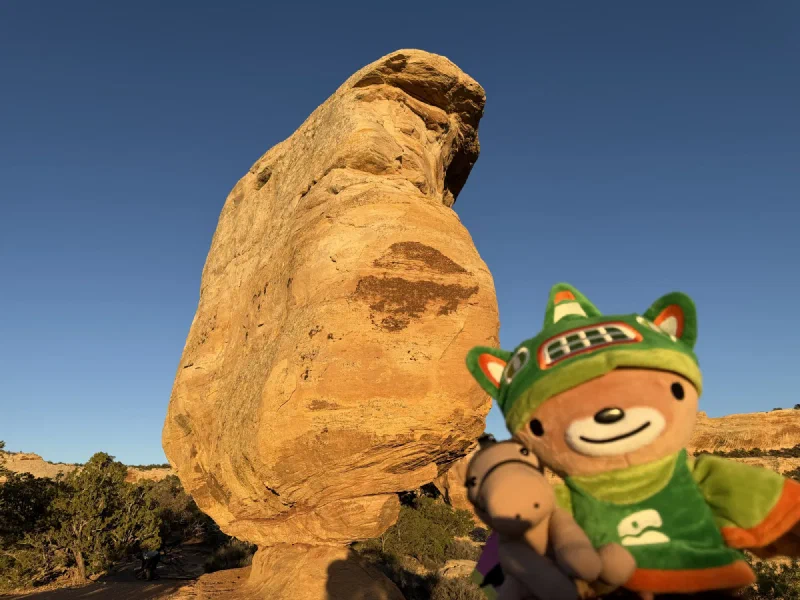
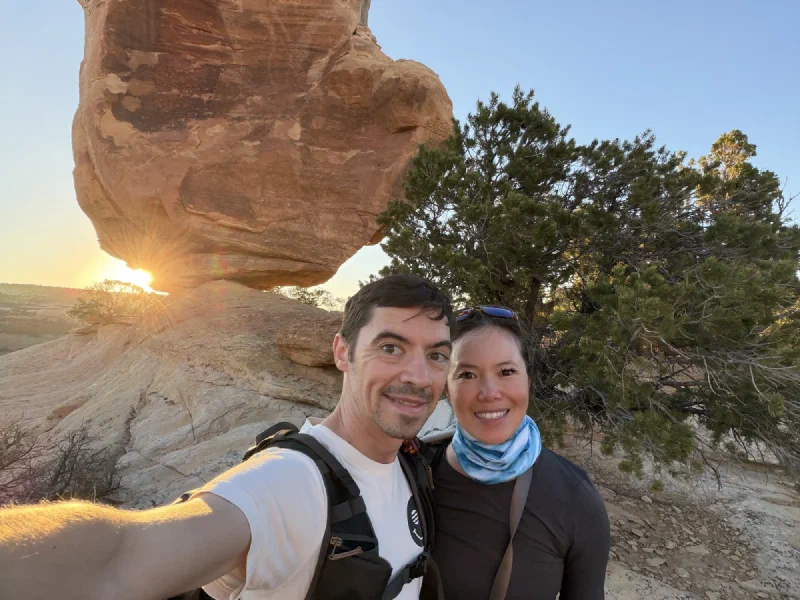
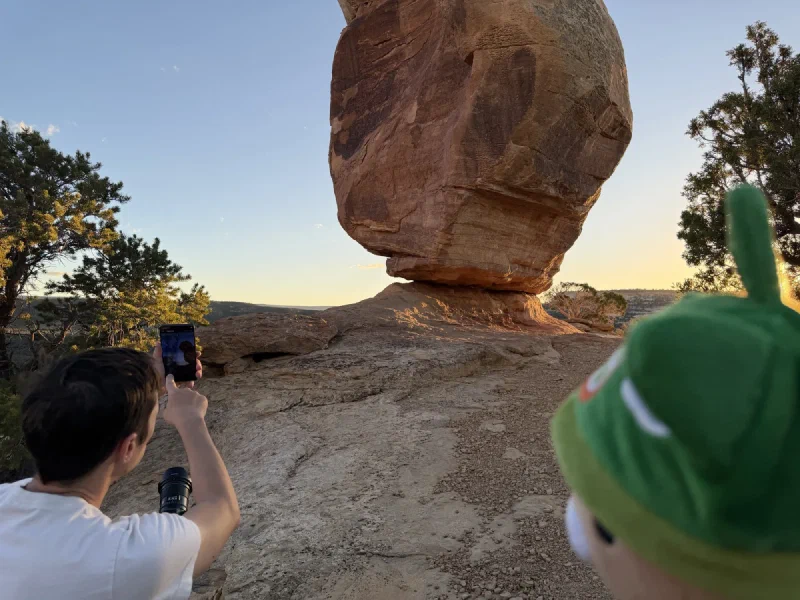
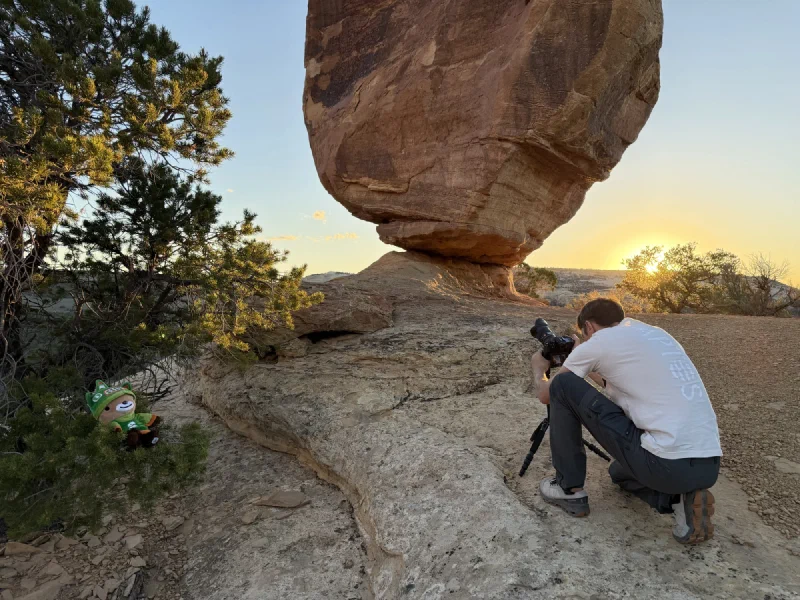
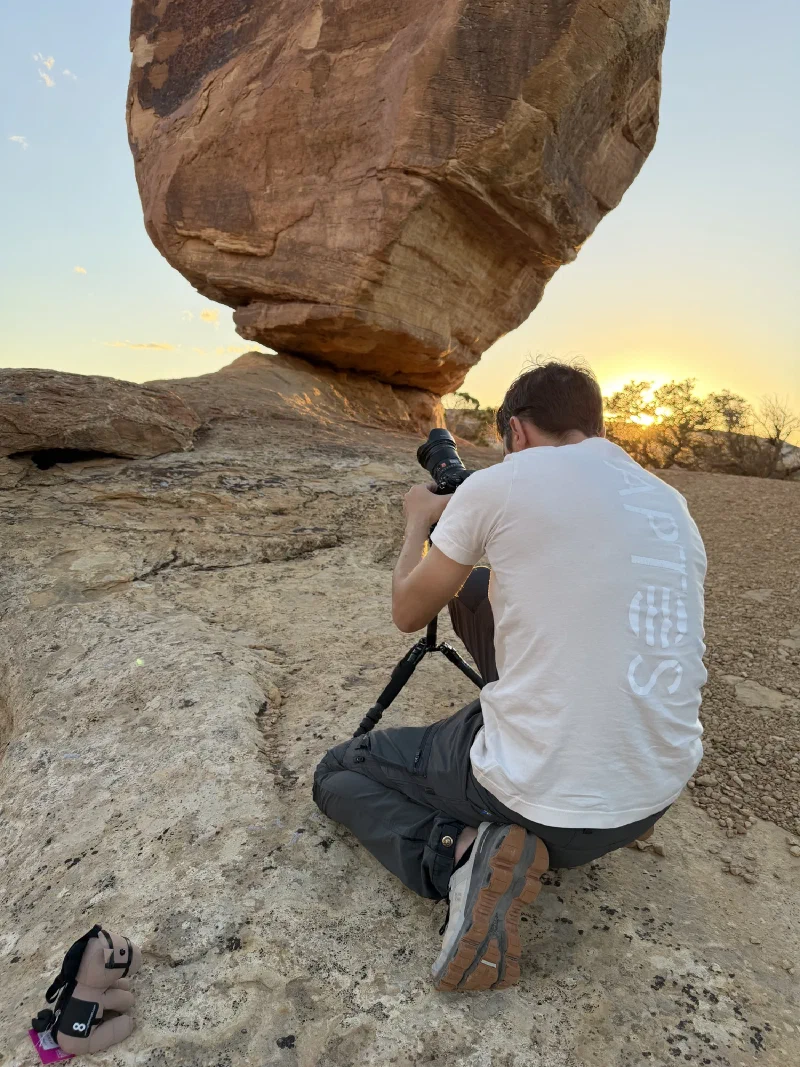
Miracle Rock is a boulder eighty four feet tall (26 m), weighing a claimed twelve thousand tons, sitting on a piece of sandstone about a foot wide.
It is on the edge of a canyon. It has been there a very long time. It will presumably not be there forever, and everyone who visits works this out within about four seconds of arriving.
That is a full sized human under twelve thousand tons of maybe.
Locals also call it Potato Rock, because it looks like a potato. I want it on record that a rock this dramatic was named twice, once by someone with a sense of occasion and once by someone who had just been to the shops, and both names stuck.
Bear for scale. Ineffective, but present.
We got there with the sun still up, which is the correct way to arrive at a night shoot. You want to see the ground before you have to walk it in the dark.
The sun went underneath it. Show off.
I supervised from a juniper. It was a good juniper. I had a clear view of the rock, the camera, and both humans, and I did not have to hold anything.
They had also downloaded the trail on AllTrails before we set off, because the word from other people was that finding your way back from this rock in the dark is genuinely hard. Remember that. It comes up later.
Camera went on the tripod. Sun went down. Everything was going well.
And then a light came on below us.
Somebody had decided to camp down in the canyon, which is entirely their right, and they had a lamp, which was also their right, and that lamp pointed directly up into the one bit of dark my bud needed. He did not say very much about it. He did not have to. I have known him fourteen years and I can hear the exact quality of silence that means a man is recalculating an entire composition around a stranger’s tent.
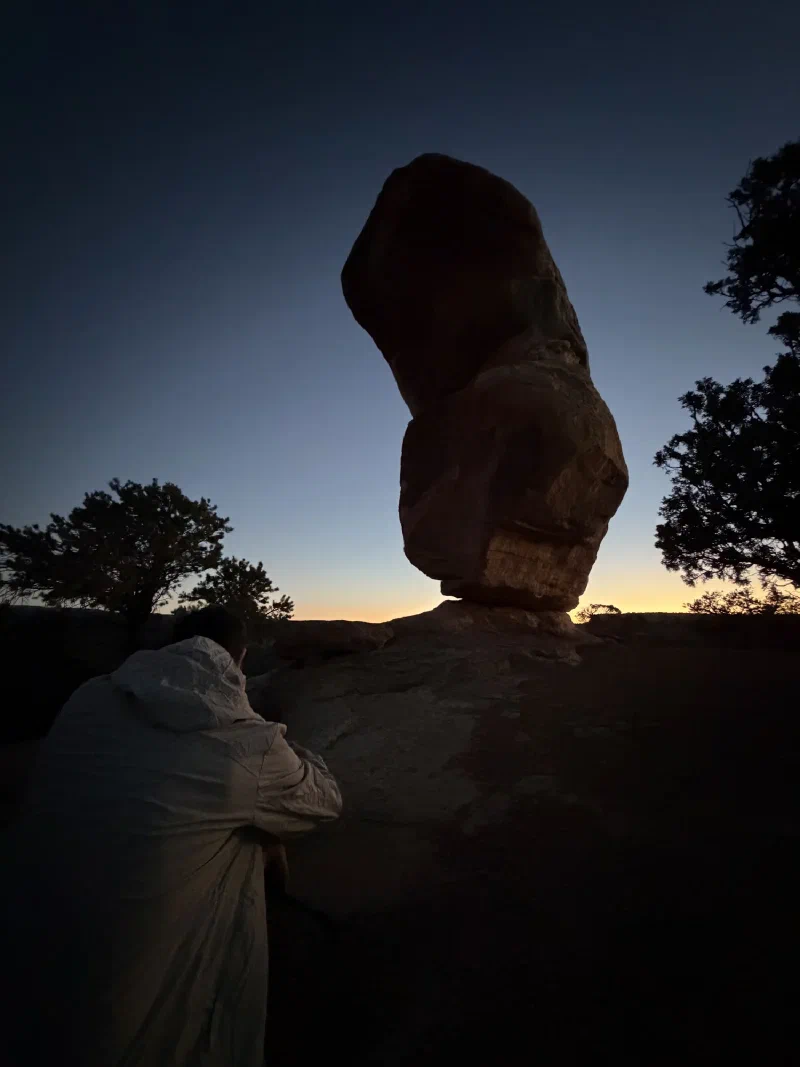
Chestnut took the front row, undoubtedly shouting something like “you’re doing great!”Blue hour. The rock stops being a rock and starts being a shape.
Then came the part of astrophotography nobody photographs, which is the hour and a half of standing on a plateau in the dark waiting for a specific arrangement of the sky. Back and forth. Back and forth. Two adults pacing a slab of sandstone with their hands in their pockets, waiting for the galaxy to get into position.
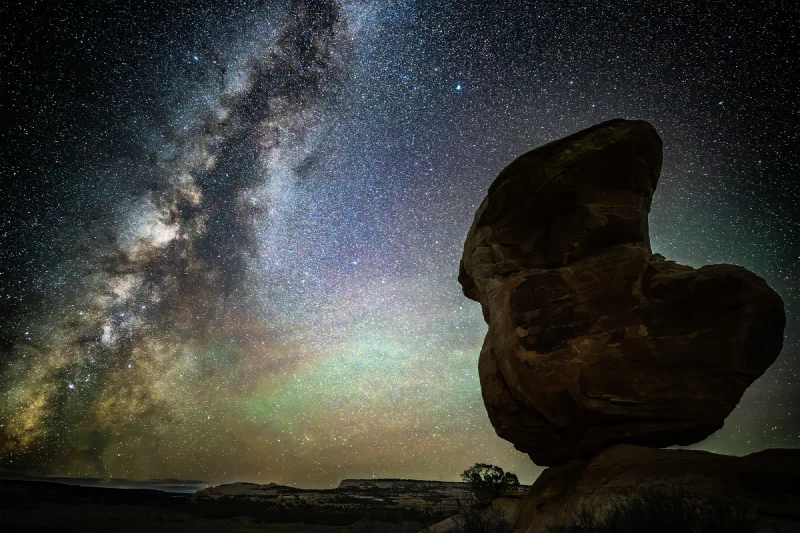
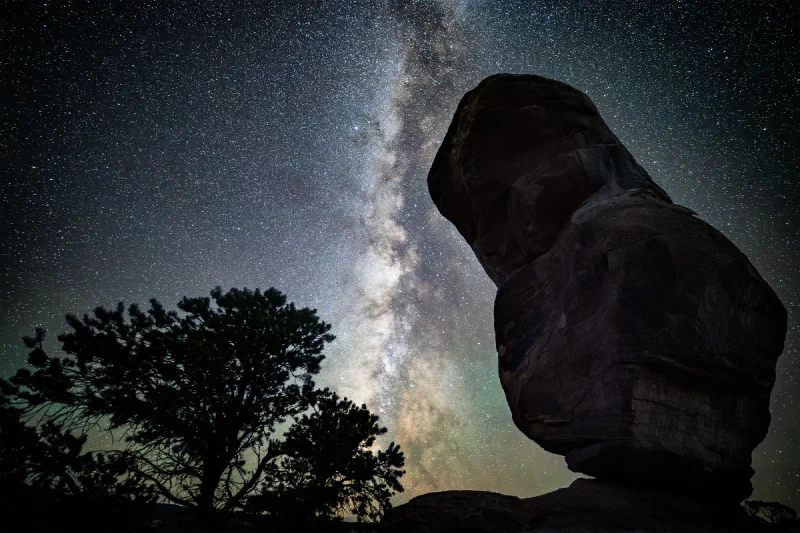
Twelve thousand tons of potato, and behind it, everything.
Look at the colour low in that sky. The green and the faint pink are not light pollution and they are not the camper. That is airglow, which is the upper atmosphere quietly giving back energy it soaked up from the sun during the day. The whole sky does it every night. You simply cannot see it, because your eyes are not a twenty second exposure.
The core, standing up straight beside it.
He got the shot. Then he wanted one more shot. Then it was very late and everybody was blinking slowly, and we gave up while we were ahead and put the headlamps on for the walk back down.
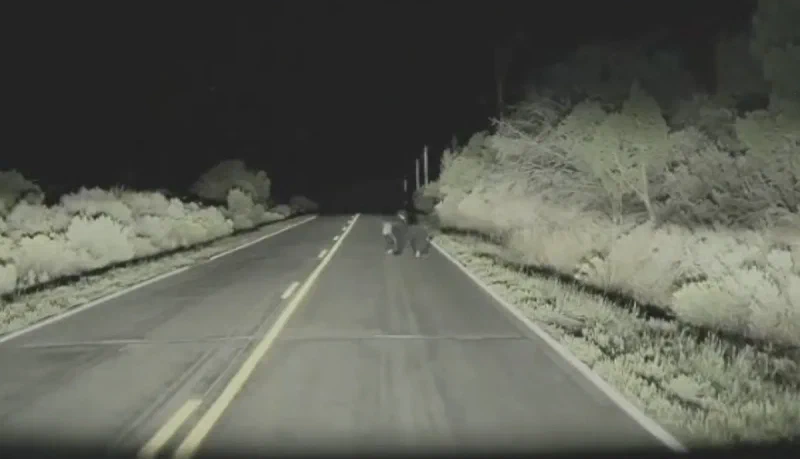
Then, on the road out, in the headlights, there was a bear.
That is not a shadow. That is not a dog. That is a bear.
A real one. Wild, black, unbothered, trotting down the centre of the road ahead of us like it had somewhere to be.
We could not get round it. So for a few minutes we simply followed it, at bear speed, in the dark, accidentally herding a large wild animal along a road in Colorado, until it worked out it had options and went off into the trees.
I have been in a lot of photographs and nobody ever asks about the bear. That night there were two of us and I still did not get asked.
I am choosing to take this personally, and I intend to keep taking it personally for the remaining six days of this trip.
Although.
She had a point about the timing, and she made sure I knew it. Early September in Colorado is peak bear season, when they go into hyperphagia and spend up to twenty hours a day eating to put on the weight that gets them through winter. They are out, they are moving, and they are thinking about food more or less constantly.
We had been standing on a dark plateau forty minutes from anywhere, an hour after sunset, and then walked back to the road by headlamp on a trail that people specifically warn you is hard to find in the dark. That bear had been out there the whole time doing its own thing in the same handful of square miles.
Nicholas had calls. Long ones. I had assumed the whole point of a spontaneous road trip was that nobody could reach you, and I was wrong about that in a way I intend to keep bringing up.
He brought a Starlink. He packed a satellite dish, for a holiday, and then aimed it at the sky from increasingly absurd places so that a meeting could continue. Red rock, no phone signal for miles, a landscape that has been quietly eroding since the Jurassic, and a man in the middle of it saying “sorry, can you repeat that, I lost you for a second.” He did not lose them. That was the tragedy. The dish worked perfectly every single time.
So we got into Arches in the afternoon, again, and the first thing my bud did on arrival was buy a mug.
Not a postcard. Not a map. A mug, from the visitor centre, with the park’s name on it. He has apparently decided that he is now a man who collects a mug at every national park, and that this decision is retroactive and binding for the rest of the trip. I want it noted that nobody voted on this.
I gave it about a day before I started checking whether the next park had good ones.
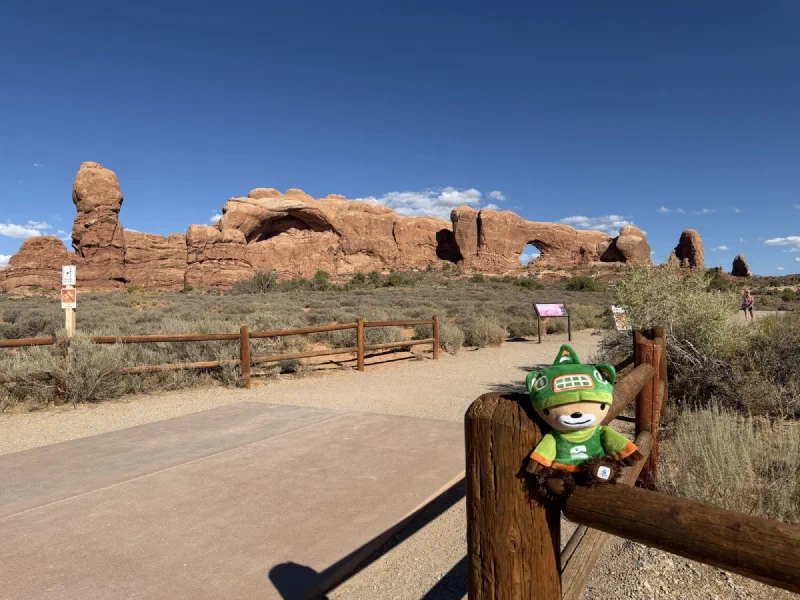
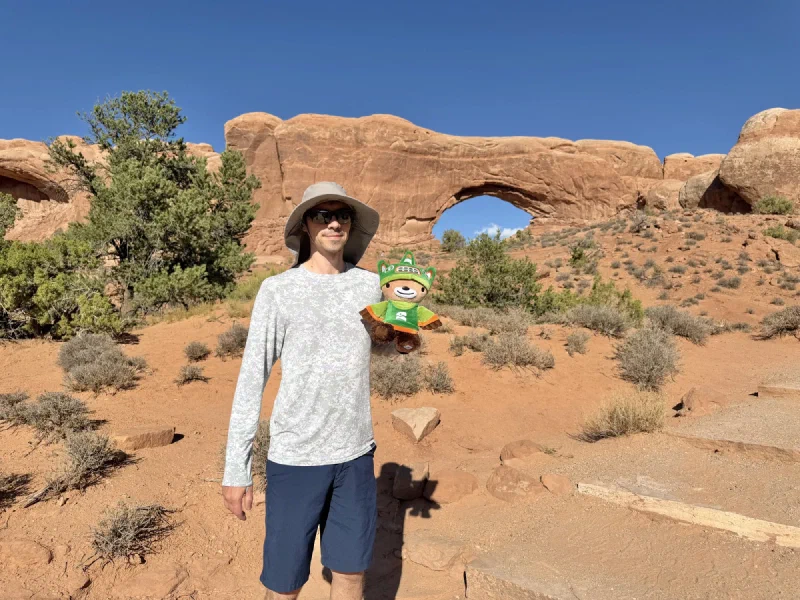
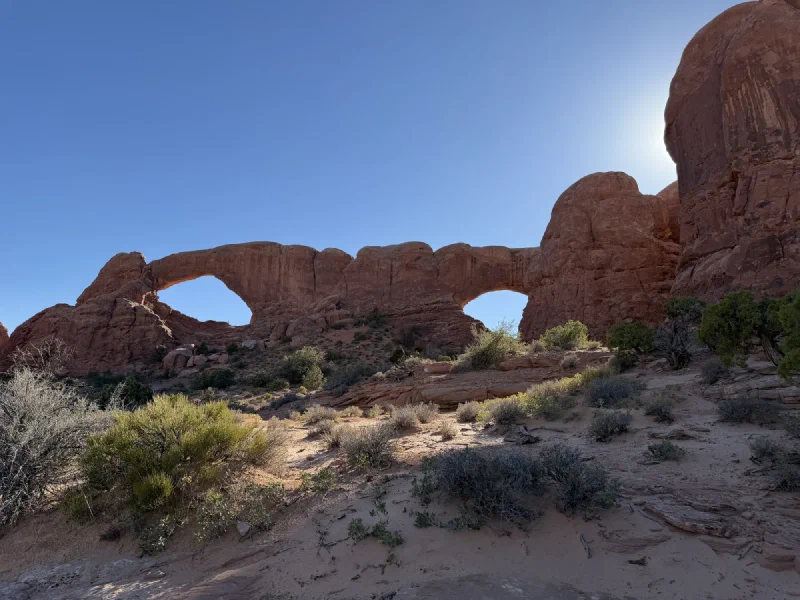
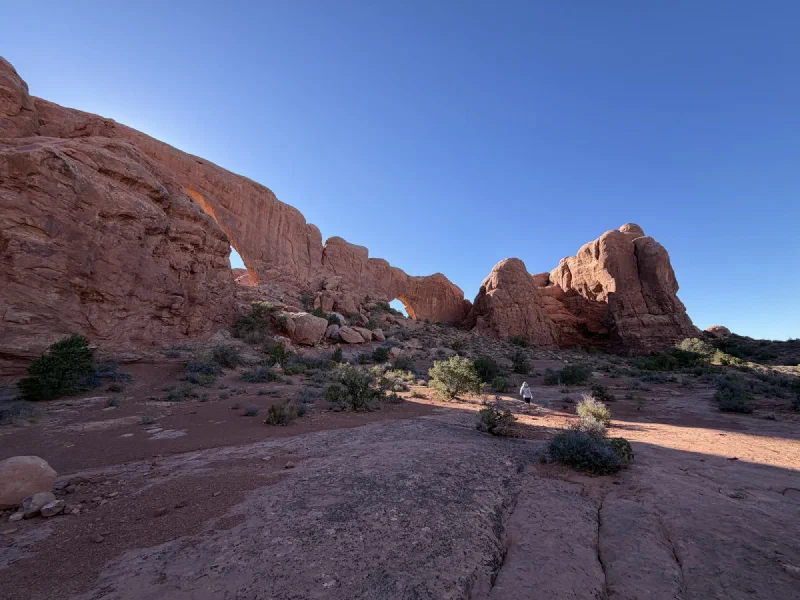
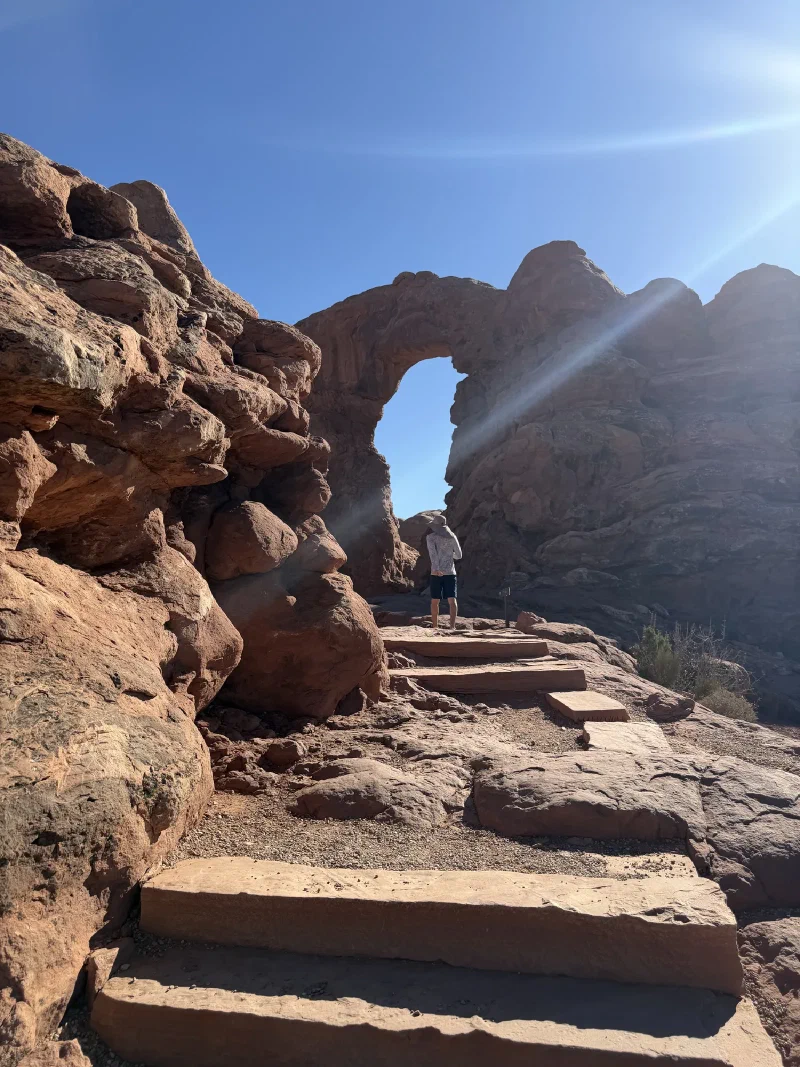
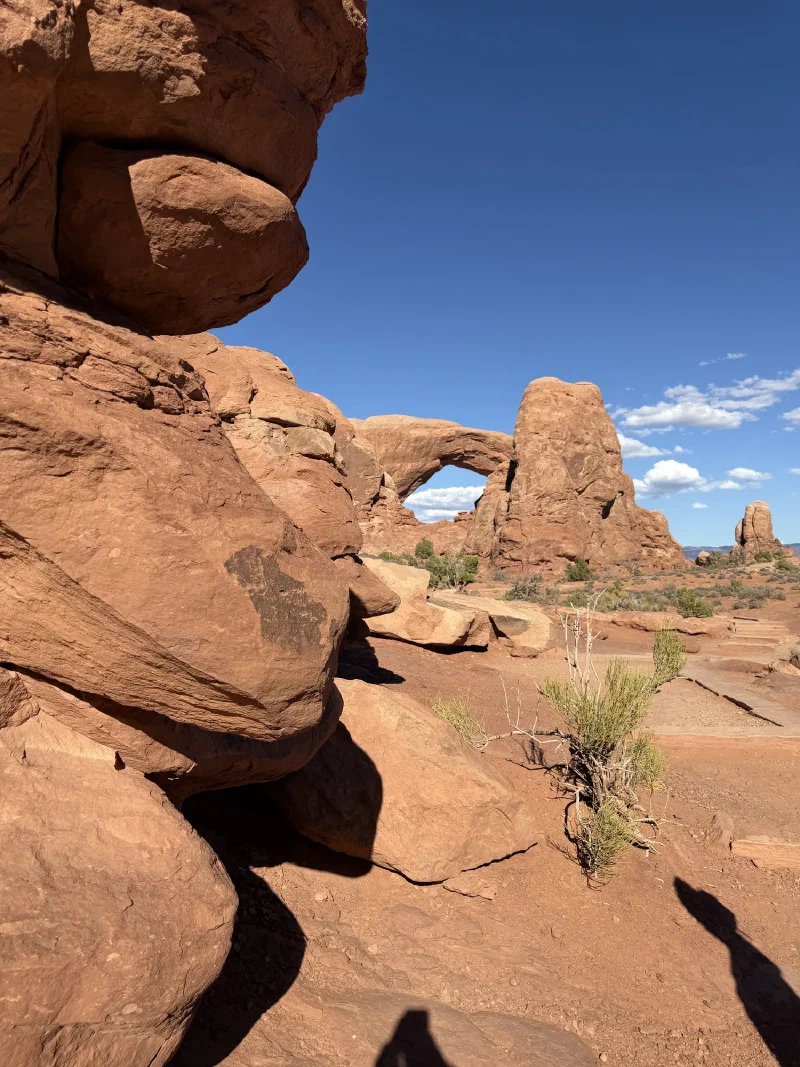
Arches has a standard loop and we did the standard loop, because the standard loop is standard for a reason. First stop was the Windows Section, which is a cluster of arches all within a few minutes’ walk of each other, so you get an extremely good ratio of arches to effort.
Two arches, one turret and a bear, all visible from the car park. Efficient.
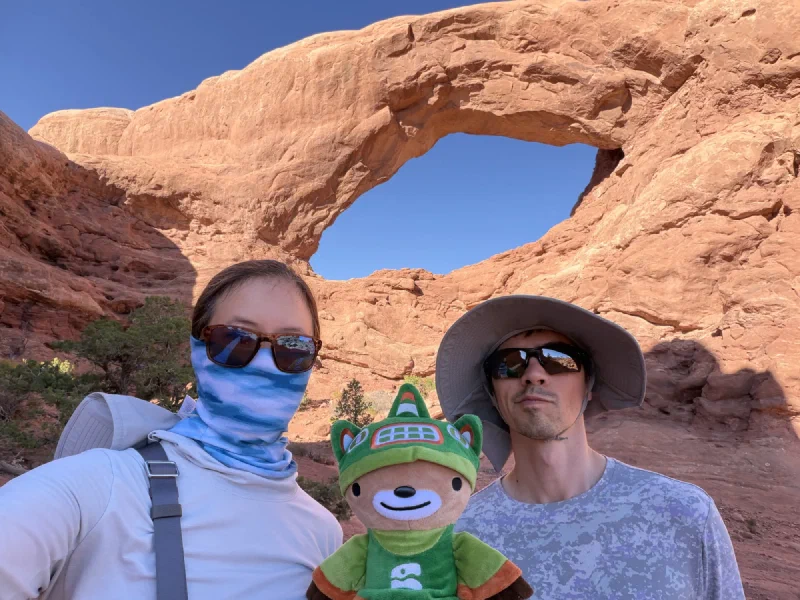
North Window. He wore the hat all day and would not be talked out of it.
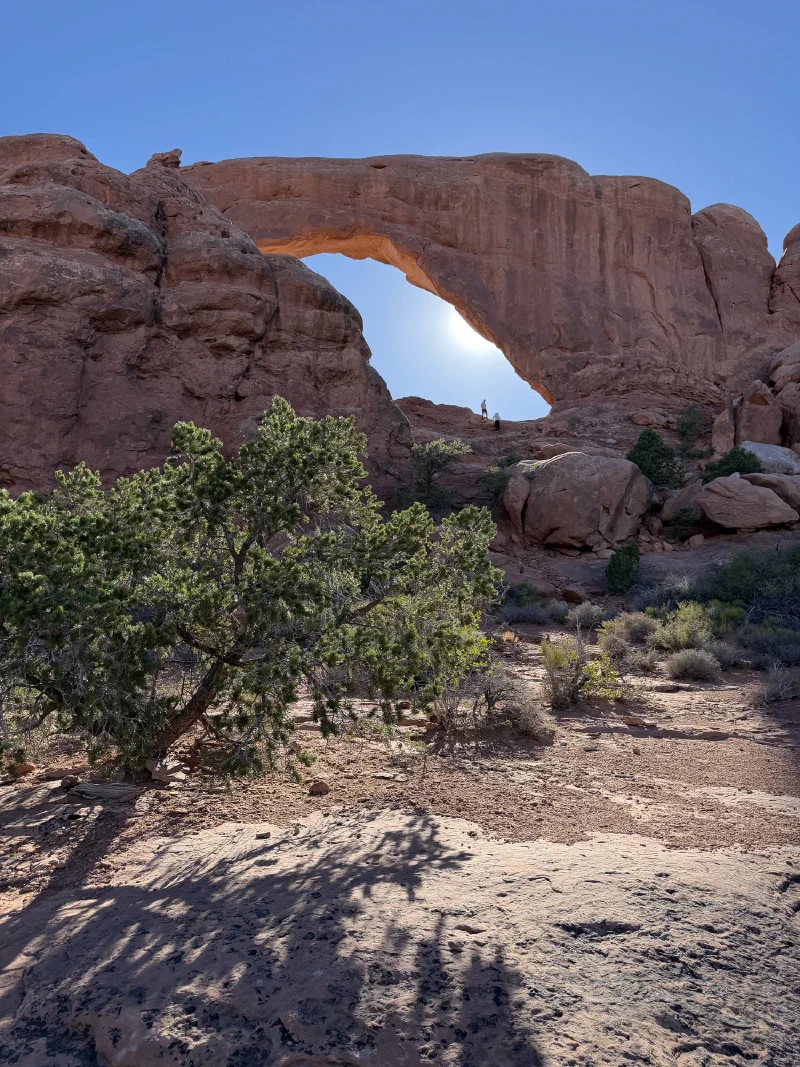
The two big openings sit side by side in one long fin, and from the right angle they line up as a pair. The park calls them the Spectacles. I have no notes. That is exactly what they look like.
The Spectacles. Someone named these and then went home early, correctly.
For scale, there is a person standing in that hole.
You can climb up inside the openings, which people do, and then stand there being a silhouette in everyone else’s photograph. Nicholas did not go up. Nicholas stood at the bottom getting quietly furious at the people who did, waiting for a gap in the queue of strangers posing in his shot. There was no gap. There is never a gap.
Turret Arch. The steps are the part they built. The rest is 150 million years of nobody doing anything.
Pokin had the sun buff on. I had no protection whatsoever and remain unblemished.
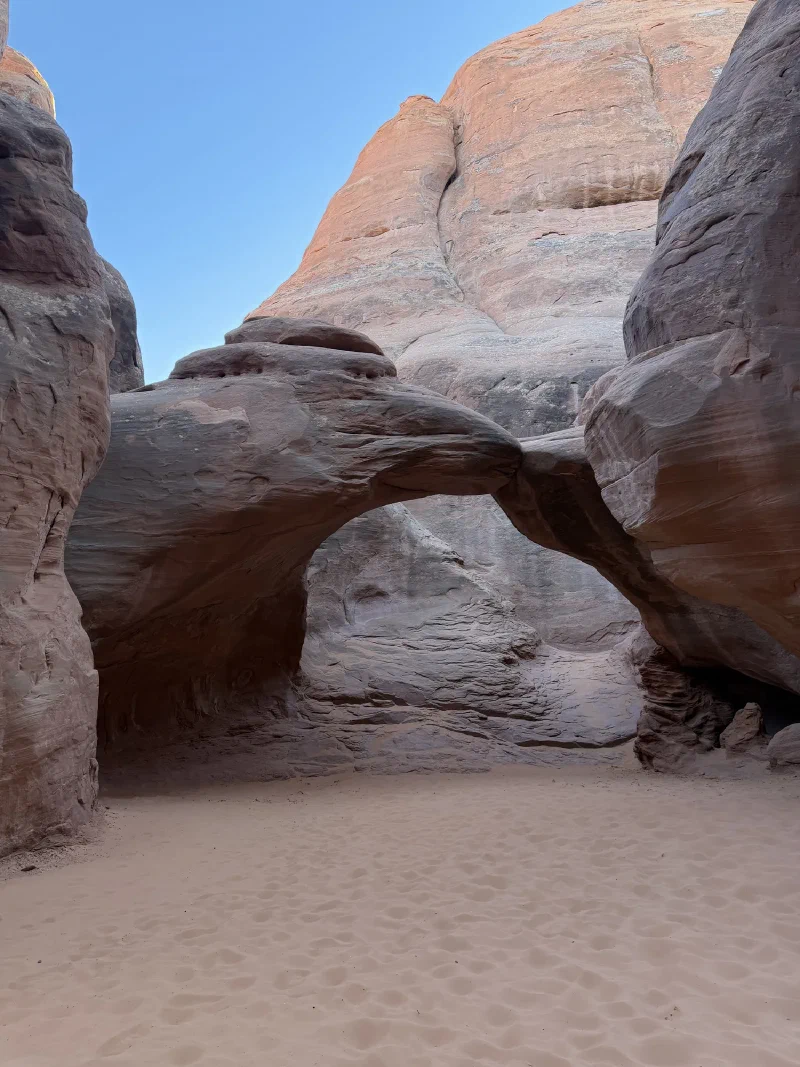
Then a short stop at Sand Dune Arch, which is down a gap between two fins and feels completely unlike the rest of the park. You walk in through a slot, the walls close over, the temperature drops, and the floor turns to deep soft sand that swallows your feet.
A beach, indoors, with no water anywhere near it. My ideal beach.
Every child in southern Utah is in there at any given moment, throwing sand. I respect the operation.
It was getting on, and the light was going, and we could do Delicate Arch or we could get to Landscape Arch. Not both. Delicate Arch is the famous one, the one on the licence plates, and I am told the walk out to it is a proper uphill slog with a crowd at the end.
We went to Landscape Arch instead. I have been informed this was a scheduling decision. I am recording it as a choice, because Landscape Arch is by far the more interesting object and I will explain why.
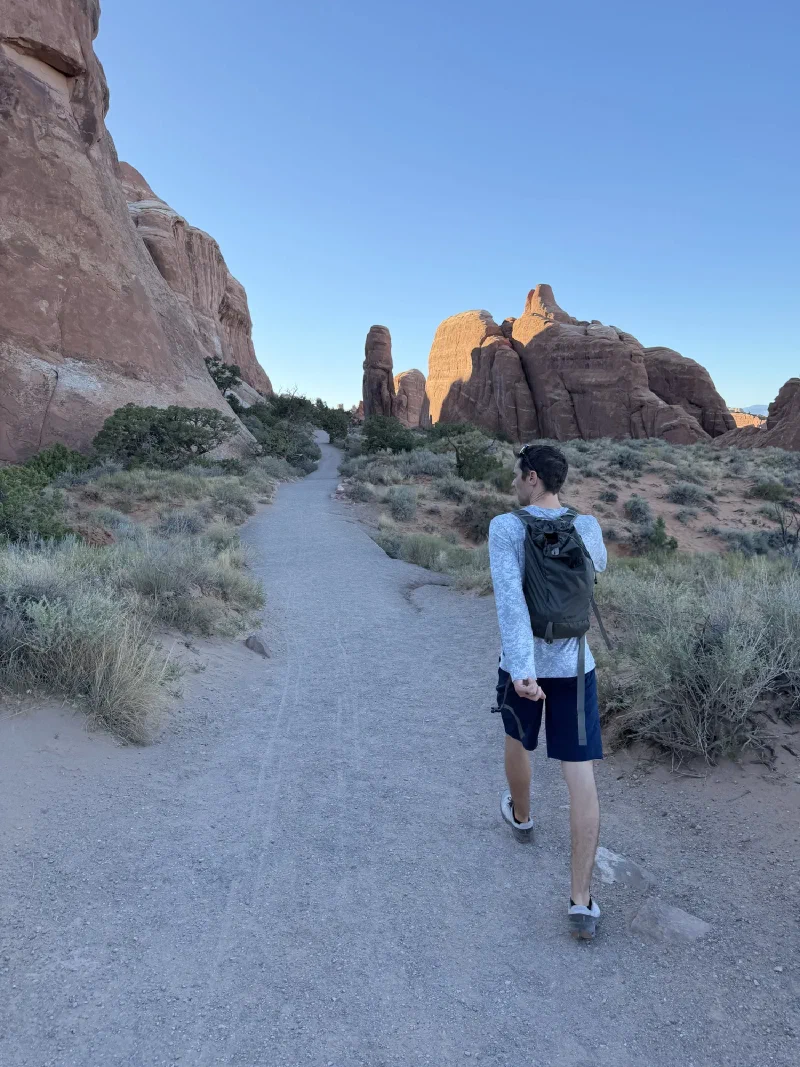
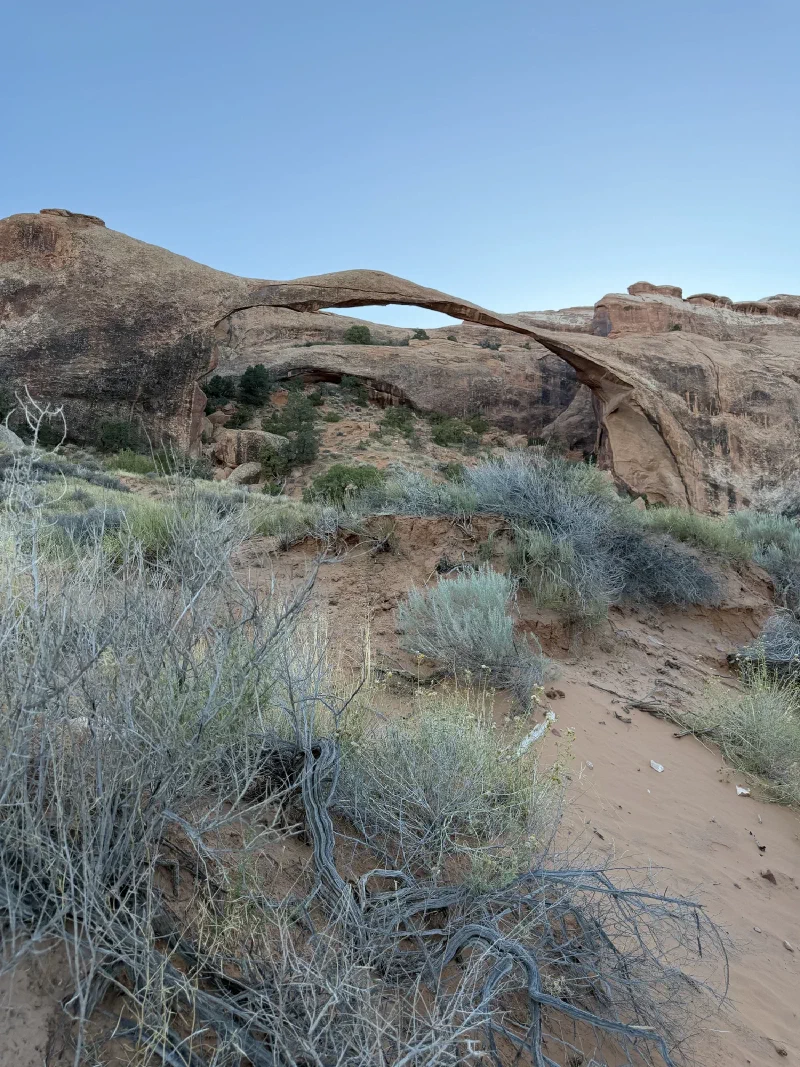
Devils Garden trail. Brisk pace, because the sun was leaving and he was not.306 feet (93 m) across. That is the longest natural arch span in North America and it is barely there.
Look at how thin it is. At its narrowest that ribbon of sandstone is about six feet (1.8 m) thick, holding a span longer than a football pitch.
And this is the bit worth knowing. Sandstone is excellent at being squashed and terrible at being stretched. A short, fat, steep arch like Delicate Arch is basically a thick lintel sitting on two thick legs, and almost all of the weight goes straight down through the rock as compression, which sandstone is happy to do all day. A long flat span is a different problem entirely. The underside of it is in tension, being pulled apart, and that is the one thing this rock cannot do. So the span gets thinner, and the thinner it gets, the less there is to share the load.
Landscape Arch is not being coy about this. It dropped a 60 foot (18 m) slab off its underside in 1991, with people standing underneath it, and shed more rock in 1995. The trail that used to run under the arch has been closed ever since. You look at it from a rope line now, at a polite distance, the way you would look at something that has already told you what it intends to do.
Delicate Arch will still be standing in a very long time. Landscape Arch is a countdown. That is why it is the better one to go and see.
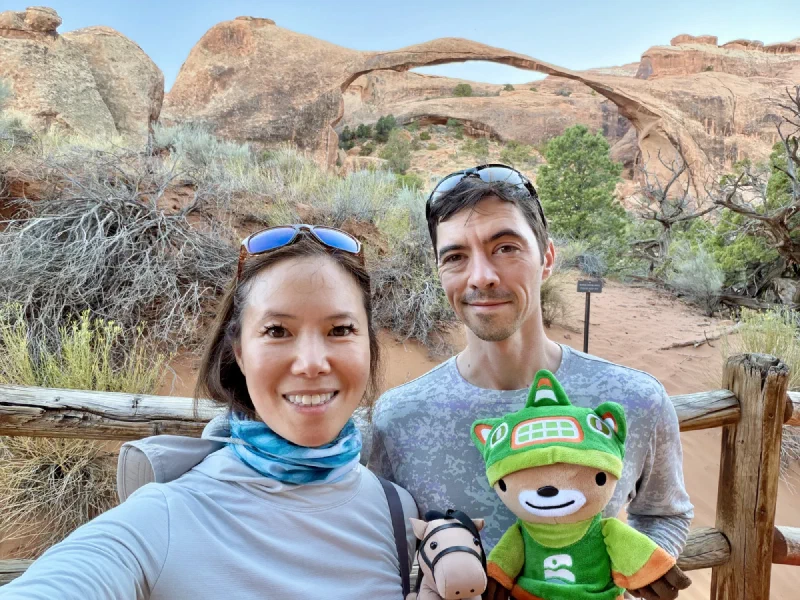
Chestnut made it out too. Nine days in and he still thinks every single thing is the best thing.
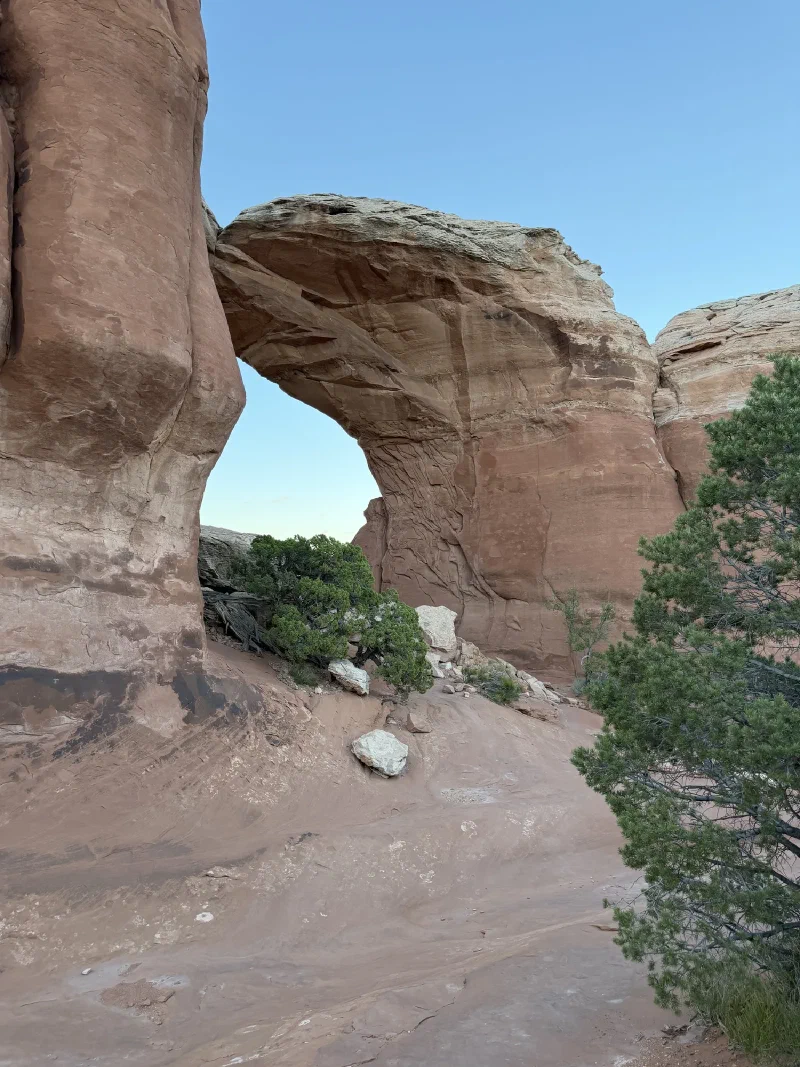
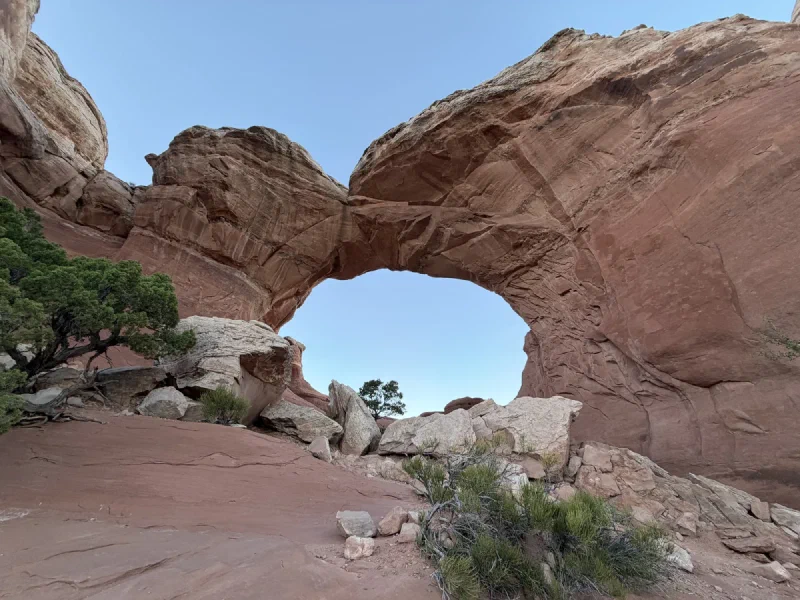
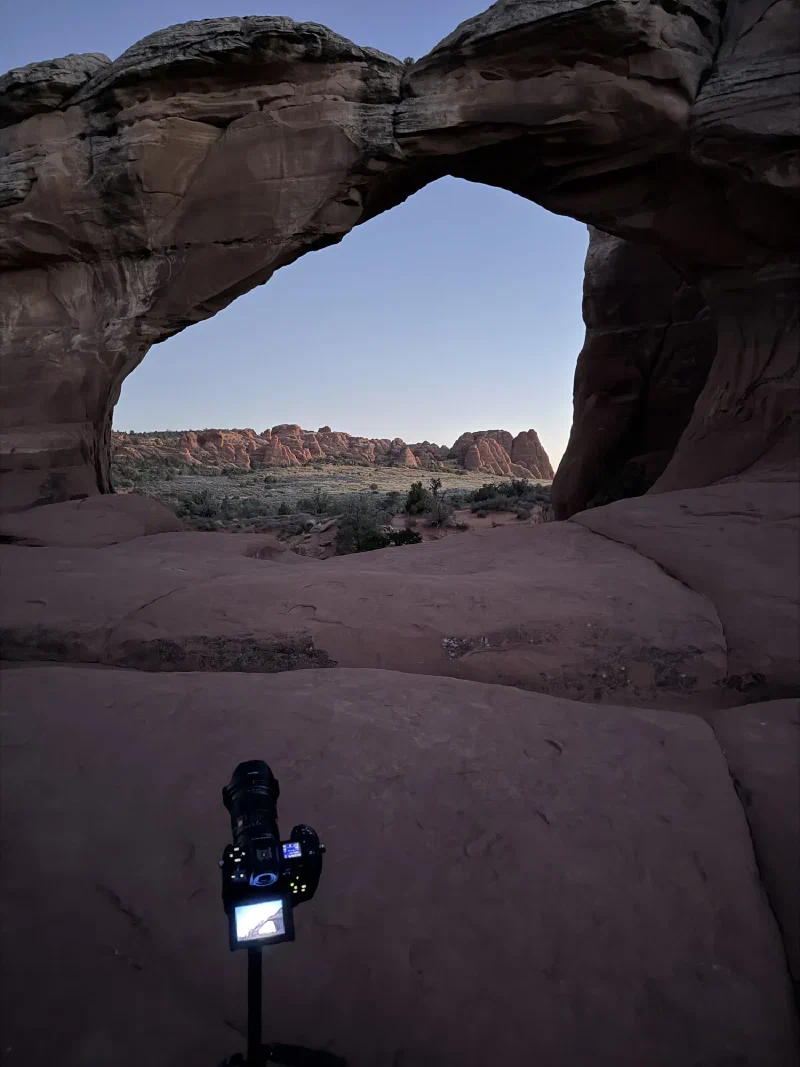
The plan was Broken Arch. He had been eyeing it all afternoon for one reason: it is an arch you can stand well back from, on open slickrock, with a clean view through the opening and nothing in the way. Which is another way of saying it would frame the galaxy nicely, and everything else that day had been reconnaissance.
Broken Arch. Not actually broken. We will get to that.There is the crack. It is named for a break that has not happened yet, which is very optimistic naming.
That notch across the top is the whole reason for the name. The span has a proper fracture through it and it has simply declined to finish the job so far.
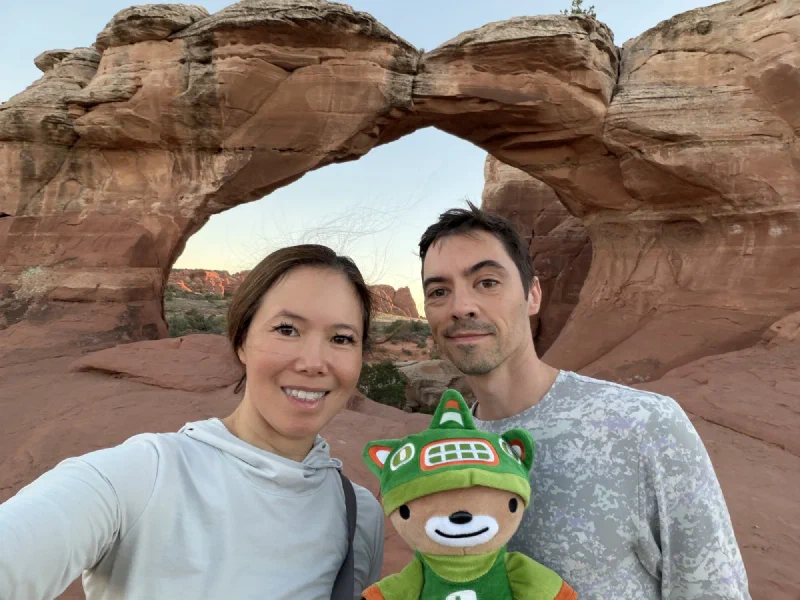
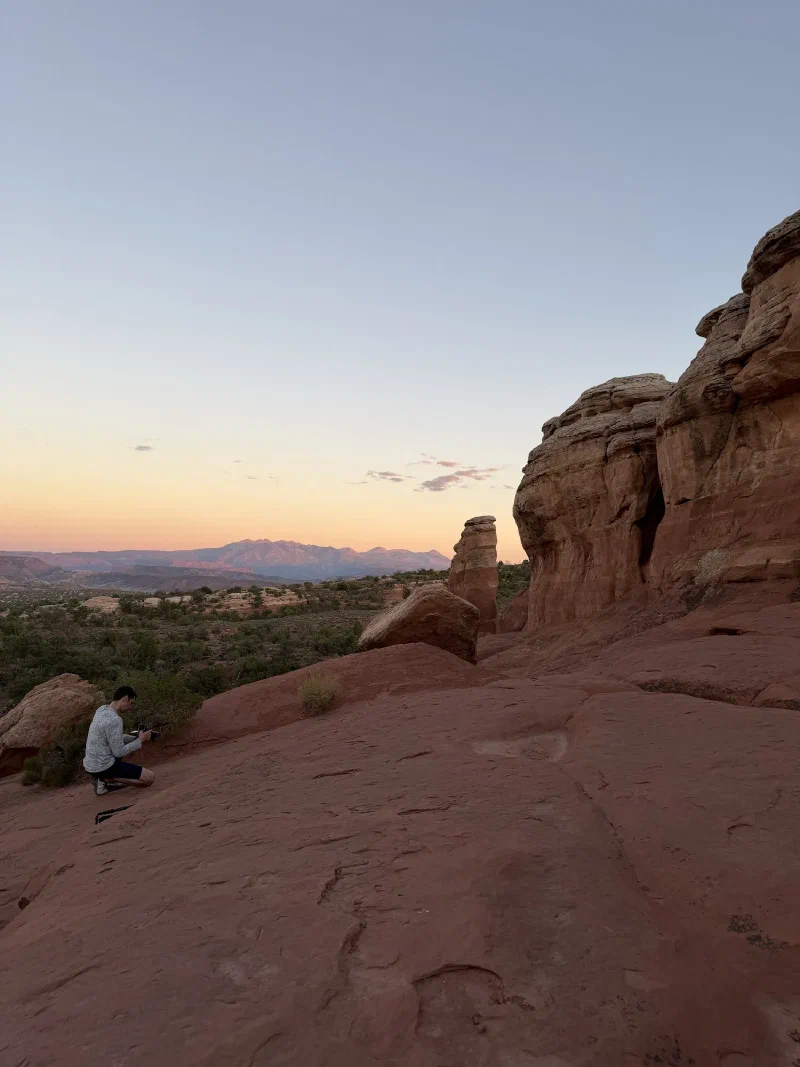
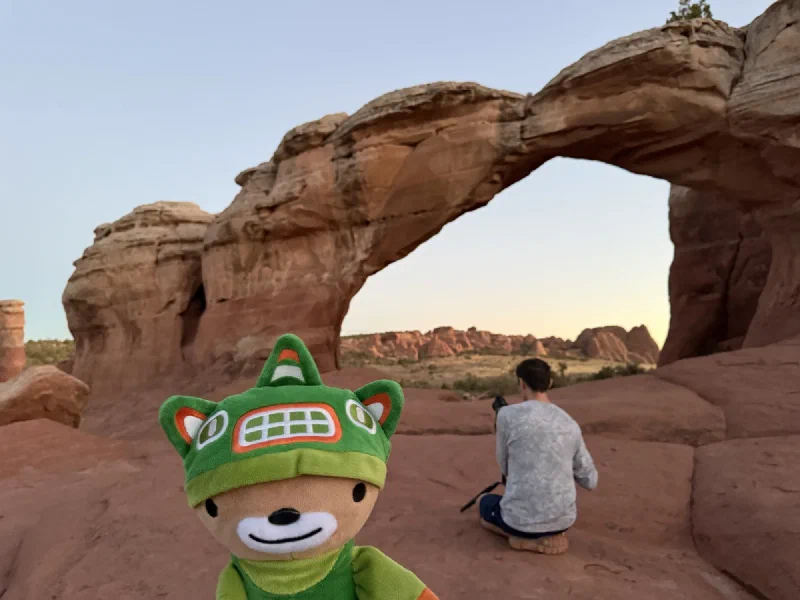
Last group photo before the light went. Note that I am centred. This is correct.Sunset doing its thing on the mountains, which is a nice touch given none of us were pointing the camera that way.Me, supervising. Him, kneeling on rock for two hours voluntarily.
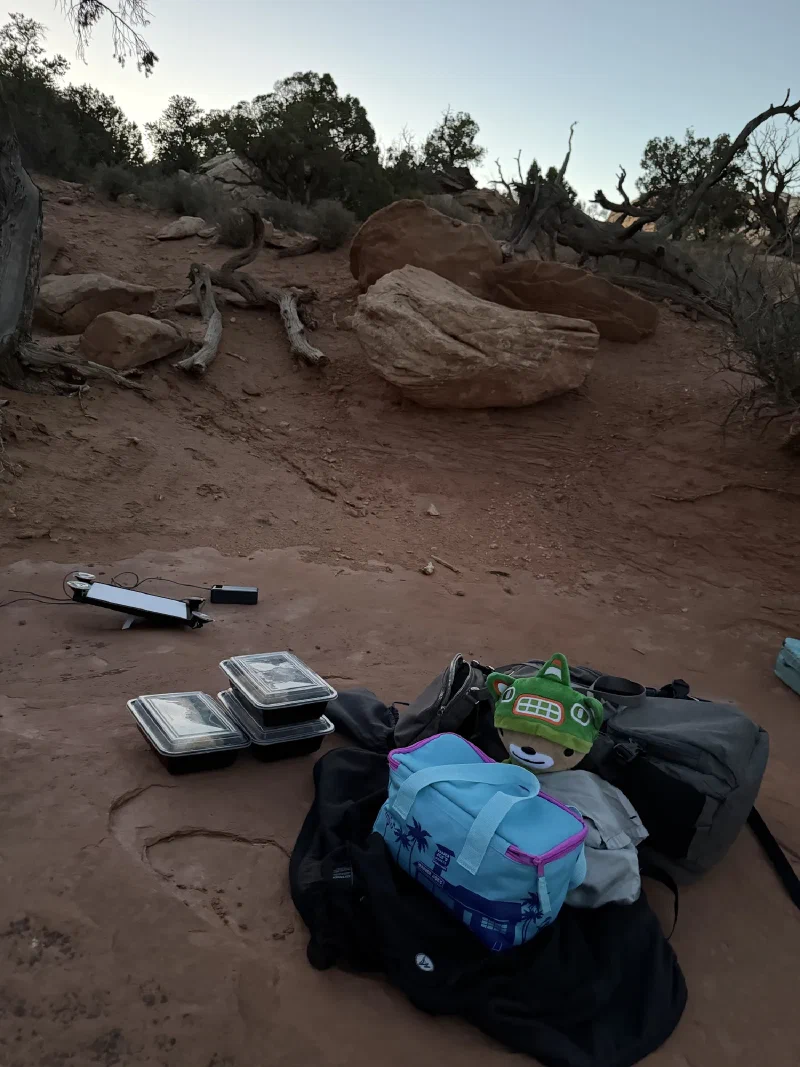
We settled in to wait for dark. Packs down, dinner out of the containers, headlamps ready, several hours to burn before the sky did anything interesting.
And then the mosquitoes arrived.
In the desert. In a national park made almost entirely of rock and sand and the absence of water, at an arch on an exposed slab, there were mosquitoes, and there were a lot of them, and they found Pokin immediately.
Base camp. I was placed among the luggage, which is where the good gossip is.
She got bitten a great deal. Nicholas got bitten a great deal. I have never once been bothered by a mosquito in fourteen years of travel and I sat there watching the two of them slap at their own arms in the dark like it was a hobby.
Pokin’s position, delivered several times, was that this had better be worth it.
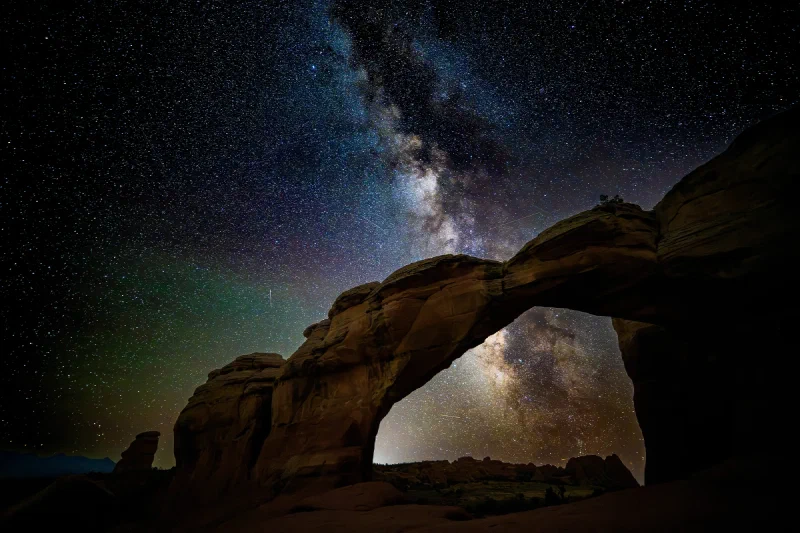
The Milky Way core came up over the arch and stood there.
The camera got the good seat. It always gets the good seat.Right through the hole. He planned that in the afternoon and it landed.
There is a faint streak on the left of that frame. Before anybody asks, yes, I checked, and yes, it is almost certainly another satellite. I have made my peace.
Then he set up the one I actually care about.
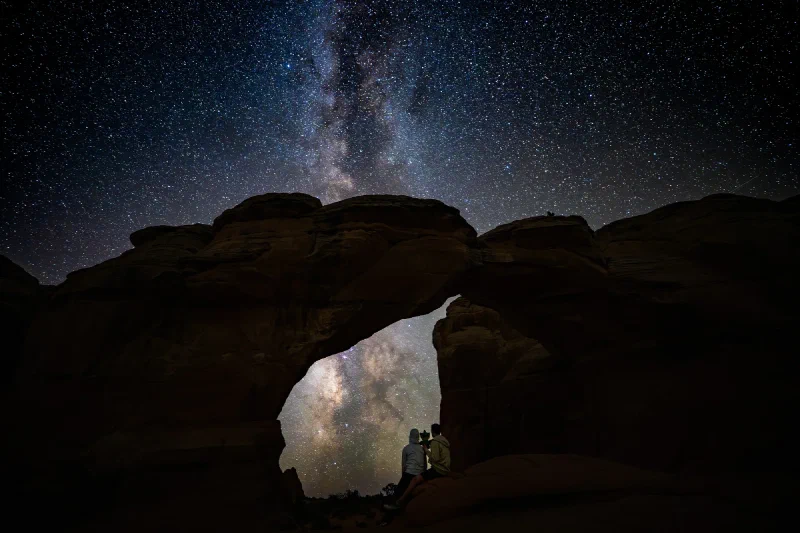
Two humans, one bear, one galaxy. I am the one in the middle wearing the toque.
That is the three of us sitting under a rock that has been slowly falling apart since before anybody was around to name it, under the arm of a galaxy, in the middle of a road trip where nobody had decided where we were sleeping.
Pokin also attempted an astro shot. On her phone. Handheld.
Nicholas, allegedly, somewhere in there.
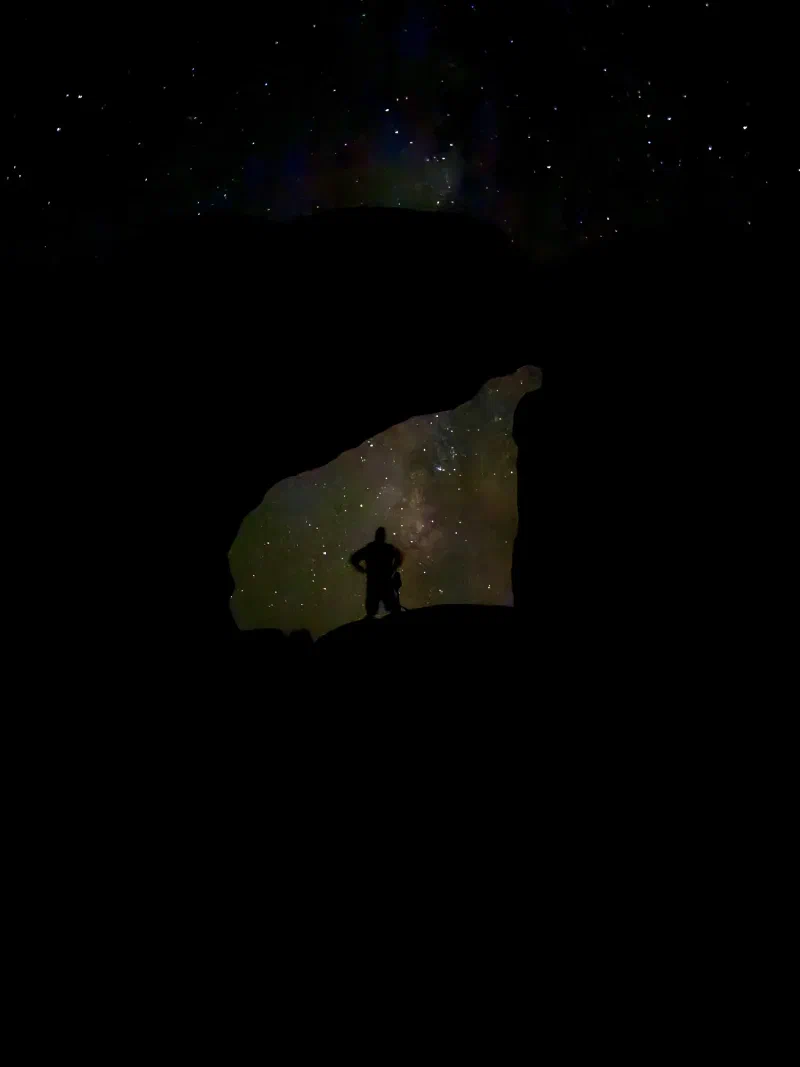
I want to be fair to it. It is a photograph of a man standing in an arch under the stars, and all of those elements are technically present. The stars are there. The arch is there. The man is there with his hands on his hips, doing the pose, fully committed.
It also looks like something recovered from a haunted camcorder. Pokin submitted it entirely without shame, which I respect more than the photo.
We hiked back to the car in the dark with headlamps, over slickrock, following little reflective markers and Nicholas’s memory of where the trail had been in daylight. Pokin was still itching. Chestnut had opinions about the dark and they were, as always, positive ones.
Two parks in two days, one mug acquired, an unknown number of bites, and one photograph that will end up on a wall.
Do you realise the last time we went on a proper spontaneous road trip was 2014?
Twelve years. Twelve years of flights and hotels and airport lounges, which I am not complaining about, but there is a specific kind of trip where nobody knows where they’re sleeping tomorrow and you just point the car somewhere and go. We hadn’t done one of those since Route 66.
It was time to rectify that. Especially since my bud might be about to get locked down by a job that eats his calendar.
So we went. Chestnut came too. He has travelled plenty, but he has never done a road trip, and a road trip is a different animal. No itinerary. No bookings. No agreed end. He was about to find out what nine days of that does to a horse.
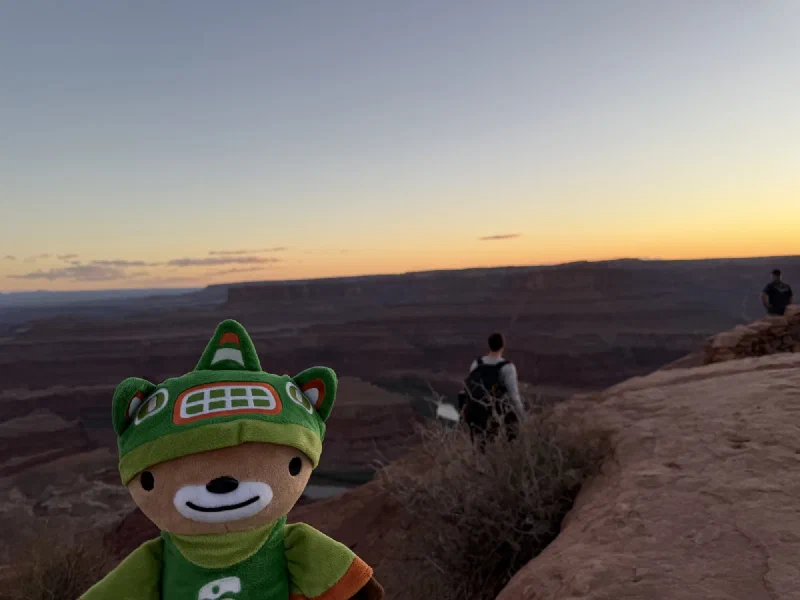
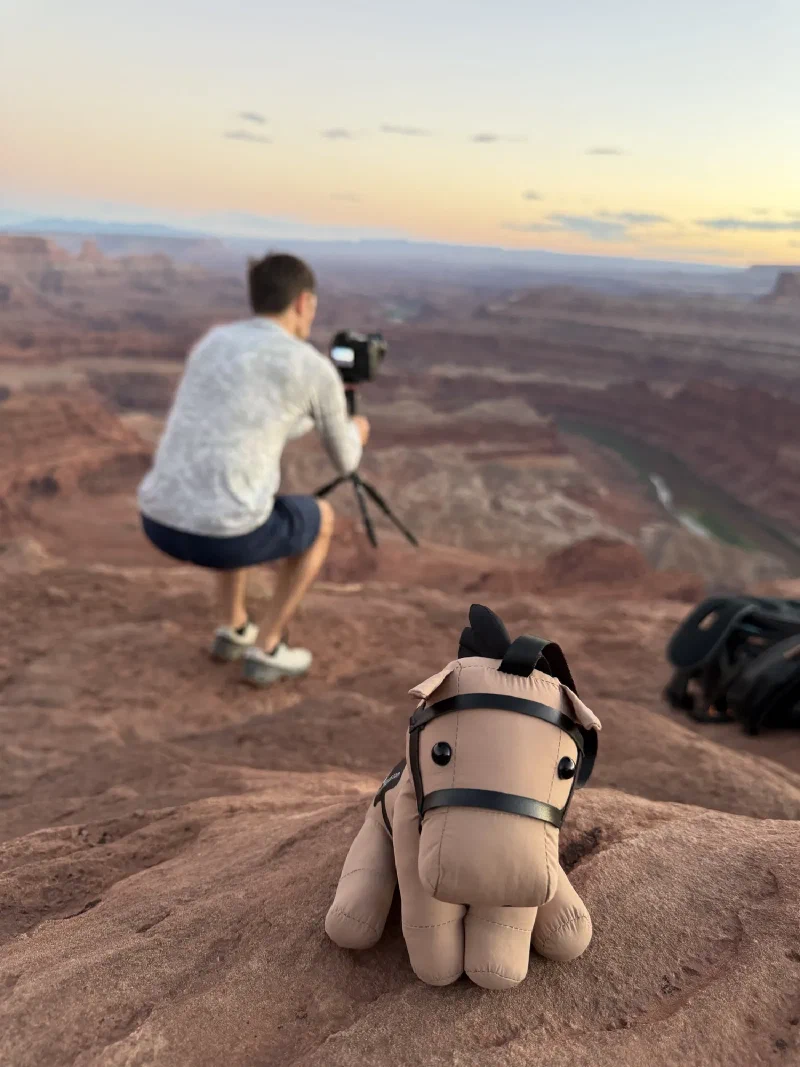
First stop: Moab. Canyonlands. Then Dead Horse Point after dark, because Nicholas has decided he’s an astrophotographer now.
Nicholas had work calls all morning. Then more work calls. Then a call about the calls. We did not leave the hotel until four in the afternoon, which for a bear who packed at dawn is a personal insult.
In fairness, it was too hot to be outside anyway. Everyone was wilting. Everyone except Chestnut, who thought the whole situation was fantastic, because Chestnut thinks everything is fantastic. That horse has never had a bad day in his life.
They grabbed sandwiches from a new place in town called Coyote Outpost so we could stay out late, and the owner threw in a tip with them: skip the pavement, take the dirt road. Go through Long Canyon.
I’m always down for an offroading adventure.
Out of the hotel at last. Only about six hours later than advertised.
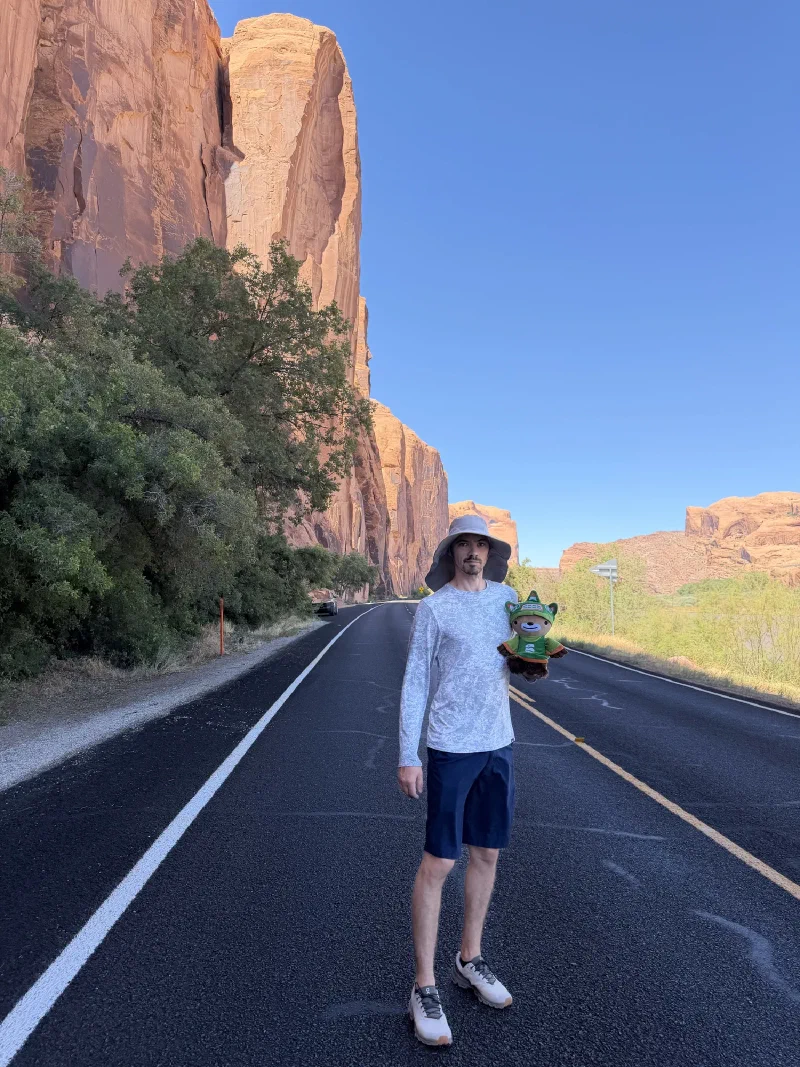
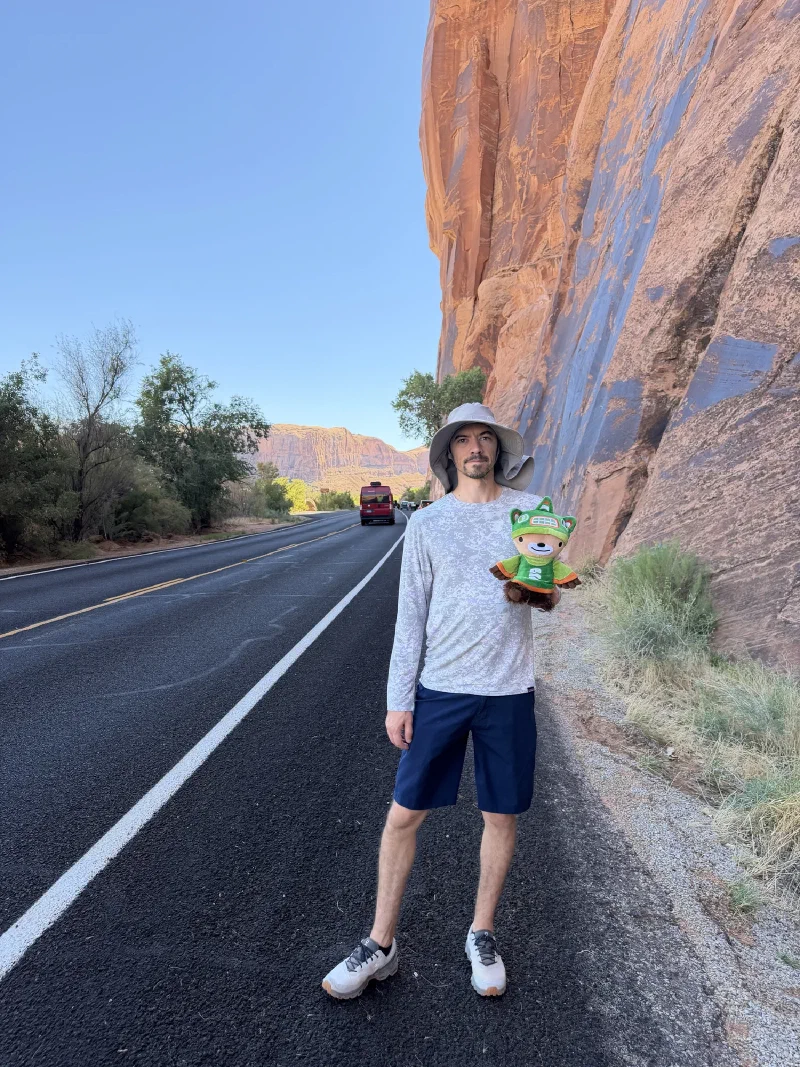
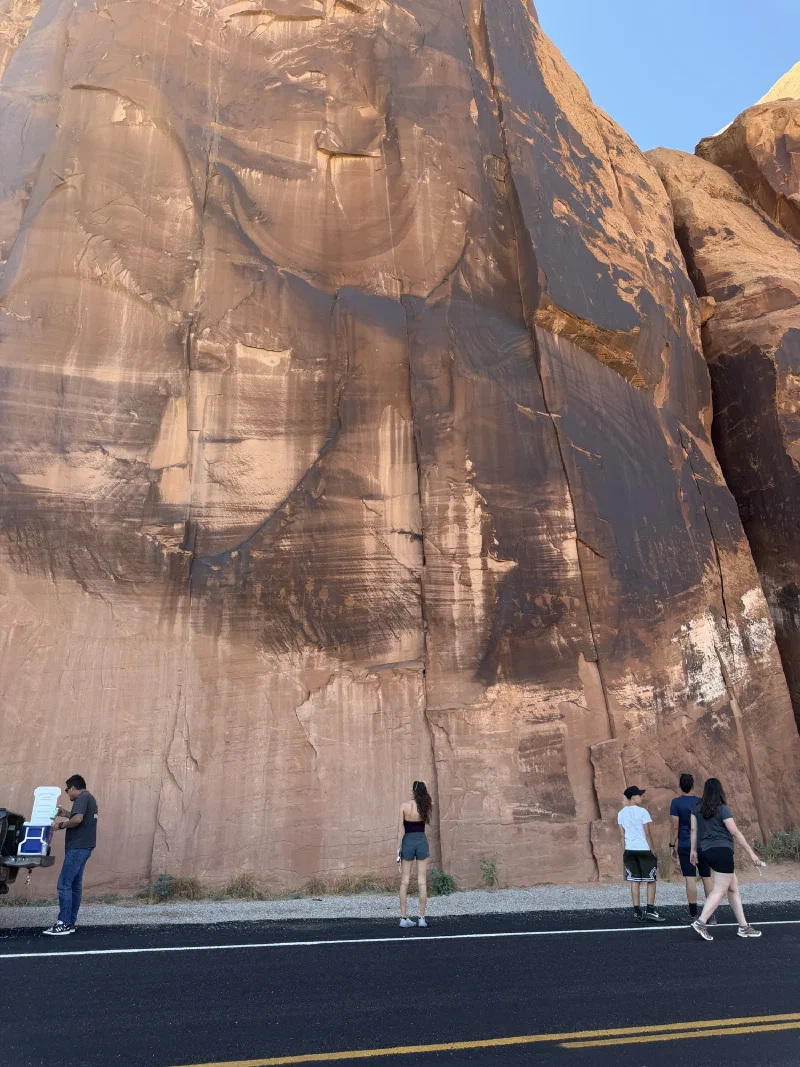
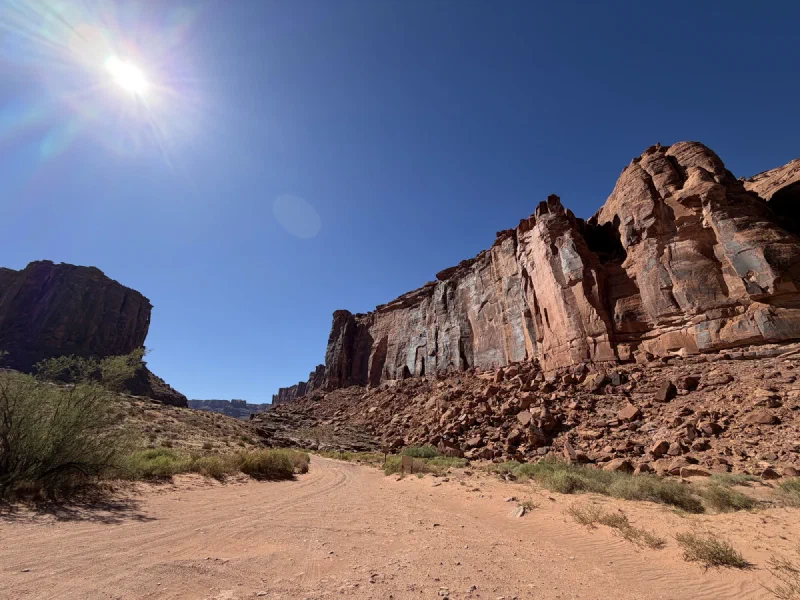
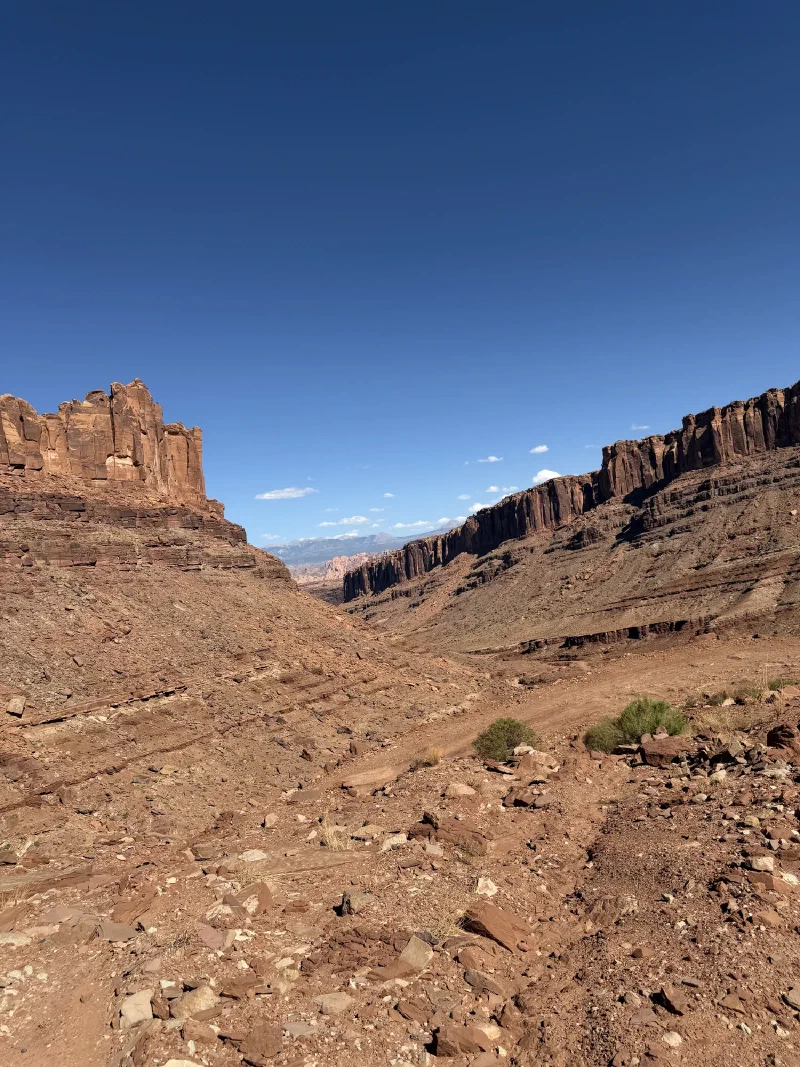
The road out of town runs right along the base of a wall that goes up forever. You drive with your nose almost touching the window.
The petroglyphs are carved into that wall, right at the side of the road, thousands of years old. No fence, no ticket, no gift shop. You pull over on the shoulder and there they are. Everybody stands in the gravel and looks straight up, which is exactly what people have been doing on this spot for a very long time.
Then the pavement ran out and the good part started.
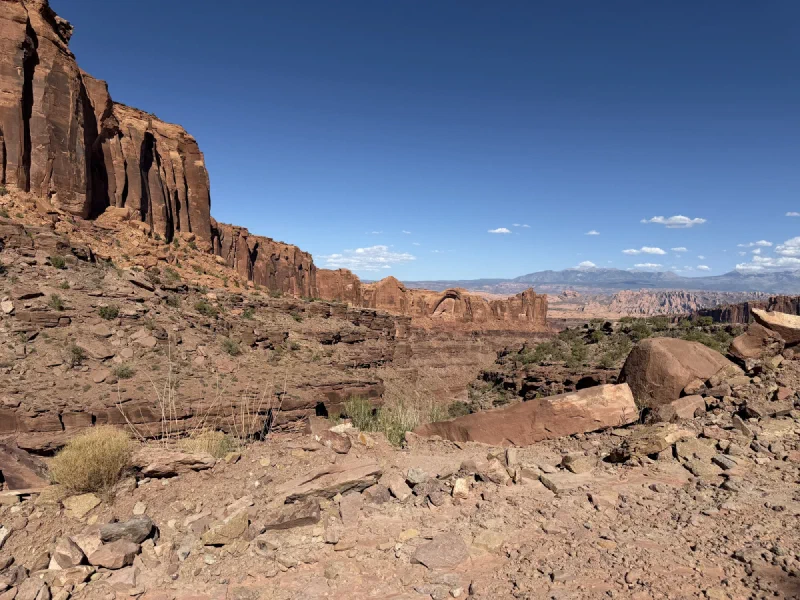
Long Canyon Road climbs out of the river bottom on a dirt track that gets narrower and more enthusiastic the higher it goes. Loose rock. Big drops. Nobody else out there. This is the kind of road where nobody is quite sure we’re going to clear that rock, so you go for it and find out.
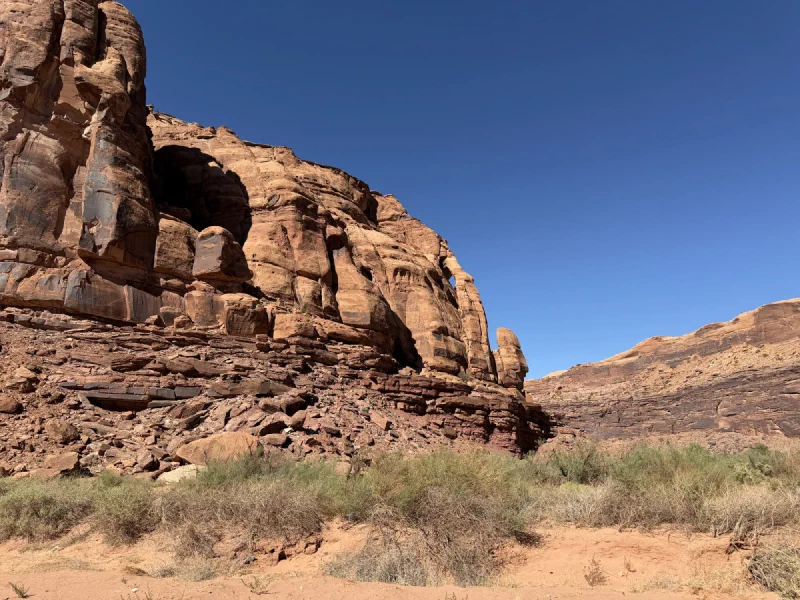
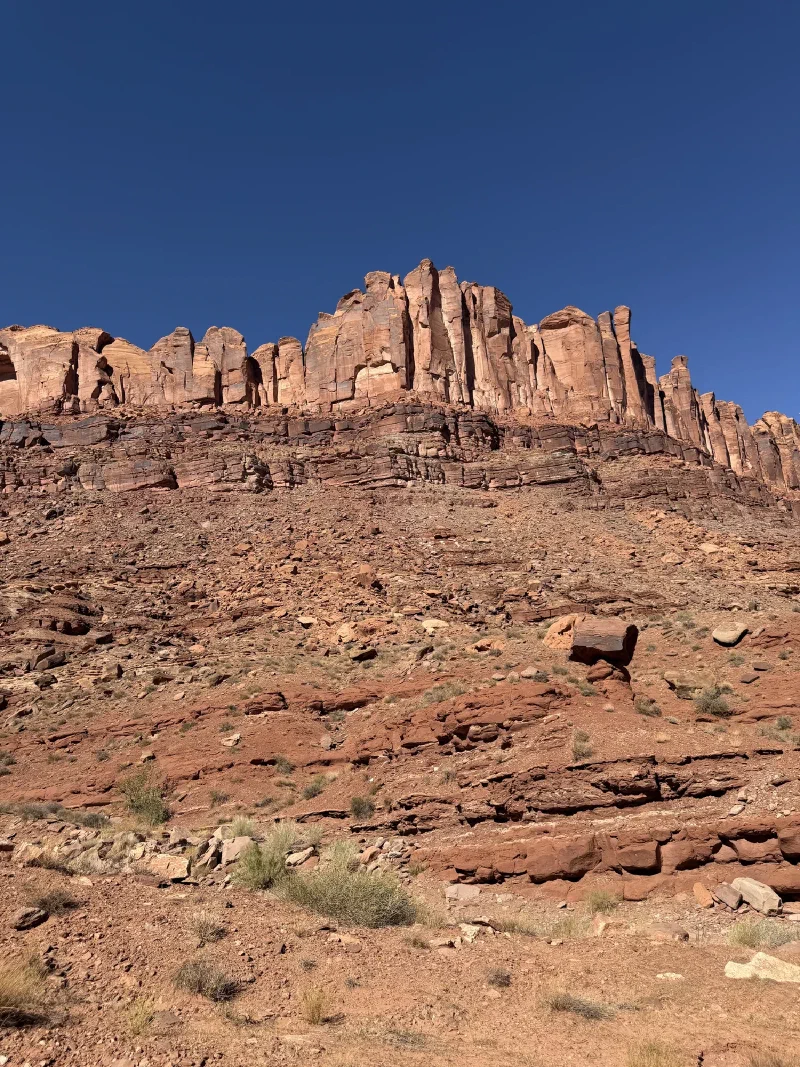
Layers. Roughly 250 million years of them, stacked like someone shelving books badly.
And then we got company.
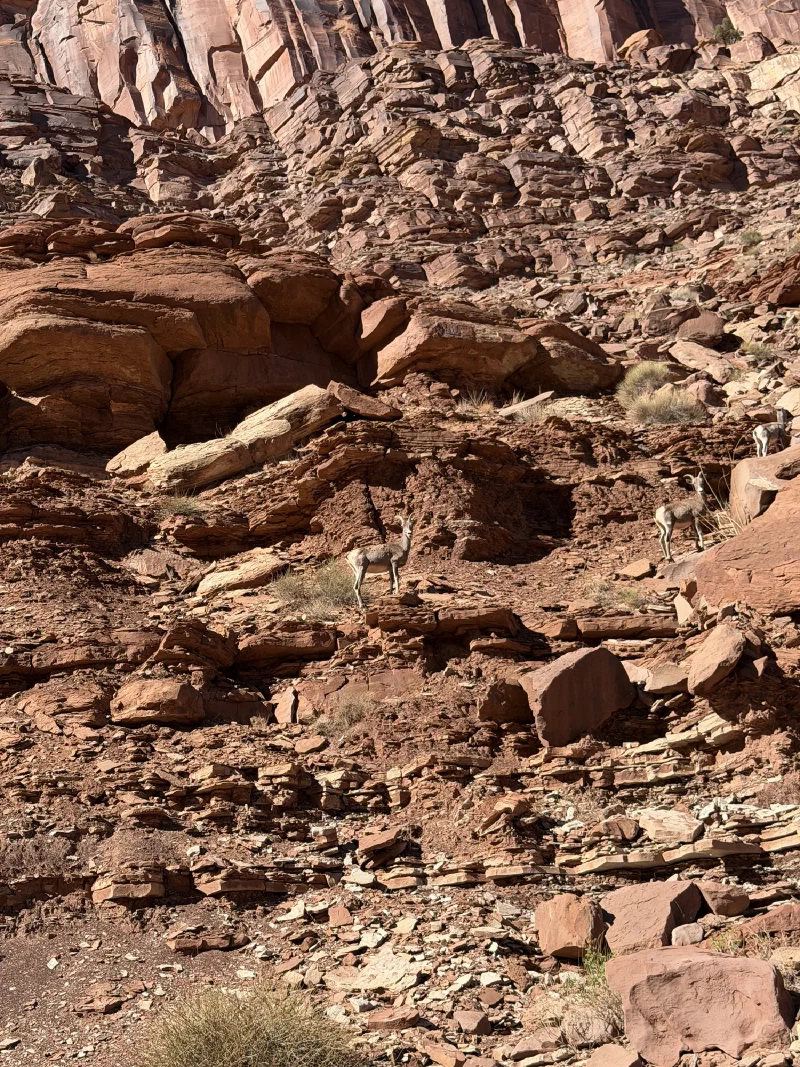
Desert bighorn, standing on a slope I would not attempt, looking at us like we were the ones doing something strange.
They were everywhere out here. Once you spot the first one you can’t stop seeing them, parked on ledges no animal has any business standing on, entirely unbothered by any of it.
I would like it on record that I spotted one of them. I will accept a medal at any time.
That’s the La Sal Mountains out in the haze, which is a genuinely odd thing to see from the middle of a desert. Red rock in every direction and then snow-capable peaks over 12,000 feet (3,700 m) sitting there at the back of the frame like they wandered into the wrong photograph.
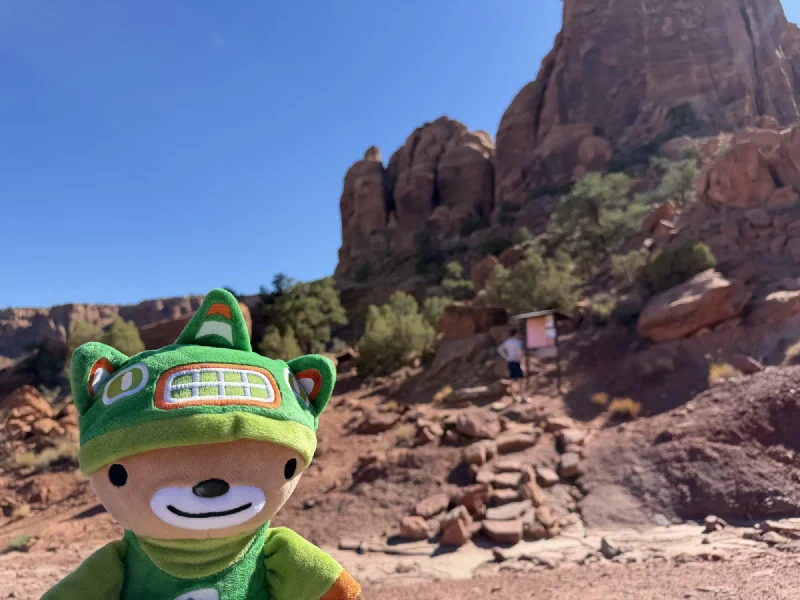
I supervised the information board from a safe distance. Reading is Nicholas’s job.
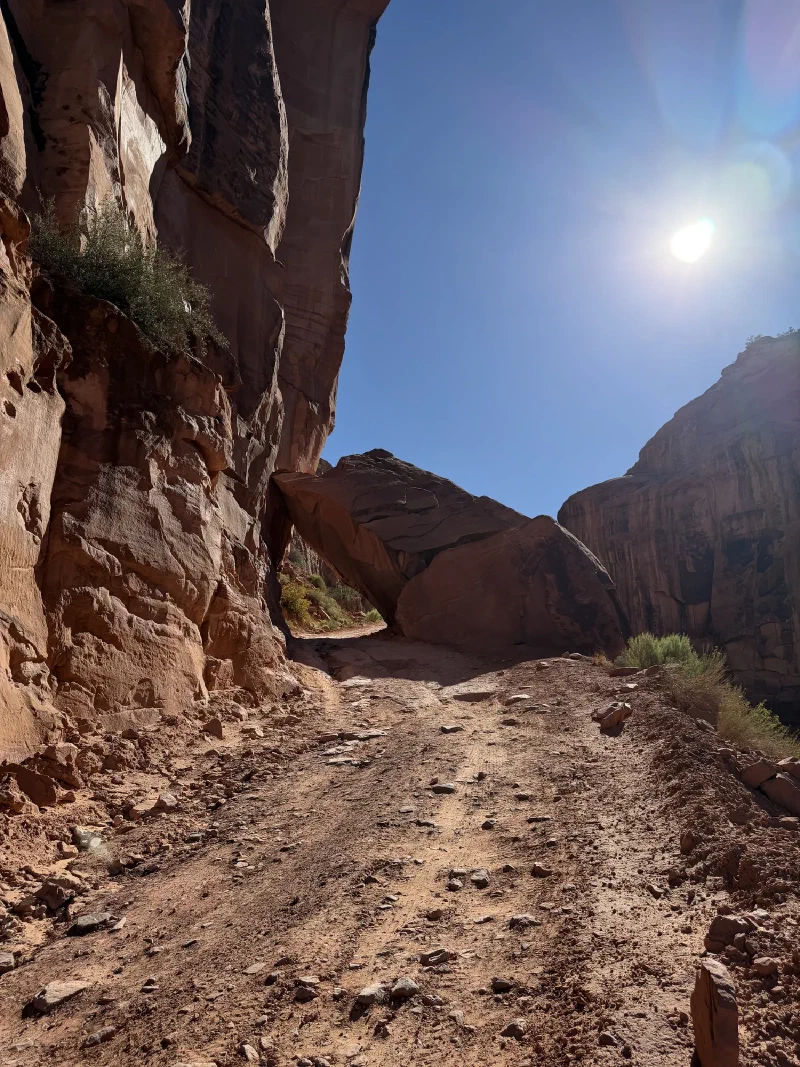
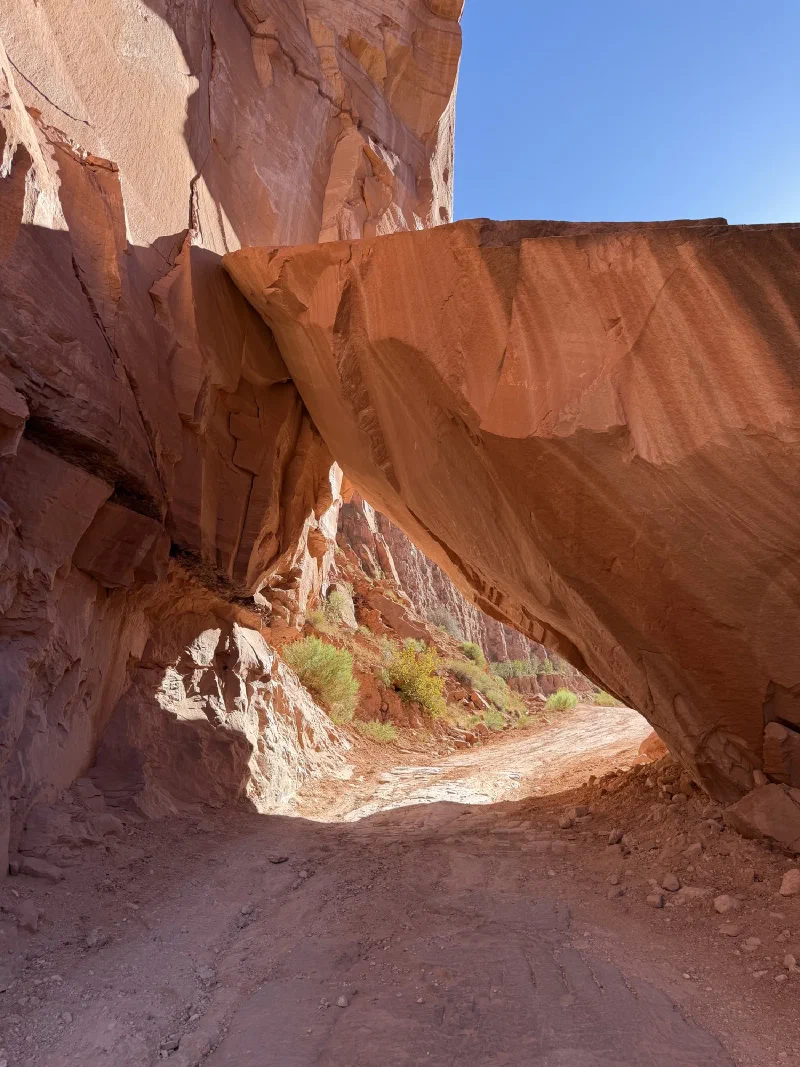
The best bit comes near the top, where an enormous slab has peeled off the wall and landed against the opposite side, and the road just goes underneath it. Nobody built that. It fell that way and somebody decided to drive under it.
The road goes under that. Yes, that one.
We came out at the top right near the entrance to Canyonlands, exactly as promised. Best sandwich-shop advice we’ve ever been given, and I didn’t even have a sandwich.
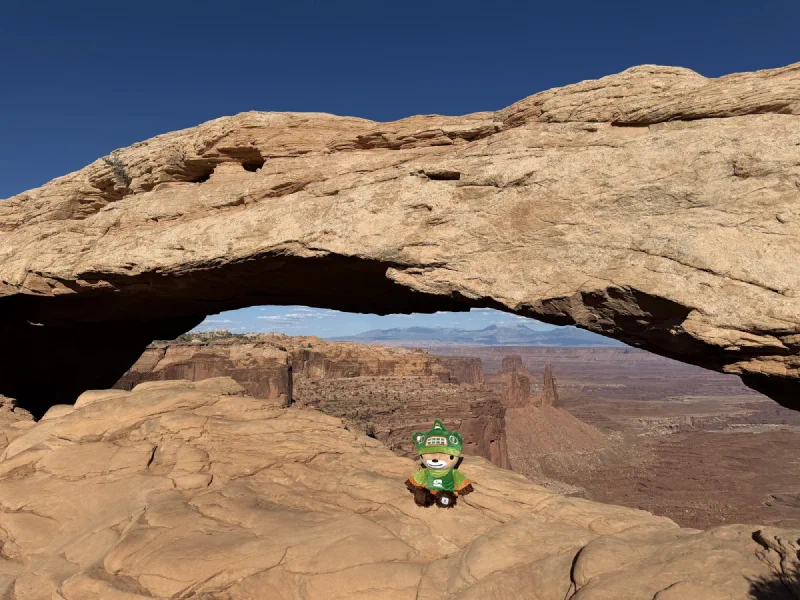
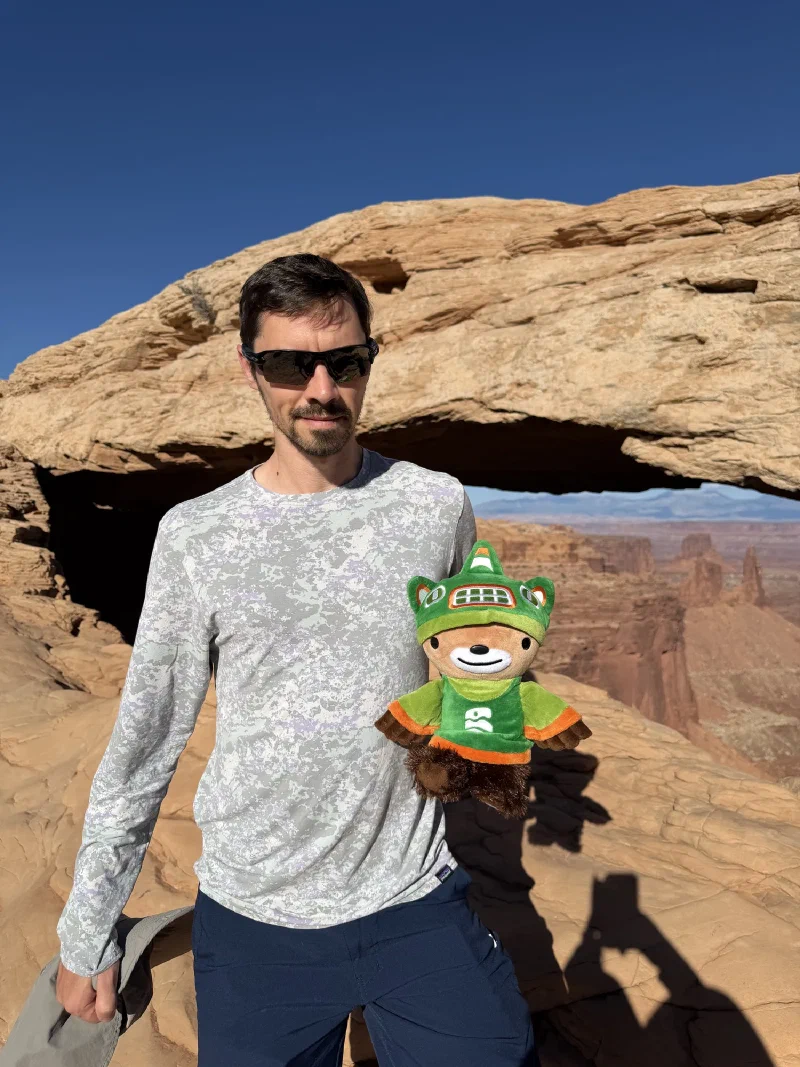
Canyonlands has an arch that sits right on the edge of a 500 foot (150 m) cliff, and the entire point of it is that it frames the whole park behind it. Buttes, canyons, the La Sals on the horizon, all of it lined up in a stone window.
Photographers queue here at sunrise. We showed up in the late afternoon with the place mostly to ourselves, which I consider the superior strategy, because it involved no early morning whatsoever.
The arch is fine. The bear in front of it is the composition.He got in the shot. He does this.
Then we drove to the end of the road, where the mesa stops.
Chestnut, dangling from a strap. Day one and already fully integrated into the luggage.
Grand View Point sits at about 6,080 feet (1,853 m) and it does what the name says with no imagination whatsoever. You walk out to the rim and the ground simply stops, and then there is nothing but canyon for a hundred miles.
I’ll give it this: it earns the name.
It doesn’t photograph properly. Nothing this big does. Your eye keeps looking for something familiar to measure it against and there isn’t one.
Then you walk back to the car. That turned out to be the shape of most of this trip: drive somewhere, walk out to the edge of it, look, walk back.
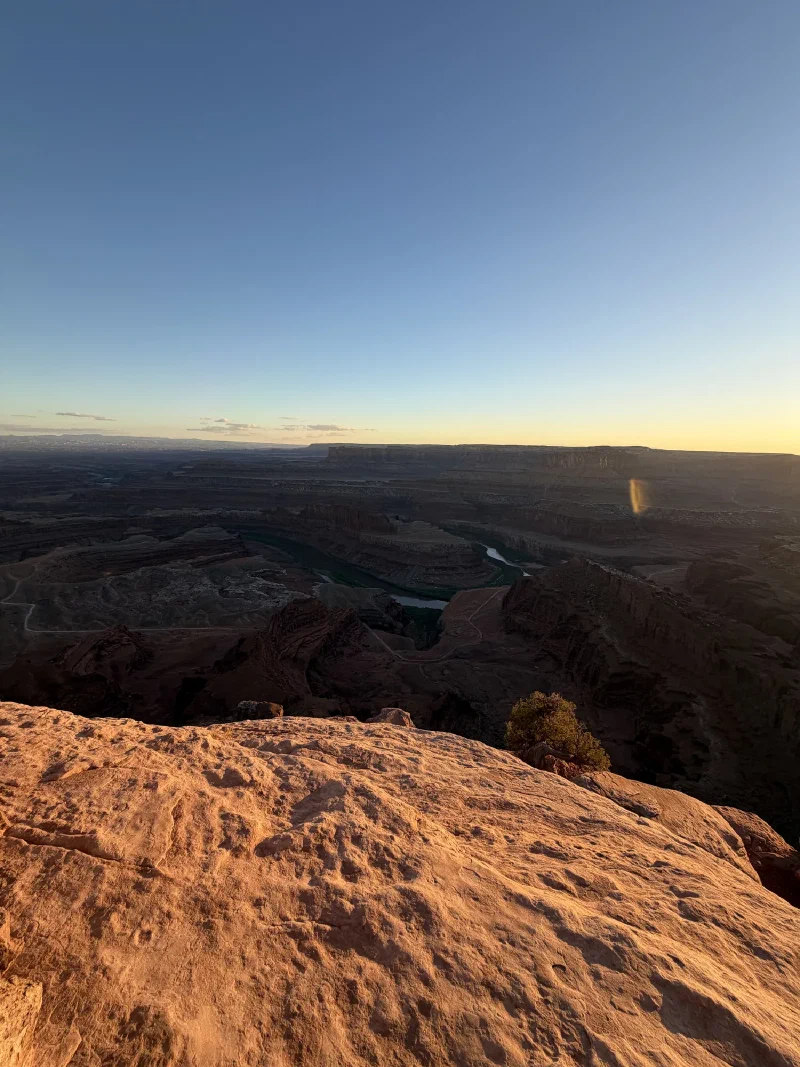
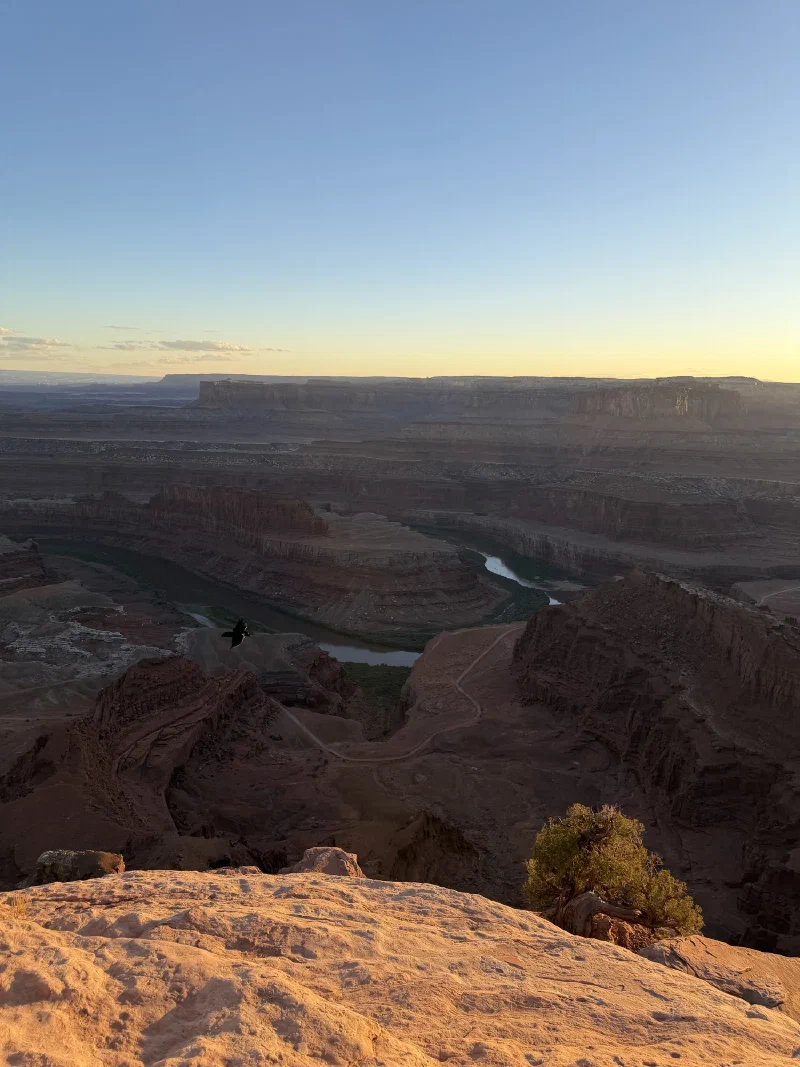
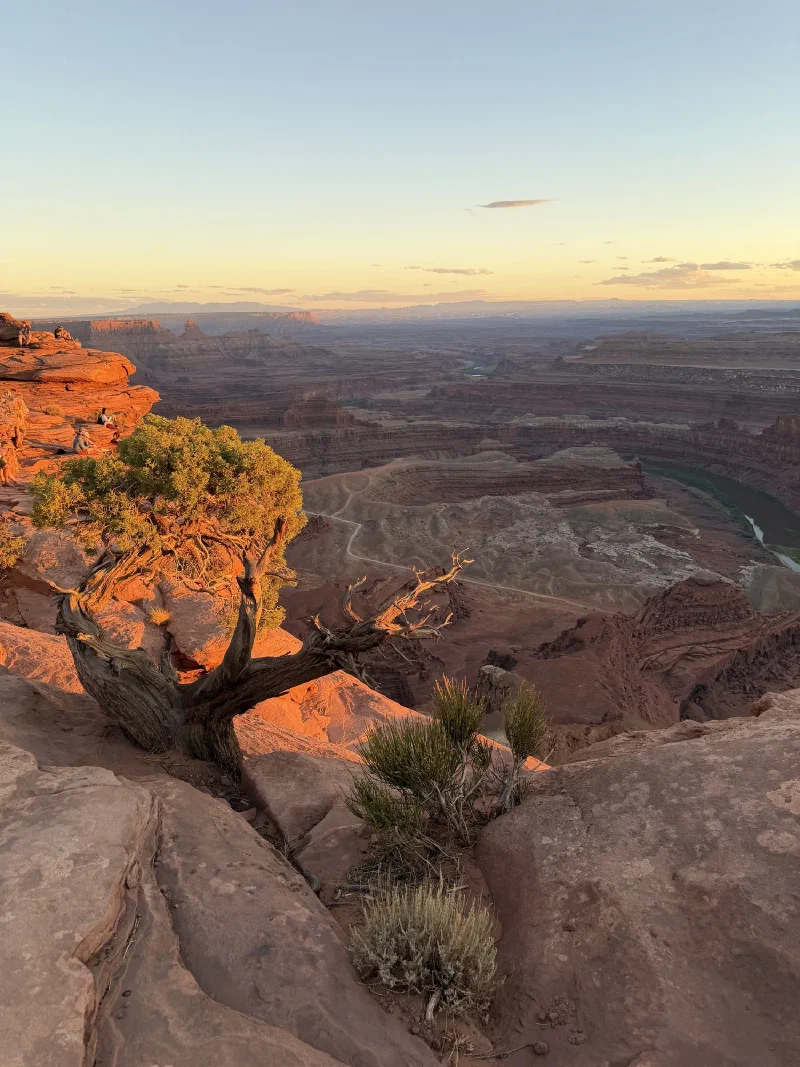
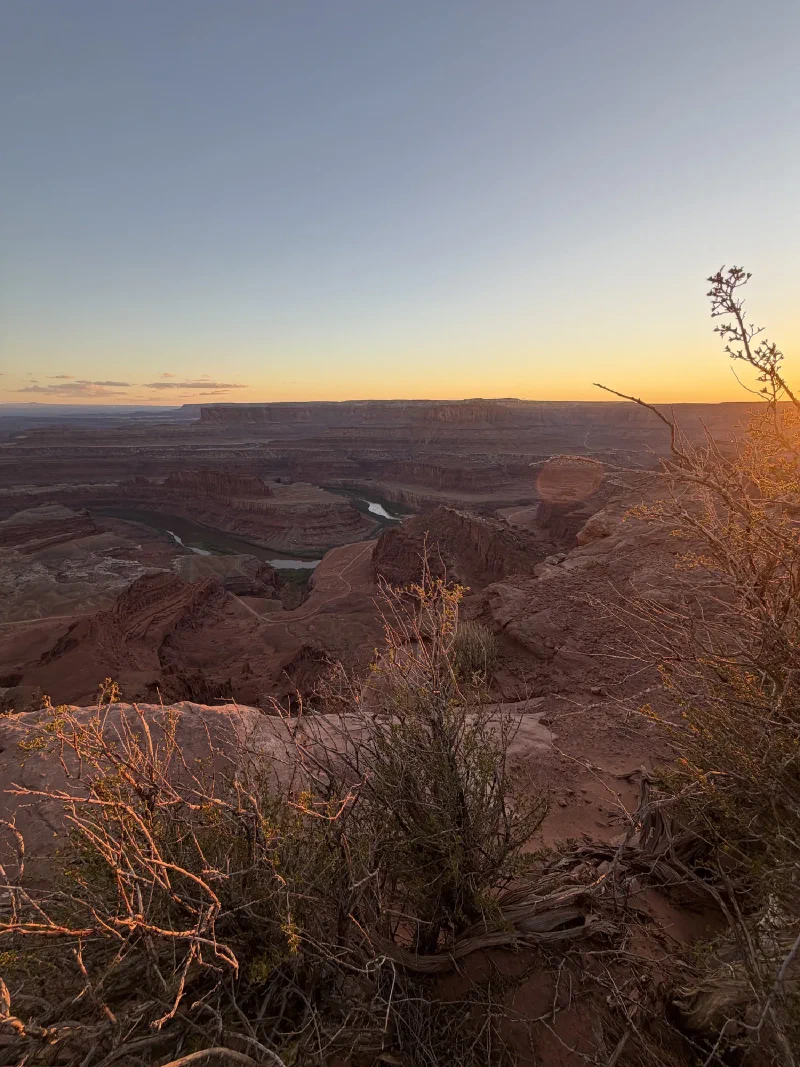
Quick history, because the name deserves an explanation. Dead Horse Point is a mesa connected to the mainland by a neck of rock only about 30 yards wide. In the 1800s cowboys worked out that if you fence off the neck, you’ve got a natural corral, and they used it to hold wild mustangs while they picked out the ones worth keeping. The story goes that one band of horses was left up there behind the fence and died of thirst, in full view of the Colorado River 2,000 feet (600 m) below them.
So that’s a cheerful bit of local colour. It became a Utah state park in 1959, and if the view looks familiar, it’s because it’s the cliff Thelma and Louise drive off at the end of the film. The film says Grand Canyon. The film is lying.
The Colorado, taking the long way round.A raven turned up to be in the photo. Jerks!This juniper has been standing here being photogenic for several centuries and has never once been thanked.
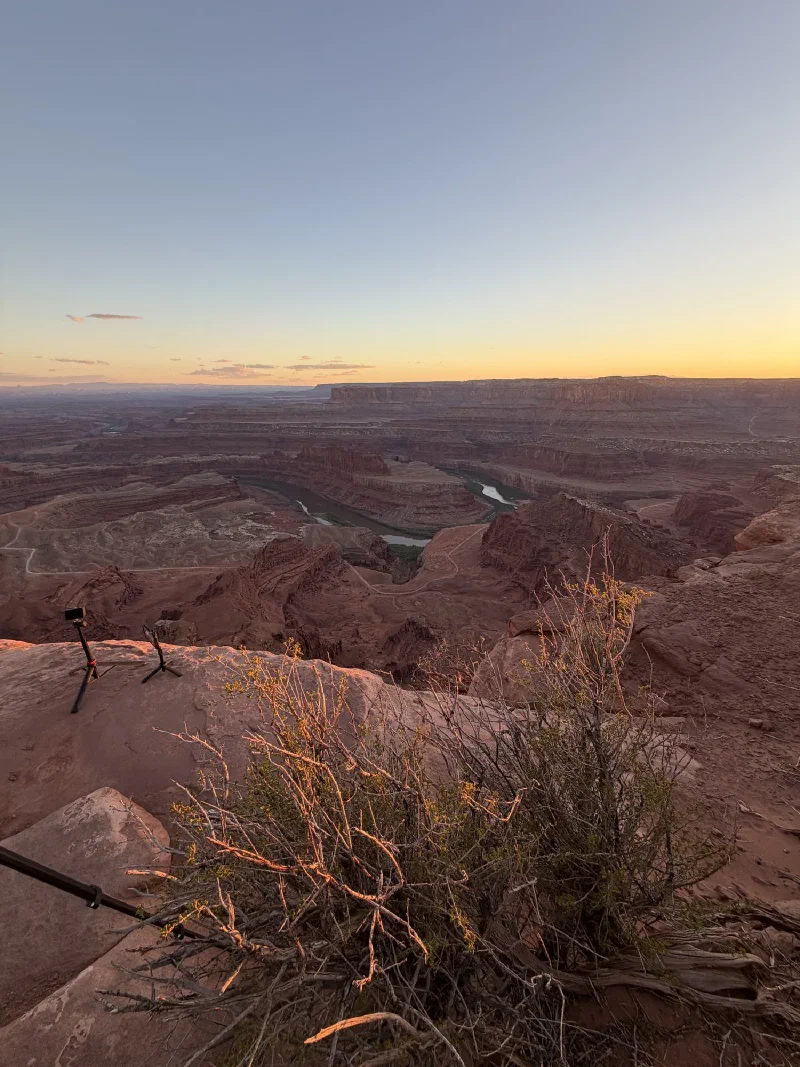
There were other photographers up there, which turned out to be the good kind of crowd. Everybody spread out along the rim, tripods up, all pointed at the same thing.
We ended up hanging out with them for the rest of the night. Nicholas pulled up the timelapses he shot at Everest and that was the end of any further conversation about camera settings. Nothing beats a man showing strangers the Milky Way turning over the Himalaya on a phone screen in the dark. I was there for those, incidentally. Nobody asked about the bear.
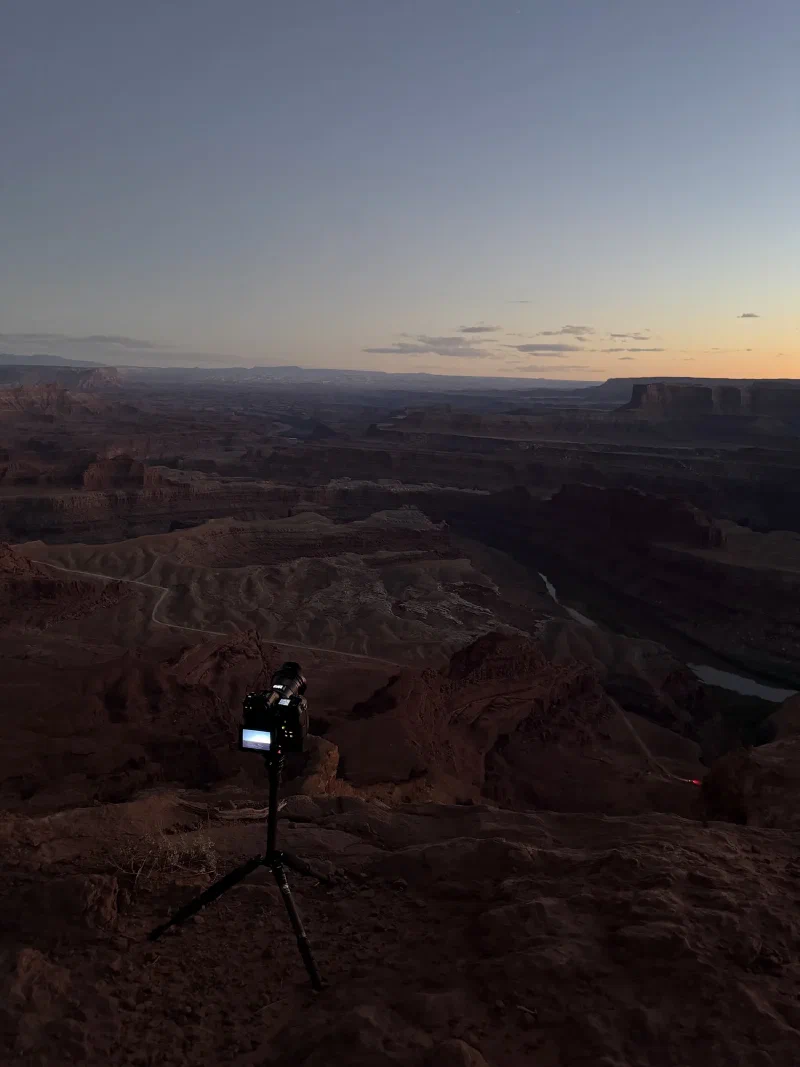
Phones on tripods, running timelapses. Fancy.My spot. Front row, obviously.
Ever since Nicholas got those Milky Way shots at Everest he’s decided this is a thing he does now, and early September in southern Utah is about as good as it gets for it. So the plan for this whole trip is simple: when the sky is clear, we shoot.
The sky was clear.
Chestnut supervising. Chestnut has no opinions about focus stacking but he is extremely supportive.And now we wait. Bears are not good at waiting.
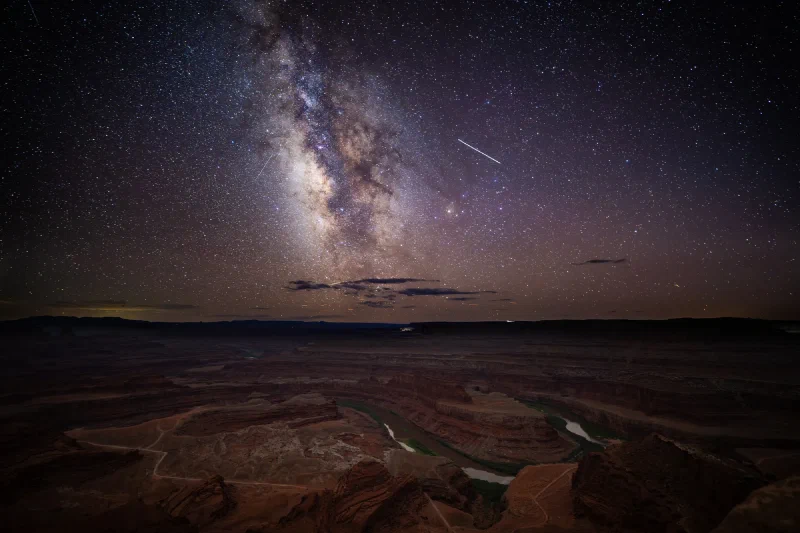
Here’s the composite he put together from that night. Two thousand feet of canyon, the Colorado doing its horseshoe, and the core of the galaxy standing straight up over the top of it.
There’s a bright streak across the middle of the frame. I would love to tell you that’s a meteor. It is almost certainly a Starlink satellite, which as a lifelong SpaceX bear I am contractually required to be delighted about, and which as a photographer’s bear is deeply annoying.
Not bad, bud.
Then we drove back to the hotel and I took my usual spot in bed, because it had been a very long day for a bear who got up at dawn for a four o’clock departure.
One day down. Eight or so to go, and nobody has decided where we’re going yet.
A while back I posted a preview. One frame, color graded on a phone in a freezing lodge, with a promise that the real versions were coming once we got home to actual monitors and actual software.
We’re home. They’re done. Four nights of no sleep at altitude, and here is what survived.
A quick reminder of what went into these, because I am not going to let it go. Four nights, Nicholas climbed out into the cold while the rest of us were sensibly unconscious and let the camera shoot the sky for hours. I supervised from inside a sleeping bag, which is the correct division of labour.
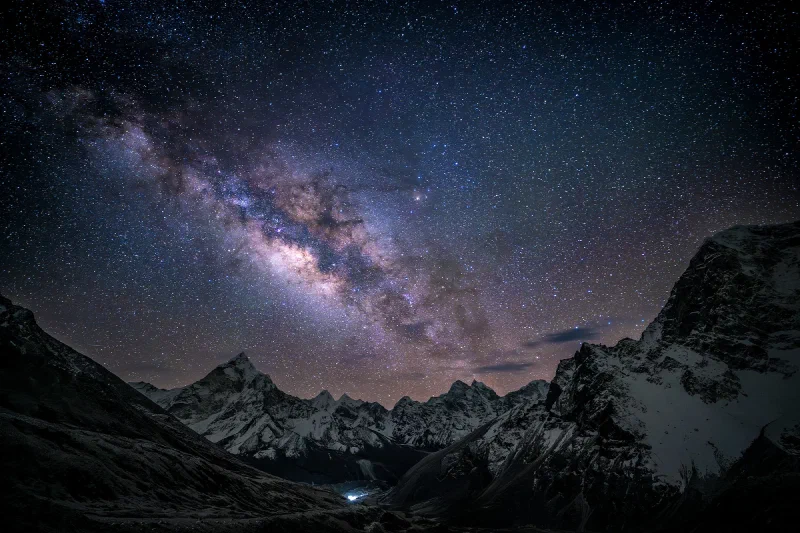
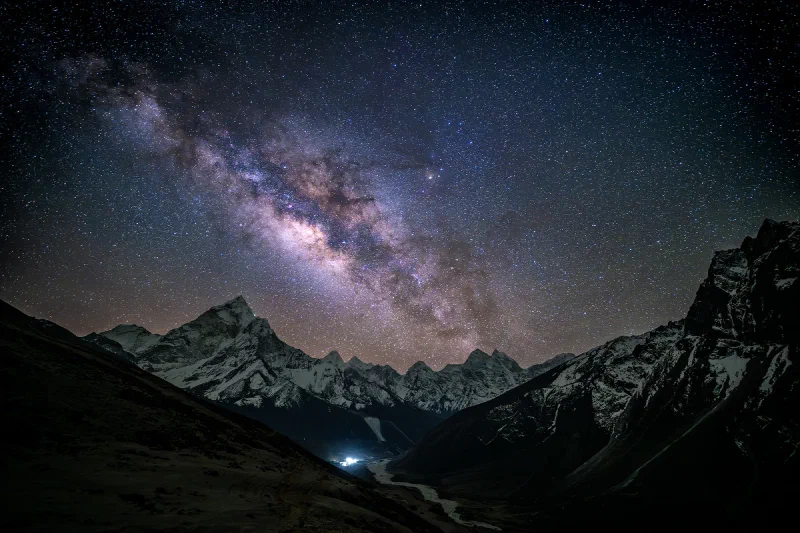
First, the Sherpa Memorial at Chukpi Lhara, near Lobuche. The one from the preview, except now it looks the way it was supposed to look. The Galactic Center over the valley, the snow peaks catching starlight, and a single cluster of lights at the bottom, which is the village of Dingboche being very far away and very small. Full story: Redemption at the Sherpa Memorial.
The Sherpa Memorial, Chukpi Lhara. The lights at the bottom are Dingboche, a long way down. This is the one the phone preview was pretending to be.
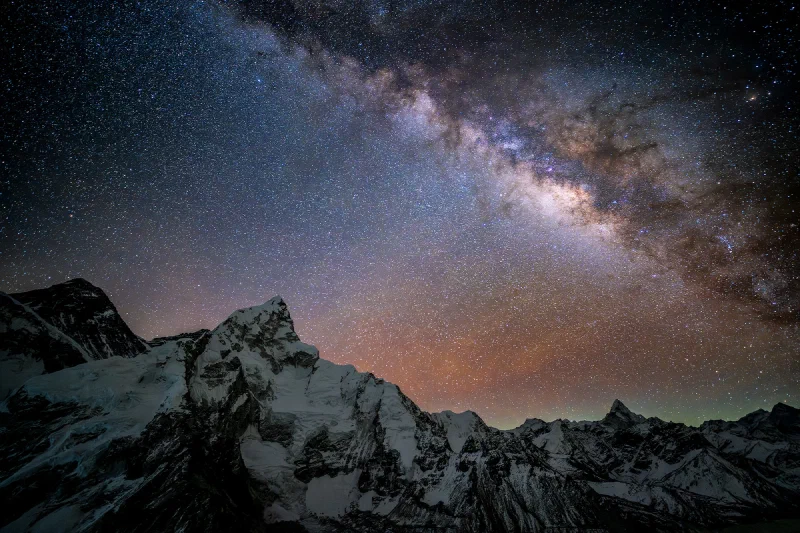
Second, Everest, from Kala Patthar at 1 AM. The highest and coldest of the bunch. No valley, no village lights, just a wall of jagged snow peaks and the most colorful sky of the set, a band of orange airglow on the horizon with a faint touch of green off to the side. The climb behind it: The Kala Patthar Speed Run, at 5,164 meters on three hours of sleep.
Everest, from Kala Patthar at 1 AM. Strongest airglow of the set, that orange band along the horizon. Worth every degree below freezing, apparently.
Third, Thukla, on the way back down. The hill Nicholas crossed an unfinished bridge to reach, because the sensible route did not exist yet and that was apparently not reason enough to pick a different hill. The path winds down toward more village lights, the core parked right over the central peak. The saga: Sleeping on the Mountain.
Thukla. The winding path leads your eye straight down to the lights, and the core parks itself right over the peak. He earned this one with a gorge crossing.
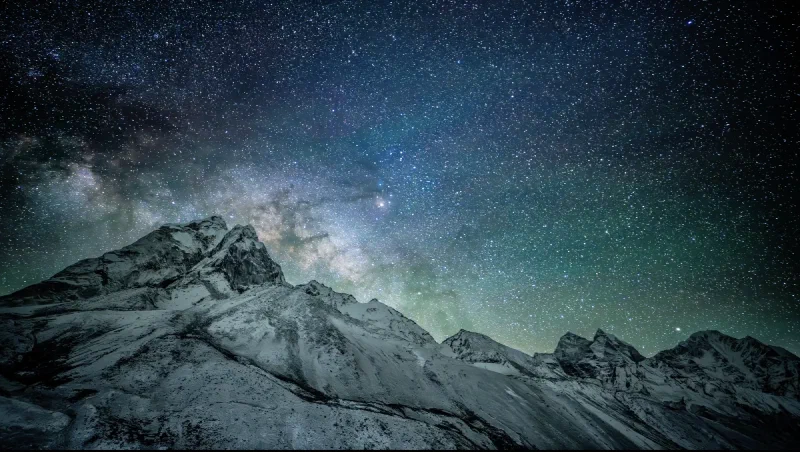
And then there is the one that got away. The first frame from the night framed on Ama Dablam, with a new moon and the Milky Way set to rise right behind the peak. You can see it starting. The dust band curling out from behind the mountain, green airglow along the ridge, and the Galactic Center still tucked behind that big peak on the left, about to climb into the open.
The first frame, with the core right there behind the peak, seconds from rising into the open. This is as good as this shoot got.
It never made it. A frozen lens quietly dropped its aperture a few frames in, and everything after this went pure black. Five hundred photographs of nothing, and one early frame that survived to show what it would have been. The full, gutting story is in The Astrosaster.
The stills are only half of it. The real point of standing in the cold for hours was the motion, the stars actually wheeling over the Himalayas, which does not fit in a photo. So Nicholas cut it into a short film.
Four nights of suffering, three keepers, and one bear who stayed warm the entire time and regrets nothing.