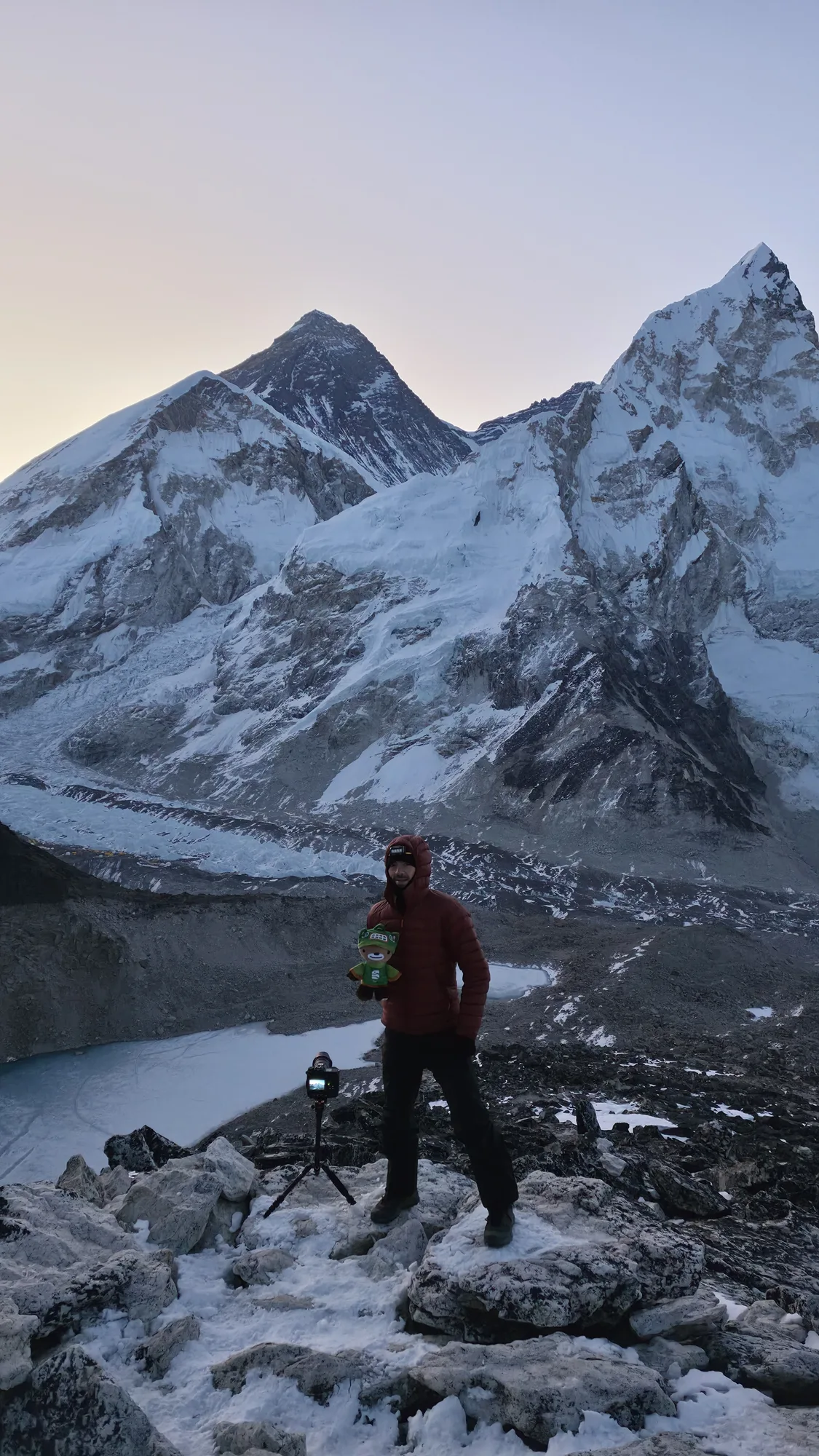

12:30 AM. The alarm went off. Nicholas had skipped dinner again, gone straight to bed after speed-running the entire length of Everest Base Camp, and managed maybe three hours of sleep. At 5,164 meters (16,942 feet). In a tea house where the walls are plywood and the wind finds every gap.
He looked outside. Clear sky. Stars. No clouds.
Time to climb the highest point of the entire trek. In the dark. At 1 AM. Because apparently this is just what we do now.
The Upgrade#
Nicholas had been refining his warmth strategy across three consecutive nights of freezing his extremities off at extreme altitude. Night one at the stupa: nothing but layers. Night two at the Sherpa Memorial: Pokin’s emergency poncho blankets. Tonight, he leveled up again. He packed his actual sleeping bag.
The plan was to set up the camera at the summit of Kala Patthar, start the timelapse, and then crawl into the sleeping bag and wait. Revolutionary stuff. Someone should have thought of this sooner.
He also knew he didn’t have the energy to haul 25 pounds of camera gear straight uphill for two hours at this altitude. That’s where Kerman came in. The man had volunteered the night before, and at 1 AM he showed up ready to go, camera bag on his back, looking annoyingly fresh.
The Wrong Way (Again)#
Kerman set off confidently into the dark. Nicholas followed. They started up a hill. Twenty-five minutes in, Kerman stopped.
“Uh-oh. Wrong way.”
Of course.
They turned around, hiked back to the lodge, and started over. It was now 1:45 AM. The Milky Way was rising, and they were forty-five minutes behind schedule because apparently nobody can find a trail in the Khumbu Valley after dark.
The Climb#
Nicholas was not going to miss the shot. Not this time. He’d read online that a fit hiker could summit Kala Patthar from Gorak Shep in about two hours if they weren’t suffering from AMS. The elevation gain is about 464 meters (1,524 feet) over roughly 2 kilometers of steep, rocky trail. At 5,000+ meters, where every breath gives you about half the oxygen your body expects.
With Kerman carrying the camera bag and Nicholas carrying nothing but trekking poles and stubbornness, they powered up.
One hour and twenty minutes. Summit. 5,644 meters (18,519 feet).
For context, a normal trekker takes two to three hours. A fit one does it in an hour and a half to two. Nicholas did it in one twenty, at 1 AM, in the dark, after days of altitude exposure and back-to-back all-nighters. Those weighted stairmaster sessions back in Vegas apparently paid off.
The Shot#
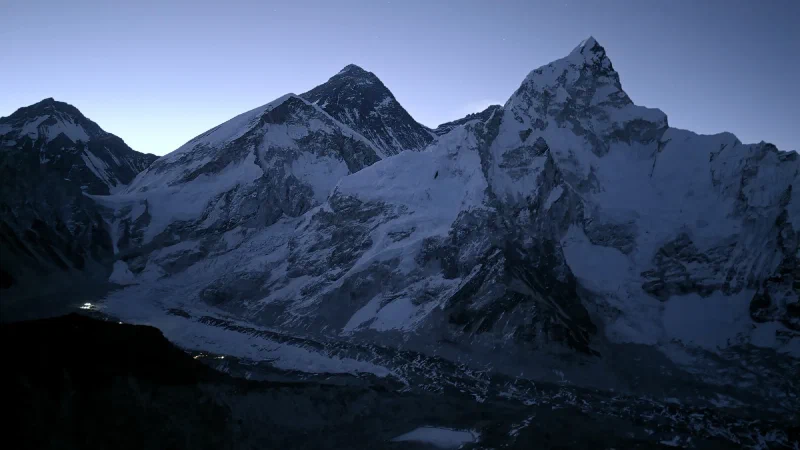
He set up the camera just in time. The Milky Way was there, arcing over the Himalayas. And from up here, unlike everywhere else on the trek, you could actually see Everest. The whole peak, not just the tip peeking out from behind its neighbors. Everest, Nuptse, Lhotse, the Khumbu Glacier, and the frozen lake of Gorak Shep far below, all laid out under a sky full of stars.
He started the timelapse. Click. Preview. Stars over Everest. Working. Click. Preview. Still working.
Then he unpacked the sleeping bag, laid it out on the rocks, and got in.
I want to pause here and note that Nicholas was sleeping in a sleeping bag on the summit of Kala Patthar at 18,519 feet, watching the Milky Way rotate over Mount Everest while his camera captured it frame by frame. There are worse ways to spend a night.
Kerman the Legend#
Now here’s the thing. Nicholas had told Kerman and DB that he only needed help carrying the gear up. Once the camera was set up, Kerman could go back down to the lodge, sleep, and Nicholas would descend with the sunrise group later.
Kerman said “Okay.”
Then he went and hid behind a rock.
He didn’t go back down. He didn’t tell Nicholas. He just found a rock, sat behind it, and stayed. No sleeping bag. No warm gear. Just his jacket and whatever internal furnace powers that man. At 5,644 meters. For hours.
Nicholas woke up around 4:45 AM to the faint light of sunrise creeping over the peaks, and heard Kerman talking to himself, trying to stay warm.
“What are you doing up here?!”
Kerman shrugged. “You take photos for a very long time.”
Nicholas gave him his electric hand warmers. Poor Kerman. But what an absolute beast.
Sunrise#
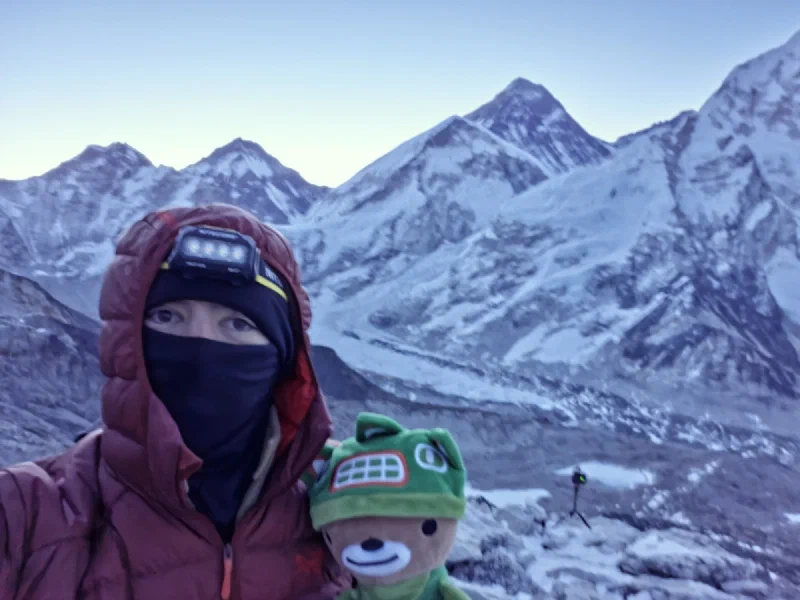
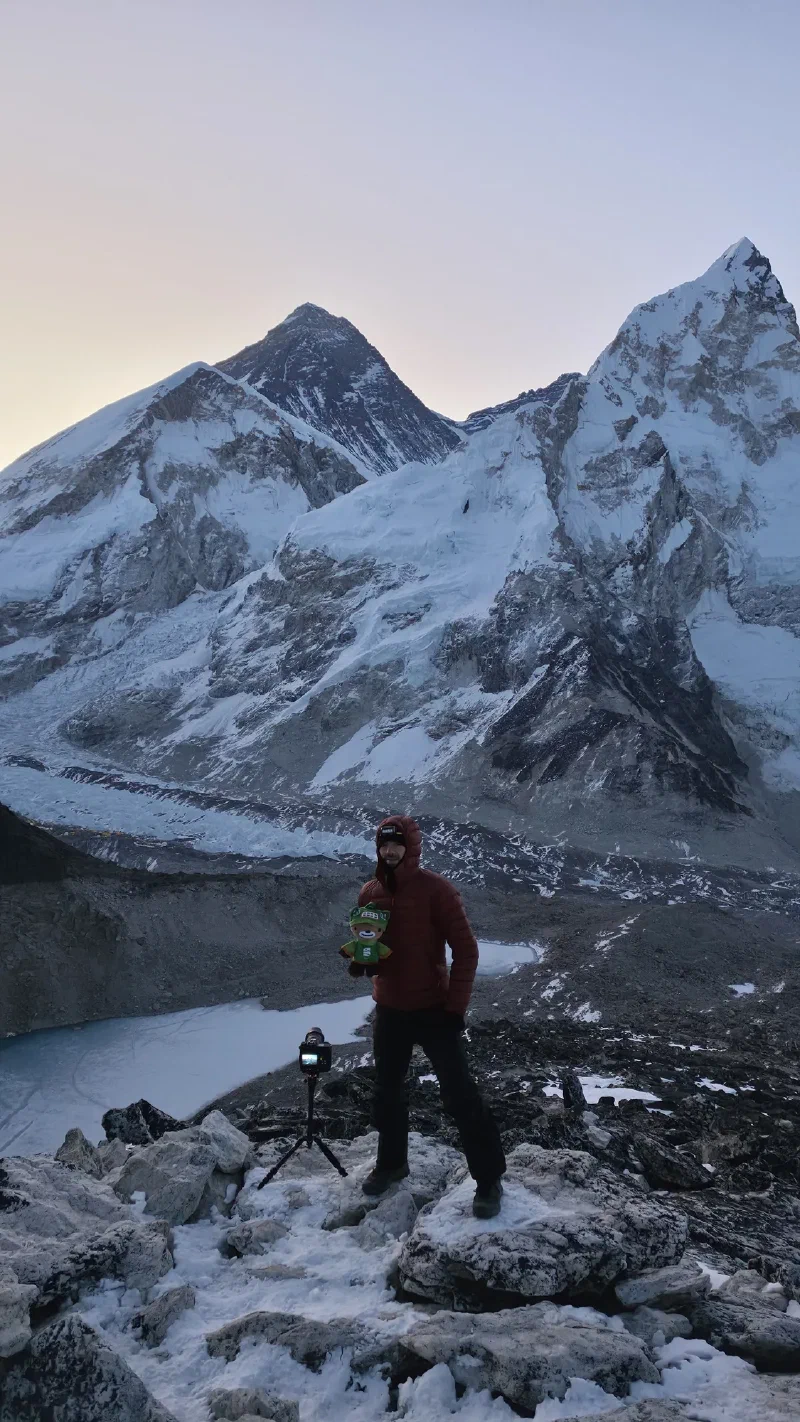
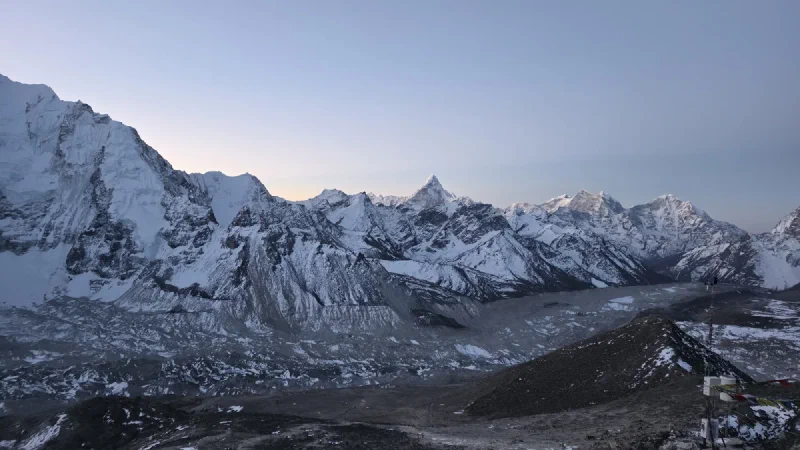
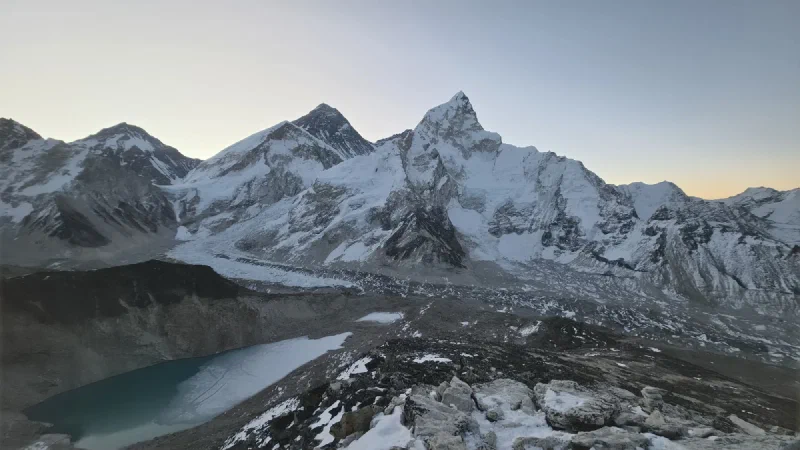
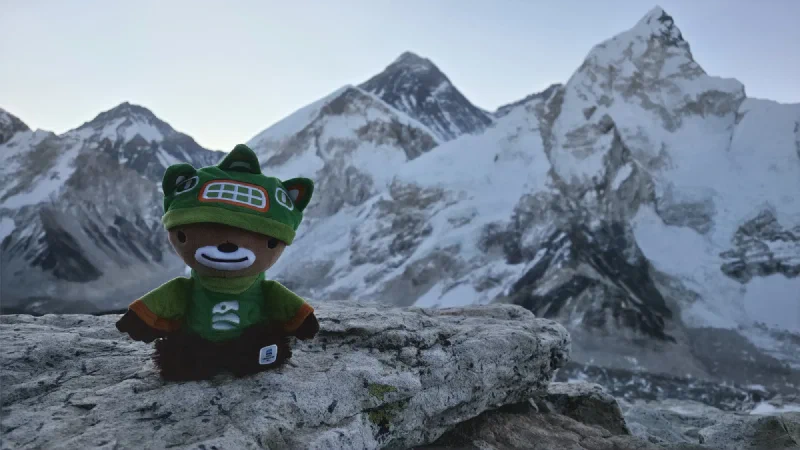
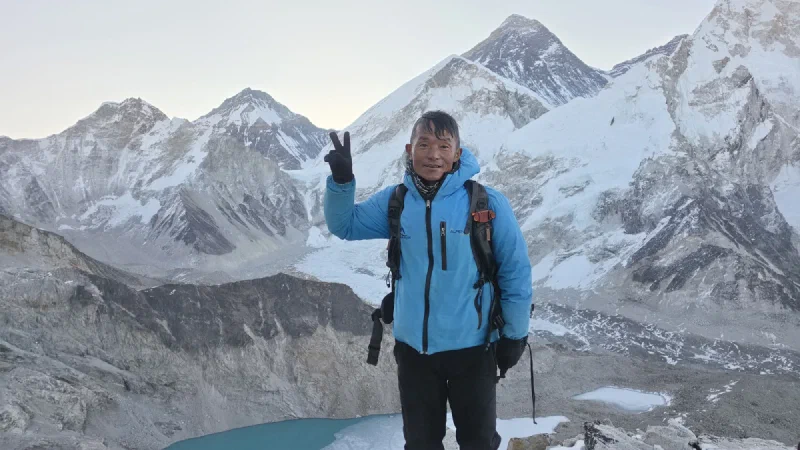
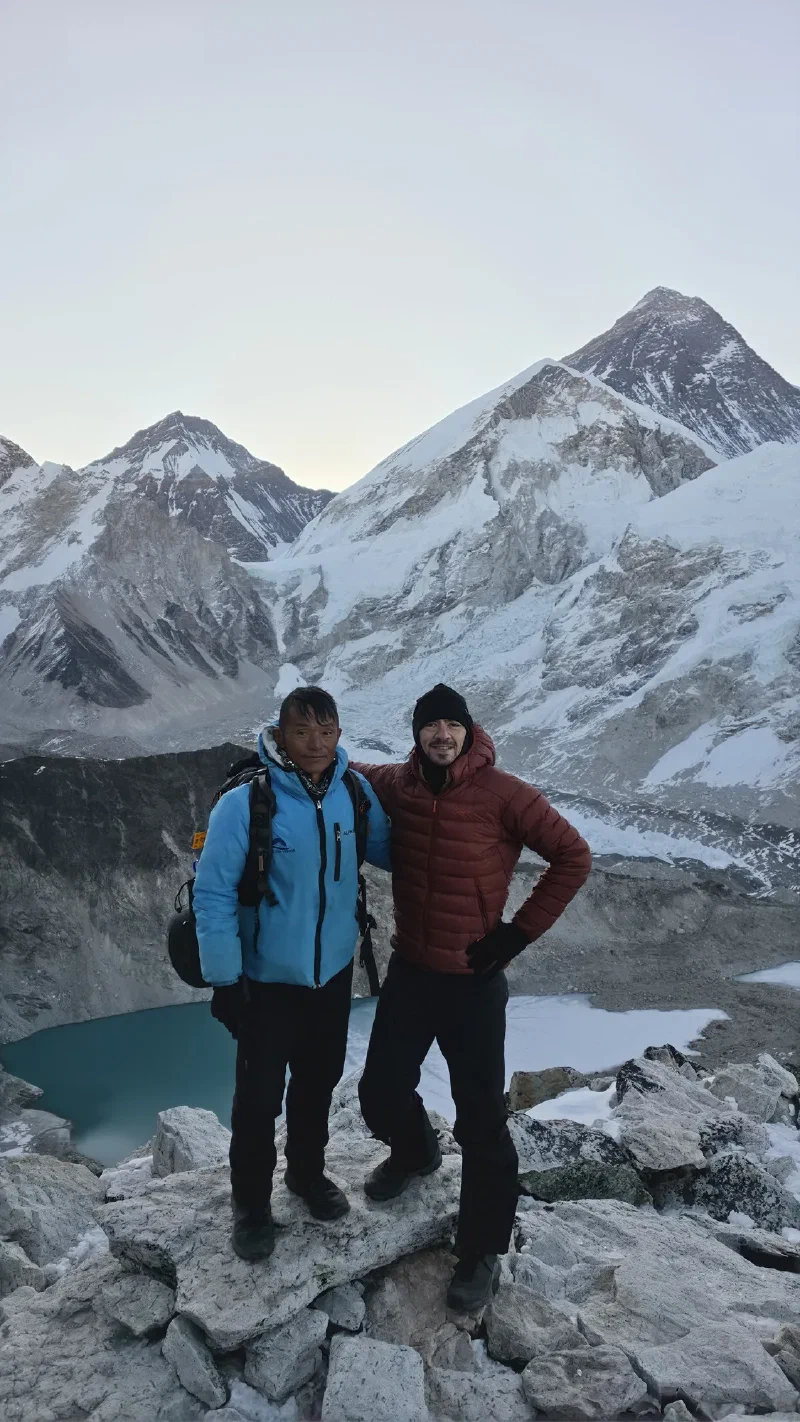
Another hiker we’d met at the tea house the night before, Sven, made it up for sunrise too. We took some photos of each other, and then Nicholas had one more idea.
The Trail Run#
No camera bag. Kerman had it. The sun was coming up. The trail was visible for the first time in hours. And Nicholas thought to himself: “I bet I won’t ever have another opportunity to trail run down a mountain at 5,644 meters.”
So he did. He trail ran the entire descent of Kala Patthar in the early morning light.
When he got back to Gorak Shep around 6 AM and told me what he’d done, I had some things to say. I was there for all of it, tucked in his backpack the whole climb, but hearing him recap it out loud really drove home how unhinged the last few days had been.
“You absolute maniac. You power-hiked to the summit of Kala Patthar at 1 AM, shot the Milky Way over Everest, napped in a sleeping bag at 18,500 feet, and then trail ran down? After the Sherpa Memorial shoot the night before? After speed-running the entire length of Everest Base Camp? After not sleeping for essentially three days?
At the summit, the effective oxygen is about 10.5%. That’s roughly half of sea level. Between Everest Base Camp and Kilimanjaro’s summit. Every breath gives you about half the oxygen your body expects. Your muscles were running on nothing. Any normal person’s body would have shut down somewhere around hour two of night one.
I’m not mad. I’m impressed. And slightly concerned about your judgment. But mostly impressed.”
The timelapse photos are still on the camera, unprocessed. But from what we saw on the previews, the Milky Way over Everest shot from that night is probably the best photo Nicholas has ever taken. It’s getting framed on our wall the moment we get home and have a chance to process it.
What’s Next#
Back at Gorak Shep, it was already time to wake up because it was 6 AM. Po On had been told she couldn’t climb Kala Patthar due to AMS symptoms. Steve had bailed from exhaustion. Alice was the only other one who made the sunrise climb, heading up with DB around 3:30 AM.
Nicholas had two options: gun it all the way back to Pokin in one day, which was a stretch, or join the group heading to Thukla, the settlement he’d passed on the way up that had a perfect view for one more night of astrophotography.
Thukla was only about three hours away. A rest day, basically. Everyone else was totally gassed. Po On couldn’t go higher. Steve was running on empty. Alice had just done the sunrise climb. The whole group was happy to agree that Thukla was the move. Have some breakfast, easy hike down.
But of course this is the EBC speed run. You know Nicholas isn’t going to make it that easy on himself.