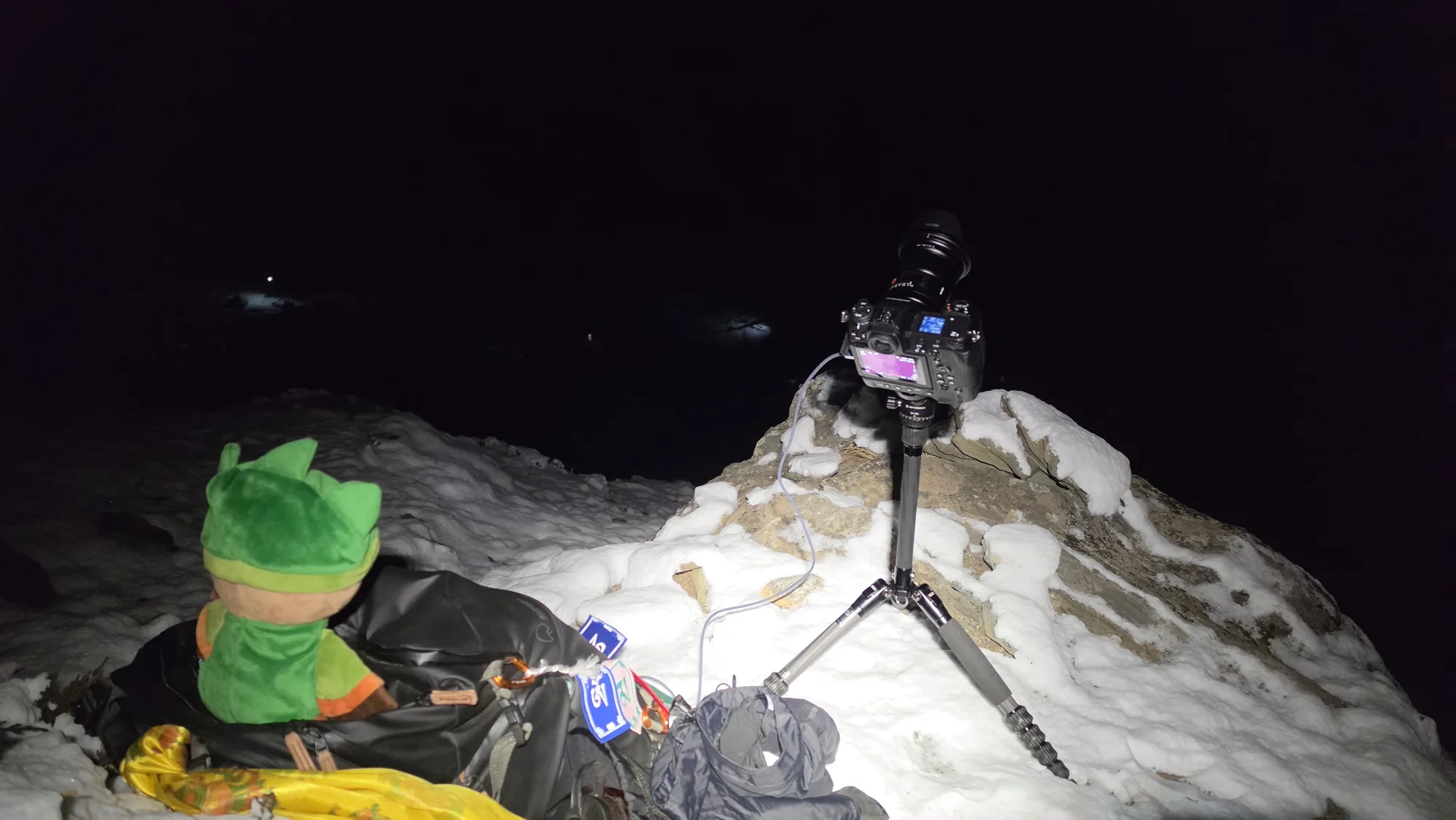

Nicholas had been planning this shot for months. Long before we left Vegas, before the trek even started, he’d mapped out a narrow window where everything would align: a new moon (so no moonlight washing out the sky), clear weather at extreme altitude (rare), and the Milky Way rising behind the Himalayan peaks at just the right angle to fill the frame. That alignment only happens for a few nights each year from this location. We were here for it.
The trip was falling apart around us. Pokin’s lungs were getting worse. The group had split up. Nicholas hadn’t decided yet whether he was going with Pokin to lower altitude or pushing on alone. But this shot was the one thing that could still go right.
We’d already been up to the stupa the previous night, when fog killed the shot after a single frame. But that attempt wasn’t wasted. We knew exactly where to go, exactly where to set up, exactly how to frame it. Tonight would be faster.
It had snowed during the afternoon, which sounds bad but is actually good. Snowfall pulls moisture out of the atmosphere, and once the system passes, what’s left is dry, stable air. The kind that lets starlight through clean.
Around midnight, Nicholas set his alarm and looked out the window.
Clear sky. Stars everywhere.
The Climb#
We packed the camera gear, bundled up in every layer we had, and hiked up to the stupa in the dark. Twenty minutes through two inches of fresh snow. Probably around -12°C (10°F) before wind chill, closer to -20°C (-4°F) with it. At 4,410 meters (14,469 feet), the air is already thin enough to make you dizzy. Add subzero temperatures and high-altitude gusts and you’ve got yourself a party.
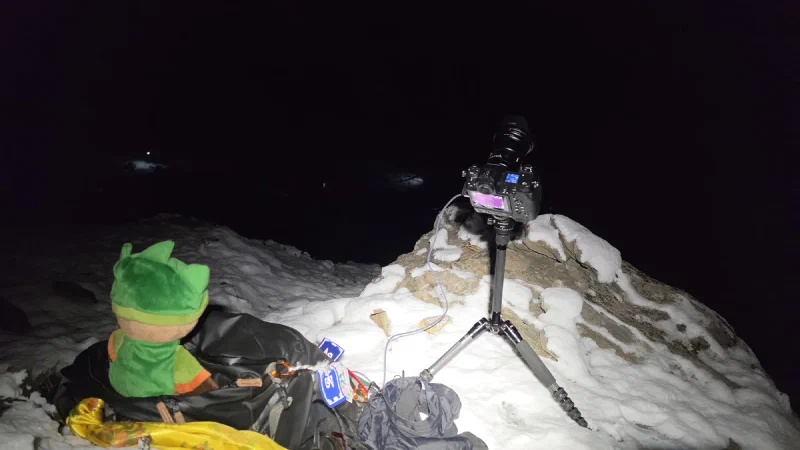
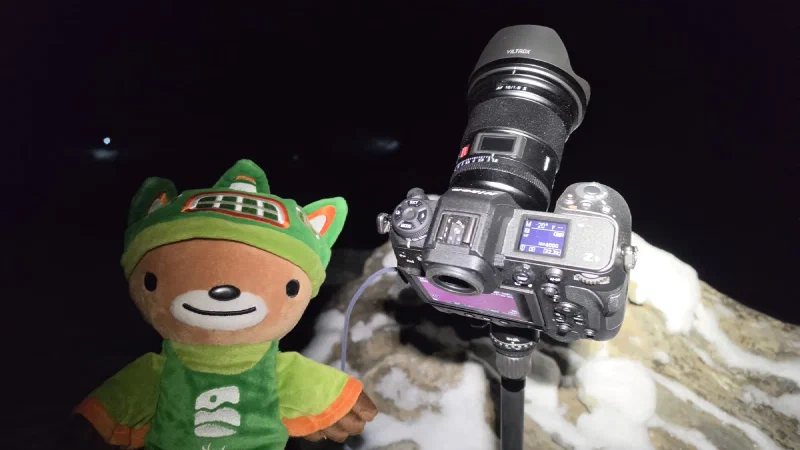
Nicholas set up the camera on the tripod, framed the composition exactly how he wanted it: stupa in the foreground, Ama Dablam rising behind, Milky Way cutting diagonally across the sky. He took a test shot. Beautiful. Sharp stars, clean foreground, perfect exposure. He ran a test timelapse for a few frames to make sure the interval was working. Checked them. Everything looked great.
He set it to 500 frames. About four hours of shooting. Clicked go.
The Wait#
For the next four hours, Nicholas and I paced circles around the stupa, hiding behind it when the wind got bad. He did squats. Push-ups. Jumping jacks. Marched in circles. Anything to keep blood flowing. He had thermal long johns, hiking pants, an Arcteryx shell, three shirt layers, a fleece, a down jacket, an outer shell, leather glove liners, down mittens, and hand warmers. Still freezing.
I sat on the backpack and provided moral support, which is arguably the most important job.
The Milky Way was right there. He could see it with his own eyes, a faint misty band cutting across the sky above the mountains. It was rising up behind Ama Dablam exactly as planned, rotating slowly through the frame over the course of the night. Every time he glanced at the camera, it was clicking away. Click. Twenty seconds of silence. Click. Over and over.
This was the shot. The once-in-a-lifetime alignment he’d planned for. Clear skies, no moon, the galaxy arcing over the Himalayas. He was watching it happen in real time.
Around 4:30 AM, the camera stopped. 500 frames captured. Four and a half hours in the cold. Nicholas walked over with frozen fingers and pressed playback.
Frame 1. Black.
Frame 2. Black.
He scrolled. Frame 50. Black. Frame 100. Black. Frame 250. Black. Frame 500. Black.

All of them. Every single one. Five hundred photographs of absolute nothing.
What Happened#
The lens has an electronic connection to the camera body. In extreme cold, that connection can drop. When it does, the lens forgets its settings and defaults to a tiny opening that lets in almost no light. The test shots were fine because the connection was still holding. Somewhere in the first few frames of the real timelapse, it failed. Every frame after that was so underexposed that they’re pure black. Not dark. Not fixable. Black.
The worst part: the camera screen goes dark during timelapse shooting. That’s normal. Nicholas was watching the camera the entire time, but there was nothing on the screen to tell him something was wrong. It was supposed to look like that. He had no way of knowing unless he pressed a specific button to preview a frame mid-shoot.
He didn’t know that button existed.
One press would have caught the failure on frame one. He could have fixed it and still had three and a half hours of shooting left. But he didn’t know. So he stood in the cold for four hours, watching the most beautiful sky of his life, while the camera recorded nothing.
After#
Nicholas didn’t say much on the walk back down. I didn’t either.
He got back to the lodge at 5:30 AM. Wake-up call was at 6:00 AM. Zero sleep. Zero usable frames. And now, on no sleep and completely gutted, he had to face everything else: Pokin probably couldn’t make it to Everest Base Camp. His own trip was likely getting cut short. He had to choose between going down with Pokin or sending her alone with a porter who didn’t speak English. The new moon window had maybe three more nights before moonlight would ruin the sky, and he’d probably just blown his only real chance at the shot he’d been planning for months.
He watched the Milky Way rise over the Himalayas with his own eyes. It was perfect. And the camera got none of it.