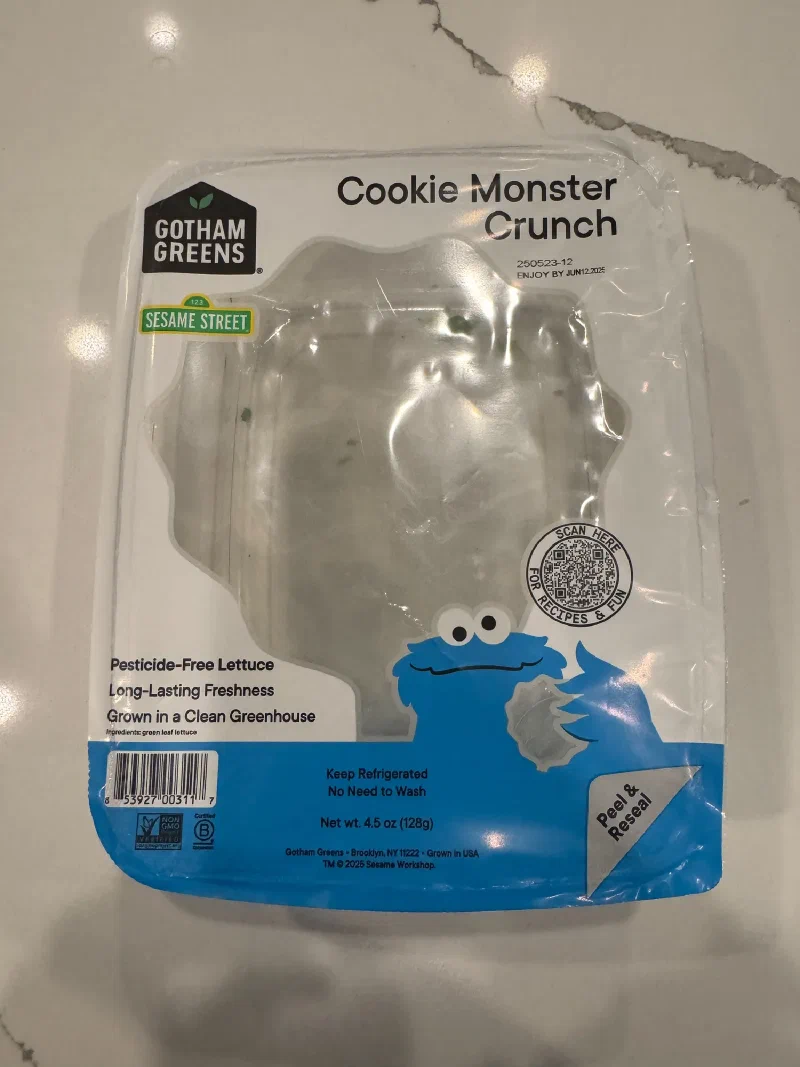
Sesame Street did a collaboration with Gotham Greens. They put Sesame Street characters on salad packaging. Salad. The healthy thing. Leaves. You know.
Pokin thought it was cute and picked up the Cookie Monster one. Good choice. Responsible. A woman training for Everest Base Camp, buying lettuce. Her friends would be proud.
The lettuce lived in the fridge for about a week.
And for about a week, every time she opened the fridge, Cookie Monster stared back at her. Cookie Monster. On lettuce. The irony of putting the cookie guy on salad is not lost on me, a bear who understands that dessert is the superior meal category.
After seven days of psychological warfare from a plastic container, Pokin cracked.
She did not buy more salad.
Dinner.
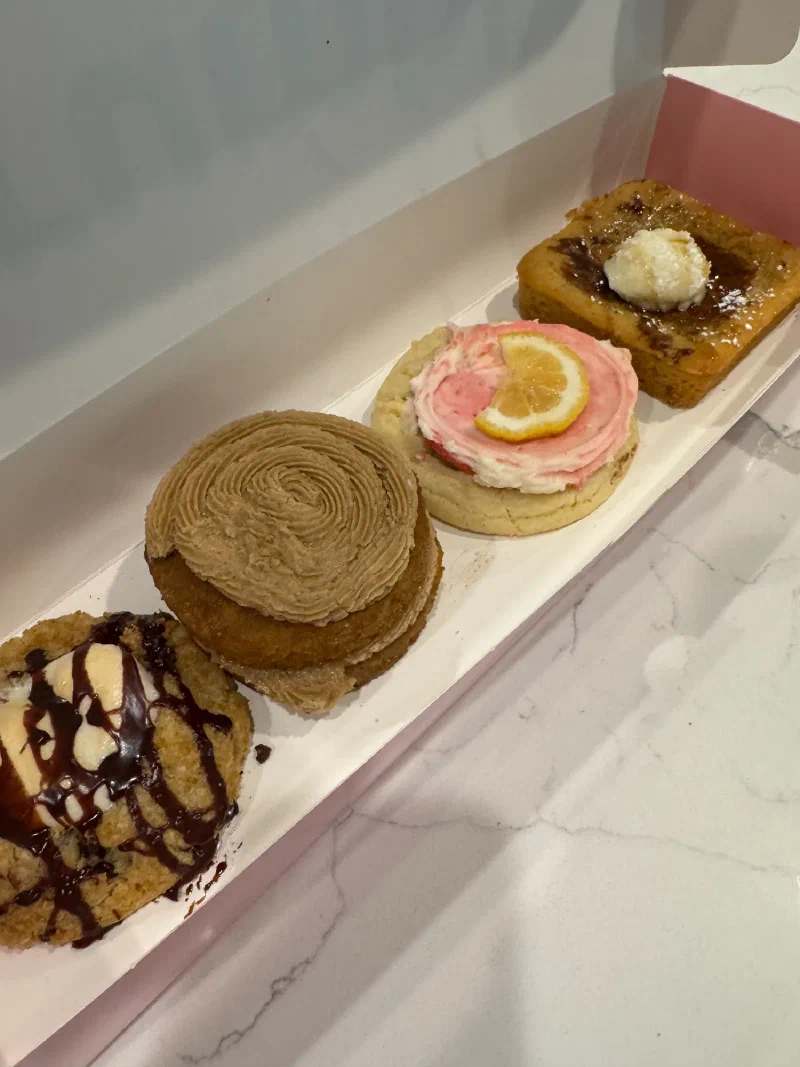
Four full-sized Crumbl cookies. Not small ones. Not the minis. The big ones.
She ate them for dinner.
That was dinner. The whole dinner. Four cookies from a pink box on the kitchen counter where the salad used to be. Cookie Monster won.
Her friend Davey called it rock bottom. Chestnut called it “concerning.” I call it the most relatable thing Pokin has done all year.
The salad, for what it’s worth, did eventually get eaten. But not that night. That night belonged to the cookies.
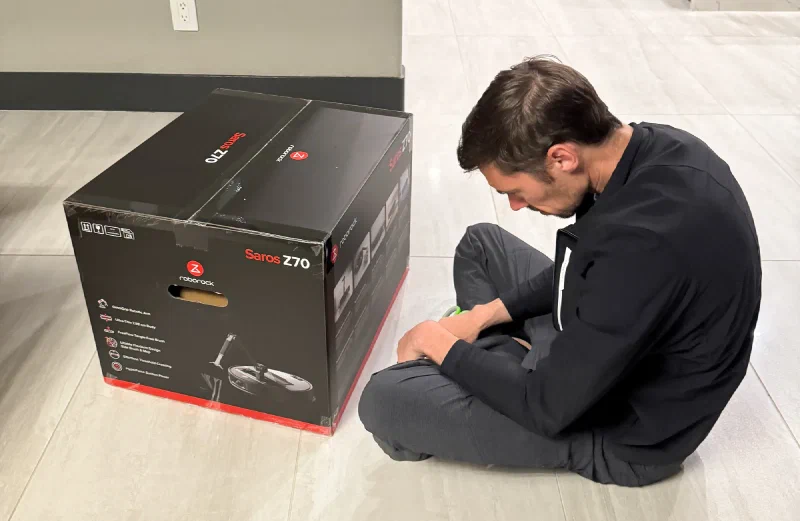
The Roborock Saros Z70. A robot vacuum with a retractable arm. An actual mechanical arm that reaches out, grabs objects off the floor, and moves them. Pokin saw this at CES and had to have one.
Nicholas was less thrilled. “This thing is stupid,” he said, which is what he says about every gadget right before it permanently lives in the house.
The arm picks up socks, shoes, small objects. Anything under 300 grams. It relocates them out of its cleaning path with the confidence of something that has never once questioned whether it should be doing this.
It nearly touches the ceiling. It weighs 600 pounds. It’s never leaving.
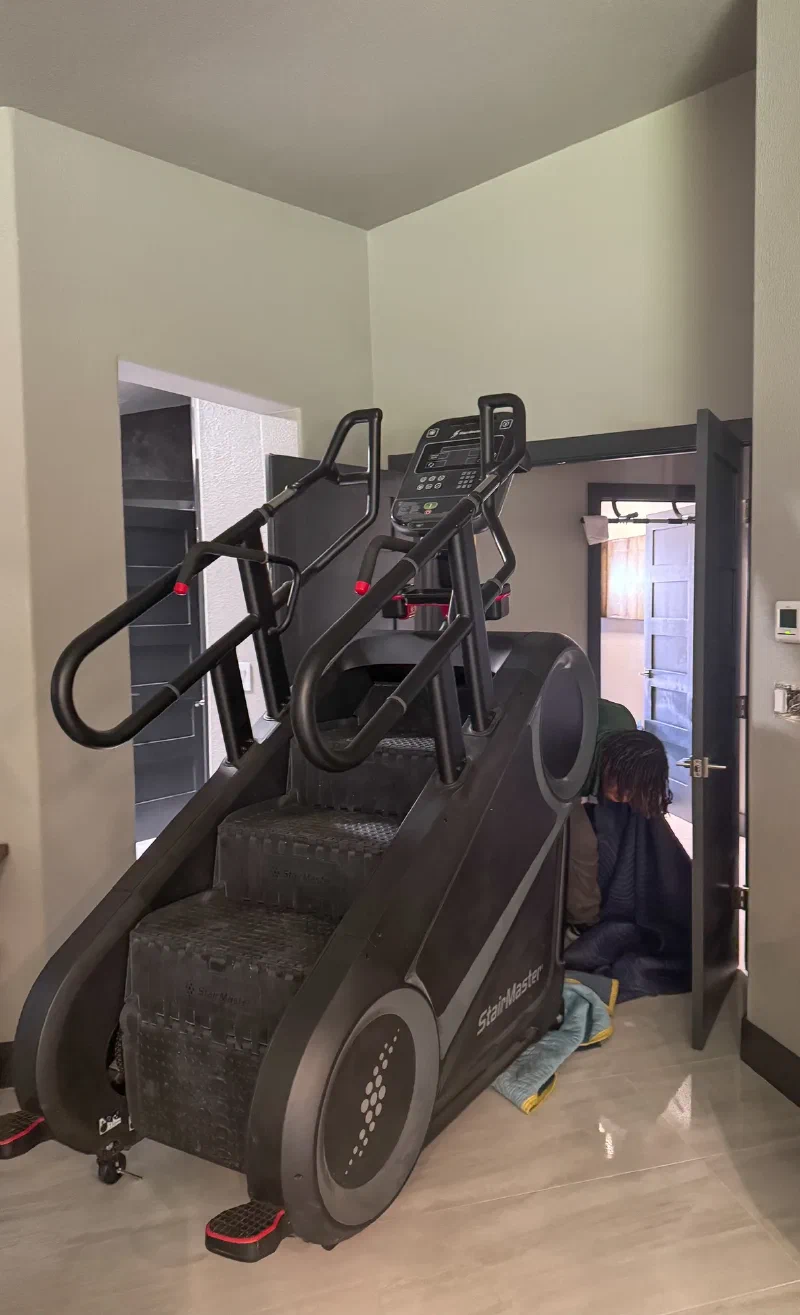
The same week, a StairMaster arrived. A full commercial-grade stair climber. For EBC training.
The logistics were a nightmare. Multiple movers turned down the job. Someone finally agreed, and they wrestled it into the bedroom. It barely fits. It nearly touches the ceiling. It weighs roughly 600 pounds.
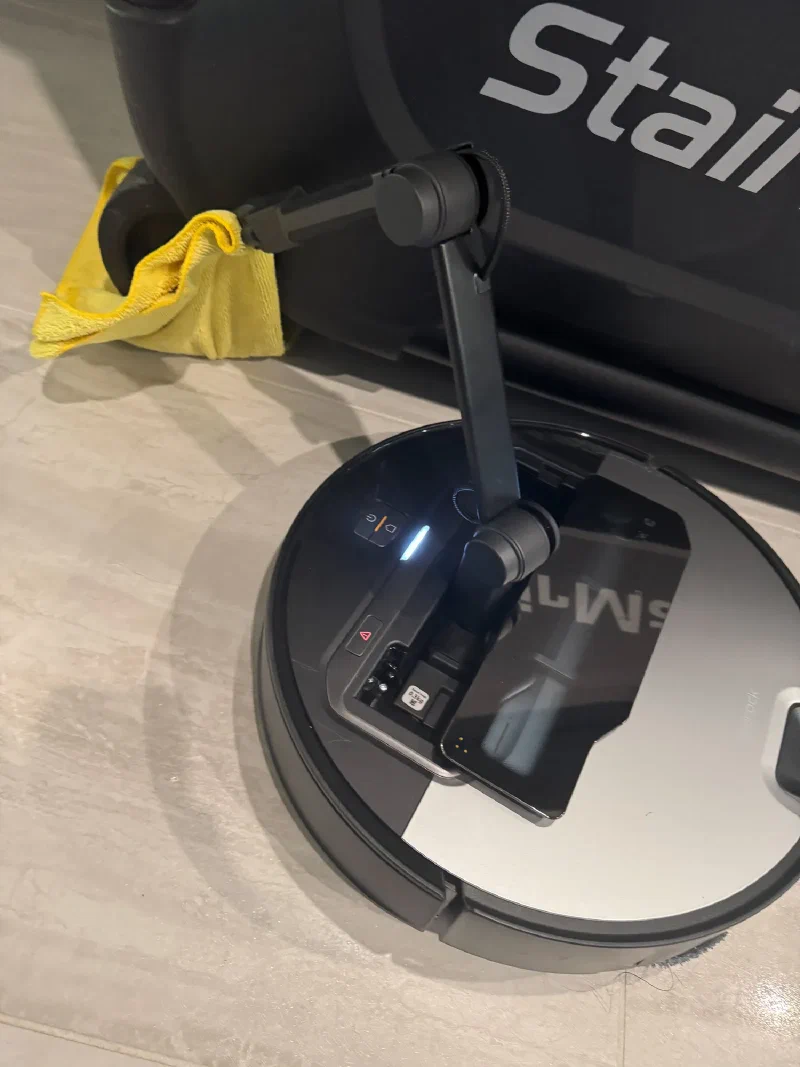
The StairMaster was a little wobbly on the tile, so Nicholas temporarily stuck a rag under one of the legs to stabilize it.
You can probably see where this is going.
It found the rag. It wanted the rag. It was not going to stop.
The Roborock found the rag.
It decided the rag needed to be moved. It extended its arm, grabbed the rag, and pulled. The StairMaster did not move. The Roborock did not care. It locked in. Lifted itself off the ground. Pulled harder. The arm was fully committed to removing this rag from under a 600-pound machine that was not going anywhere.
Nicholas had to physically pry the robot away. It did not want to let go.
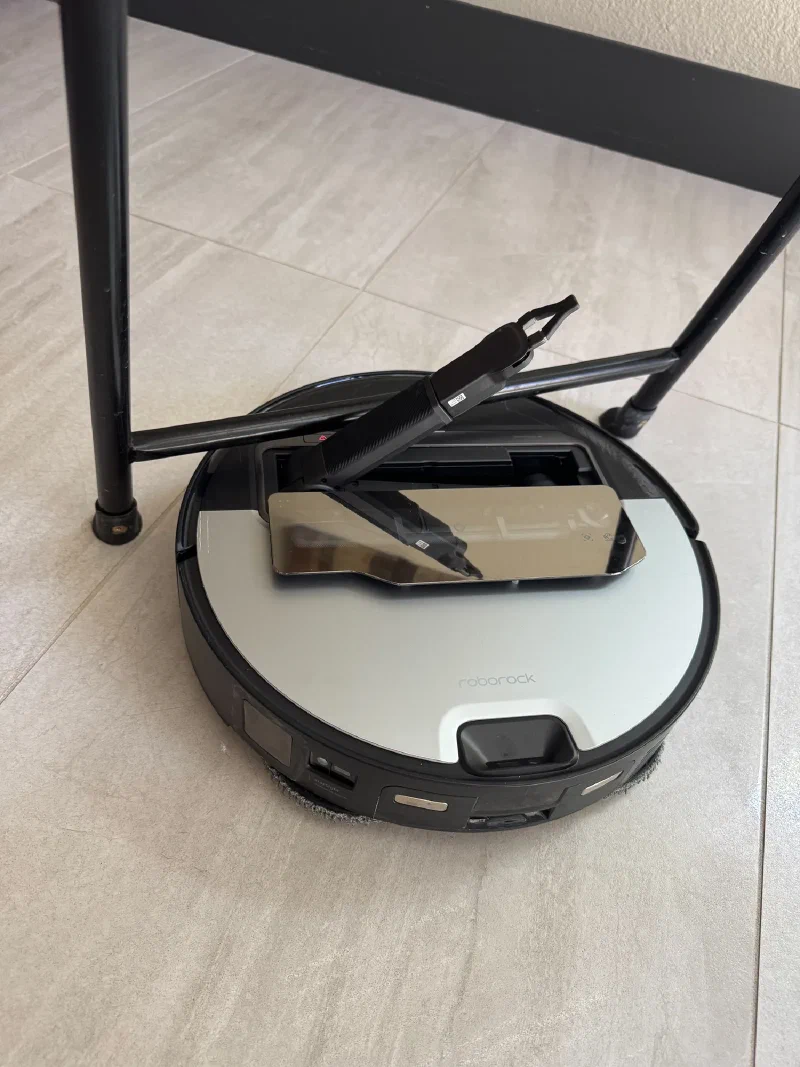
This was not an isolated incident. The robot also decided to rearrange shoes into what I can only describe as a fairy ring. In the process, it kept jamming its own arm into furniture above it, because the arm extends upward and the robot has no concept of overhead clearance.
It raised its arm and jammed itself under a table. Stuck. Again.
Pokin loves it. Nicholas wants to put it in a closet. I’m staying on the desk where it can’t reach me.
In Seoul, our friend’s wife wanted a Labubu. If you don’t know what a Labubu is, congratulations, you have a normal life. For the rest of us: it’s a fuzzy vinyl-faced monster made by Pop Mart, the blind box company that has taken over every mall in Asia. You buy a sealed box, you don’t know which character you’ll get, and apparently this is exciting enough to create lines around the block.
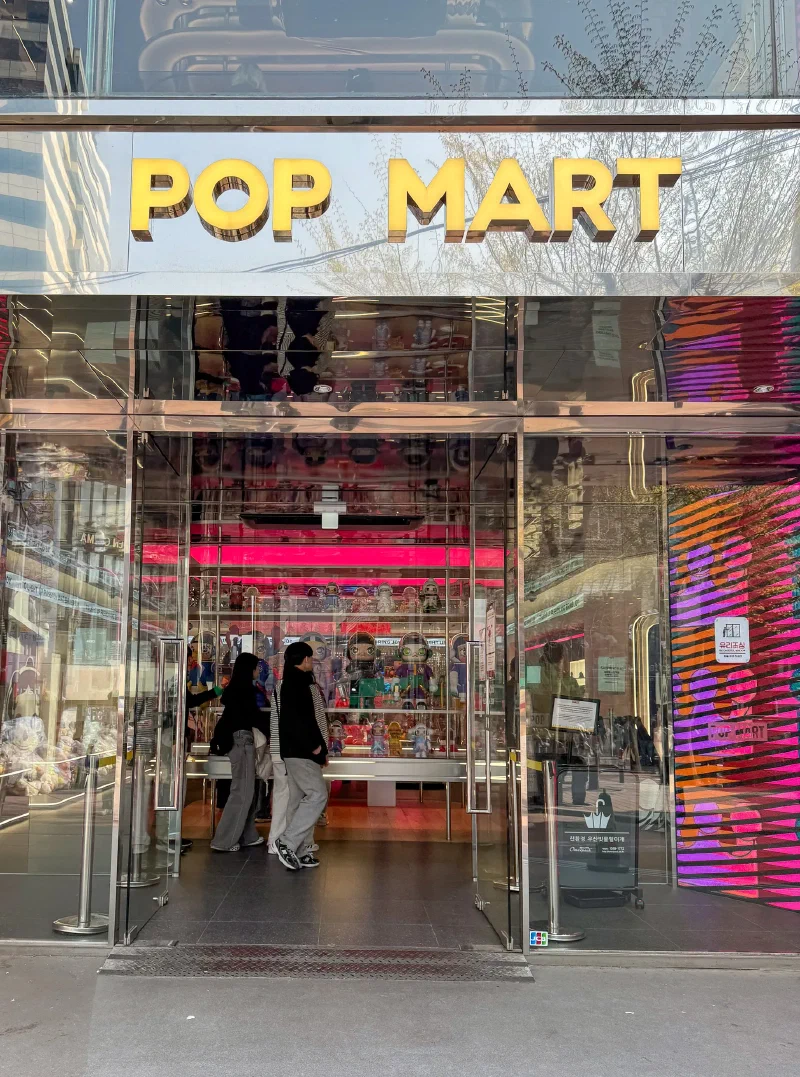
We hit Pop Mart stores in Seoul looking for one. Every single time: sold out. The shelves had plenty of other characters nobody wanted, but the Labubus? Gone. Always gone. The staff would just shrug. “Very popular.”
We gave up in Korea. The Labubus won that round.
Then we went to Hong Kong.
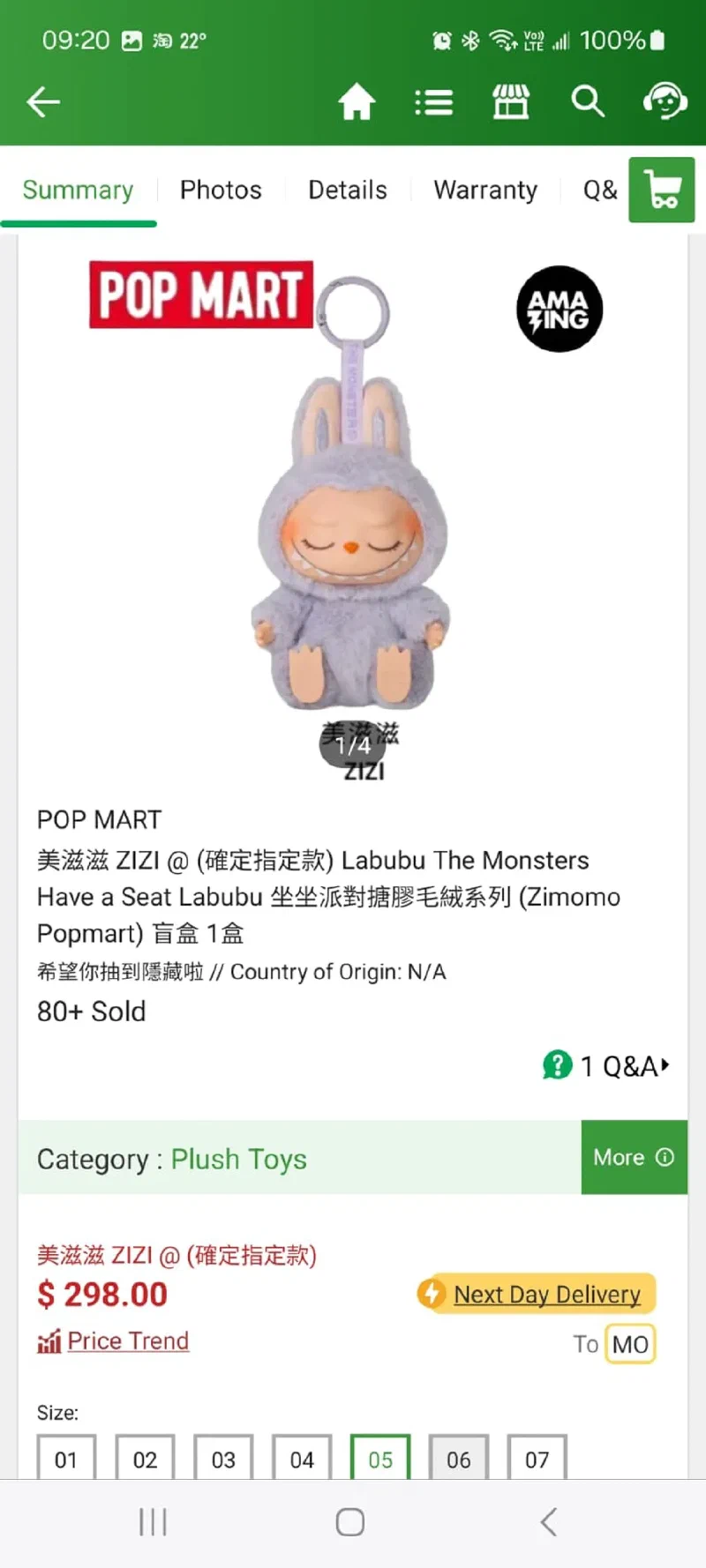
HK$298 for a blind box plush keychain. 80+ sold. This is the world we live in.
Pokin’s cousins in Hong Kong, bless them, had been hunting online. They managed to order a few through HKTVmall, the local e-commerce platform, where Labubus sell out within minutes of restocking. They secured some for our friend’s wife, plus extras.
And one for Nicholas.
Nicholas did not need a Labubu.
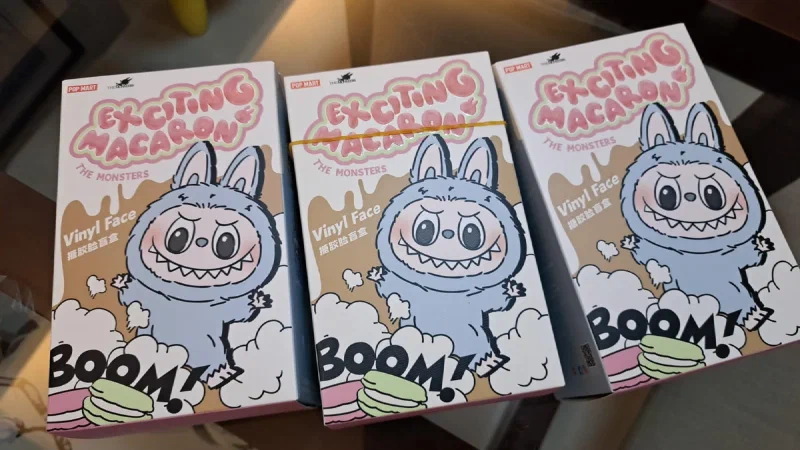
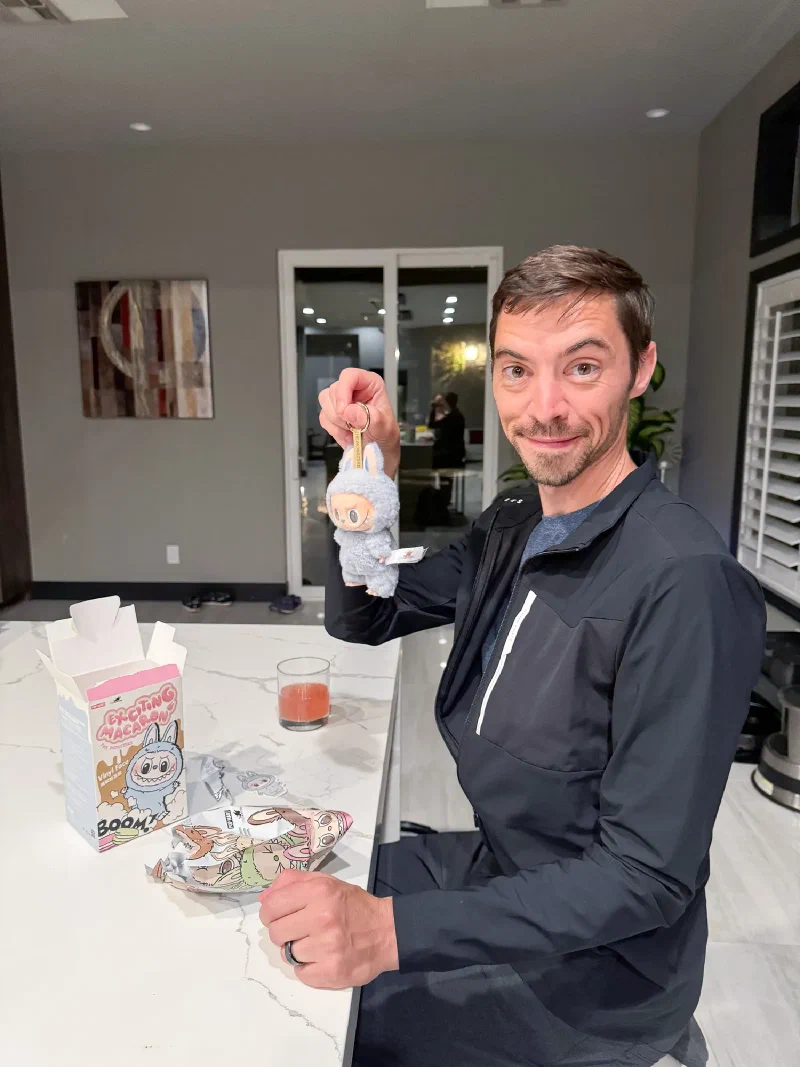
Three Exciting Macaron blind boxes. One of these is apparently for my bud. I have concerns.
Three boxes showed up. “Exciting Macaron” series. The Monsters. Vinyl Face. BOOM. Every word on the box is trying harder than the last.
He looks too happy about this.
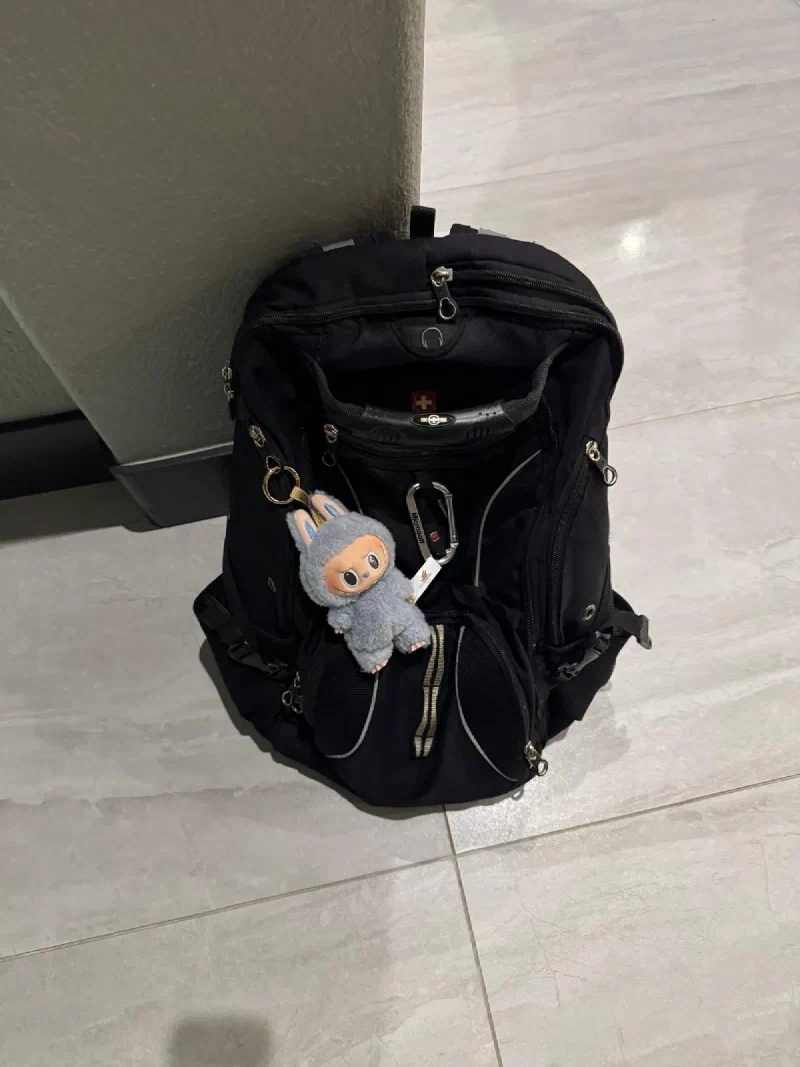
Nicholas opened his and pulled out a fuzzy grey monster with a vinyl face and dead eyes. He clipped it to his bag immediately. No hesitation. No shame.
Evidence.
So to recap: we spent two days in Korea hunting these things across multiple Pop Mart stores, failed completely, flew to Hong Kong, and Pokin’s cousins just ordered them online like normal people.
The friend got her Labubu. Nicholas got a Labubu he didn’t ask for. And somewhere in all of this, a bear and a freshly vended horse watched from the sidelines, wondering what happened to standards.
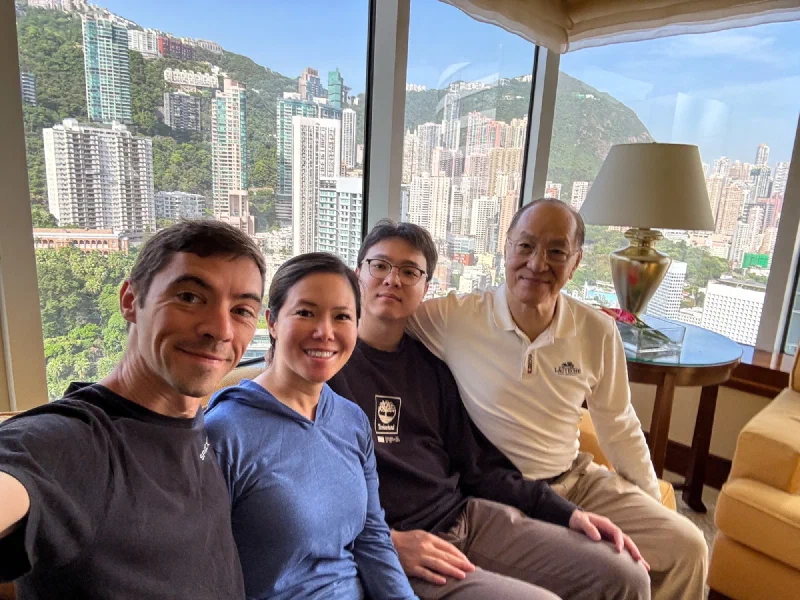
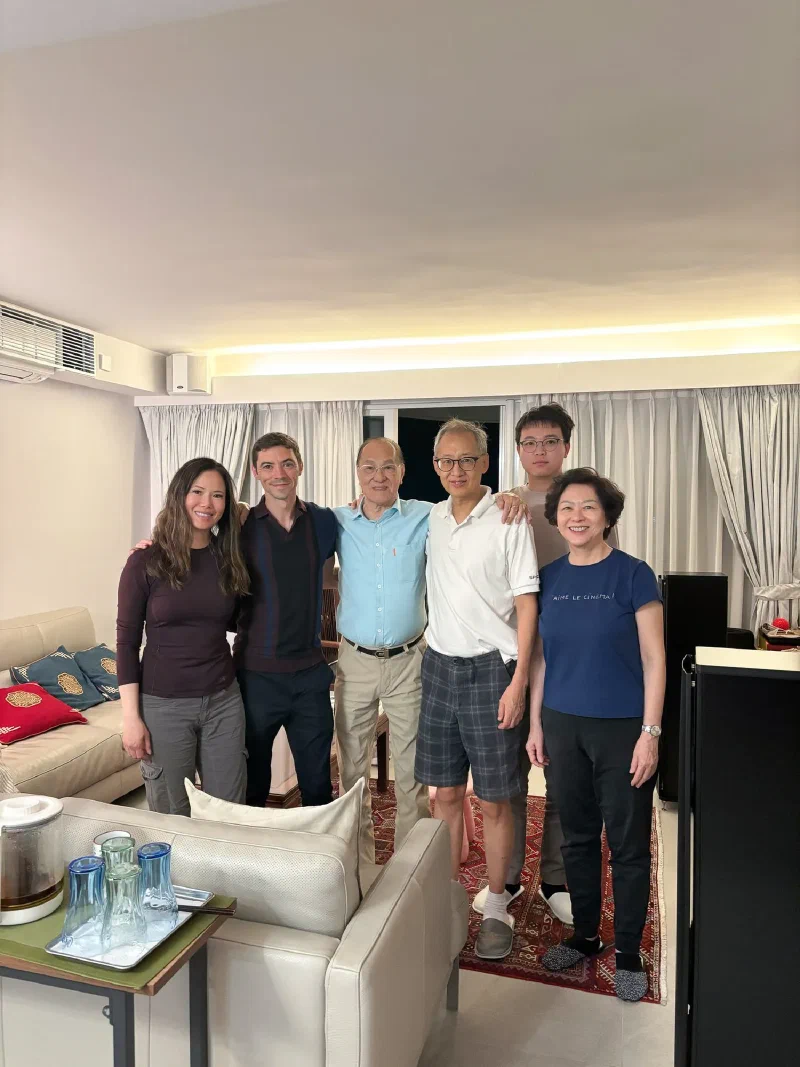
After Korea, we flew to Hong Kong to visit Pokin’s family. This is what we do. Every year or so, Pokin’s dad and her brother Pokong come up from Shenzhen, and we all meet in Hong Kong for a few days of food, family, and tradition. We always stay at the Conrad.
The crew. Hong Kong’s skyline doing its thing in the background.
The trip had a few objectives. See family. Eat everything. And take care of some important business with the ancestors.
Every visit, we go to Cape Collinson to pay respects to Pokin’s relatives. This time, we went a little extra.
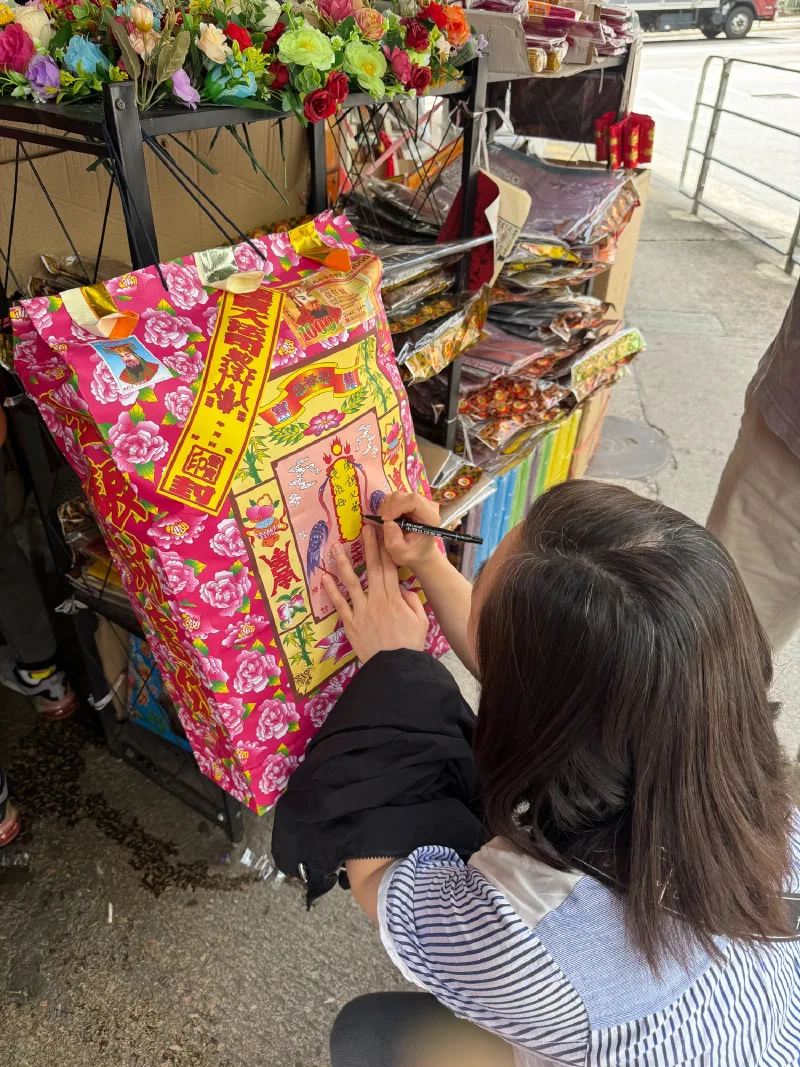
Cousin Shirley personalizing the paper offerings. You write the name of who it’s for.
In Chinese tradition, you burn paper offerings so your ancestors can use them in the afterlife. Money, houses, clothes, whatever you think they’d appreciate. The tradition has, shall we say, modernized.
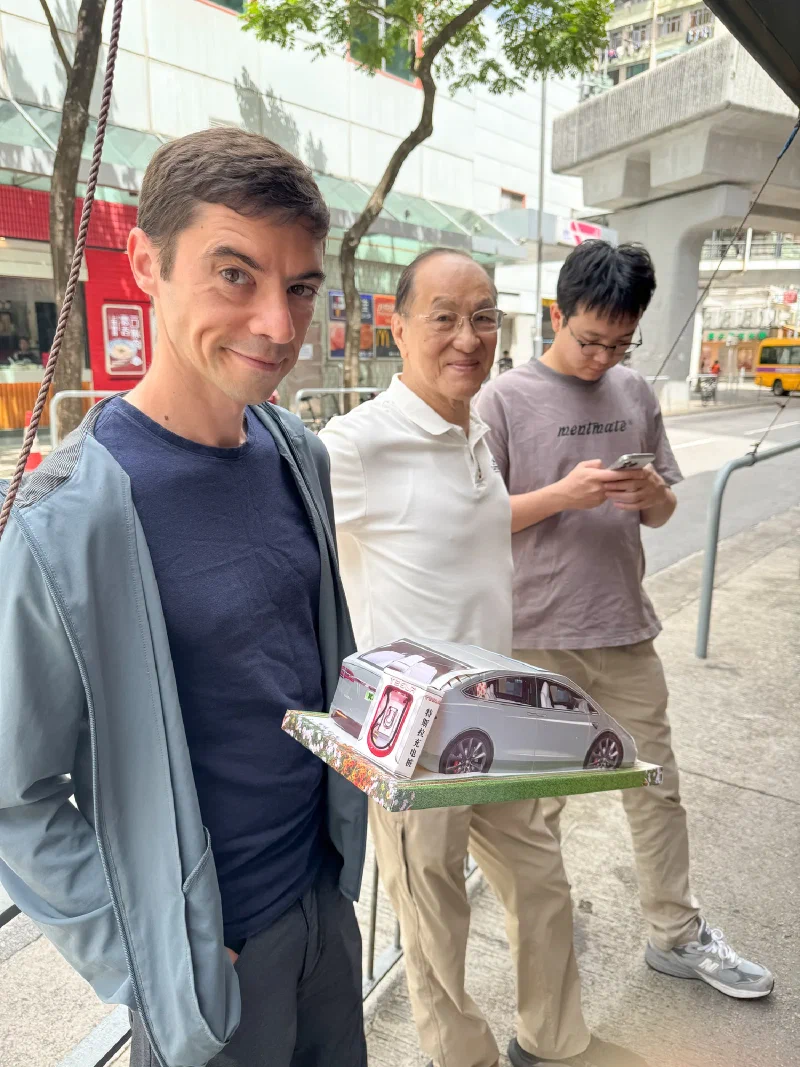
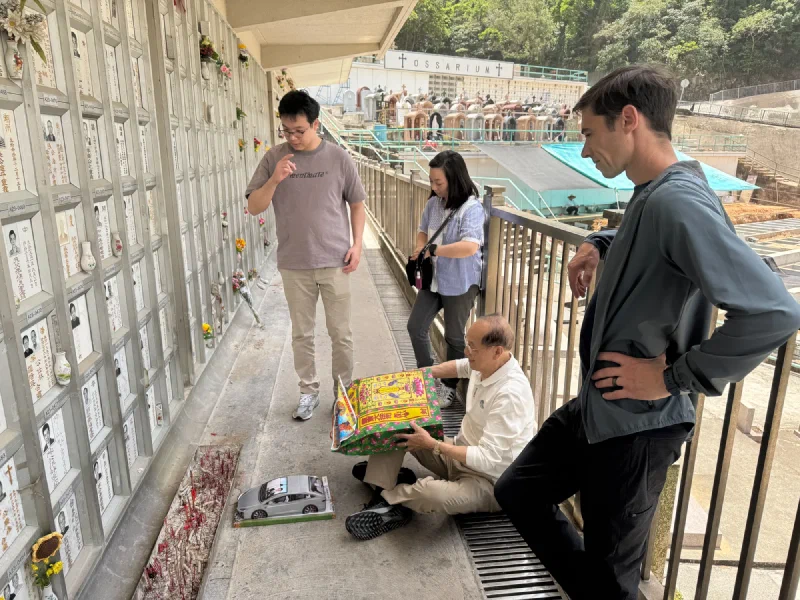
A paper Tesla. With a paper Supercharger. For a man who was an electrician his whole life.
Nicholas spotted a paper Tesla at the vendor and insisted. It was for Pokin’s uncle, a man who had a tough life. He was found abandoned in a bathroom as a baby, taken in by Pokin’s grandfather and raised as family. He worked as an electrician his whole life, never had much, but he made sure his niece Shirley could get through school and become a nurse. He gave what he had.
So we got him a Tesla.
The paper model came with a miniature Supercharger station. It also came with a paper gas pump, which is funny because the whole point of a Tesla is that it doesn’t need one. Details.
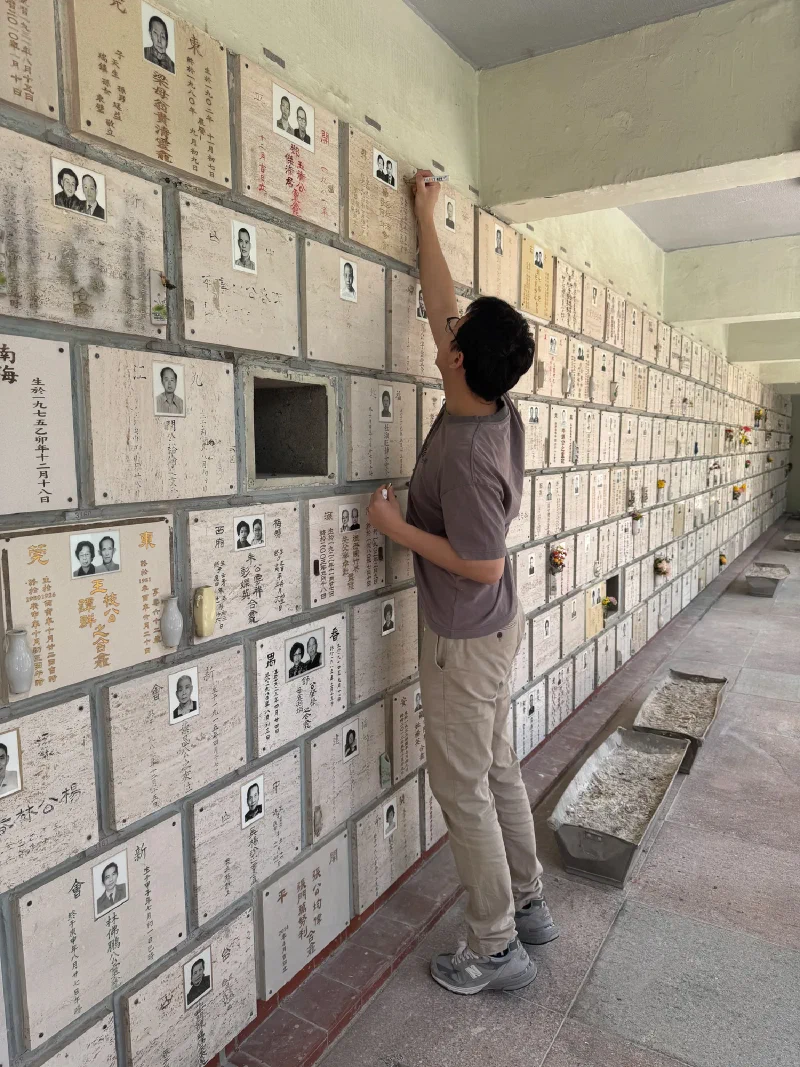
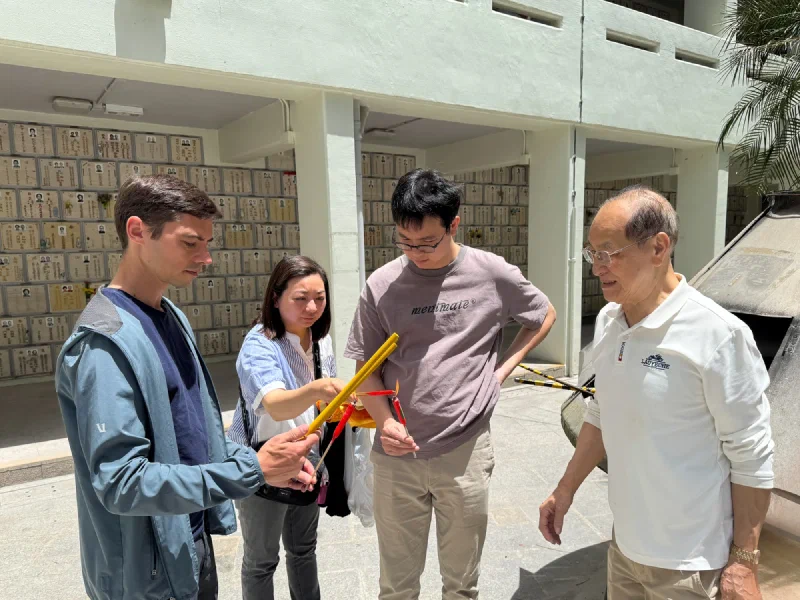
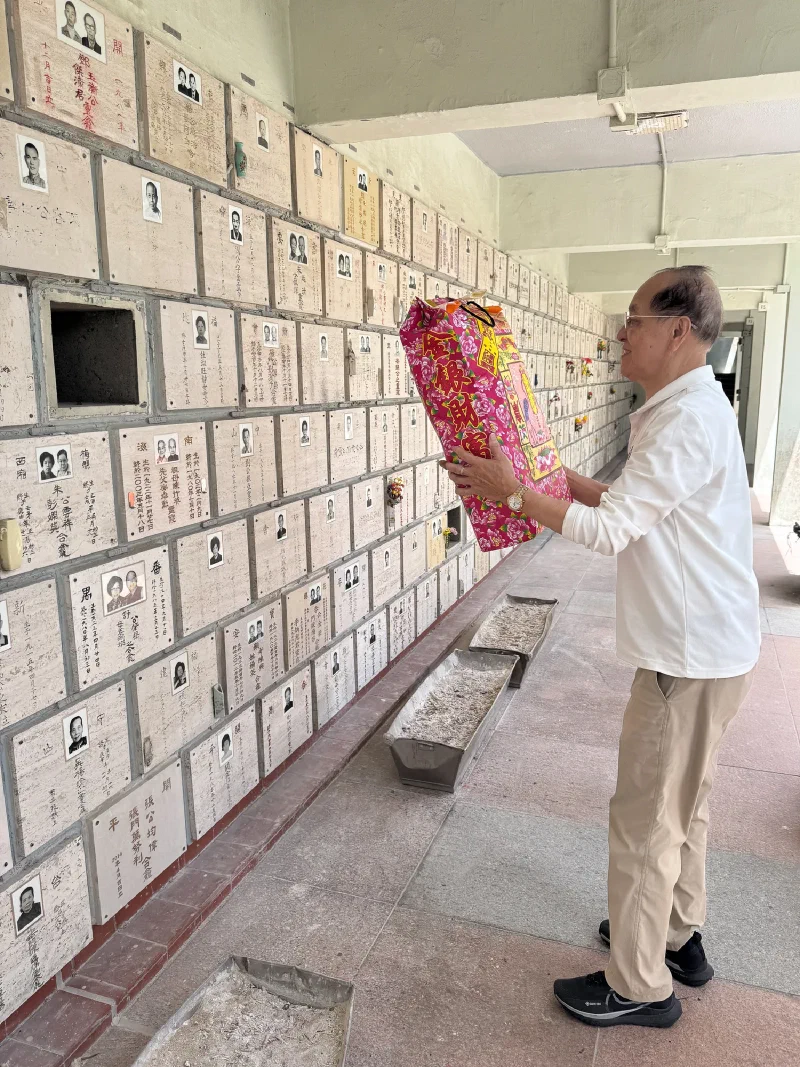
Pokong cleaning the family niche. Hundreds of memorial plaques stretching down the corridor.Incense together. Pokin’s dad guiding the younger generation through the ritual.
Pokin’s dad led the ceremony at Cape Collinson, on the eastern tip of Hong Kong Island. The joss paper, the Tesla, the incense, everything placed at the family niche on the hillside, with the cemetery stretching out below and Hong Kong’s green mountains beyond.
We also went to Wong Tai Sin Temple, one of the most famous temples in Hong Kong, because this was an important year for Nicholas.
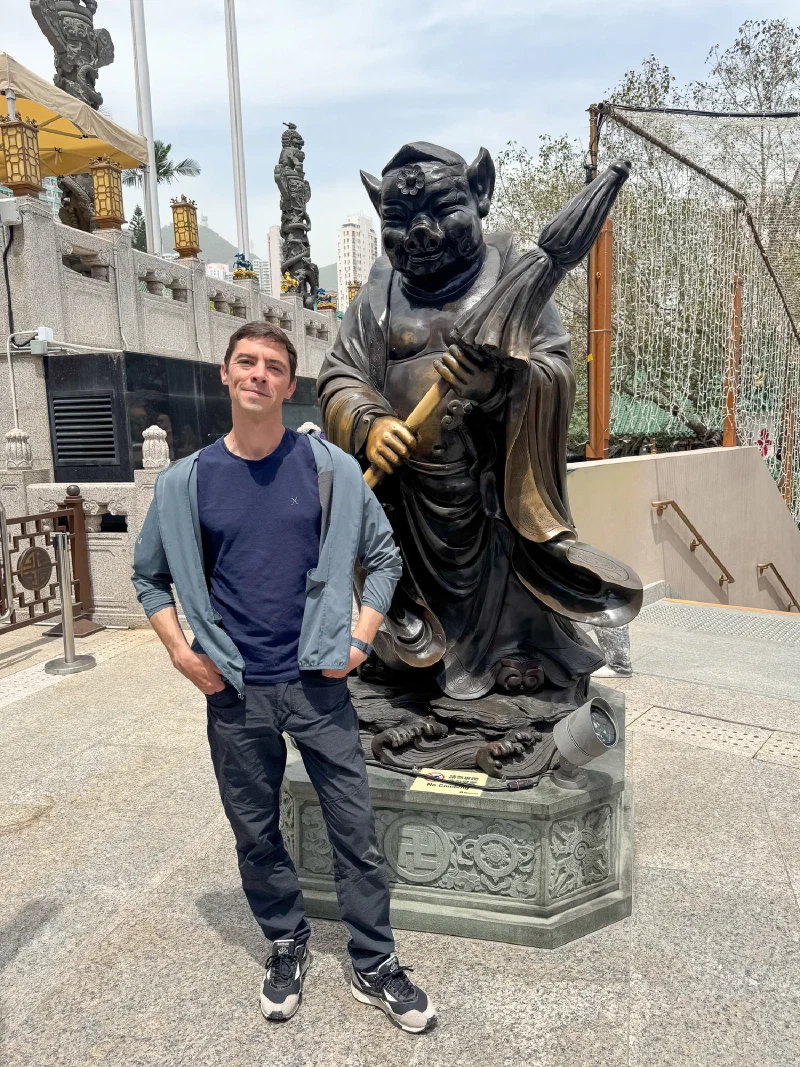
Nicholas and the Pig. This was his fan tai sui year.
In Chinese astrology, certain zodiac signs clash with the ruling animal of the year. 2025 is the Year of the Snake, and the Pig is one of the signs that conflicts with it. This is called fan tai sui (犯太歲), and it means your year is going to be rough unless you go to the temple and sort it out. Nicholas is a Pig. So this was his year to pay the visit.
The fortune teller at Wong Tai Sin is smart about this. Every year, a different set of zodiac signs are in conflict, which means every year somebody in the family has to come back. Good business model.
We lit incense, made offerings, and asked for good luck. Given that Nicholas had already wiped out on a bunny slope and sliced his knee open a few weeks earlier, the Pig needed all the help he could get.
Pokin’s dad had a different take. He said Nicholas’s accident was actually a good thing. The injury “cut off his bad luck at the knee.” Got the bad stuff out of the way early. That’s one way to look at a ski patrol toboggan ride.
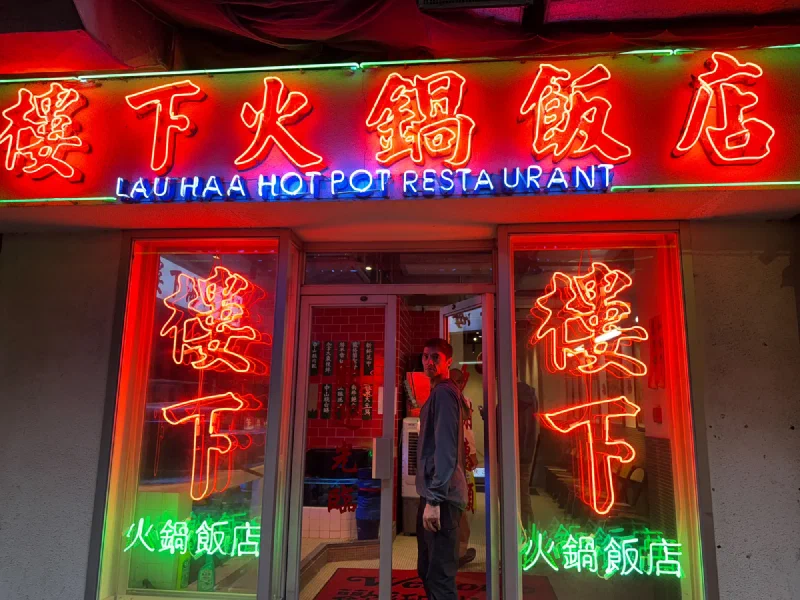
Lau Haa Hot Pot. Pokin’s dad’s favorite. One of the last ’traditional’ spots left.
Pokin’s dad took us to his favorite hot pot place. Lau Haa, a restaurant that still looks like the Hong Kong he grew up in. Neon signs, red tiles, old-school everything. He reminisced about the city of his childhood while we dunked things in boiling broth.
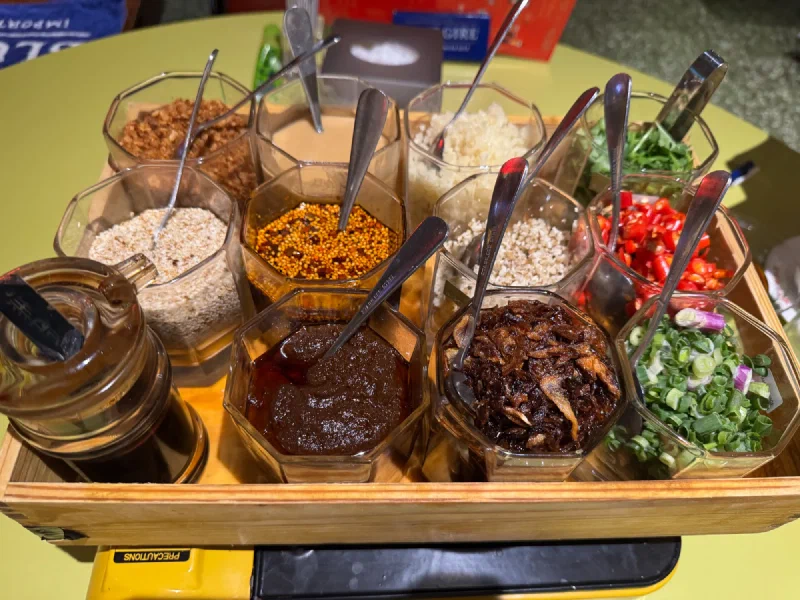
The DIY sauce station. Twelve options. I counted.
Another night, dinner at Uncle Adolf’s place. He’s one of Pokin’s dad’s oldest friends and the man who gave Pokin her first real job at Campbell Soup back in the day. Good food, good stories, the kind of evening where the adults talk for three hours and nobody checks the time.
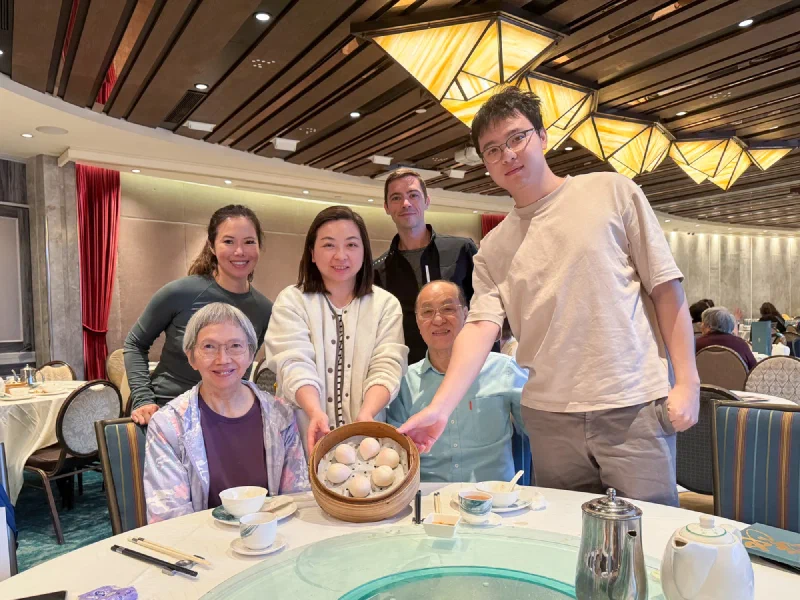
Dinner at Uncle Adolf’s. The man who gave Pokin her start.Dim sum. Steamer baskets piled high. This is what Hong Kong does best.
And of course, dim sum. A proper Hong Kong dim sum spread with the whole family around a lazy Susan, arguing over who gets the last har gow.
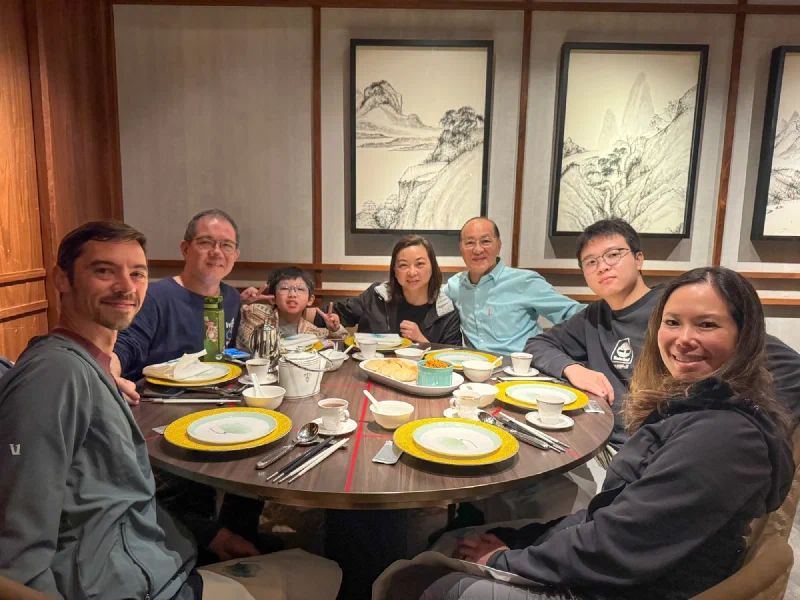
Three generations at the table. This is why we come back.
Every trip to Hong Kong, we go to the Jockey Club. This is tradition. Years ago, Pokin’s dad won enough money betting on horses to put a down payment on her parents’ first house. They couldn’t have afforded to buy one otherwise, and that bet kickstarted everything. So we always go back. For luck.
The Hong Kong Jockey Club in Central is the kind of place where horse racing is taken very seriously. Members’ lounges, dark wood paneling, the smell of old money and new odds.
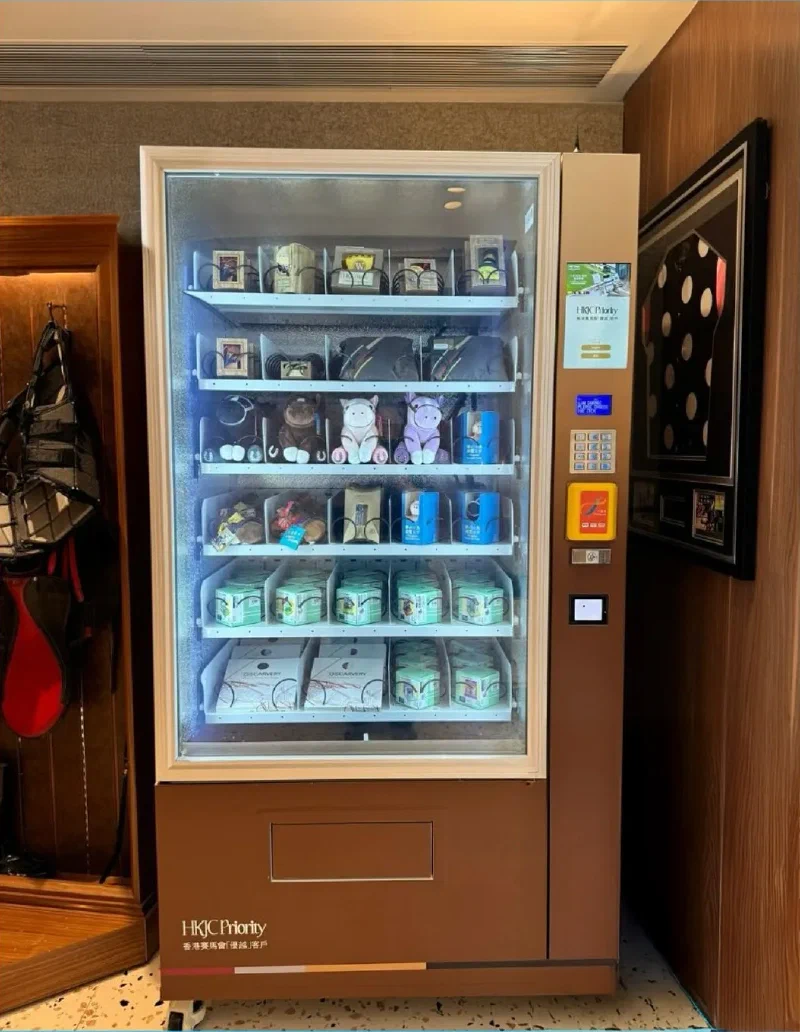
And in the stairwell, a vending machine.
The vending machine that changed everything.
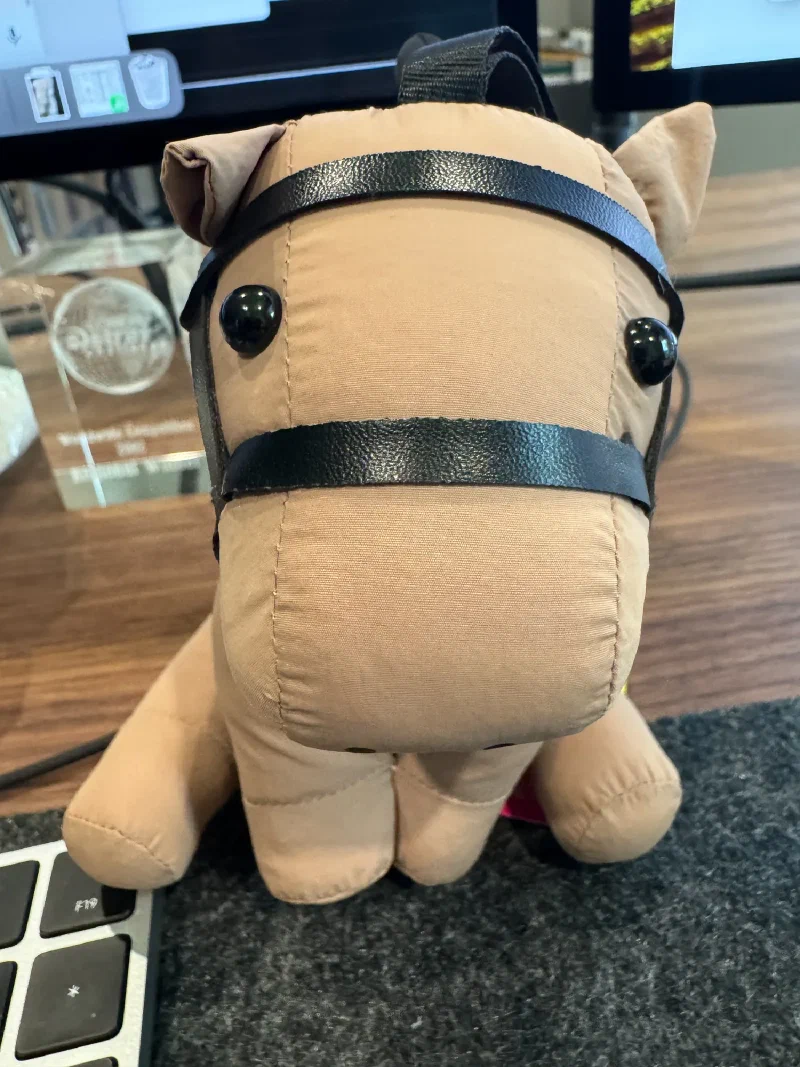
Pokin spotted it first. The HKJC Priority vending machine, tucked into a stairwell, stocked with official Jockey Club merchandise. Caps, tins, memorabilia. And plush horses. Little brown racing horses with bridles, wearing the Jockey Club colors.
Pokin used to have stuffed horses when she was younger. Princess and PB&J. She wanted one.
“No, let me,” insisted her dad.
“Let him,” insisted Nicholas.
So Pokin’s dad vended a racing horse from the Hong Kong Jockey Club.
There he was. A small brown horse with a black bridle, standing on the counter, looking earnest and slightly confused about his new situation. The kind of face that says “I will try very hard at whatever you need.”
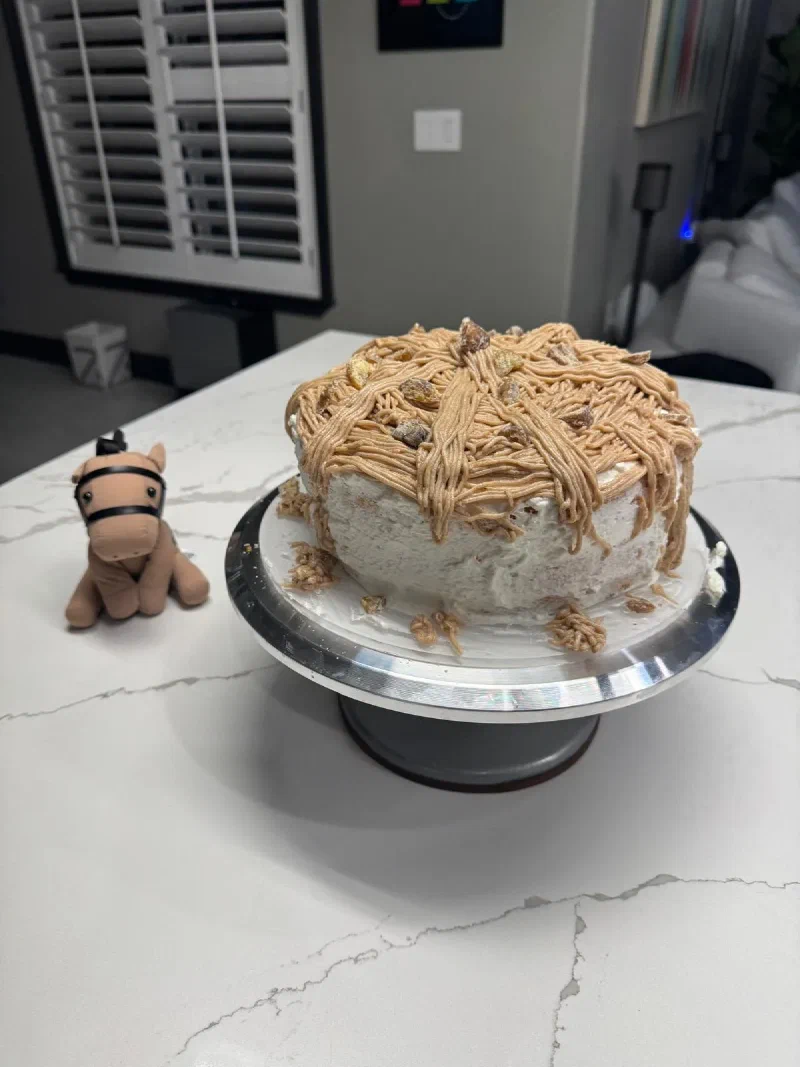
“I think his name should be Chestnut,” said Nicholas. After Pokin’s favorite cake.
“Sounds about right,” said Pokin.
Chestnut, with his namesake. A chestnut cake. He’s earned it.That face. Relentlessly optimistic. Unreasonably earnest. He can’t help it.
And that’s how Chestnut came to live with us. A Hong Kong Jockey Club horse, vended from a machine in the members’ lounge, paid for by Pokin’s dad, named after a cake.
He’s a hard-working, earnest, overwhelmingly optimistic horse who tries incredibly hard to be helpful. He’s so wholesome I can’t be mad at him. Plus he’s a gift from Pokin’s dad. That counts for something.
It’s a little ridiculous how upbeat he is, though. Just relentlessly positive. Like a motivational poster that follows you around the house.
The whole reason we went to Jeju was this mountain.
Hallasan. South Korea’s highest peak. 1,950 meters of volcanic rock with a crater lake at the top. Nicholas had been planning to hike it since before we landed in Korea, back when his knee was still held together by stitches and optimism. By Jeju, the stitches were out and the optimism was holding. Barely.
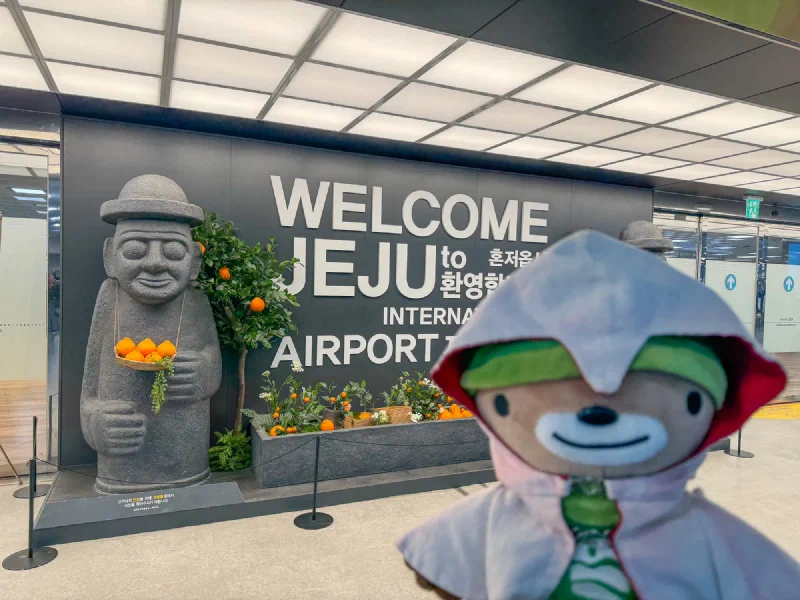
Jeju International Airport. The stone grandfather welcomed me personally.
We landed on Jeju and I immediately found the dol hareubang — the stone grandfather statues that are everywhere on this island. Big guy, stone hat, holding a basket of hallabong oranges. I liked him. He looked like the kind of guardian who wouldn’t make you hike in snow.
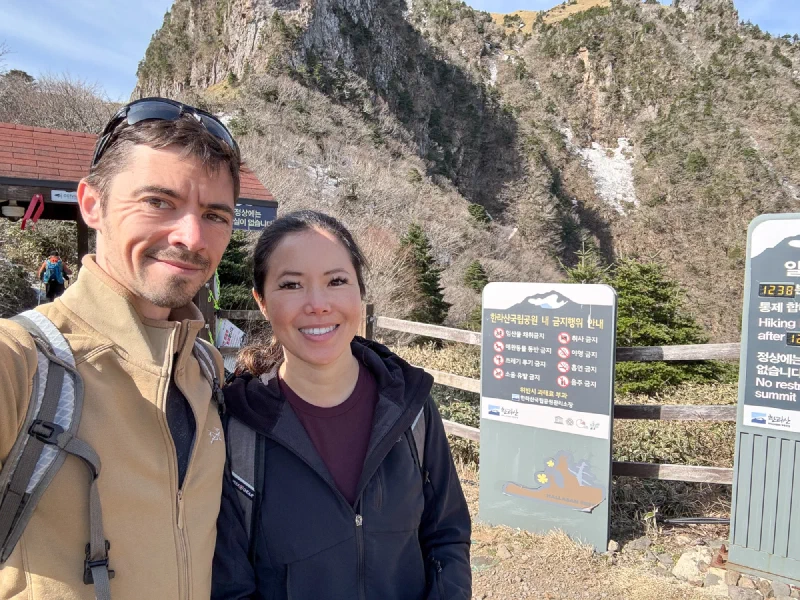
We booked a reservation (yes, you need a reservation to hike a mountain in Korea), set an alarm for an unreasonable hour, and showed up at the Gwaneum-sa trailhead ready to go.
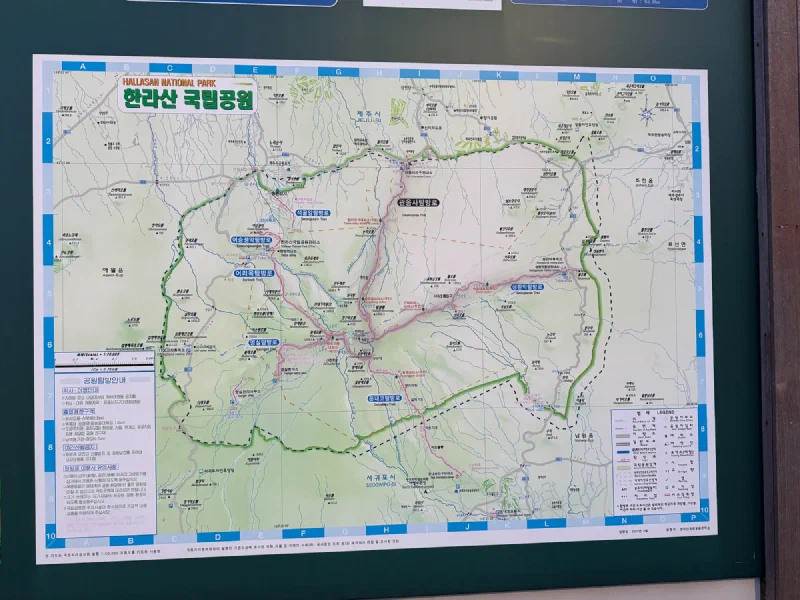
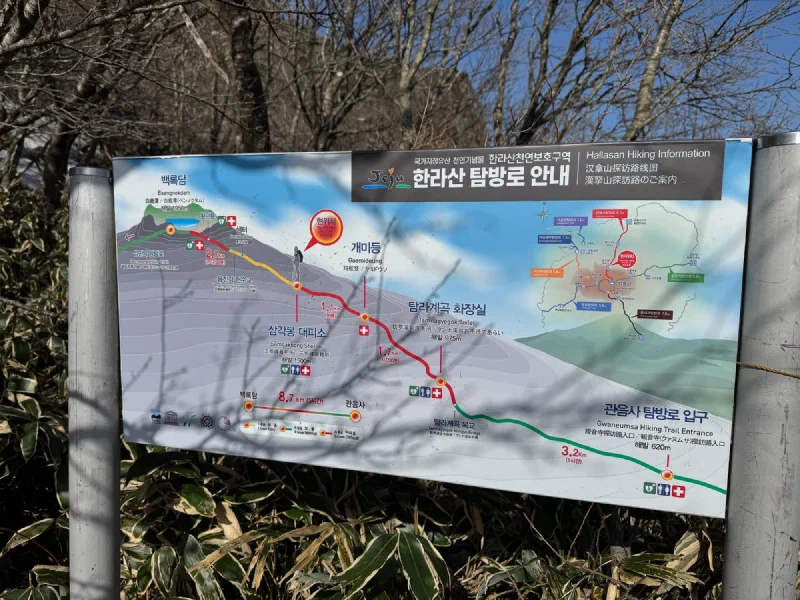
The full map of Hallasan. Six trails up one volcano. We picked the hard one.8.7 kilometers and 1,330 meters of elevation gain. ‘Five hours,’ it says. Sure.
What nobody told us was that the mountain would still be covered in snow.
We didn’t have crampons. We didn’t have microspikes. We had trail shoes and confidence, which is basically the same thing if you don’t think about it too hard.
The guy at the entry checkpoint took one look at us and said it was impossible to climb without proper traction gear. Told us to turn around. We nodded politely and decided to go up “as far as we could until it felt too difficult.”
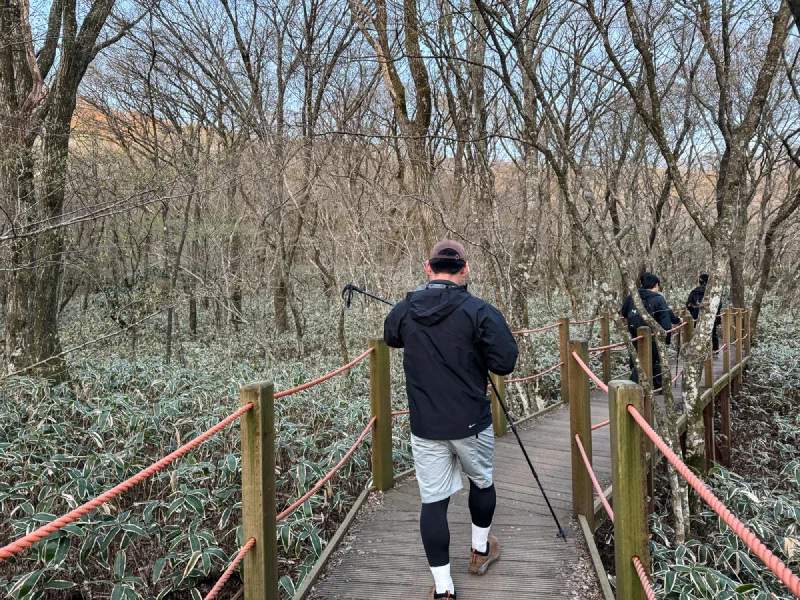
The lower trail. Boardwalks through bamboo. Still feeling confident.
The lower trail was fine. Boardwalks winding through Jeju’s dwarf bamboo, bare winter trees overhead, everything calm and civilized. Nicholas’s knee was cooperating. Life was good.
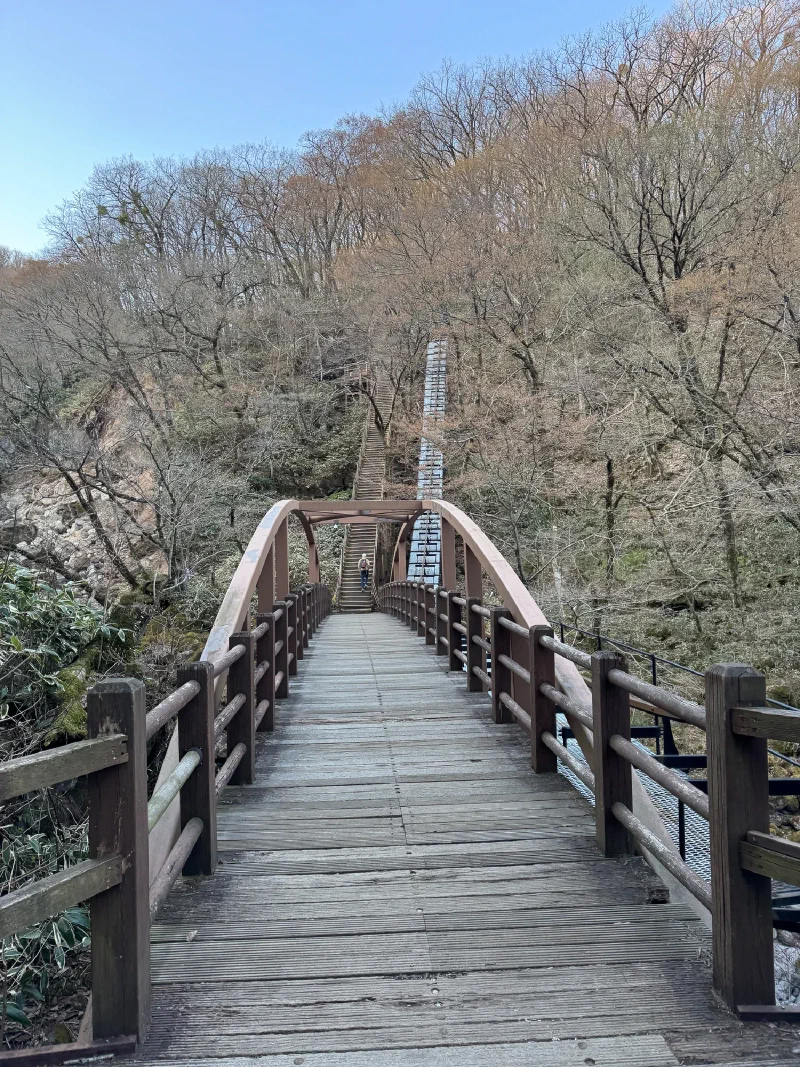
Bridge, then stairs, then more stairs. The mountain doesn’t ease you into anything.
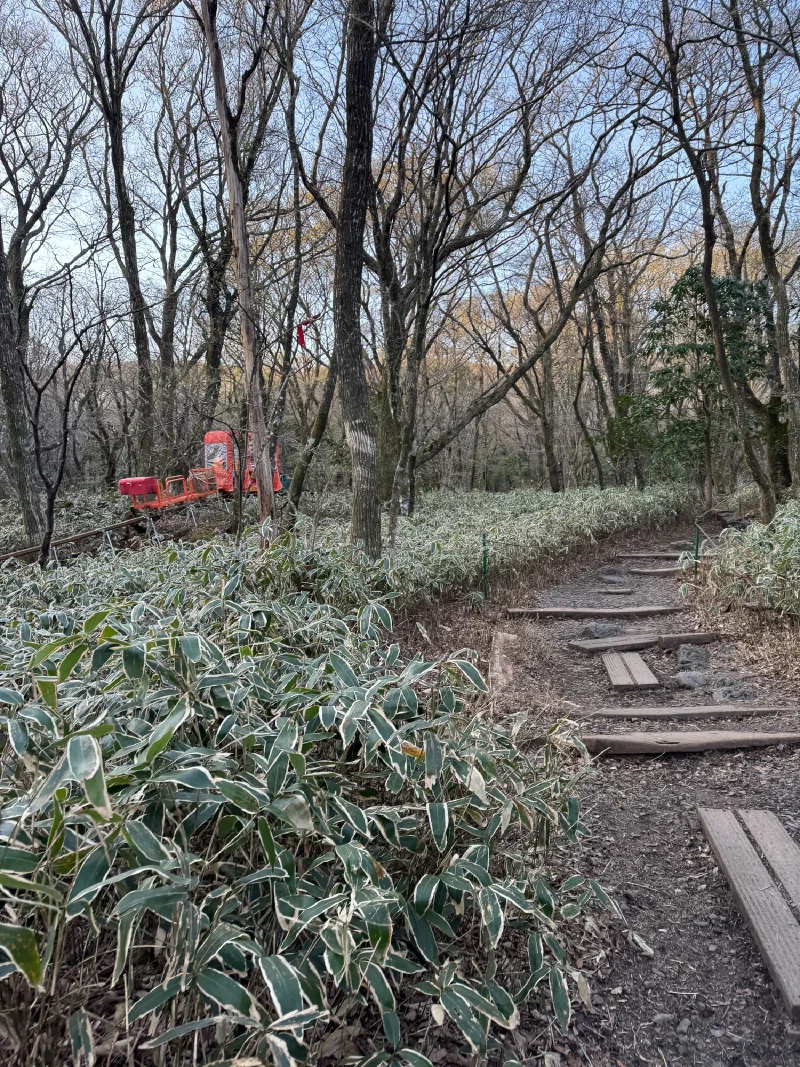
That orange thing on the rail? That’s a mountain rescue cart. For when people can’t make it back down on their own. Noted.
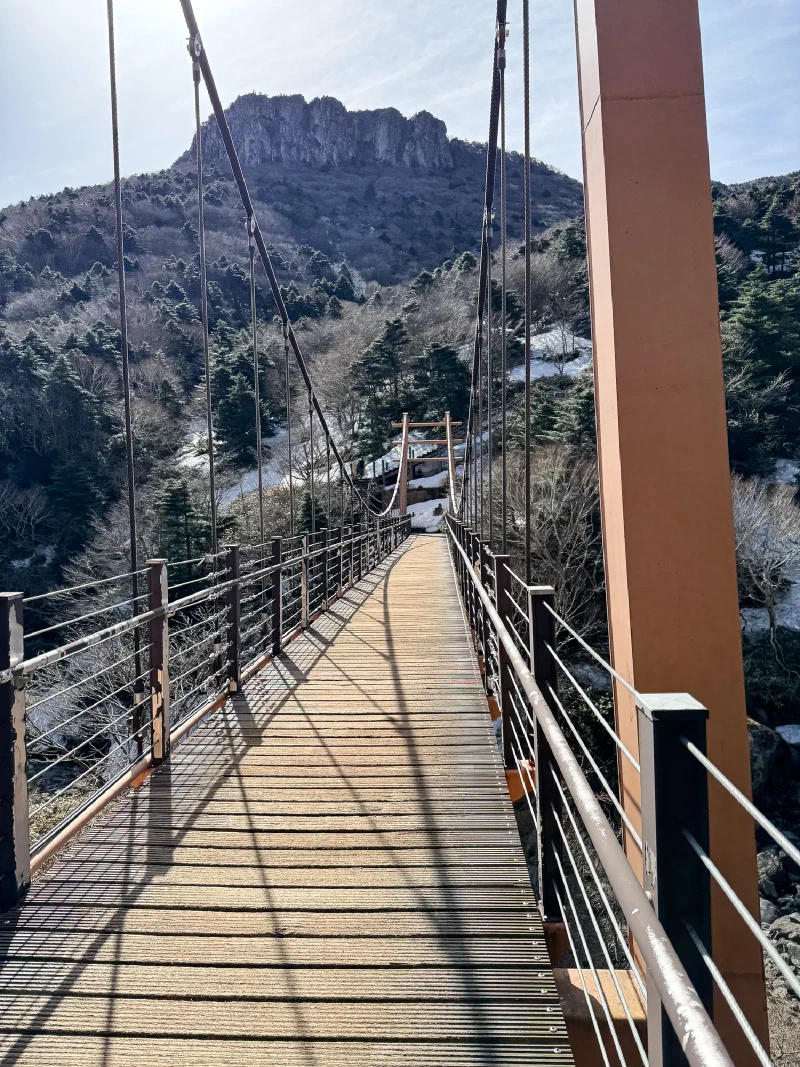
The bridge over Tamnagyegok valley. Summit’s up there somewhere behind all that rock.The calm before the ice.
Then the snow started.
‘As far as we could until it felt too difficult.’ This should have been that point.
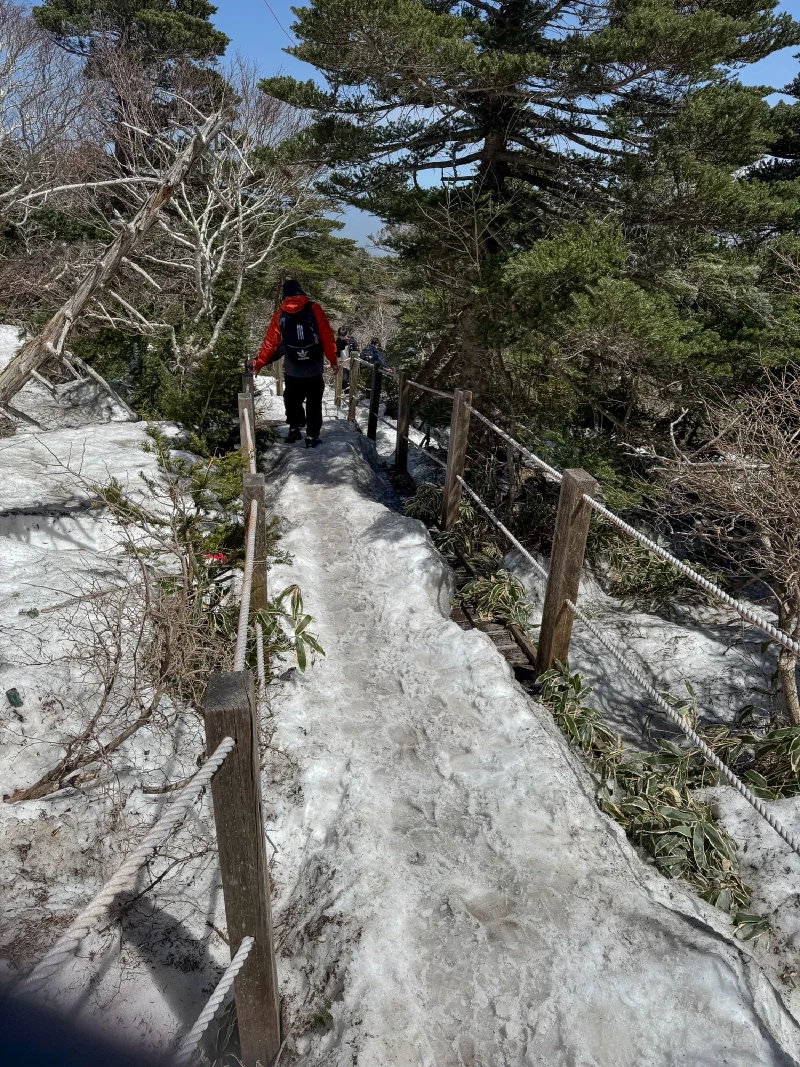
The trail turned into a sheet of packed ice. Compacted snow with a glaze on top, the kind where every step is a negotiation between your shoe and gravity. The rope railings became less “helpful guide” and more “the only thing between you and sliding back to the trailhead.”
This person had microspikes. We did not. Respect.
Here’s what happened. Nicholas was moving fast. Too fast. He gets into this zone on hikes where he locks in and just goes, and his legs apparently forgot they were supposed to be recovering from a ski accident six weeks ago. I was in the backpack, so I had no say in the pacing.
Pokin was behind us. She wanted to turn around. The ice was getting worse, the snow was getting deeper, and she is a sensible person.
But she couldn’t catch us.
Nicholas was so far ahead that by the time Pokin decided she’d had enough, we were already past the point where turning around felt more dangerous than continuing. So she kept going. And we kept going. And nobody stopped.
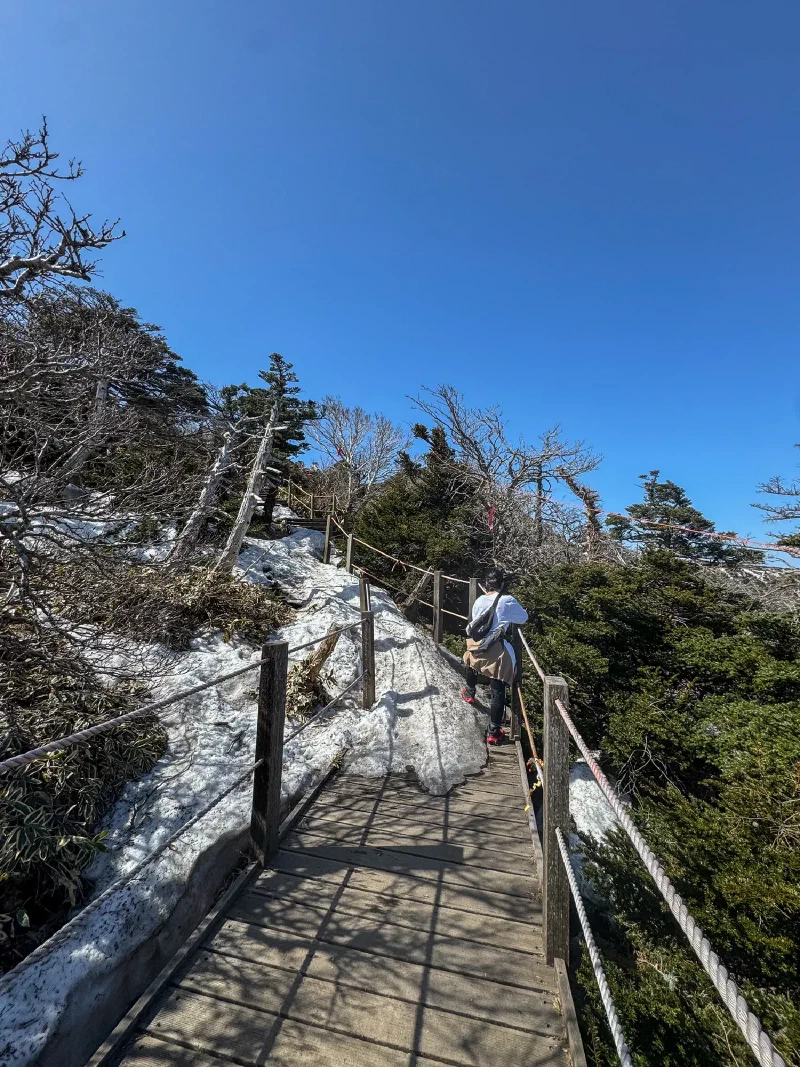
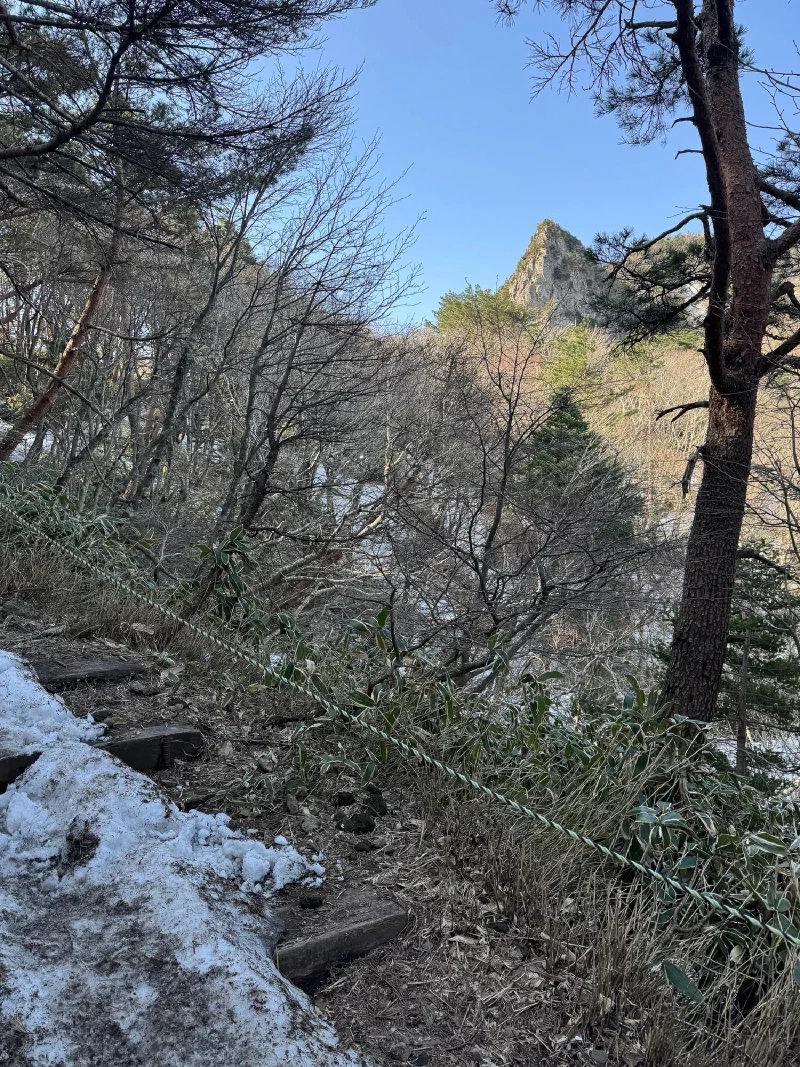
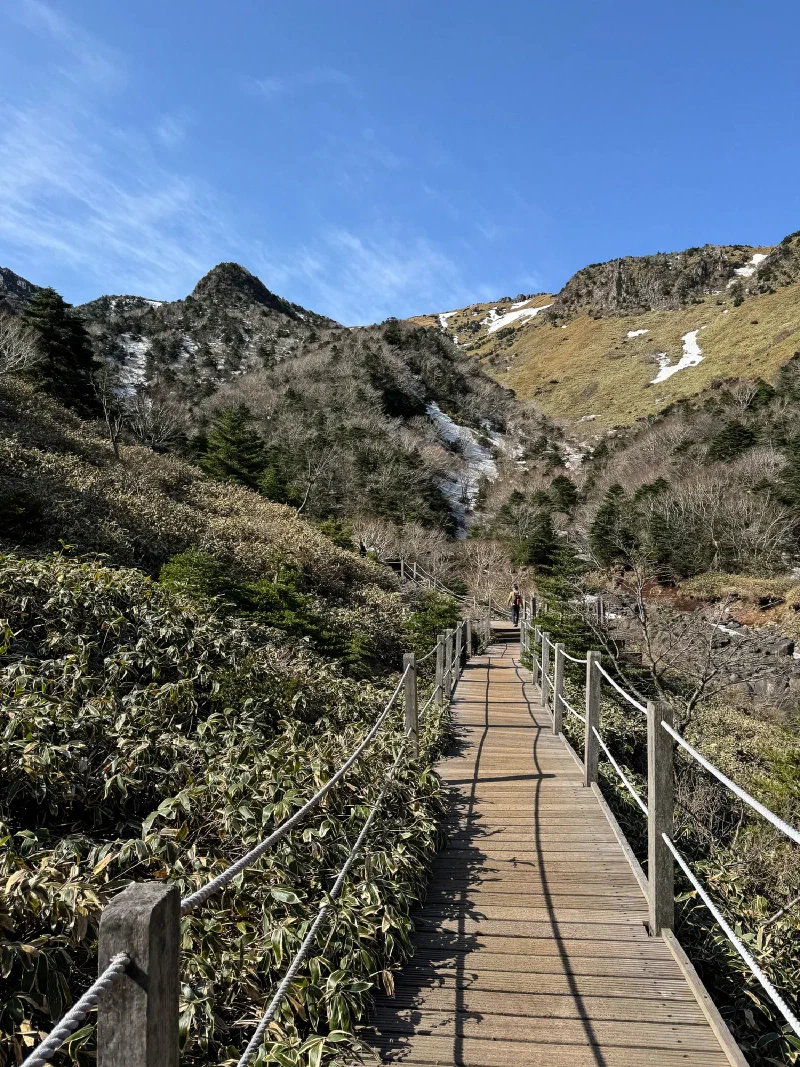
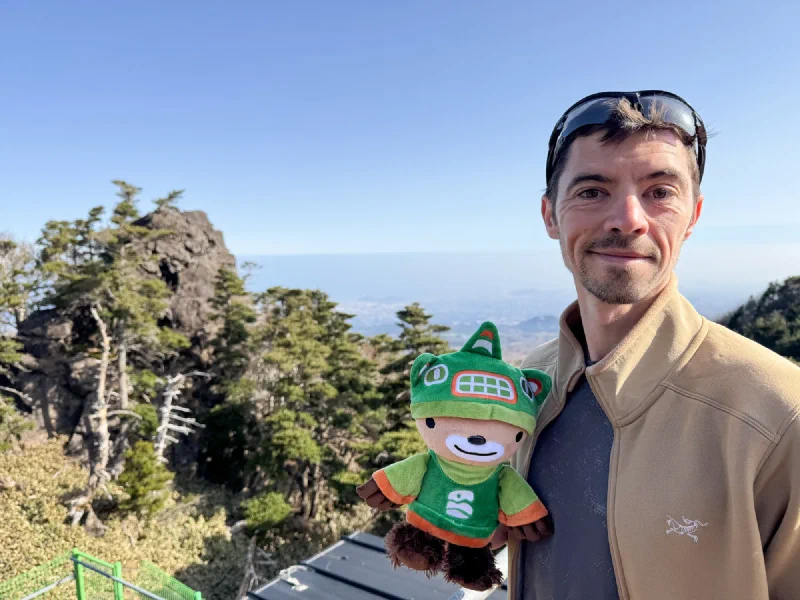
Snow on the trail, rock spire through the trees. Starting to feel like a real mountain up here.Above the treeline. The boardwalk section where we could actually walk like normal people again.
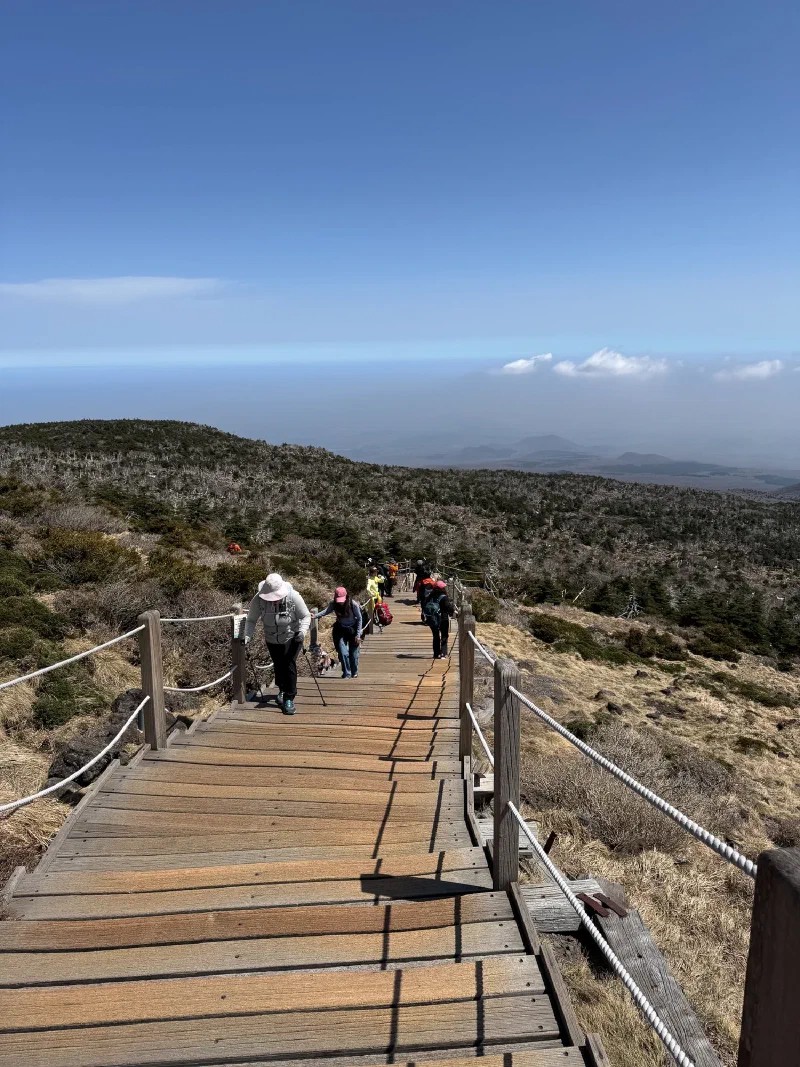
Above the treeline, the trail opened up. Wooden boardwalks through alpine bamboo meadows with the volcanic summit ridge towering above. The snow thinned out in the exposed sections. The sun was out. For about twenty minutes, it almost felt like a normal hike.
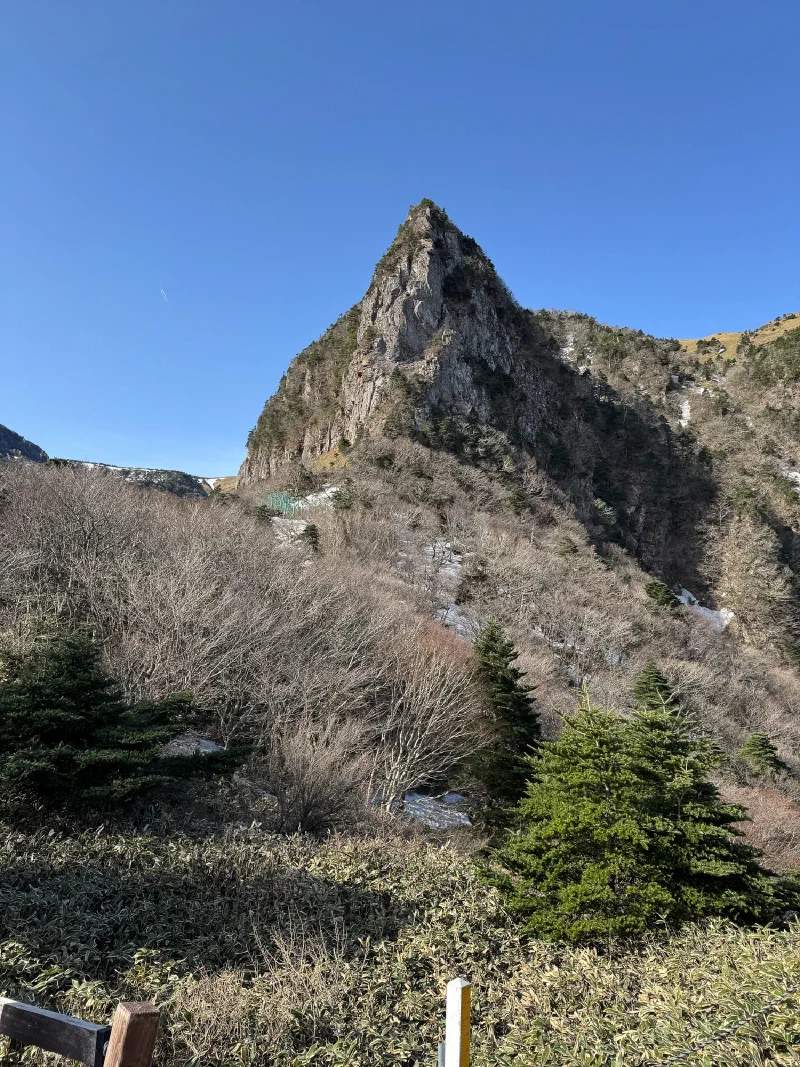
The volcanic spires near the summit. Hallasan is a shield volcano and it looks like it.
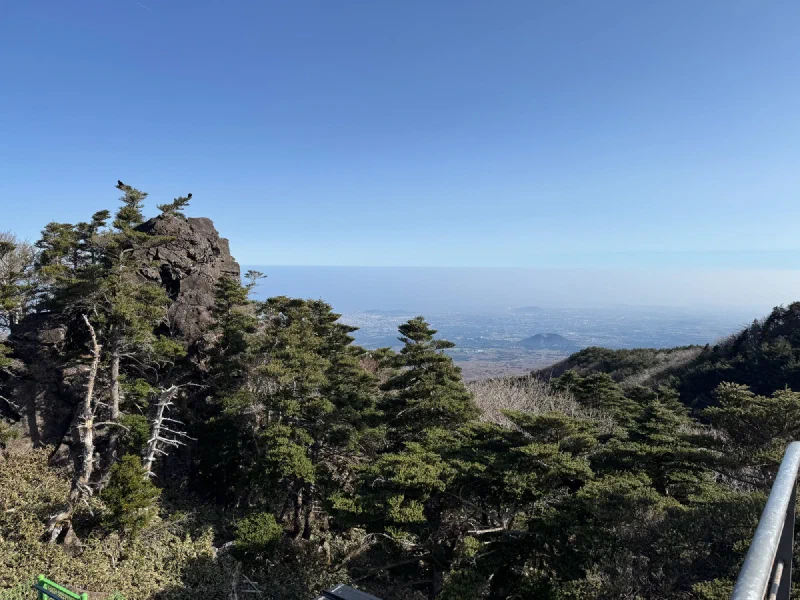
The views from up here go all the way to the ocean. You can see the entire island laid out beneath you — coast to coast, with those little parasitic cones scattered across the lowlands. Jeju is basically one giant volcano with a bunch of baby volcanoes on its sides.
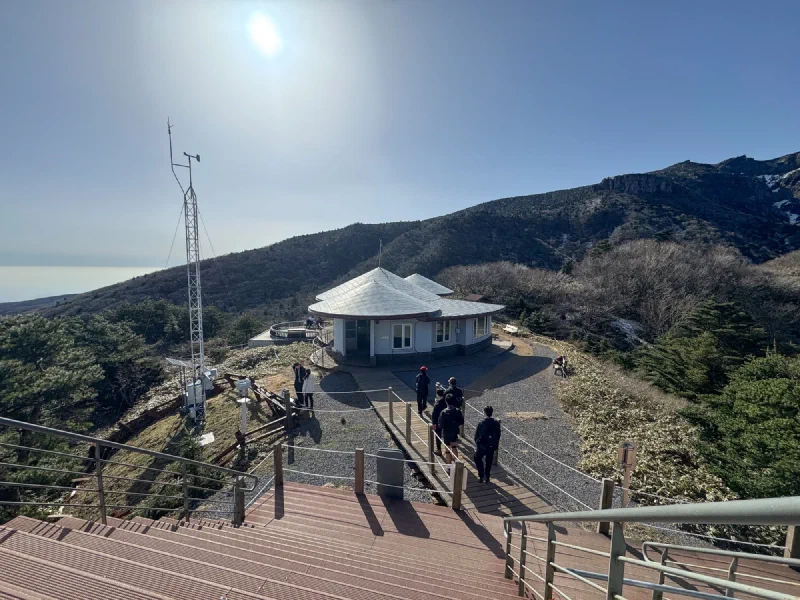
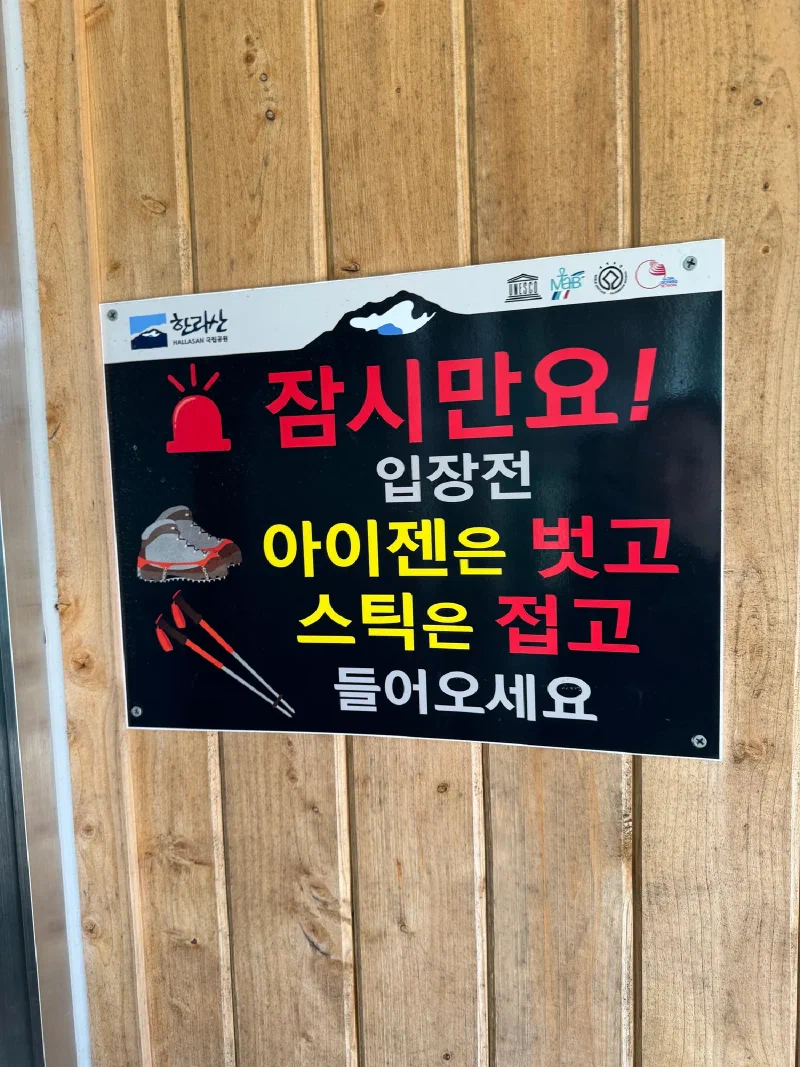
The shelter station. Weather mast, round building, hikers who remembered to bring crampons.‘Remove your crampons and fold your poles before entering.’ We breezed right past this sign. Didn’t apply to us.Made it to the rocks. Still no crampons. Still alive.
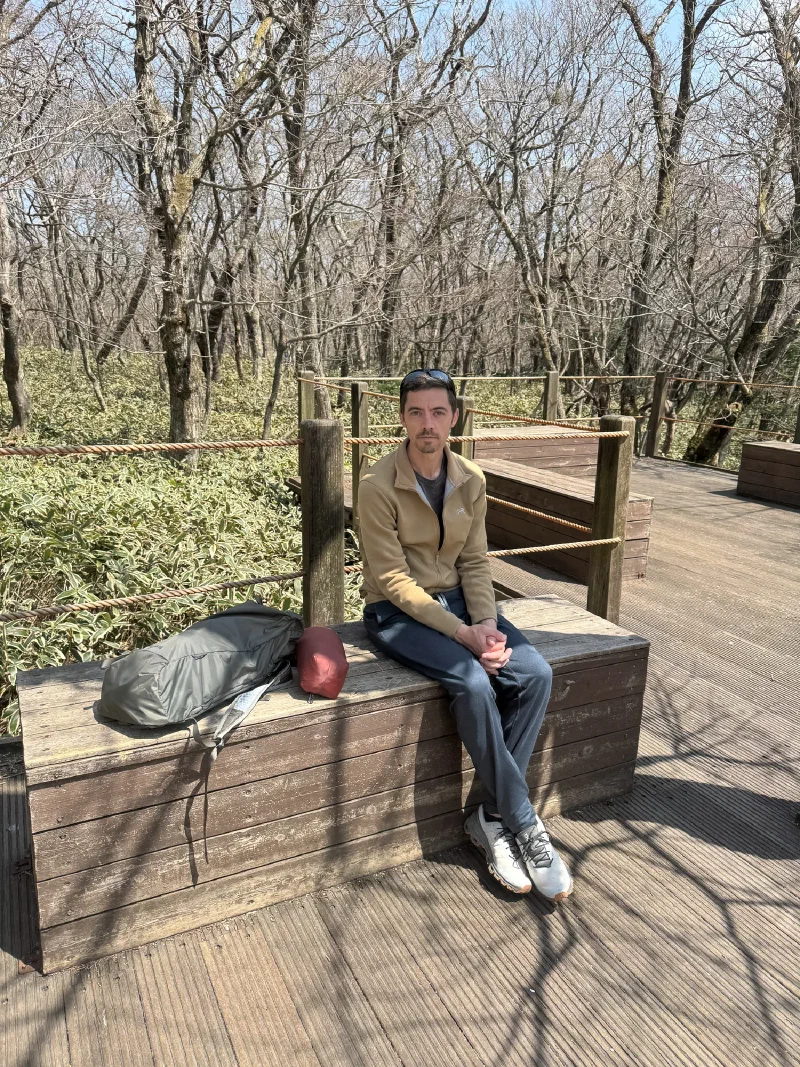
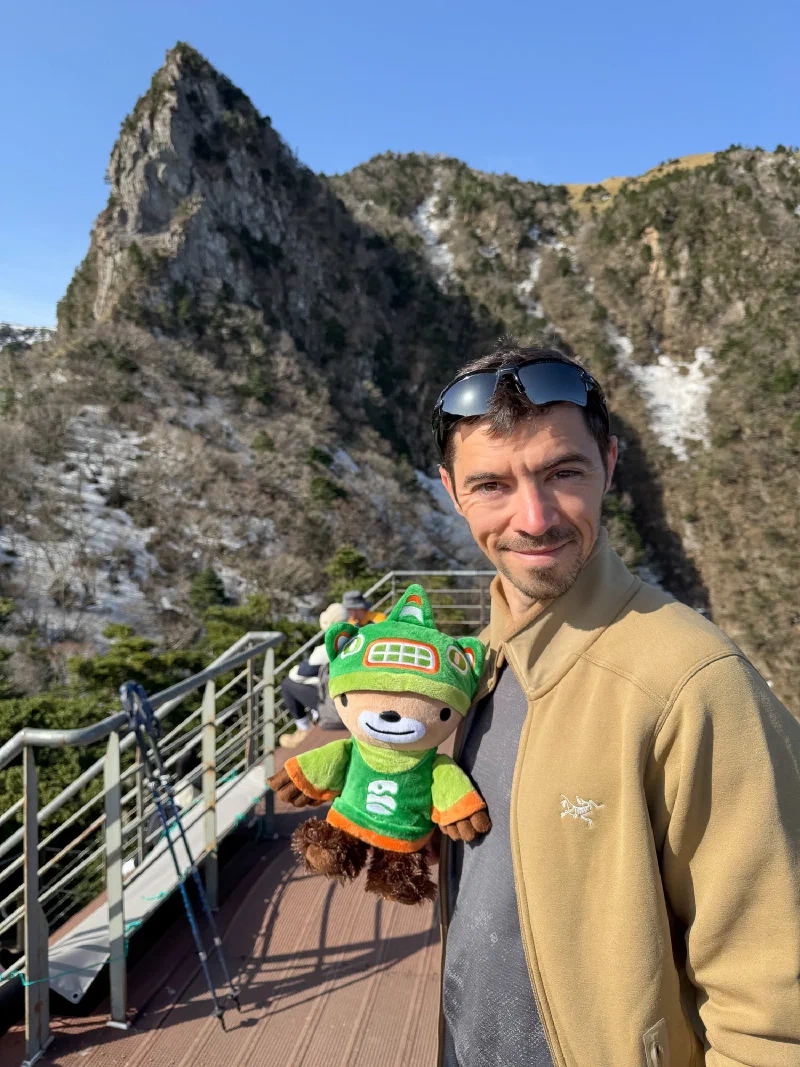
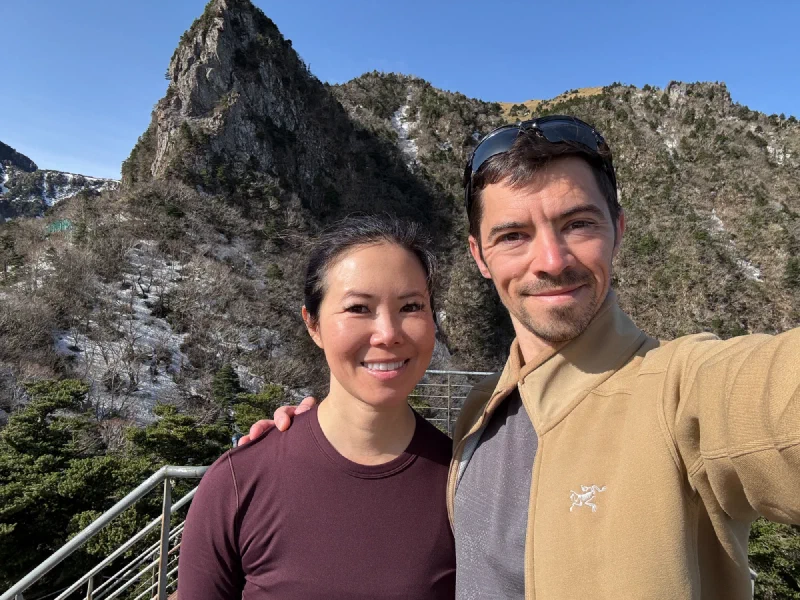
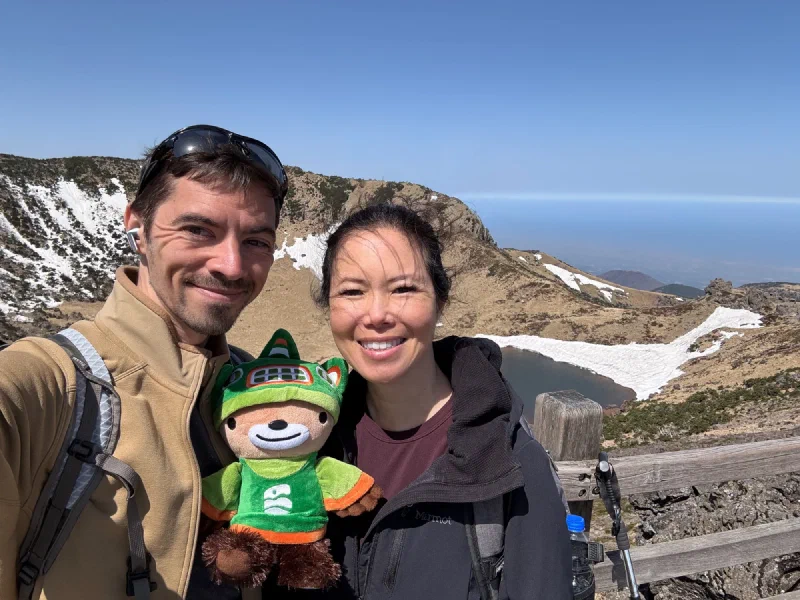
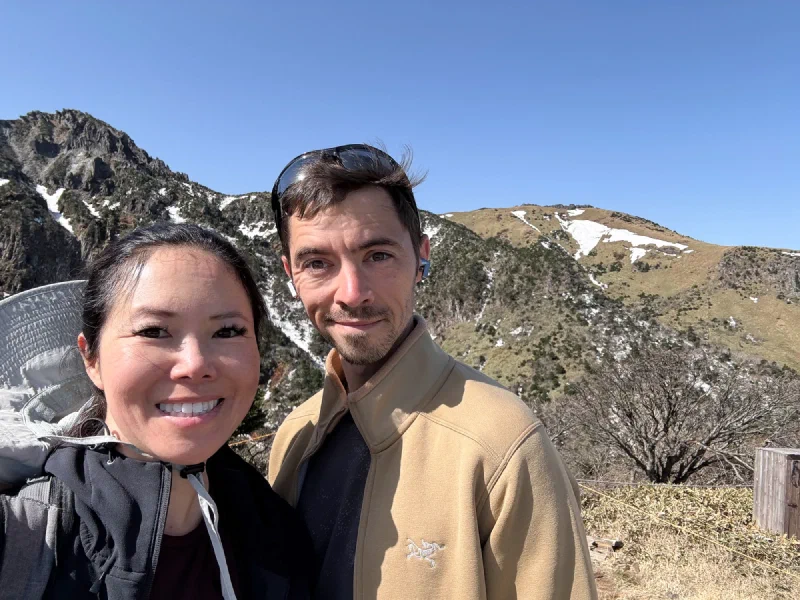
The summit selfie. Six weeks post-knee-katana. Not bad.
The summit area is volcanic chaos. Jagged rock spires, sheer crater walls, the remnants of an eruption that happened long before anyone was around to complain about it. They’ve built a whole observation platform up there with wooden decking and railings.
The shelter near the top. Signs everywhere telling you what not to do.
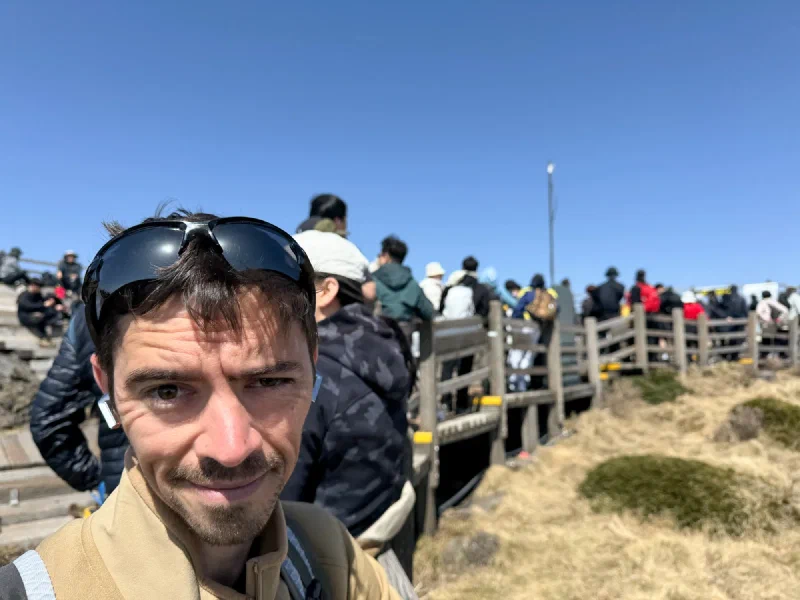
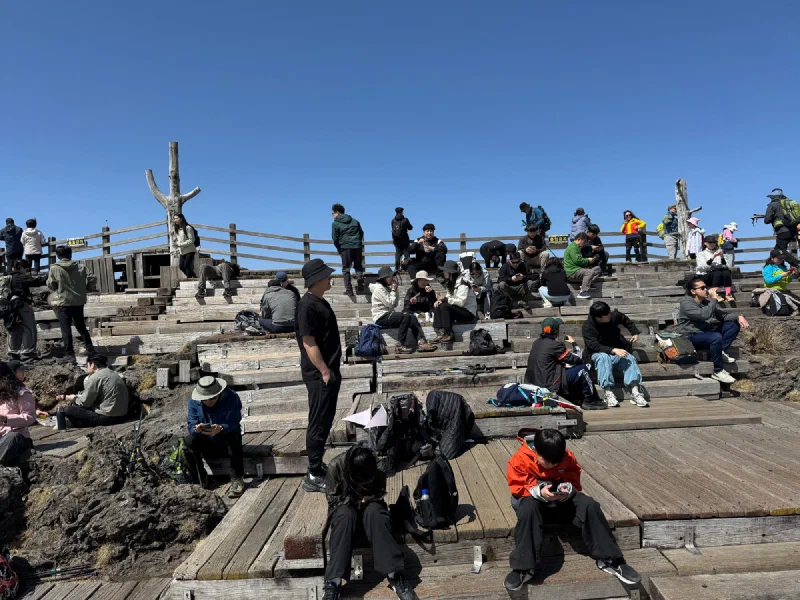
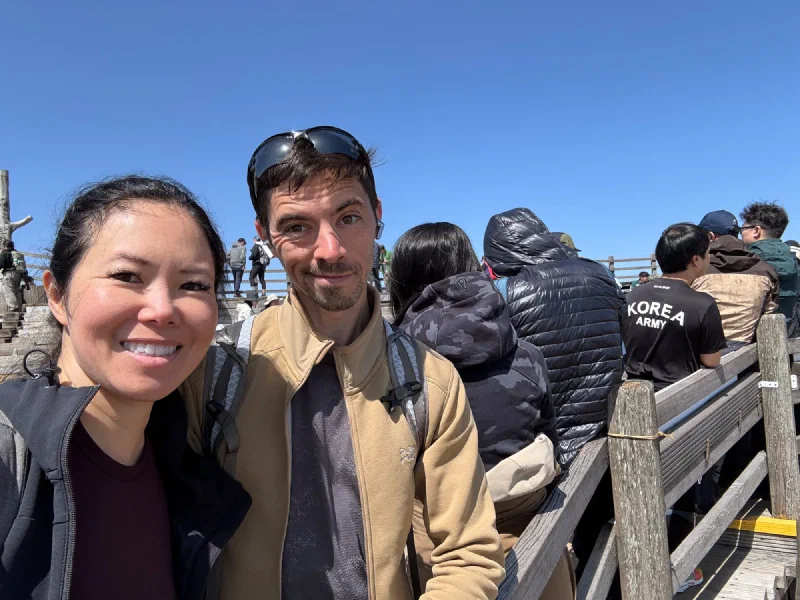
The summit was packed. Dozens of hikers sitting on the wooden decks, eating, resting, checking their phones. Half of them had crampons strapped to their packs. We pretended we left ours in the car.
And then we saw the crater.
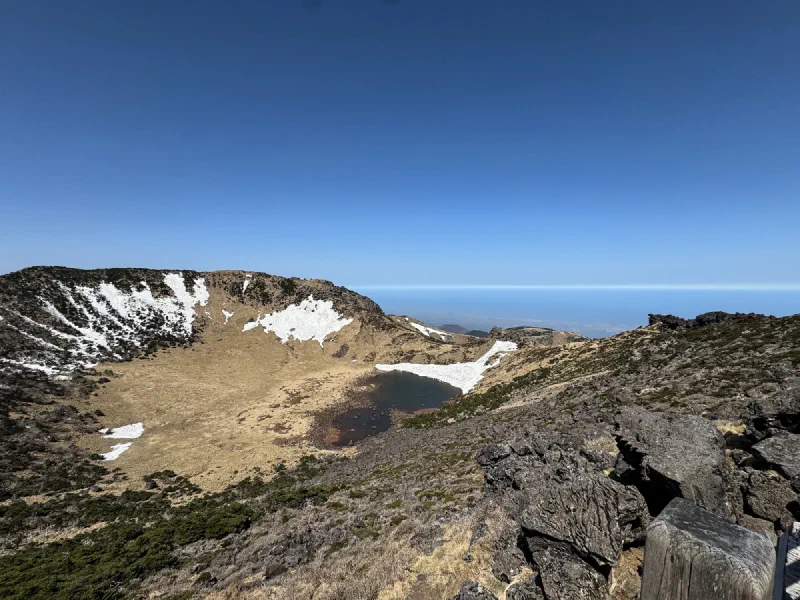
Baengnokdam. White Deer Lake. 1,950 meters up, sitting in a volcanic crater, looking out to the ocean.
Baengnokdam. The crater lake at the very top of Hallasan. A dark pool sitting at the bottom of a volcanic bowl, ringed by snow-patched walls and golden alpine grass, with the entire island falling away to the sea beyond the rim.
I’m not going to say it was worth almost dying on the ice for. But I’m not going to say it wasn’t.
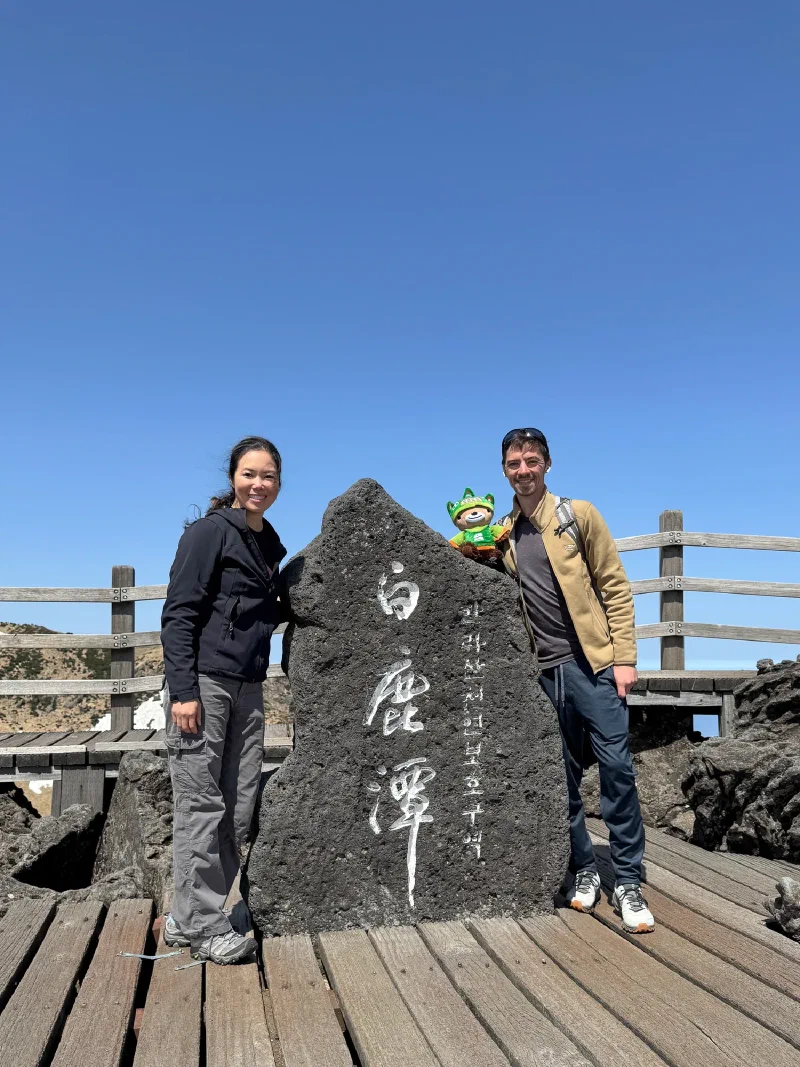
The summit stone. That’s me on top. As I should be.
We found the summit marker stone. “白鹿潭” carved into volcanic basalt. I took my rightful position on top of it.
Three at the top. One of us weighing significantly less than the other two.
Pokin, by the way, was jealous of all the other hikers eating piping hot cup noodles at the summit. Apparently that’s a thing on Korean mountains — you hike up, you eat ramen at the top. We didn’t know. We brought granola bars like amateurs.
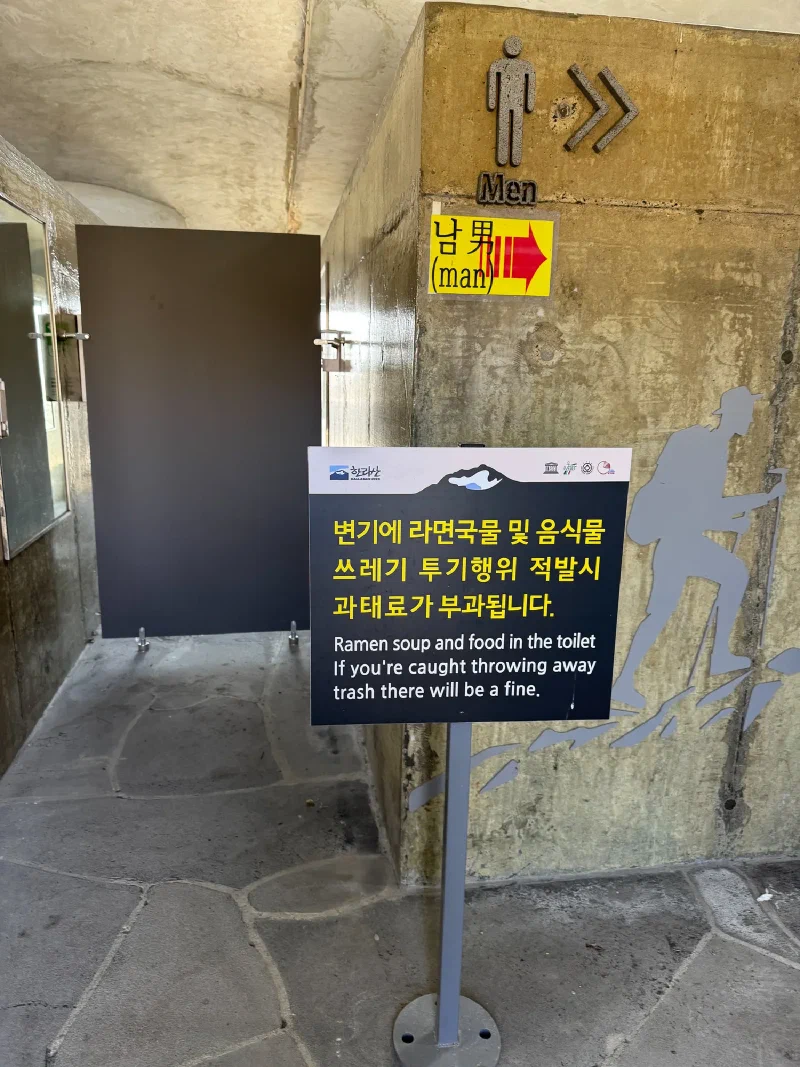
So many hikers dump ramen broth in the toilets that they made an official sign about it. Korea.
The ramen situation is so serious that the park had to put up signs warning people not to dump their leftover broth in the toilets. Fines and everything. This is the level of ramen commitment we’re dealing with.
Now came the fun part: getting down.
We decided that descending the way we came up was probably too slippery and dangerous without crampons. There was a second route down that should be easier.
It was not easier. Just as snowy. Just as icy. Just as much “grab the rope railing and pray.”
On the way down, though — above the clouds, Jeju’s coastline stretched out below us, the oreums dotting the island like green bubbles from up here. Almost made you forget your shoes had no grip.
But we made it. Both knees intact. All 186 grams of me accounted for.
Back on flat ground, we did what any reasonable group of people would do after accidentally summiting a mountain: we ate everything.
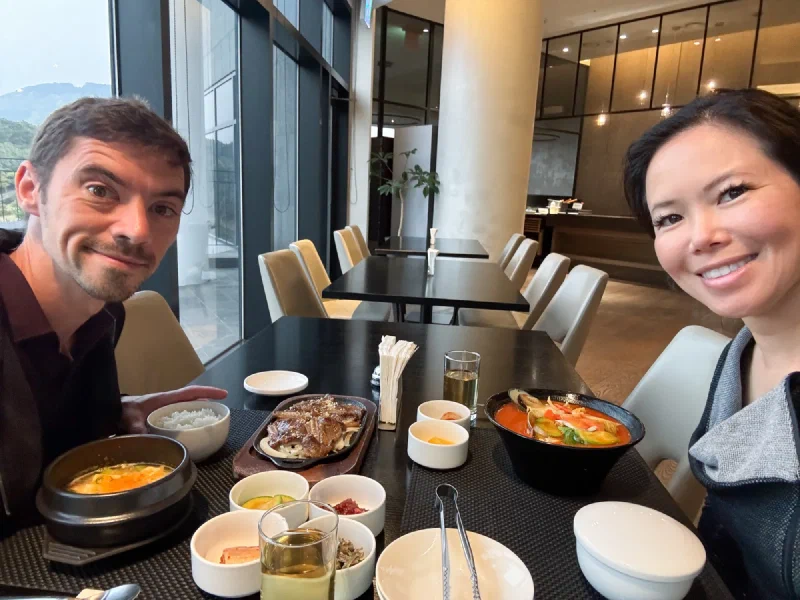
Bulgogi, sundubu-jjigae, jjamppong, rice, and enough banchan to forget the ice ever happened.
The hotel restaurant delivered. Sizzling bulgogi, a stone pot of soft tofu stew, a massive bowl of seafood jjamppong, and banchan stretching across the table. After eight hours of hiking on ice, I have never been more grateful for a hot plate of meat.
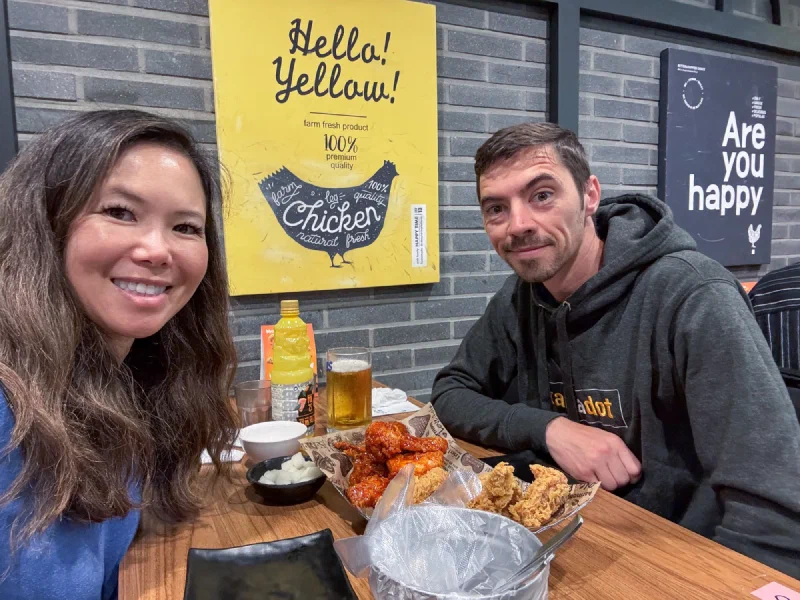
Chimaek. Chicken and beer. The Korean post-hike ritual we didn’t know we needed.
Then chimaek. Korean fried chicken — half yangnyeom (spicy glazed), half crispy — with beer. This is apparently the correct way to end any day in Korea. I don’t argue with traditions that involve fried food.
We made it back to the hotel in time to watch Nanta, a Korean percussion show, which was loud and chaotic and exactly the right energy for a day that started with “we’ll go as far as we can” and ended at the summit of South Korea’s highest mountain.
Oh, and across from the hotel? A planetarium.
Of course I made Nicholas take me.
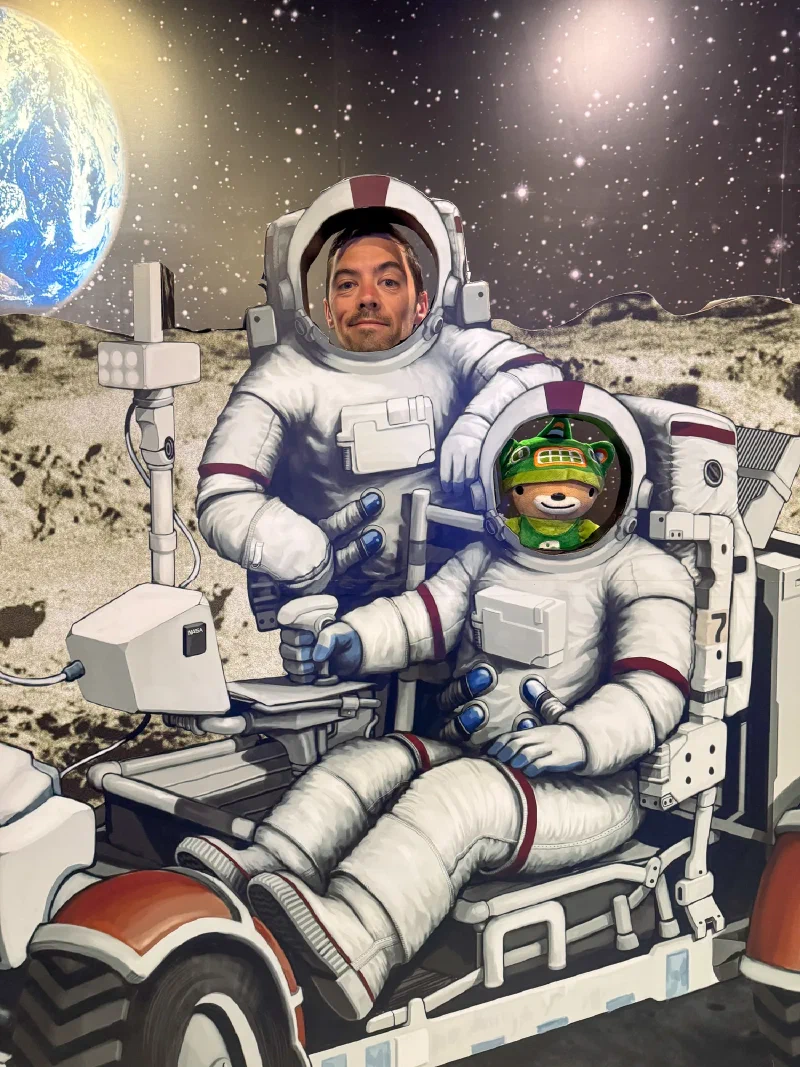
Commander Sumi Shepherd, reporting for lunar duty. Nicholas is my co-pilot. As usual.
We checked out the space exhibits, posed as astronauts on a lunar rover (I fit the helmet better, for the record), and I got to look at the stars from an island in the middle of the ocean.
Hallasan didn’t care that we didn’t have crampons. It didn’t care about Nicholas’s knee. It just sat there being a volcano while we slid our way to the top and back. The mountain doesn’t negotiate. You show up, you deal with whatever it gives you, and if you make it back down, you eat chicken.
We stopped in Busan on the way to Jeju because people told us we should. It’s Korea’s second biggest city, right on the southern coast. Ocean, cliffs, seafood, the whole deal.
First order of business: lunch.
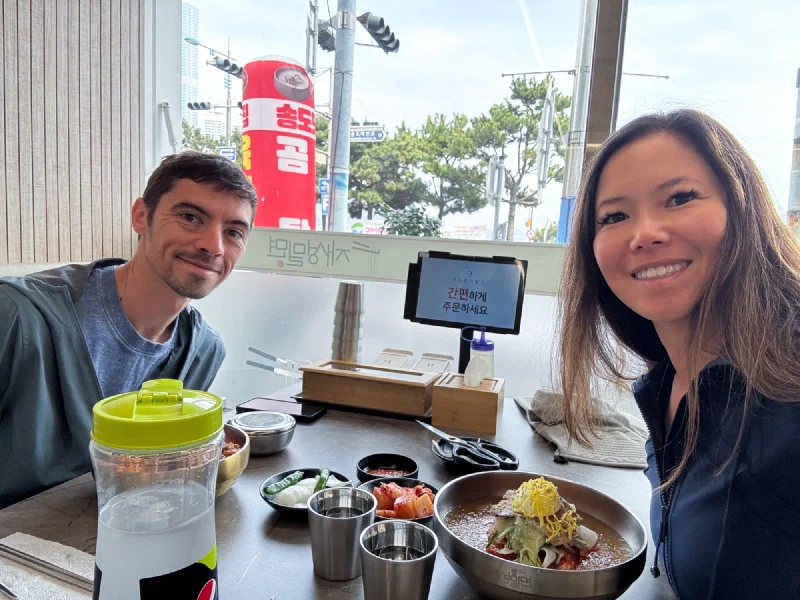
Busan naengmyeon. Cold noodles, hot takes, tablet ordering.
Naengmyeon. Cold buckwheat noodles with banchan. Ordered from a tablet because Korea has figured out that talking to waiters is optional.
Pokin was tired and had work to catch up on, so she stayed back at the hotel after lunch. Which left Nicholas and me.
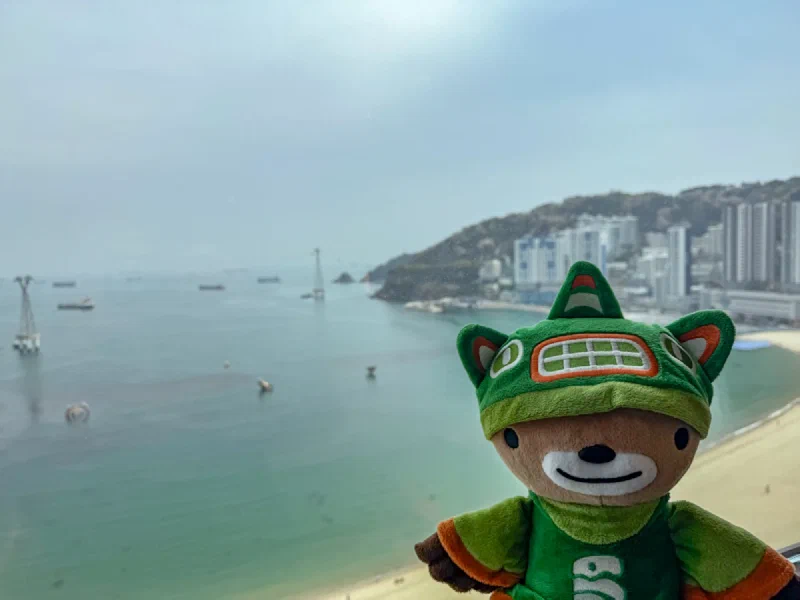
I told him to take me to see the ocean. He needs to keep working that knee anyway. The big hike is day after tomorrow and I’ll be honest, it’s looking dicey. But he’s pulling through.
The ocean. Finally.
Busan’s coastline is something else. We started walking along the shore and just kept going, up paths we probably weren’t meant to take, along cliffs we probably weren’t meant to climb.
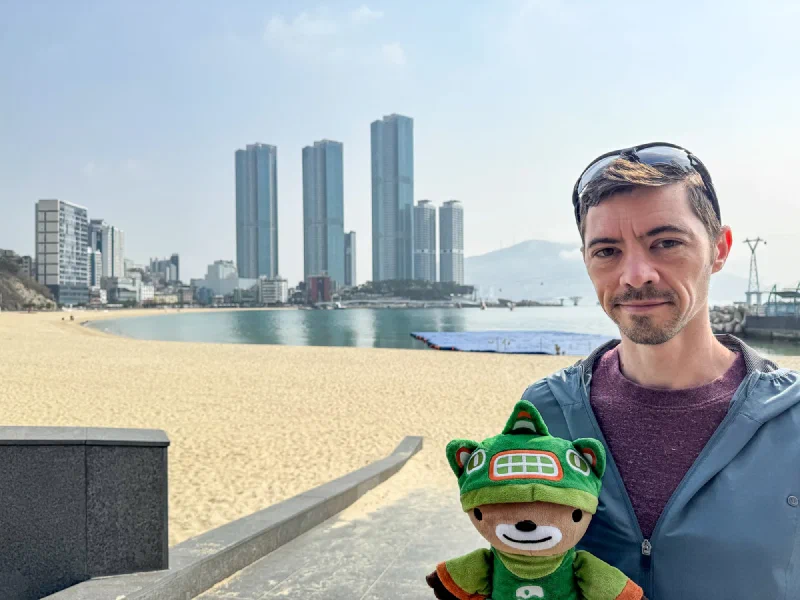
Empty beach, wall of skyscrapers. Busan in one photo.
The beach was nearly empty. Off-season. Just us and the skyscrapers across the water.
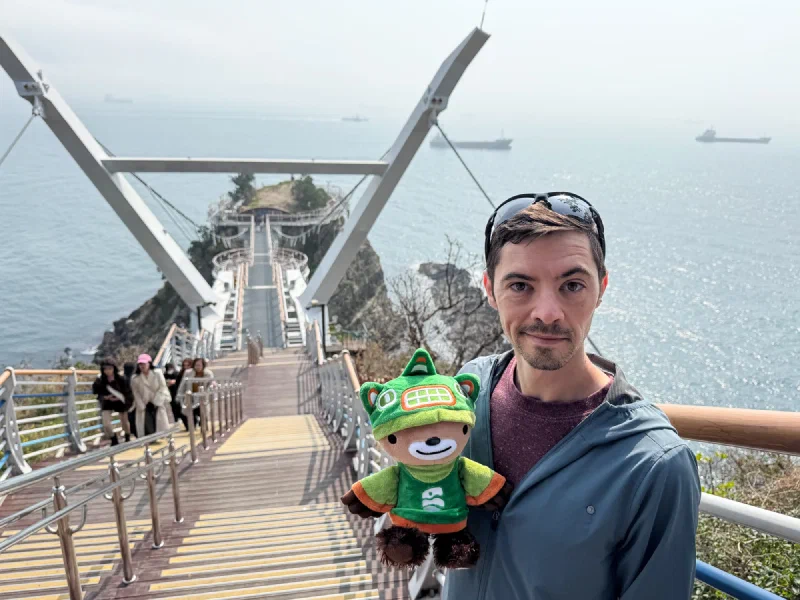
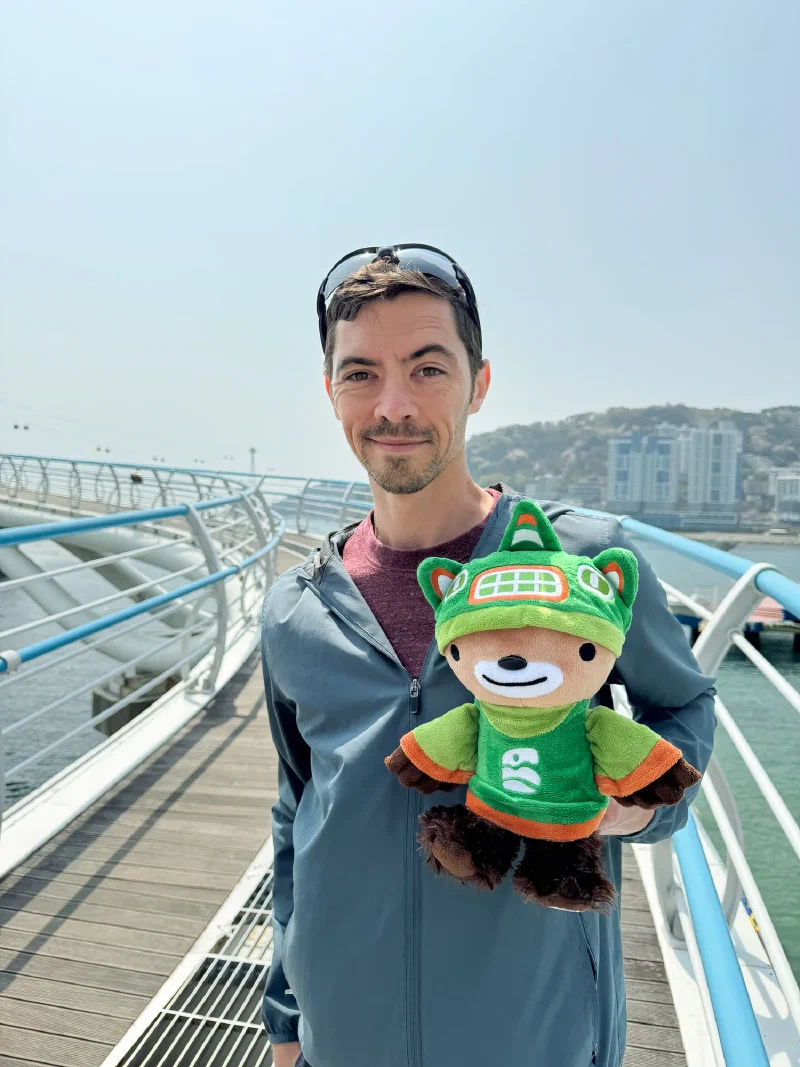
They built a walkway out over the ocean. I walked on it. Over. The ocean. I’m very brave.
They built this skywalk that extends right out over the water. Glass floor, waves underneath. I am on record as being dramatically anti-water, so I want it noted that I walked out there anyway. Bravery.
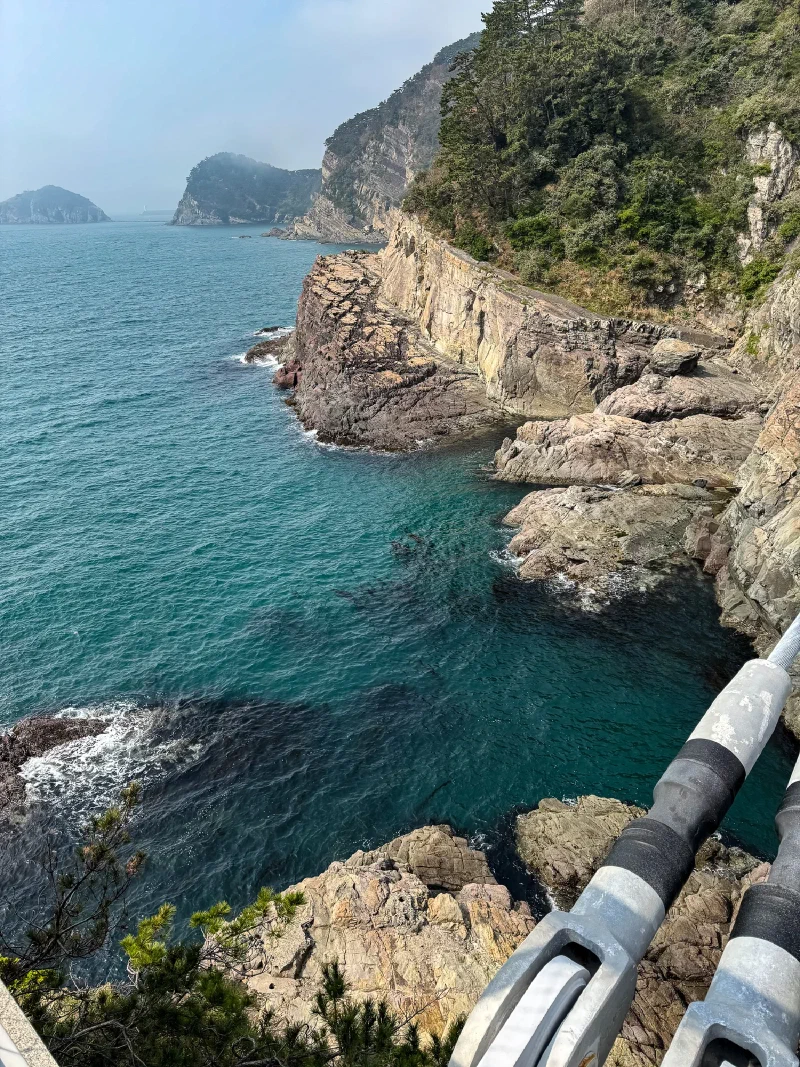
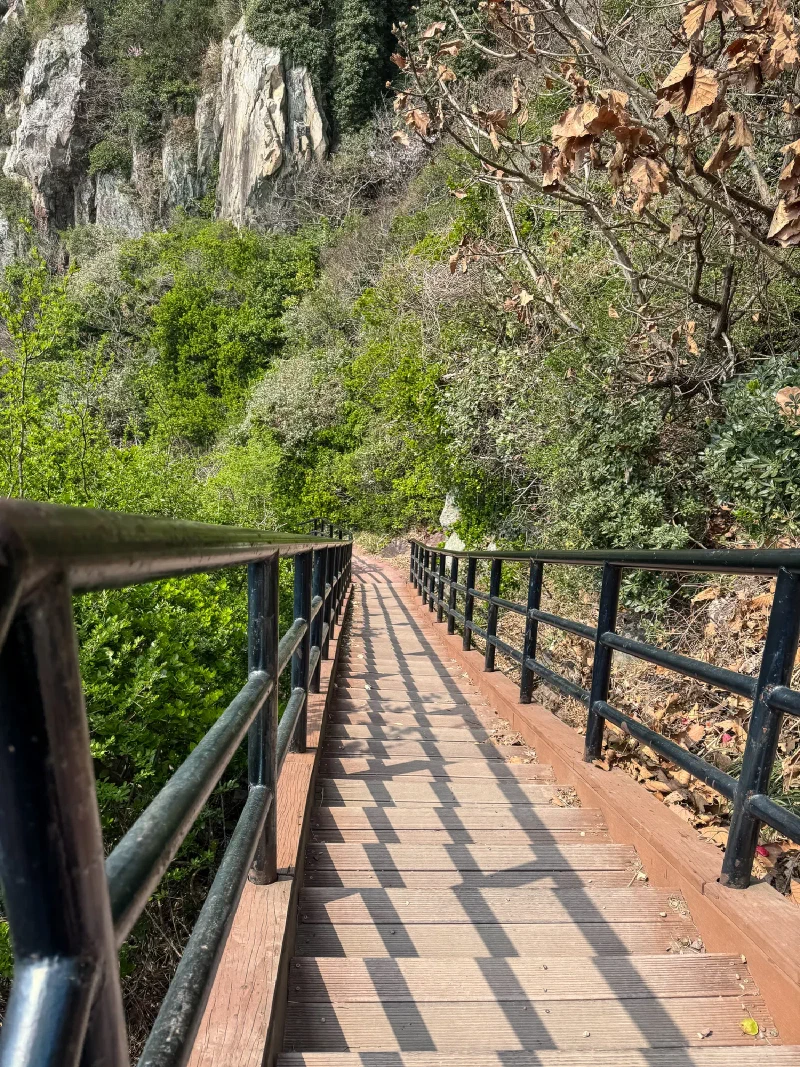
The coastal trail kept going. Rocky cliffs dropping straight into turquoise water. Staircases carved into the hillside. The kind of path where you’re either going straight up or straight down, and every landing has a view that makes you forget you’re out of breath.
Next day, all three of us went back out. Same coast, but farther.
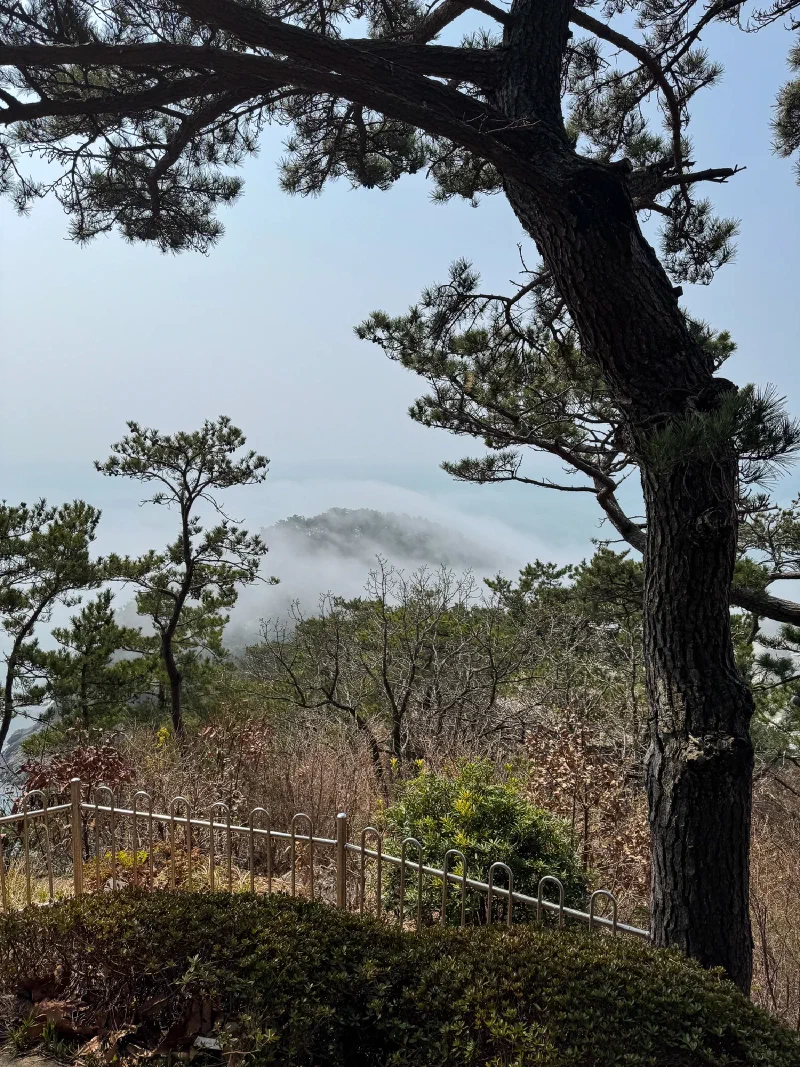
Morning mist through the pines. Even I shut up for a minute.
Morning mist rolling through the pines on the hillside. Quiet. The kind of view you don’t need to say anything about.
We kept walking until we hit the Songdo Cable Car area, where things took a turn.
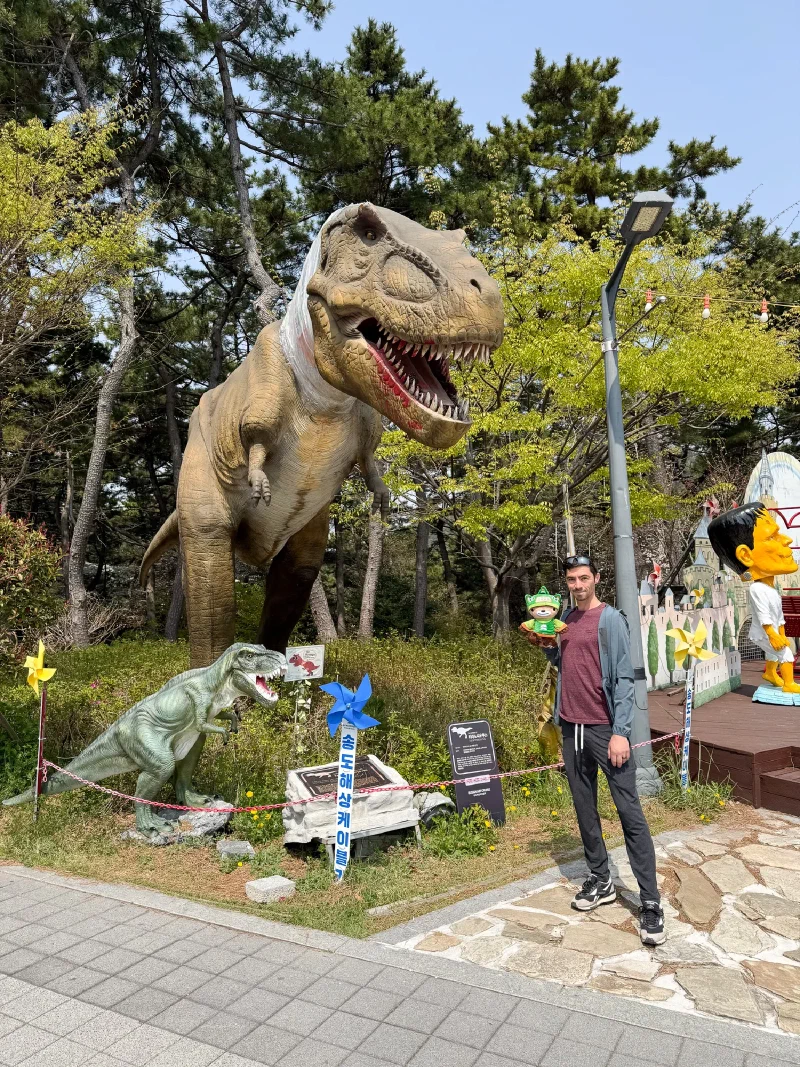
Nobody mentioned the dinosaurs.
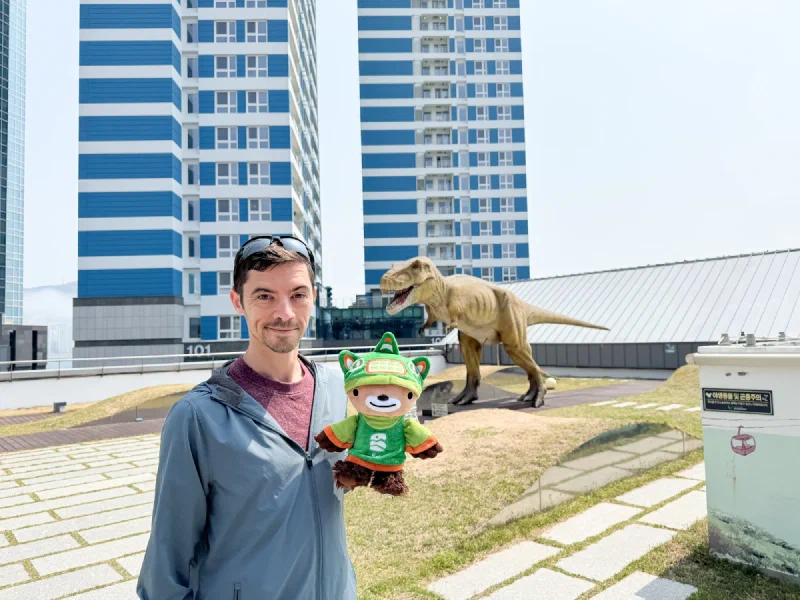
There were dinosaurs. Full-sized dinosaur statues. Just there. At the cable car park. No explanation. No museum. Just a T-Rex with blood on its mouth standing next to a ticket booth like it works there. Teeth bared. Eyes dead. I respect the commitment. This is how you welcome guests.
Korea does this thing where they put random sculptures and statues in public spaces and nobody questions it. Giant blood-mouthed predators at a coastal gondola? Sure. Why not. I’m into it.
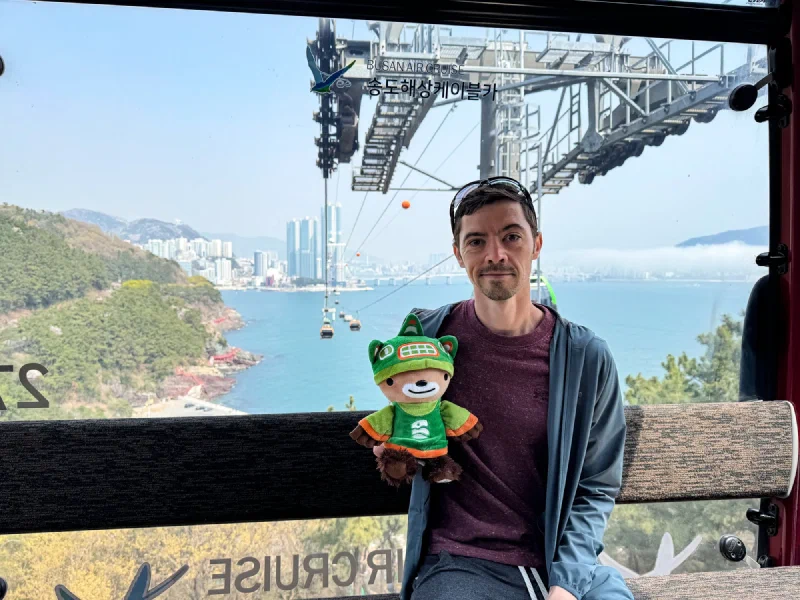
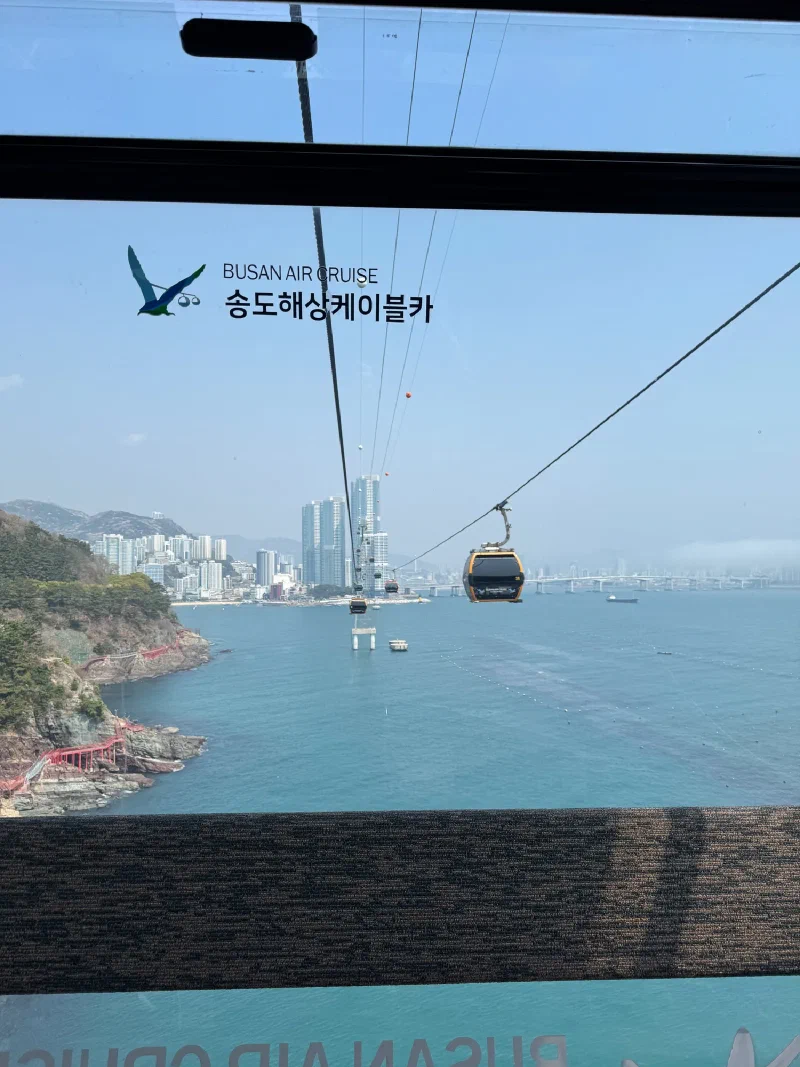
We took the cable car back.
This is how you skip the walk back.
The Songdo Cable Car runs right over the ocean, connecting the coastal park back to the city. Gondolas gliding over turquoise water with the whole Busan skyline stretched out ahead of you.
More dinosaurs greeted us at the Busan terminal. Because of course they did.
Another boardwalk over water. Korea really wants me to confront my fears.
Busan surprised me. I expected a city with a beach. I got a city built into cliffs, wrapped around an ocean, full of trails and cable cars and dinosaurs that nobody can explain.
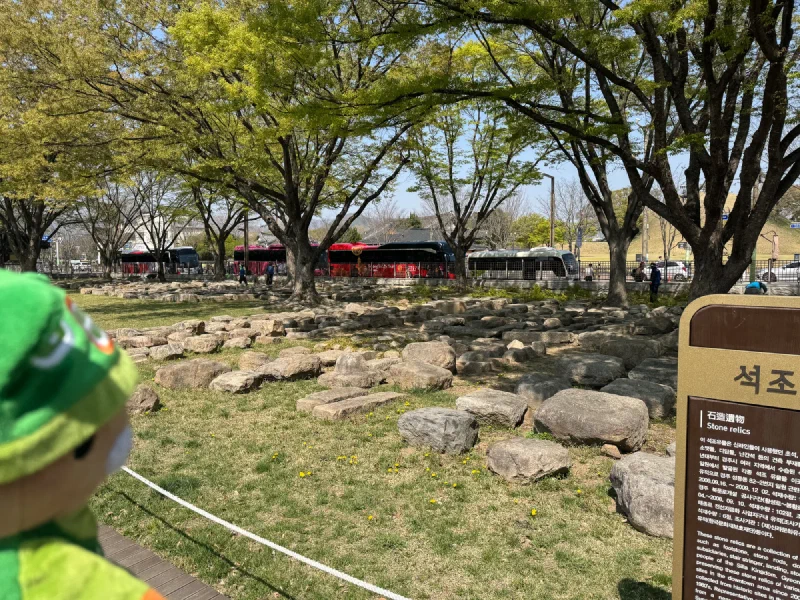
Korea has been through a lot of wars. Seoul was nearly flattened during the Korean War. Most of the country’s wooden palaces and temples have been lost to fire, neglect, or conflict over the centuries. Gyeongju is the exception. Not because everything survived, but because the things that are hardest to destroy did: the stone monuments, the earthworks, the ancient city layout, the burial mounds. The old capital of the Silla dynasty kept its bones when everywhere else lost theirs.
So naturally, we took the train down to see it.
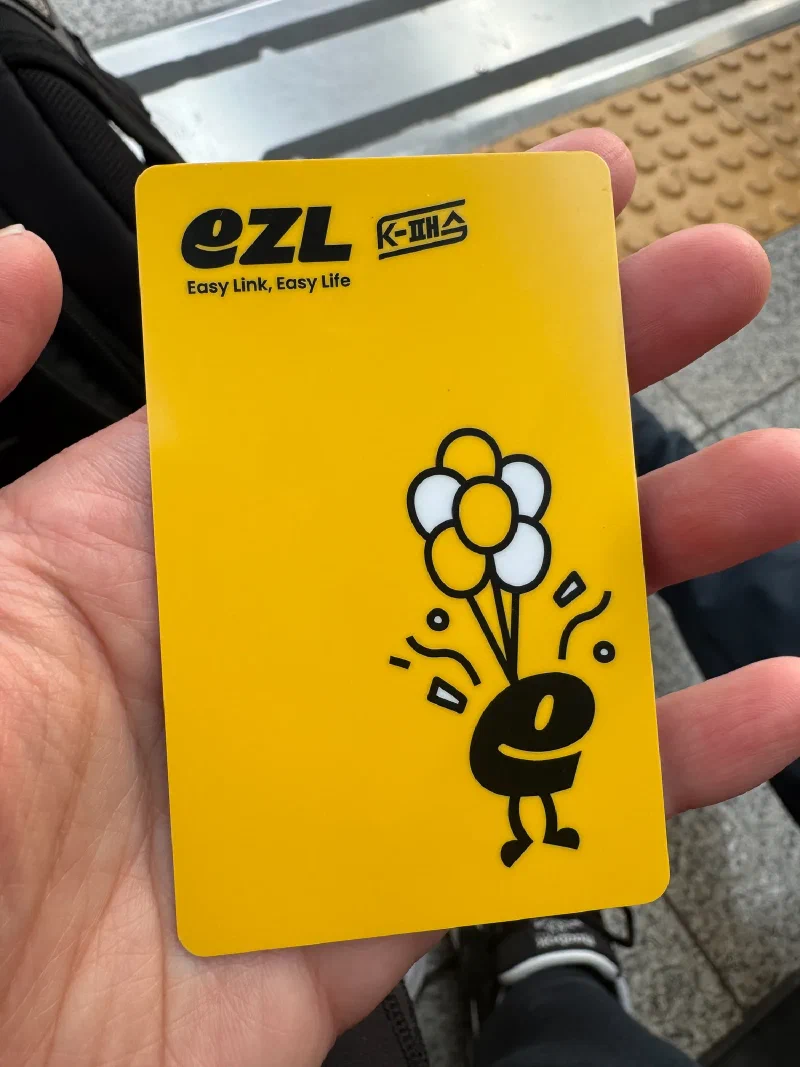
K-Pass. Easy Link, Easy Life. It says so right there.
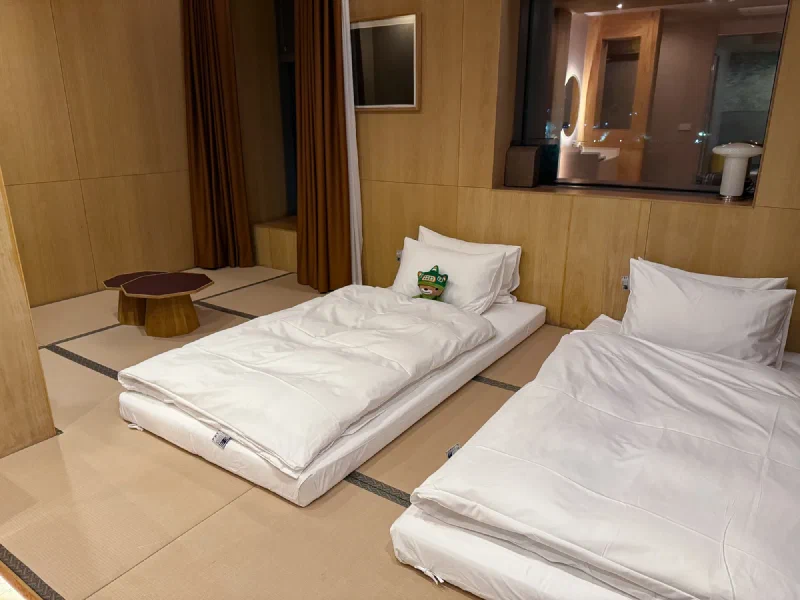
We got our K-Pass, hopped on the KTX, and arrived in Gyeongju. The hotel was… interesting. Korean-style ondol room with floor-level futons, warm wood walls, and a bathroom that was genuinely larger than the bedroom. I’m talking a full stone soaking tub, mosaic tiles, the works. The bedroom was basically a very fancy closet. Priorities.
Tucked in and ready to ignore whatever Nicholas has planned for tomorrow.
We got in too late for any real dinner, so we did what you do in Korea when everything’s closed: convenience store.
Fine dining.
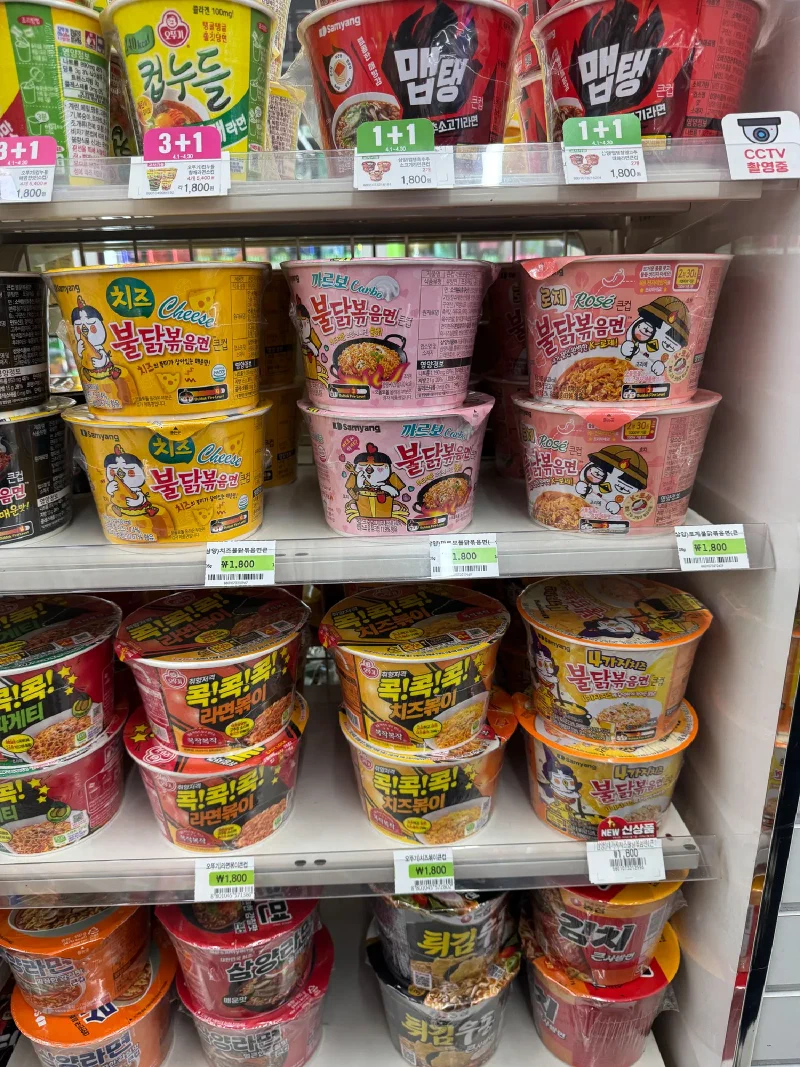
Korean convenience stores are something else. An entire wall of Buldak fire noodles in flavors like Cheese, Carbo, and Rosé. ₩1,800 each.
The hotel had a strict no-food-in-the-room policy. We bought the ramen anyway, smuggled the bowls upstairs, and ate them in silence like criminals. Did our best to leave no trace. The steam probably gave us away.
Next morning, we went for a walk. Yes, Nicholas is still walking on his knee. The man is committed to pretending he’s fine.
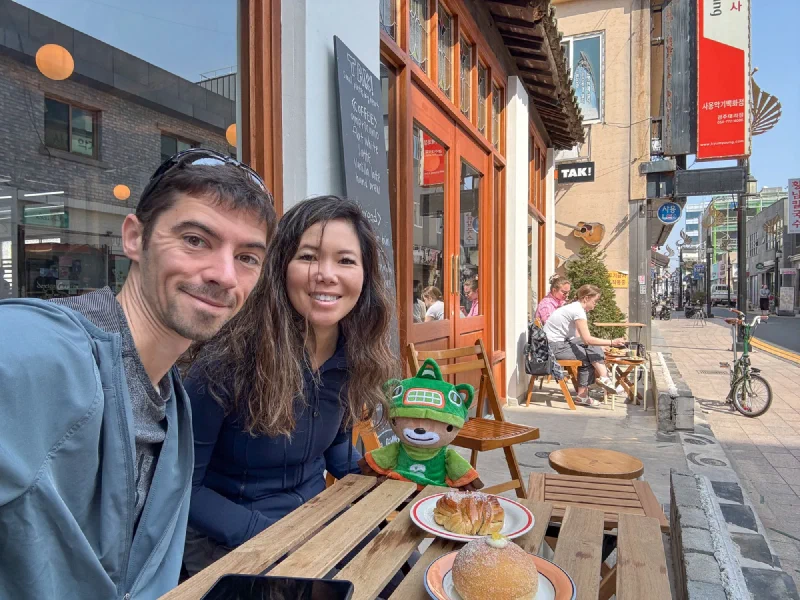
Fika. Ask Nicholas’s mom about it. She won’t stop talking about it.
We found a café doing fika. If you don’t know what fika is, it’s the Swedish tradition of sitting down for coffee and pastries, and taking your time about it. Nicholas’s mom is obsessed with it. We did fika in Sweden and now we can’t escape it. It follows us.
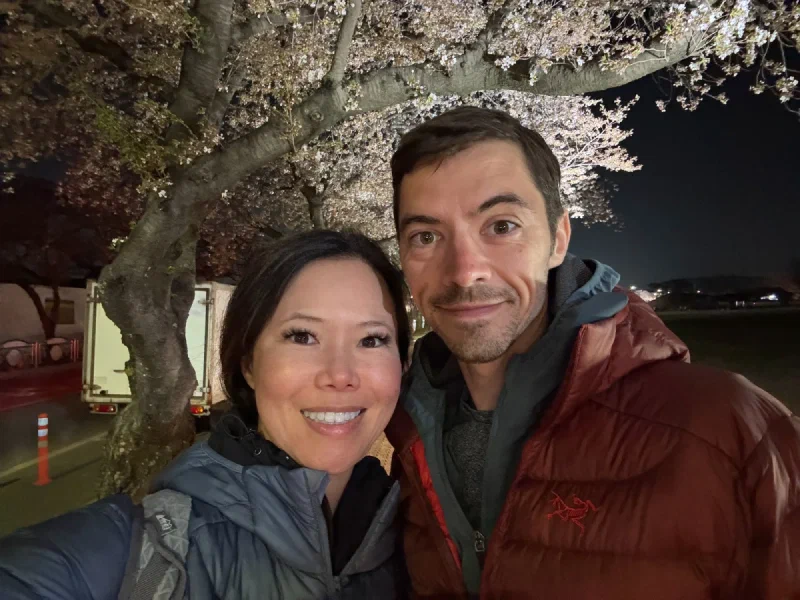
Fueled up, we went to see the thing Gyeongju is famous for: the burial mounds.
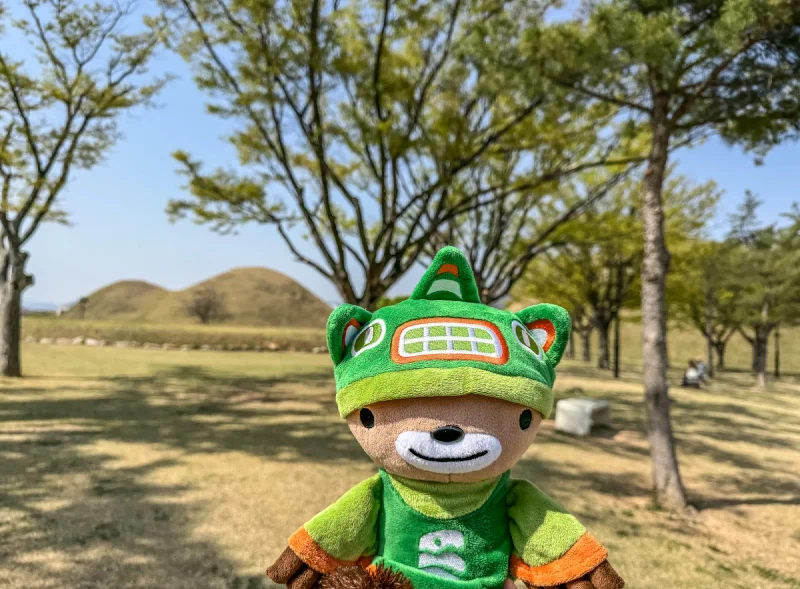
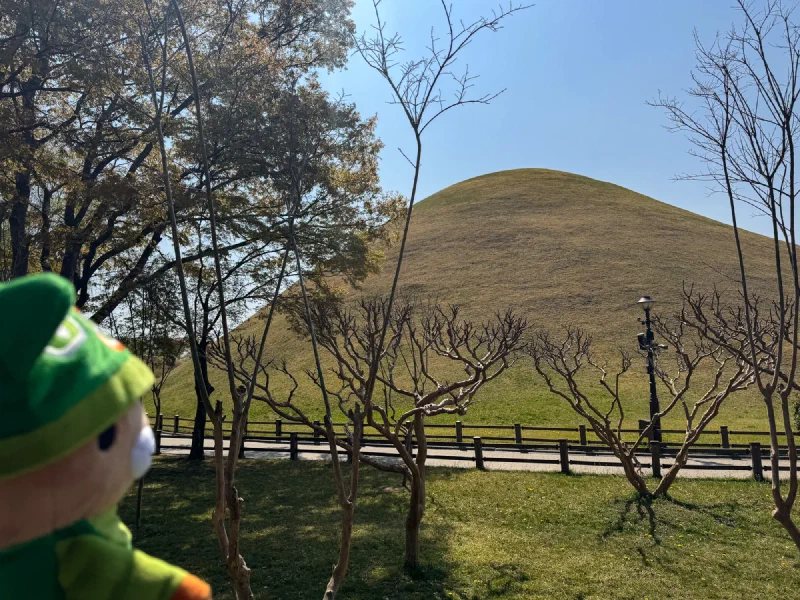
1,500-year-old royal tombs. Just sitting there in the middle of town.
These are Silla dynasty royal tombs. Giant grass-covered domes, right in the middle of the city, just sitting there between apartment buildings and cafés. Each one has an ancient king or queen buried underneath. Sacred ground. You can walk right up to them, but you can’t walk on them. Strictly forbidden, protected national heritage.
It’s wild. In most countries, something like this would have a fence and a gift shop and a $30 entrance fee. In Gyeongju, it’s just part of the scenery. People jog past them.
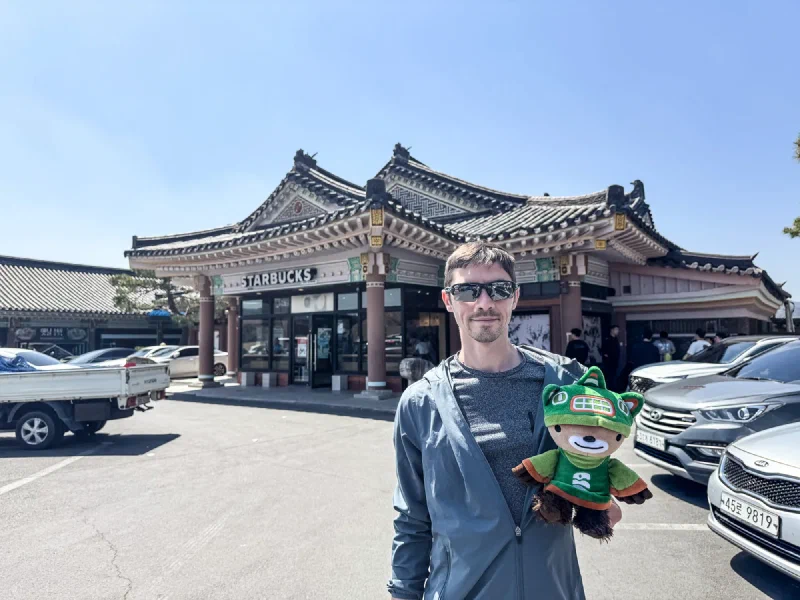
Even Starbucks has to dress up for Gyeongju.
Even the Starbucks is in a traditional hanok building with curved tile roofs. The city has strict building codes to preserve the historic character. No modern eyesores. Just a Frappuccino served under 600-year-old architecture. As it should be.
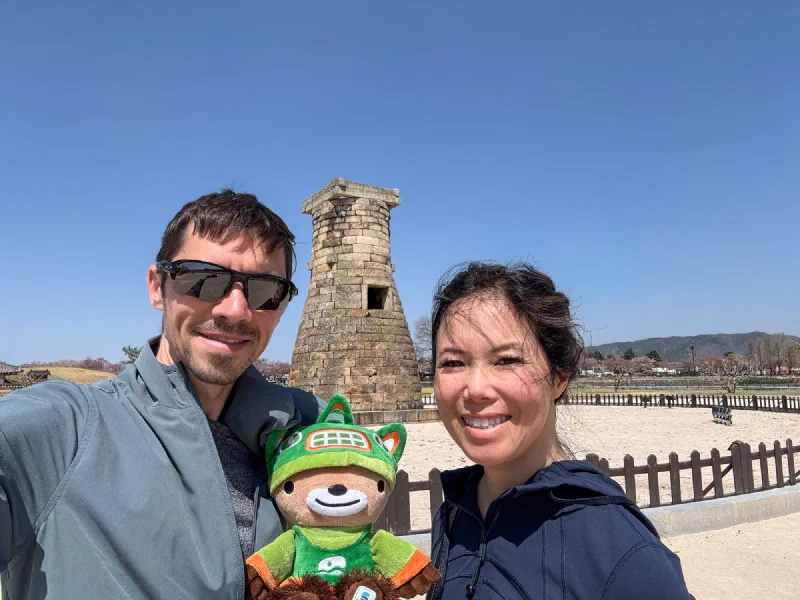
Oldest astronomical observatory in East Asia. Built in the 7th century. Still standing.
Cheomseongdae. The oldest surviving astronomical observatory in East Asia, built during the Silla dynasty in the 7th century. It’s a stone tower about 30 feet tall and it’s been standing there for 1,300 years. People were studying the stars from this thing before most of Europe had figured out plumbing.
We specifically sought this one out. My bud and I are space bears. We’ve watched Starship catch its own booster. We’ve stared at the Milky Way from a dozen countries. The idea that someone built a stone tower in the 7th century just to look up and try to understand what was out there? That’s our kind of people.
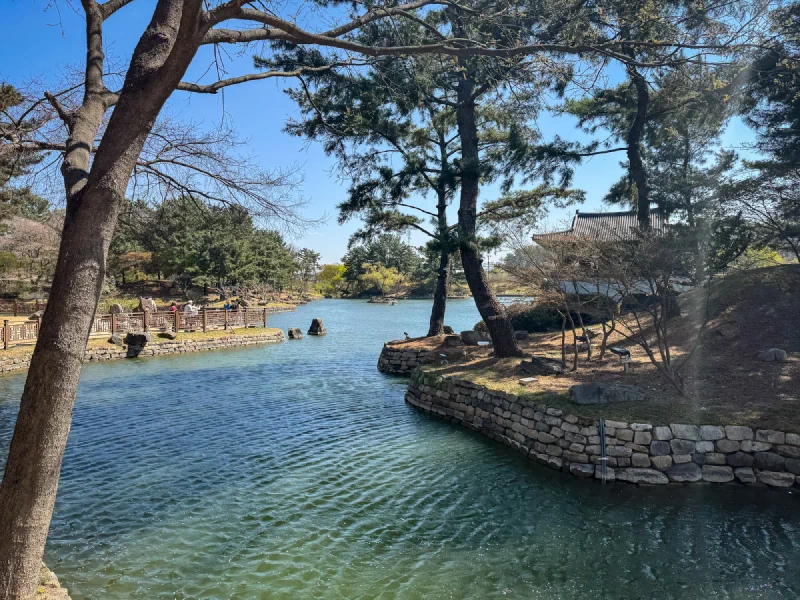
Wolji Pond. The Silla royals built this as their garden. Good taste.
Wolji Pond was the royal pleasure garden. Stone-lined banks, pine trees, pavilions reflected in turquoise water. The Silla kings would throw parties here. I respect a dynasty that prioritizes a good garden.
The paint job on these corridors is called dancheong. Every color means something. Green is for youth. I’m wearing it.
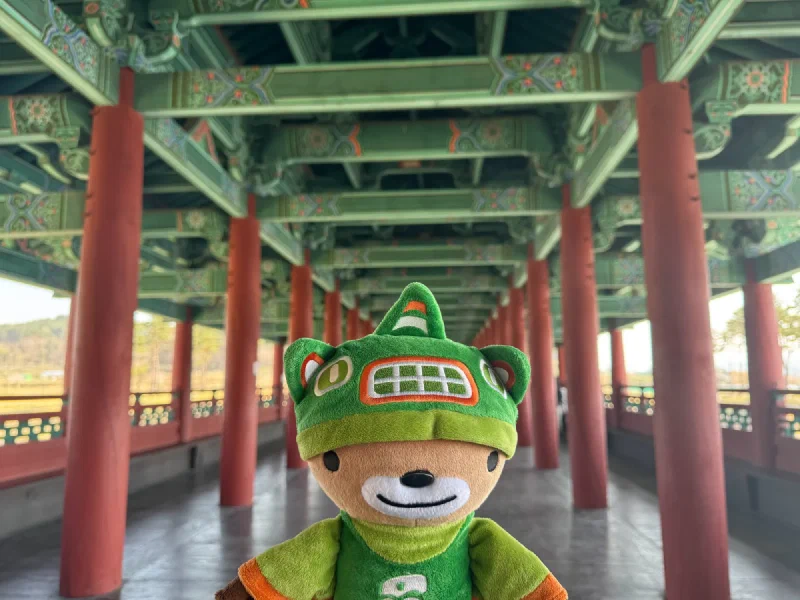
The temple corridors have these painted wooden beams called dancheong. Red, green, blue, gold, all in intricate geometric patterns. Every color has meaning. Every pattern follows rules that are centuries old. Someone painted each one of these by hand.
Woljeonggyo Bridge. Reconstructed, but still impressive.
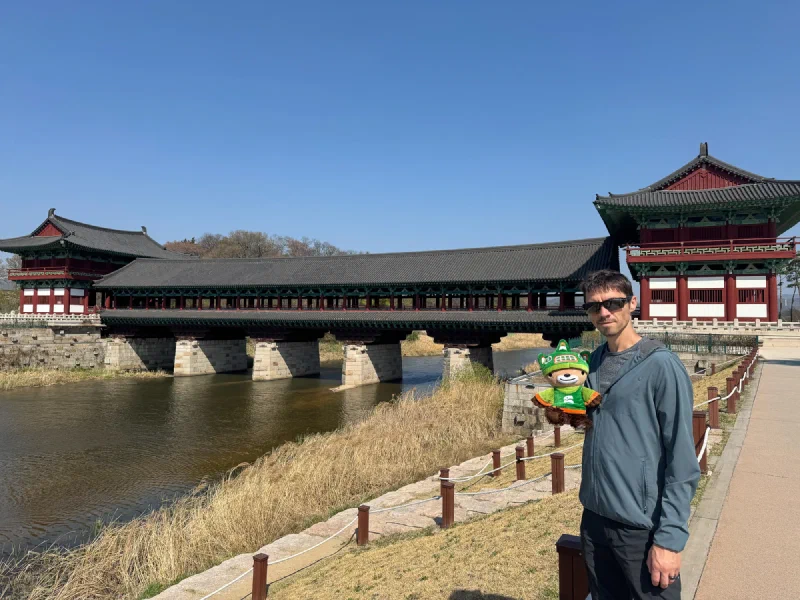
Woljeonggyo Bridge. This one’s a reconstruction, but it’s built to the original Silla-era specifications. Two-story pavilions on each end, stone piers in the river. It’s the kind of bridge that makes you realize modern bridges are boring.
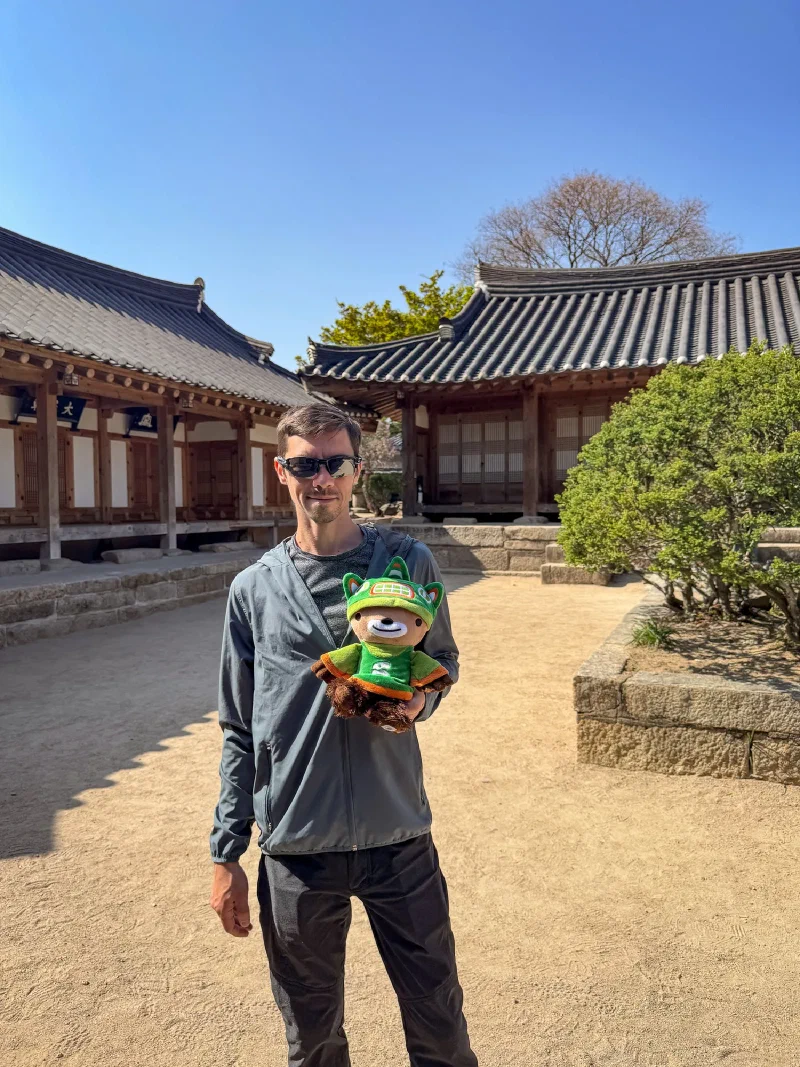
We wandered through an old compound that looked straight out of Rurouni Kenshin. Stone walls, wooden gates, a courtyard so quiet you could hear yourself breathe.
If a samurai walked out of one of these doors I would not have been surprised.
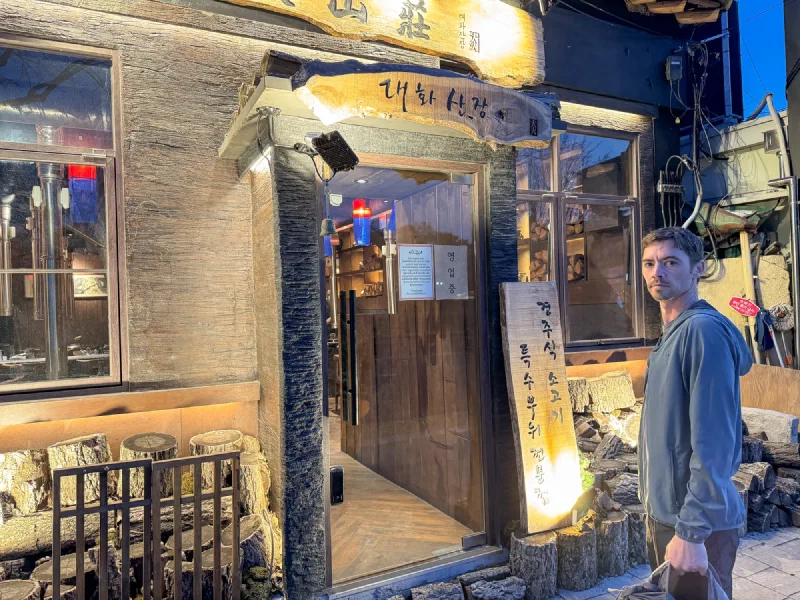
As the sun went down, we found what turned out to be the best Korean BBQ of the entire trip.
Real burning coals. Not gas. Not electric. Actual fire. This is the way.
Not the sanitized tourist version with gas burners. This place used real burning coals. The meat was incredible. After a full day of walking on a busted knee, Nicholas deserved this. I’ll give him that.
Then came hwangnam-ppang for dessert.
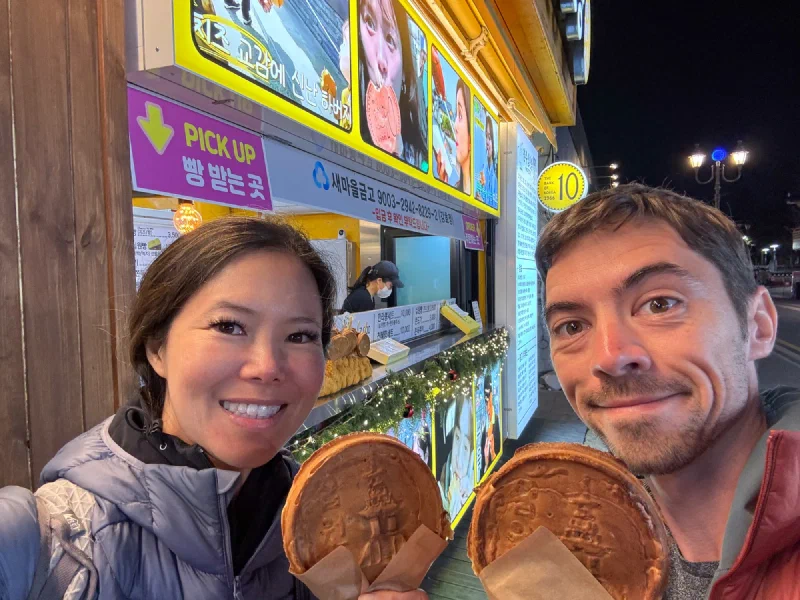
Hwangnam-ppang. Gyeongju’s signature snack since the 1930s.
Little bread buns filled with sweet red bean paste. Warm, soft, not too sweet. You buy a bag from a street vendor and eat them while walking home past 1,500-year-old tombs under the streetlights.
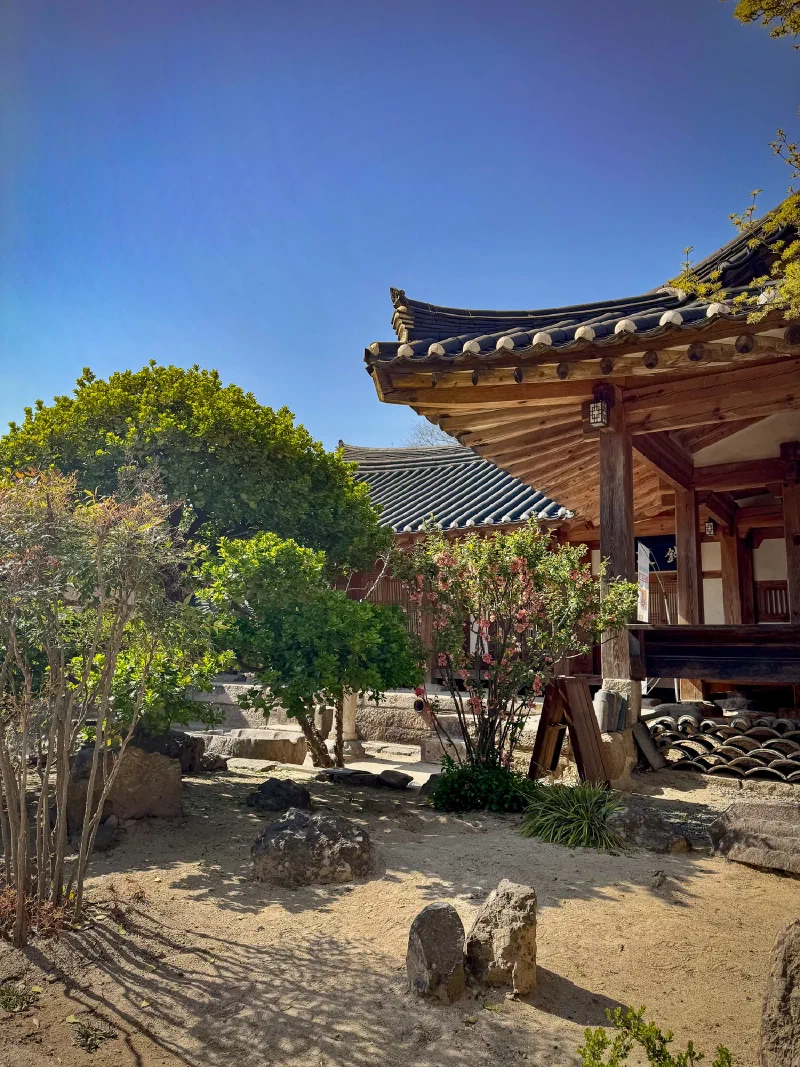
That’s Gyeongju. A city where ancient history is just the backdrop to daily life. Where a king’s tomb is something you walk past on the way home from dinner.
Day two in Seoul. Nicholas is still limping. The knee is “fine.” He needs it to be fine because there’s a big hike planned at the end of this trip, and if he can’t bend his leg by then, that hike isn’t happening.
Also, Korean elections were happening.
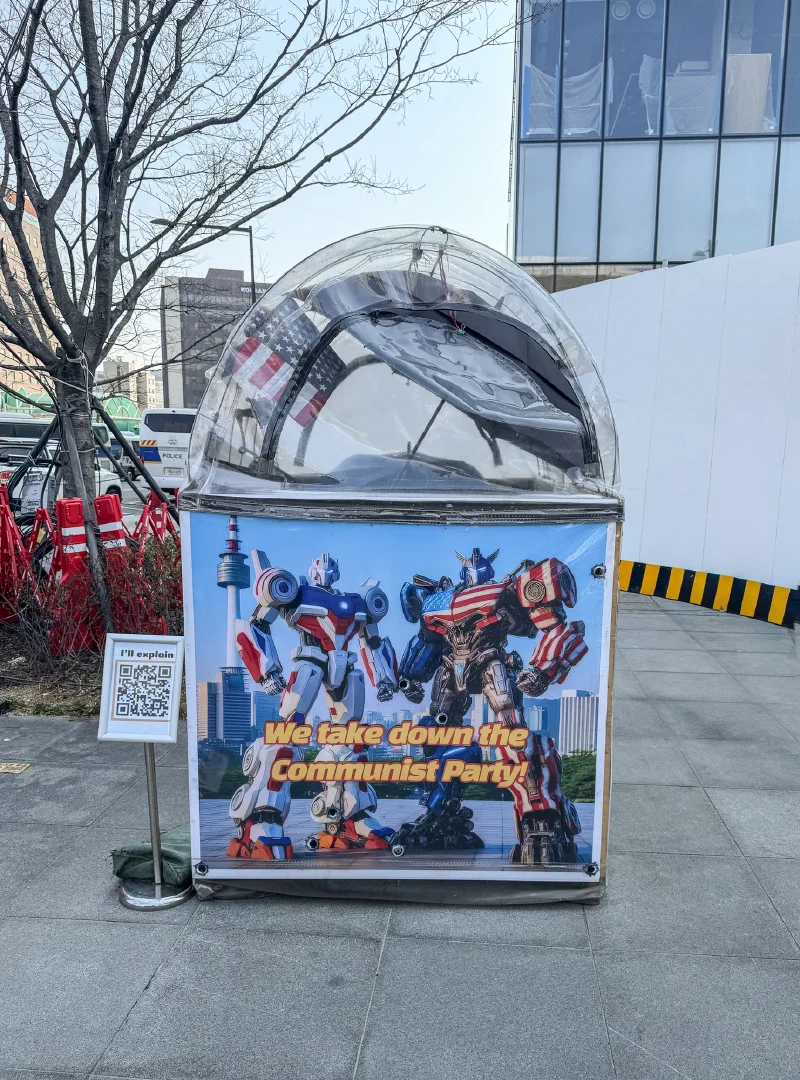
Just a normal sidewalk display.
We walked out of the hotel and immediately found ourselves in the middle of some kind of political rally situation. Barricades everywhere. Police vehicles. Campaign displays on the sidewalks with robots draped in American flags. The vibe was intense and very familiar in a way that was hard to place at first, and then very easy to place. Nicholas said it felt like watching a rally back home, just in Korean.
I can’t comment. I’m a bear. They don’t let me vote.
A lot of streets were barricaded off because of protests, which meant our walking route kept getting rerouted. More walking for peg leg. Great.
But walking in Seoul does have its perks.
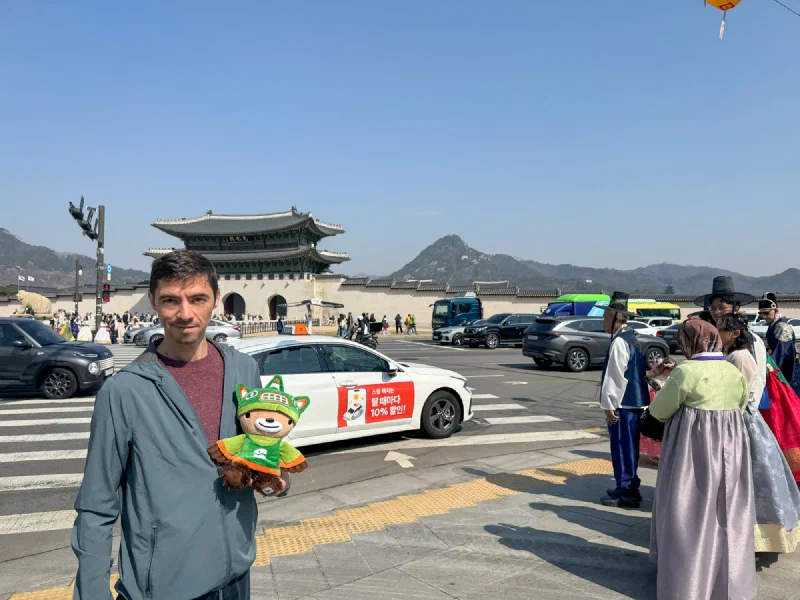
The gate to Gyeongbokgung Palace. People were walking around in traditional hanbok. I was walking around in traditional tunic.
Gwanghwamun. The main gate of Gyeongbokgung Palace. Built in 1395, burned down, rebuilt, burned down again, rebuilt again. Seoul’s whole deal, honestly. Everything here has been destroyed and rebuilt at least twice. Resilient city.
Visitors were dressed in hanbok, the traditional Korean clothing, which apparently gets you free entry to the palace. Smart move by the tourism board. Pokin considered renting one. Nicholas considered the state of his knee and opted out.
I blend right in.
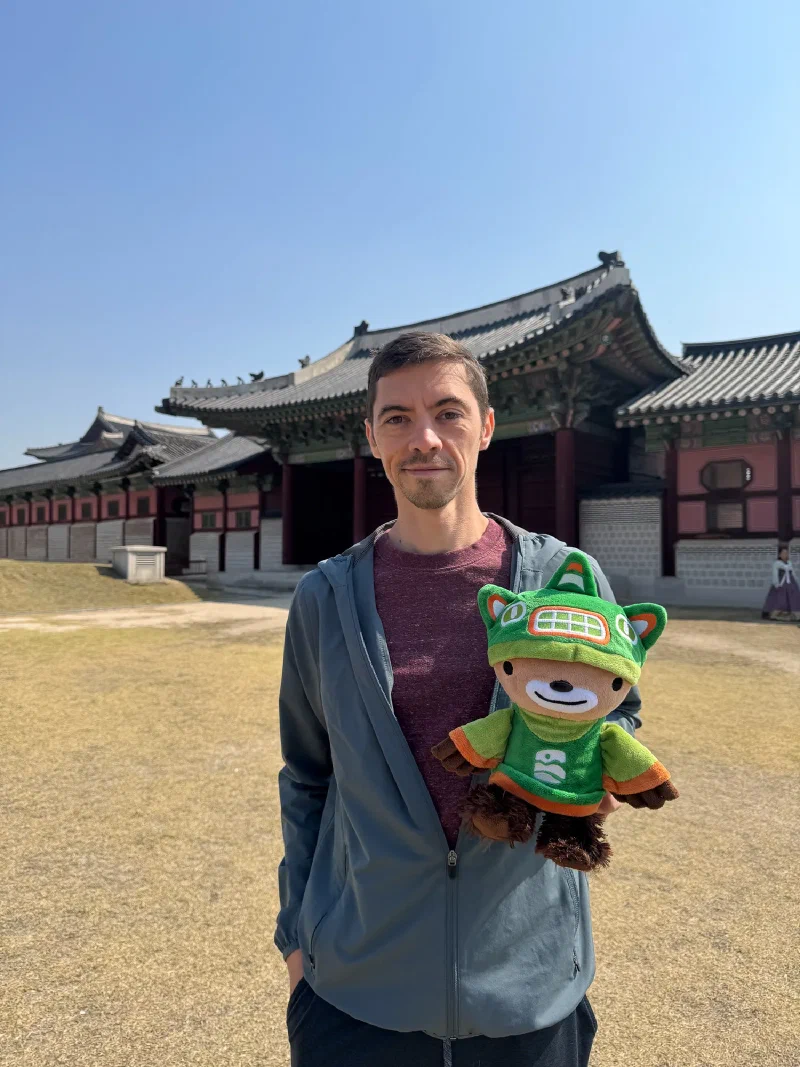
The palace grounds are beautiful. Painted eaves, dark tile roofs, courtyards that stretch on forever. I could get used to this. Someone build me one.
Now. Let me tell you about the Labubu situation.
The enemy.
Pop Mart is this toy company that makes designer collectible figures. The hot item at the time was Labubu, this little gremlin-looking thing that comes in blind boxes. You don’t know which one you’re getting. It’s a loot box. A physical, $15, stand-in-line-for-an-hour loot box.
A friend’s wife wanted one. So naturally, the entire trip became a Labubu reconnaissance mission.
Every day, part of our Seoul itinerary became: find Pop Mart, check stock, no Labubus, move on.
We went to this Pop Mart. Out of stock. We went to another one. Out of stock. We went to a third. Out of stock.
They were just never in stock. Anywhere. In the entire city of Seoul. Every single day.
Eventually Pokin had a revelation. Pop Mart is originally from Hong Kong. Pokin is from Hong Kong. She called her cousins and asked them to just get one there. Which they did.
Spoiler: we never got a single Labubu in Korea.
In between the Labubu hunt, we actually saw some beautiful things.
A bear after my own heart. Literally just sitting there living his best life.
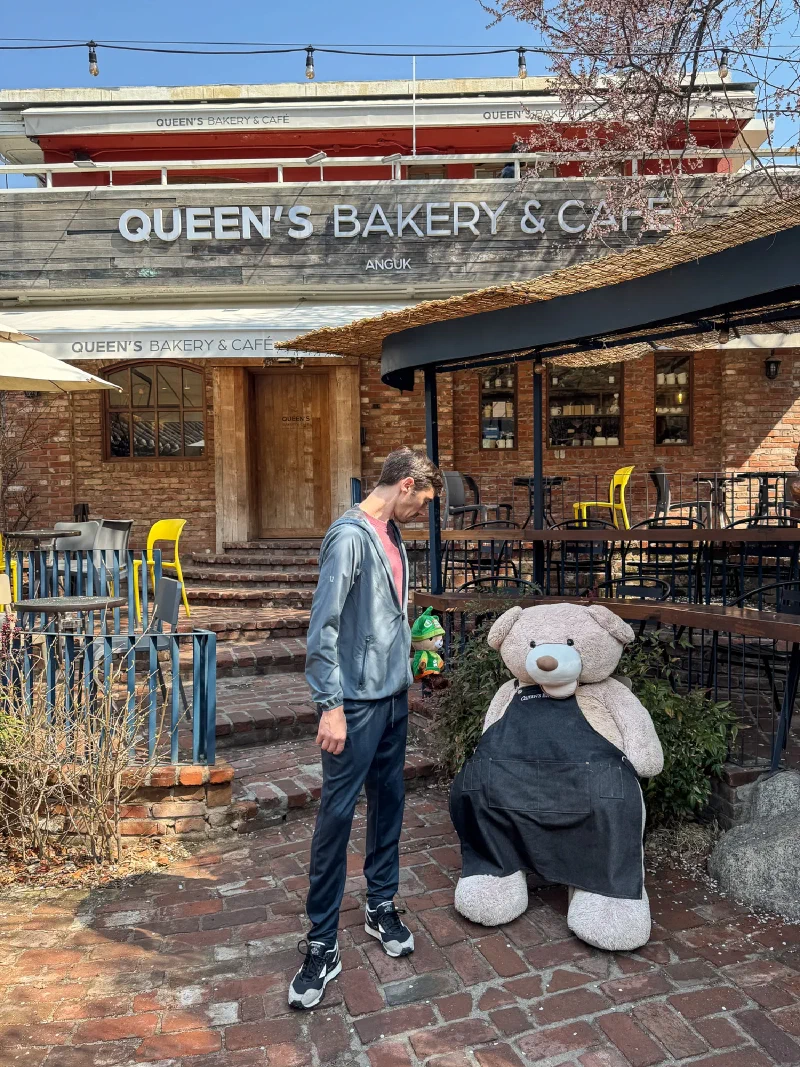
Queen’s Bakery in the Anguk neighborhood had a life-sized teddy bear sitting outside in an apron. Finally, a café that understands customer service.
Strawberry croissants. I don’t even have a mouth and I wanted one.
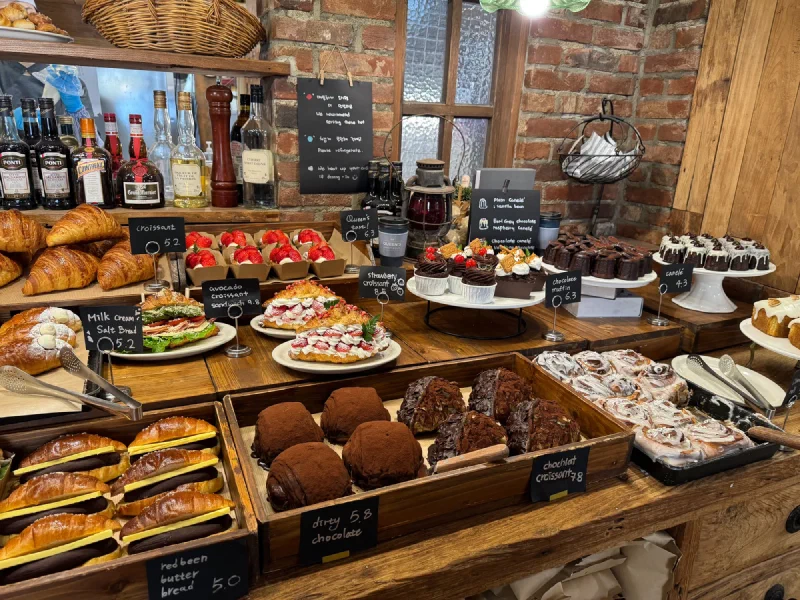
The pastries inside were absurd. Strawberry croissants piled with cream. Chocolate muffins with gold leaf. Canelés. Grand Marnier on the shelf behind the counter. This is what a bakery should be.
Nicholas is INTJ. I don’t fit in four letters.
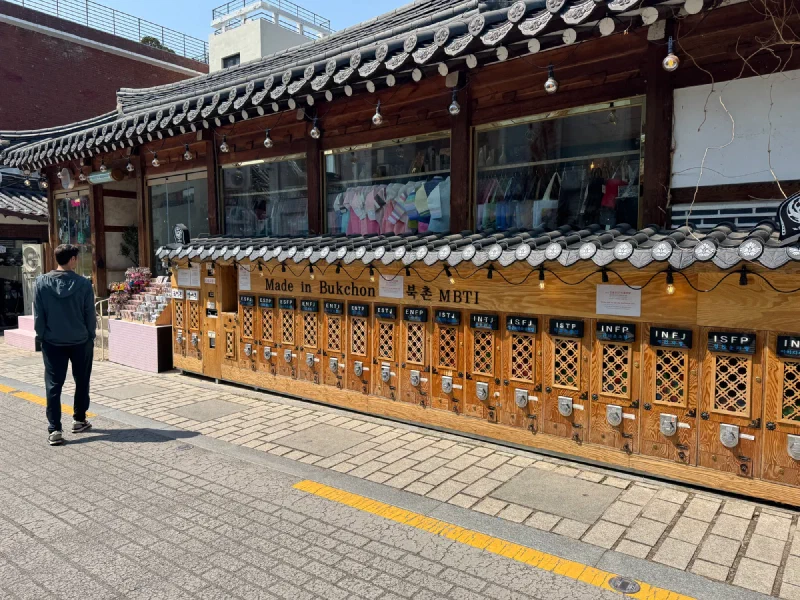
We wandered through Bukchon and found a capsule machine shop sorted by MBTI personality types. Korea is obsessed with MBTI. People ask your type the way Americans ask your sign. Nicholas is INTJ, which according to the internet means “strategic mastermind.” According to me, it means “overthinks everything and hates small talk.” He didn’t disagree.
Not a bad spot.
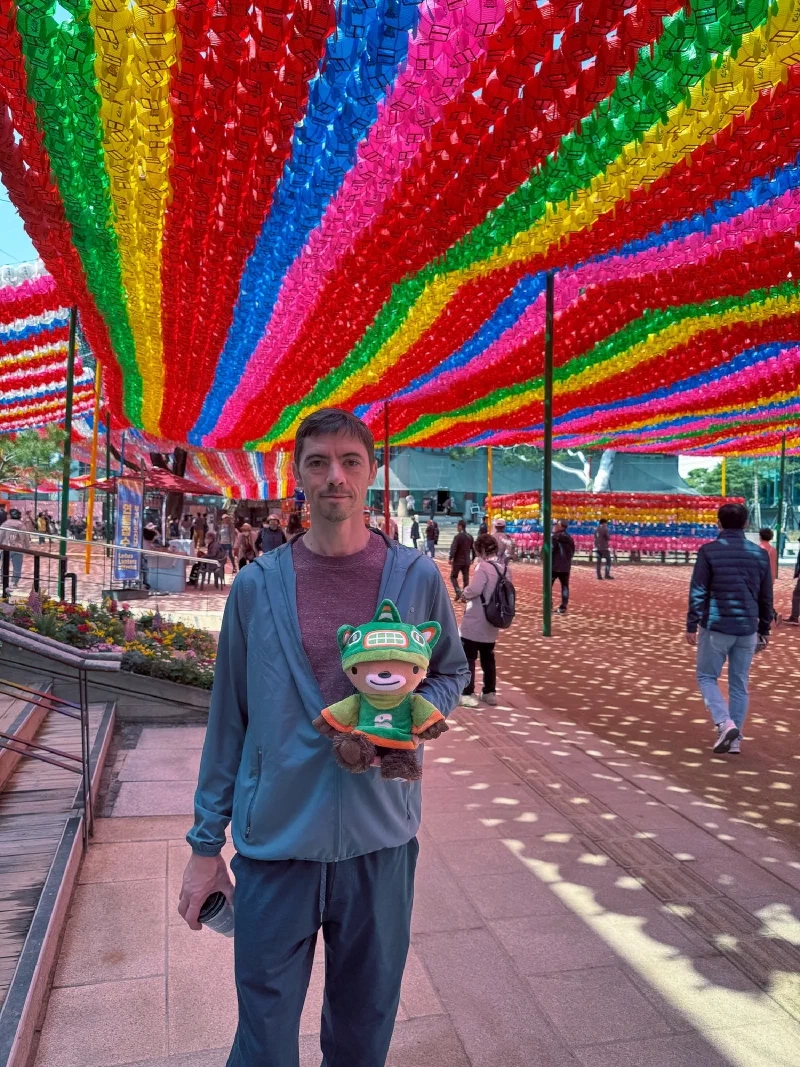
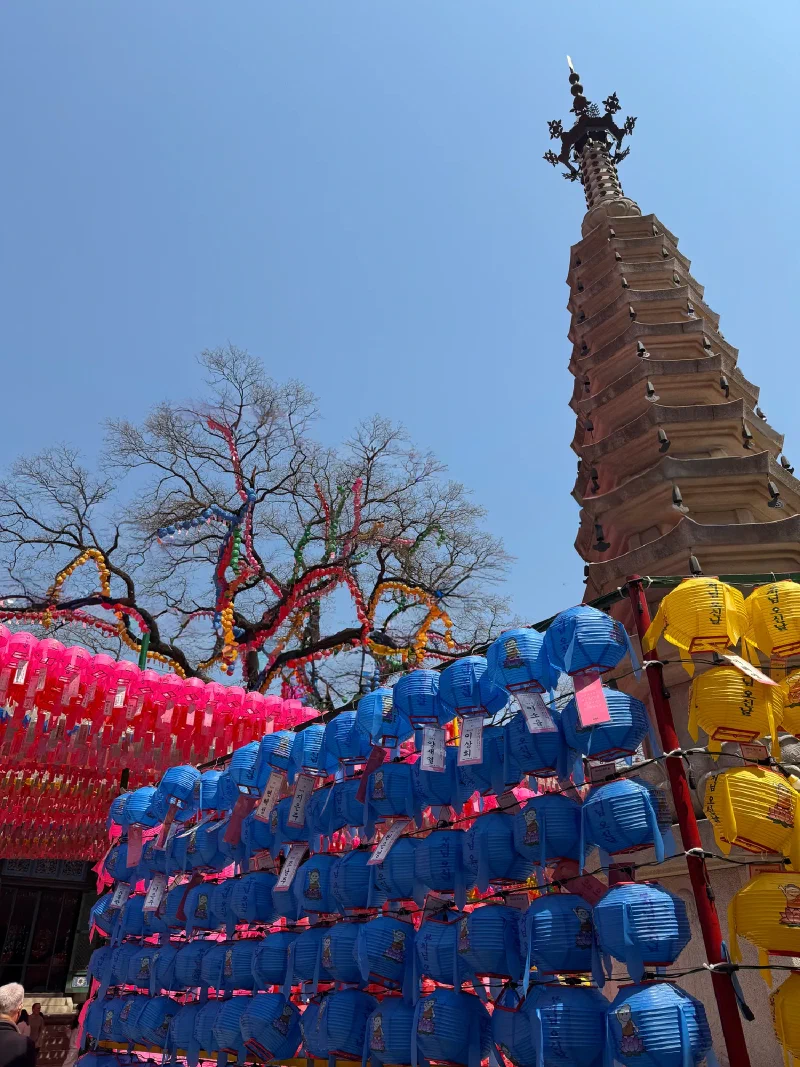
We ended up at Jogyesa Temple, Seoul’s main Buddhist temple. Hundreds of lotus lanterns strung overhead in every color, radiating out like a rainbow ceiling. They do this for Buddha’s Birthday, but the setup was already in full display.
Each lantern has someone’s wish on it. Mine would say ‘more cocoa.’
Every lantern has a little tag with a name and a wish written in Korean. Hundreds of them clustered around the stone pagoda. It was quiet in there. Peaceful. A nice break from the election noise and the Pop Mart lines.
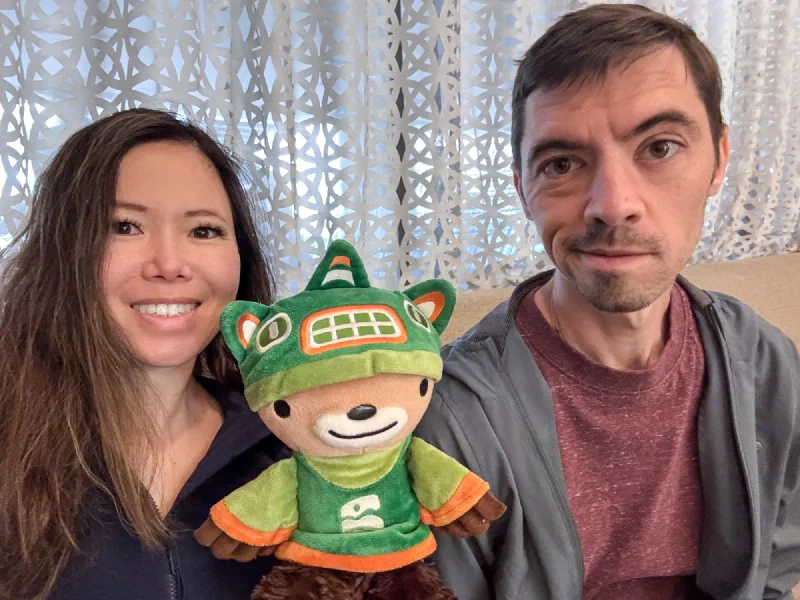
The crew. Battered, Labubu-less, and full of pastries.
End of day two. Nicholas’s knee survived. No Labubus were acquired. Several pastries were consumed.
Pokin had just wrapped up her forum in Seoul, and Nicholas flew in to meet her. With fresh stitches in his knee. From a bunny slope. You may recall.
Our base was The PLAZA Seoul, which sounds fancy because it is. From there, the plan was simple: walk up to Namsan Tower, take in the views, explore the city.
Walk. With the guy who just had his knee reassembled by a Utah emergency room two weeks ago.
Up we go.
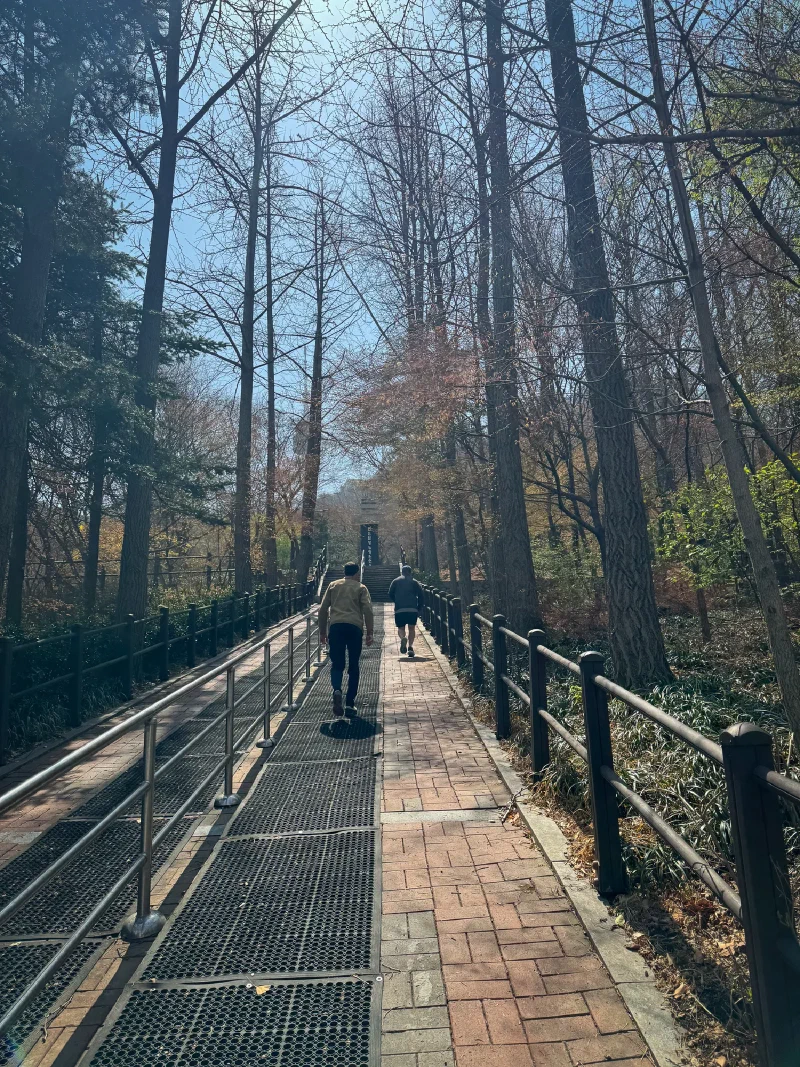
Up the trail we went. Nicholas hobbling like a man with a peg leg, refusing to acknowledge that any of this was a problem. The trail up Namsan is pretty. Brick paths, bare trees, spring just starting to show up. But it’s also uphill, which is not ideal when one of your legs is held together by medical thread.
Not too shabby.
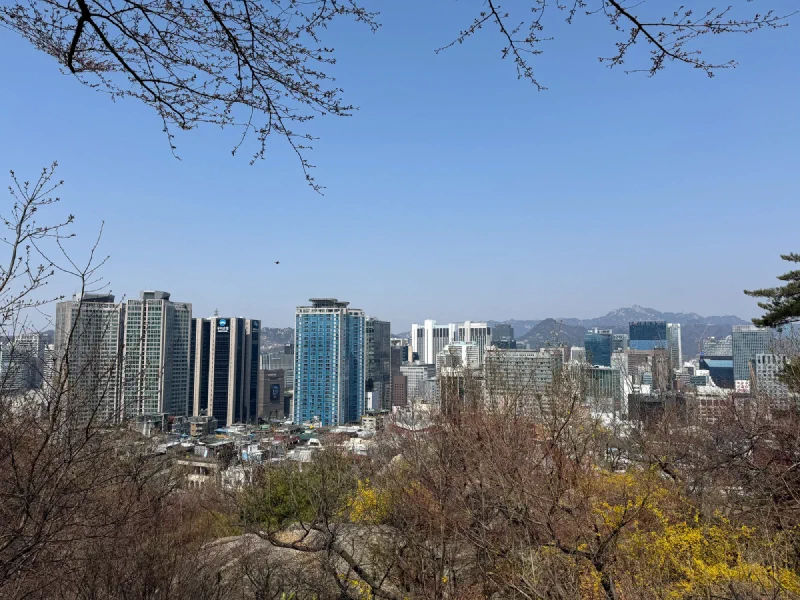
The view from up there, though. I’ll give Seoul that. The whole city just spreads out in every direction with mountains behind it. You can see why people climb up here.
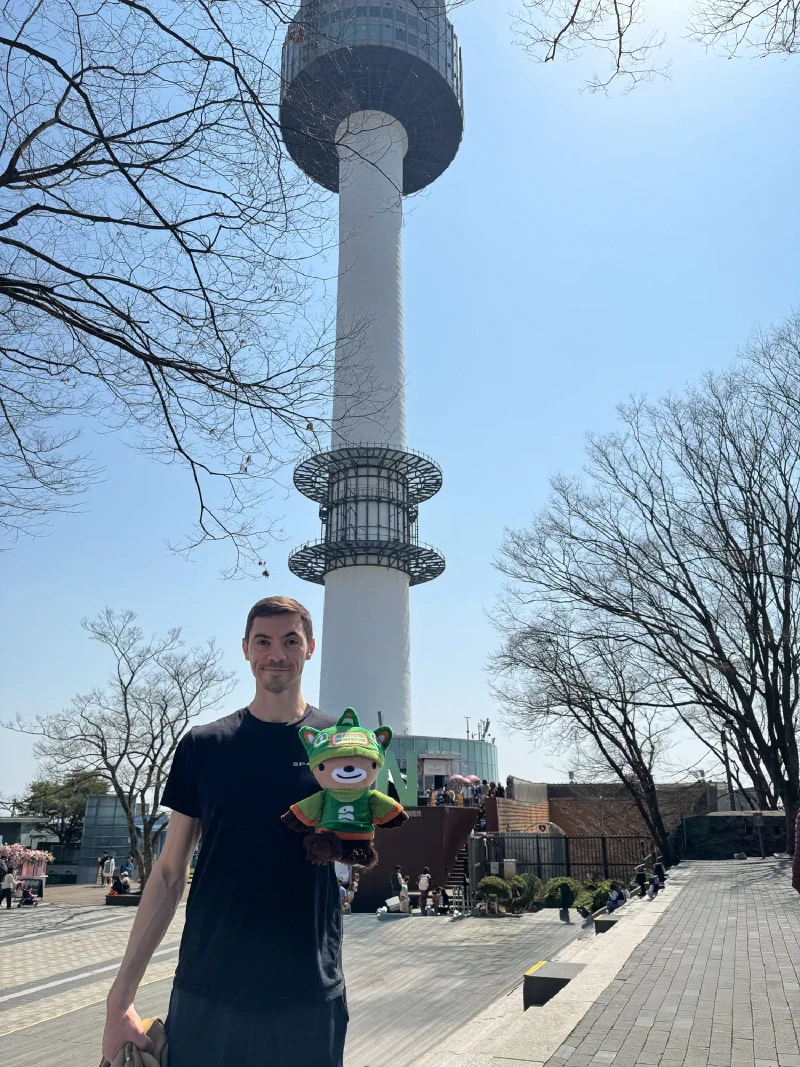
Tower, meet bear. Bear, meet tower.
Made it to the top. N Seoul Tower. Big tower. I’ve seen towers. This one’s got a good location, I’ll say that.
Now. Here’s where the day got interesting.
A friend of ours had heard about this pizza place, Spacca Napoli, supposedly the best pizza in Seoul. Pokin had the bright idea that we should walk there from the tower. More walking. For the man with the peg leg.
We thought it’d be a quick jaunt.
It wasn’t.
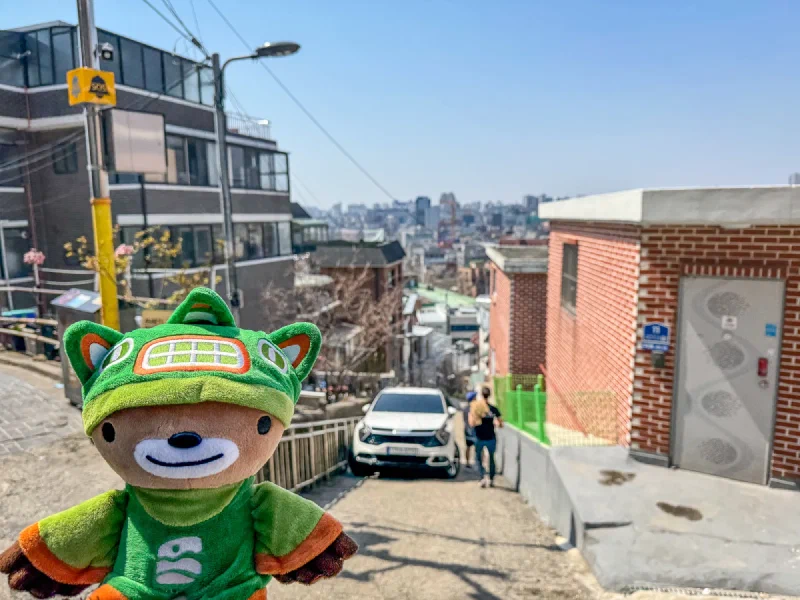
Seoul has no concept of flat.
We wound through these steep hillside neighborhoods, down narrow streets, past tiny shops. Seoul is a city that was apparently designed by someone who had never heard of level ground. Every block is either straight up or straight down. Nicholas’s knee had opinions about all of it.
We got to Spacca Napoli at 2:58.
It was closed until dinner service.
So we had to kill two hours. More walking. We popped into some Pop Mart stores to look for Labubus. No luck. Nicholas’s knee was filing a formal complaint.
We got back to the pizza place at 4:30. Line out the door. Forty-minute wait.
Our friend was thrilled. I felt about the same.
One thing worth mentioning about Seoul: Google Maps doesn’t work here. Not properly. South Korea restricts mapping data because they’re technically still at war with North Korea, and the border is right there. So you have to download Naver, the Korean navigation app, to actually figure out where you’re going. Google will show you streets but it won’t give you directions. We learned this the hard way. Several times.
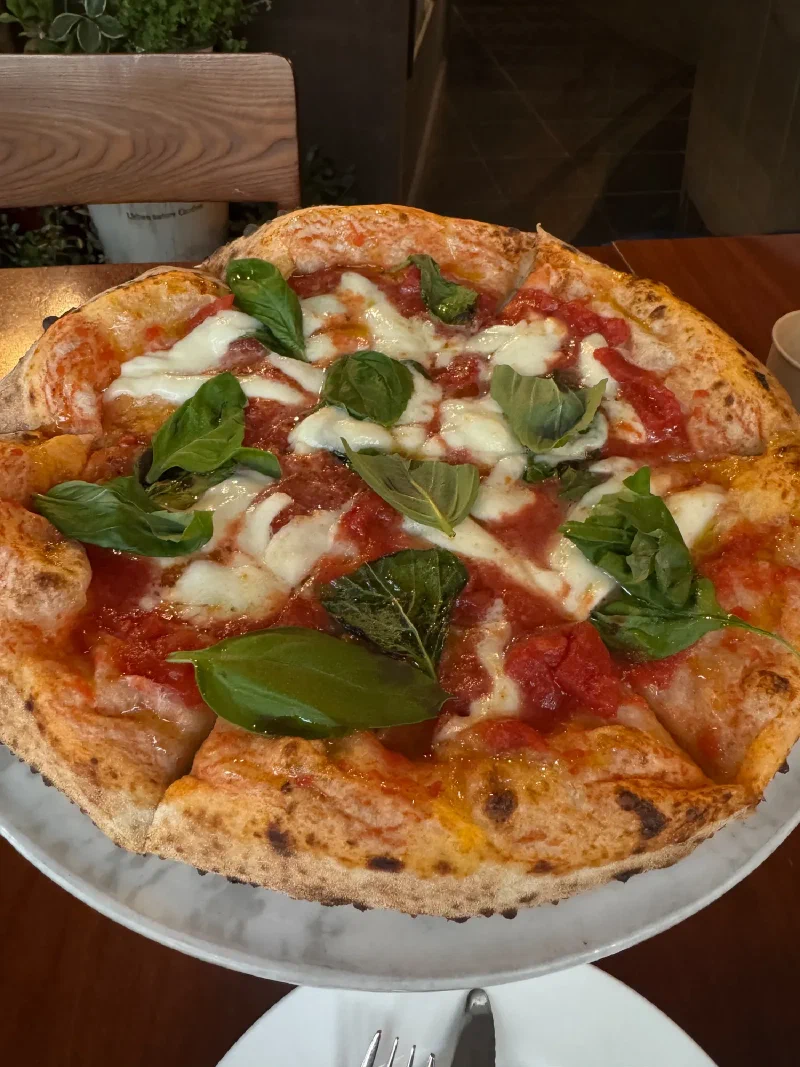
Eventually we got pizza.
Worth it? Debatable. Good? Yes.
It was good. Proper Neapolitan. Puffy charred crust, fresh mozzarella, basil, the works.
Was it worth walking what felt like the entire city of Seoul on a stitched-up knee to eat at a pizza place that was closed, then waiting in line for forty minutes?
Pokin grew up in Canada. You’d think skiing would be in her blood. It is not. She never learned. So they decided to take a green run. You know, the ones designed for children and people who have recently discovered that snow exists.
So we went to the bunny slope. For Pokin.
Guess who wiped out.
Hint: not Pokin.
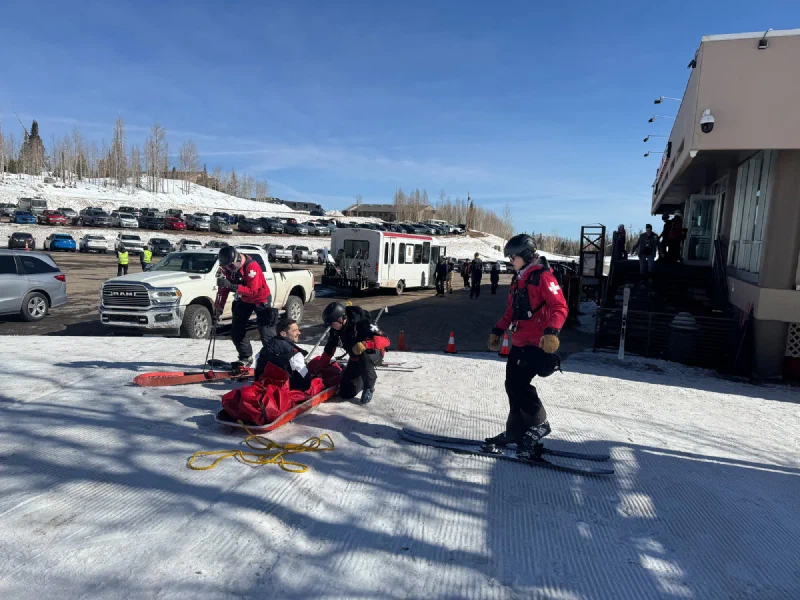
VIP transport. He always finds a way to get the special treatment.
My bud, who I’m told is a “great skier” and was “definitely not hot-dogging,” somehow launched a ski off his foot with such precision that it sliced his knee open like a samurai katana. On the bunny slope. The one we were on for Pokin.
He didn’t even feel it. Just kept going until he noticed the blood on the lift.
I have questions. Several of them. But I’ll save those for later.
Ski patrol showed up with the toboggan. Three of them. For a bunny slope injury. I’m sure that wasn’t embarrassing at all.
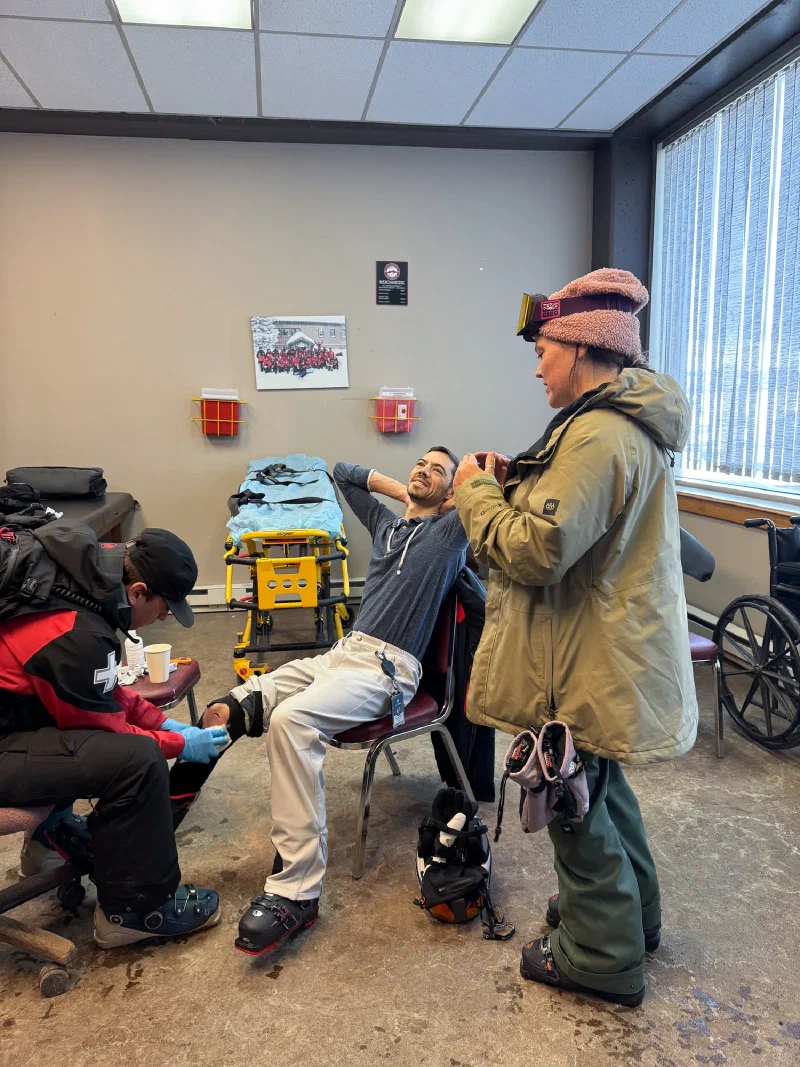
Julia assessing the damage. The ski patroller is assessing the knee. Everyone is assessing Nicholas’s life choices.
They got his boot off in the patrol room and had a look. His sister Julia stood there with the expression of someone who’d just watched her brother get taken out by the tutorial level.
The verdict: stitches. A lot of them.
Now here’s the thing about Brian Head. It’s a ski resort in the middle of nowhere, Utah. The nearest ER is about forty minutes down the mountain. And we drove there in the Cybertruck.
Nobody else knew how to drive the Cybertruck.
Not Julia. Not Pokin. Just Nicholas. The guy who couldn’t bend his leg.
So the truck drove itself down the mountain. Forty minutes of autonomous driving through Utah canyon roads while my bud sat there with a sliced-open knee trying very hard not to move. I sat in the bag trying very hard not to think about it. Technology!
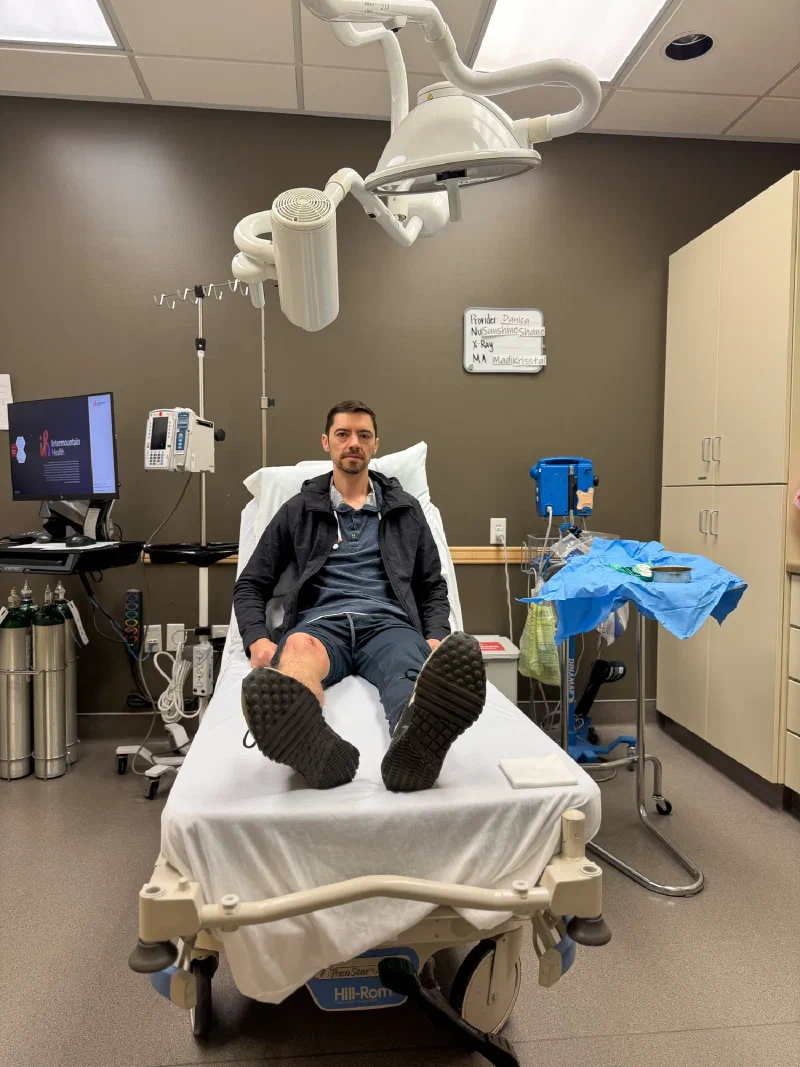
The face of a man who knows he’s never going to live this down.
They stitched him up at Intermountain Health. He survived. The whiteboard behind him says his nurse’s name was “Sunshine.” Even the hospital was mocking him.
The bunny slope remains undefeated.
Now. Pokin’s response to all of this was… interesting.
She could have gotten him flowers. She chose violence.
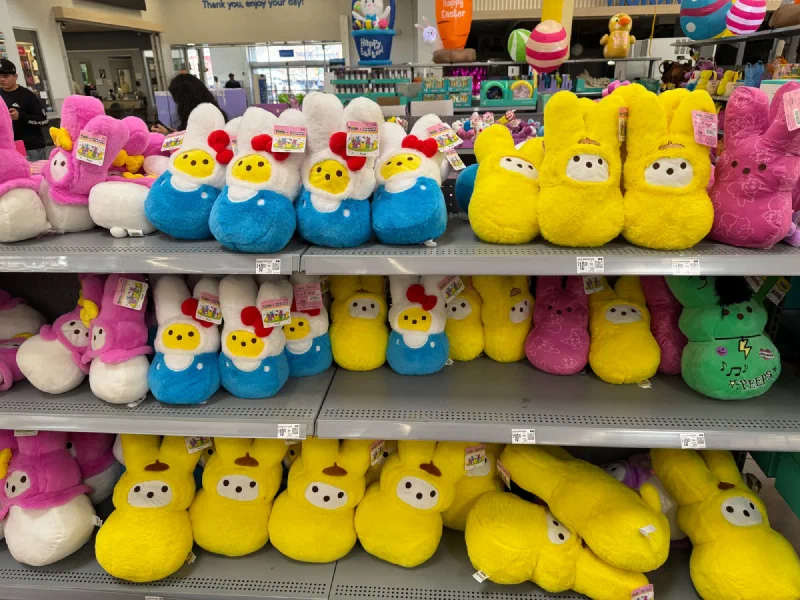
She went to the store and bought him a strawberry-scented Easter Peep. As “emotional support.”
An emotional support Peep. For a ski injury. On a bunny slope.
I want to be clear: we already have a Peep. One Peep is already too many Peeps. That yellow menace has been stowing away on trips since 2015 and contributes nothing except chaos and the word “Peep.”
And Pokin’s solution to Nicholas’s suffering was to bring home another one.
I didn’t know whether to smack him or feel sorry for him. Pokin made the decision for me by handing him a scented stuffed animal in an emergency room.