
↓ Skip to main content

Apr 2026 – May 2026

1 2 3 4 … 51

The Escape

We woke up very early at Surke and braced for the worst, because the weather report had promised the worst. Then we looked outside. It was not the worst. There were still clouds everywhere, but you could see things. Mountains. Sky. The general concept of “up.” After the fog wall that had stranded us the day before, this counted as optimism.
View out a lodge window in the early morning, partially clear sky with low clouds over forested hills
The view out our window. Not clear. But clear-ish. Clear-ish is enough to get your hopes up.

A reminder of where we’d spent the night. The “rooms” at the Surke airport were not exactly the soft-bed-and-hot-shower situation we’d been promised back in Lukla.
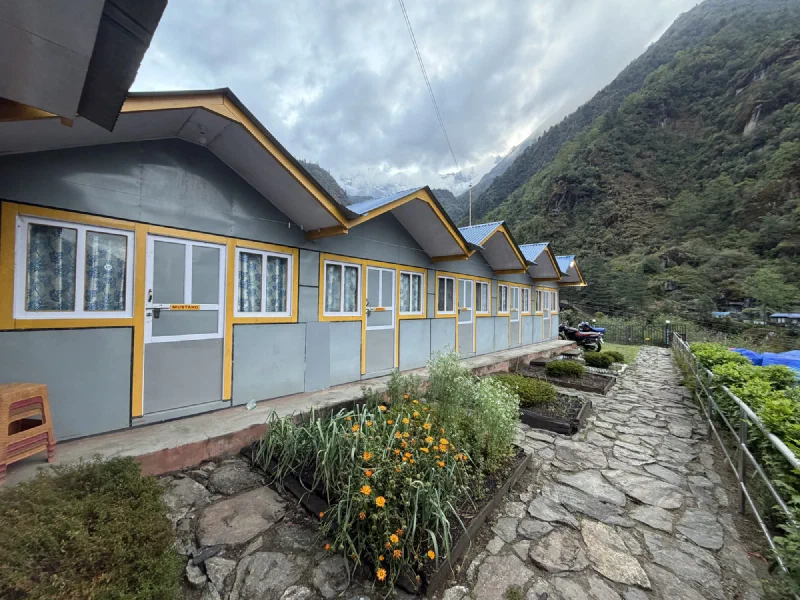
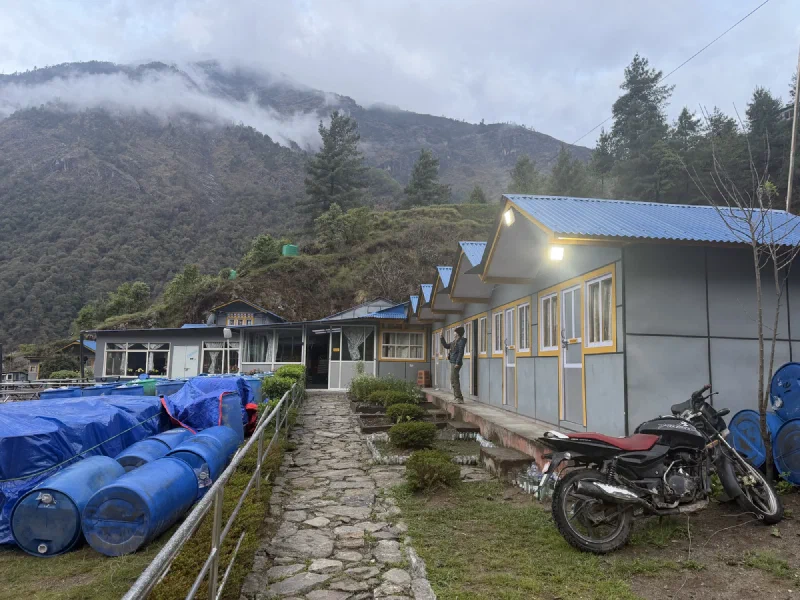
Basic plywood rooms at the Surke airport lodge

The same rooms with the airport restaurant visible in the background

So we packed up fast, because mornings are when the clouds are highest and your odds are best. And then we spotted him. Our pilot. Already out at the helicopter, prepping it to fly. The same Fishtail Air machine, parked among the same casual barrels of gasoline strewn around the field, because nothing says aviation safety like jet fuel lying loose in the grass next to the helipad. This was it. Our ride home was warming up.
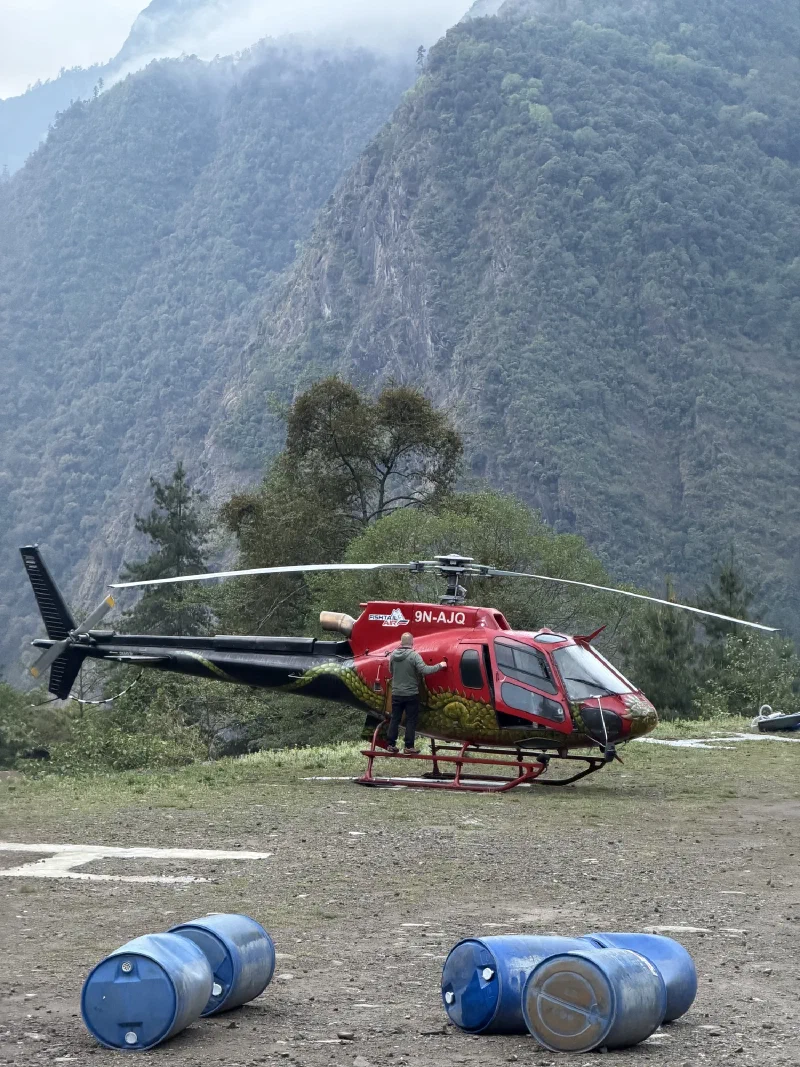
A Fishtail Air helicopter on a foggy dirt helipad, pilot leaning into the cabin, blue barrels in the foreground
The pilot prepping the helicopter. Our helicopter, we assumed. We assumed a lot of things.

He climbed in. He started it up. And then he took off.

Without us. Without a single word. We watched our ride lift off the pad and disappear into the clouds while we stood there holding our bags like a group of people who had just been very thoroughly stood up.

Oh. Well then. Back to the lounge.
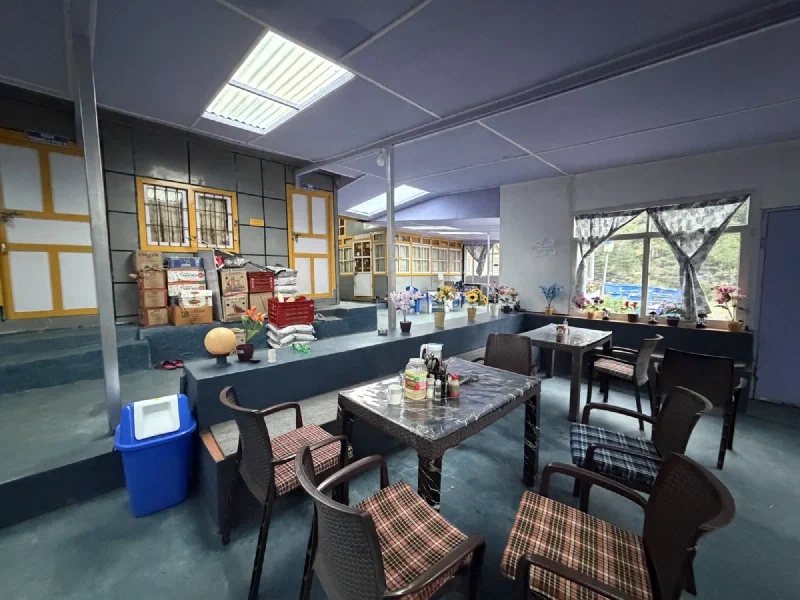
Inside the small Surke airport lounge, trekkers sitting and waiting
Back inside. Same chairs. Slightly less faith in helicopters than we’d had ten minutes earlier.

That is when the Sherpa explained how the morning after bad weather actually works. The clouds had been bad the day before, which meant a lot of people higher up the mountain never got their flights. So the morning after, every helicopter commits its schedule to rescues. They start at the top, where the clouds clear first, and they work their way down as the fog lifts, grabbing the stranded people in order of altitude. We were not up high. We were at the bottom of the list. Our pilot hadn’t abandoned us out of spite. He’d just gone to collect people with a better claim on him than us.

So the plan became: wait, and hope somebody, anybody, swings low enough to scoop us up before the clouds came back down and closed the whole valley for the day.

We settled the bill for our luxury accommodations.
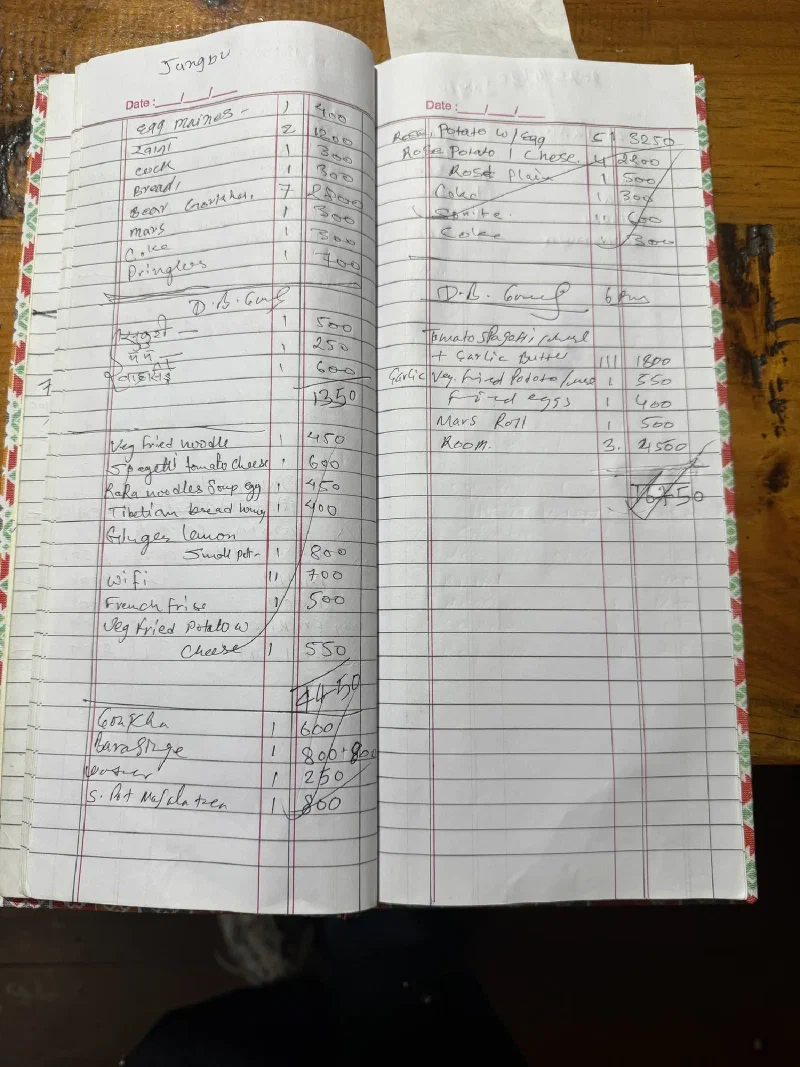
A handwritten Nepali lodge food and lodging bill
The bill for the night. You pay for the plywood. You pay for the food. You do not get a refund for the helicopter that left without you.

Nicholas hauled the bags back outside.
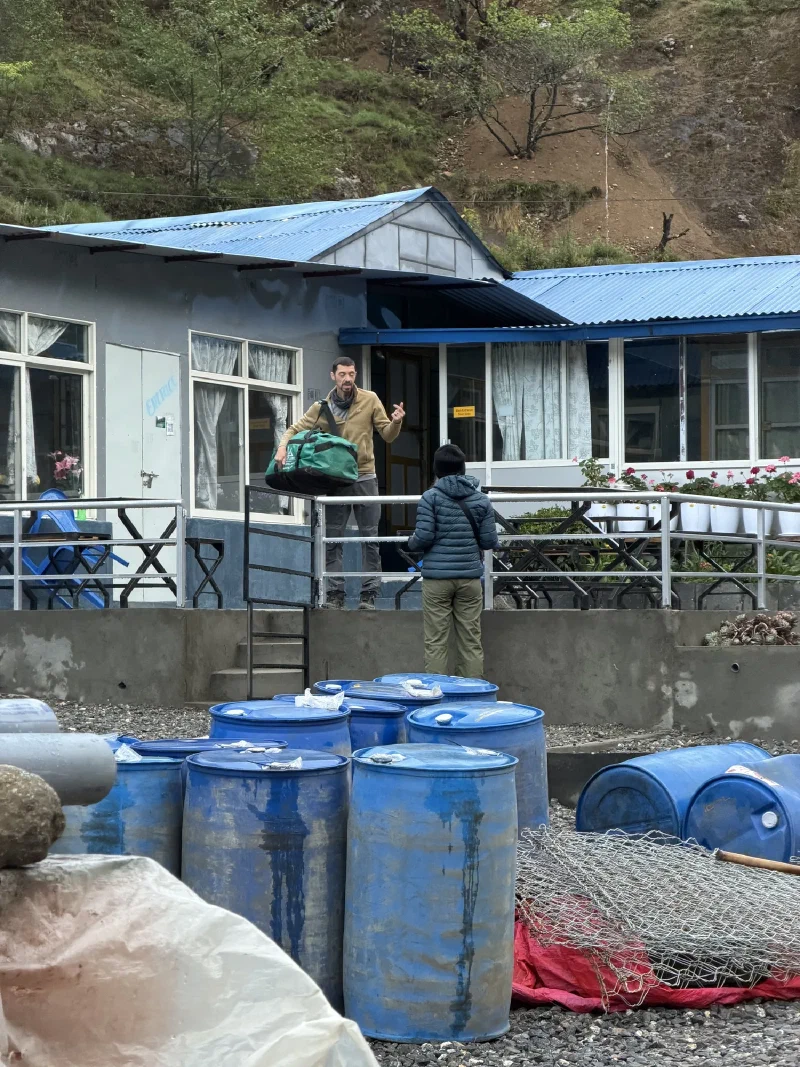
Nicholas carrying a bag out of the lodge to wait outside

And then we did the thing trekkers do best by this point in the trip. We stood around outside and waited for the sky to make a decision.
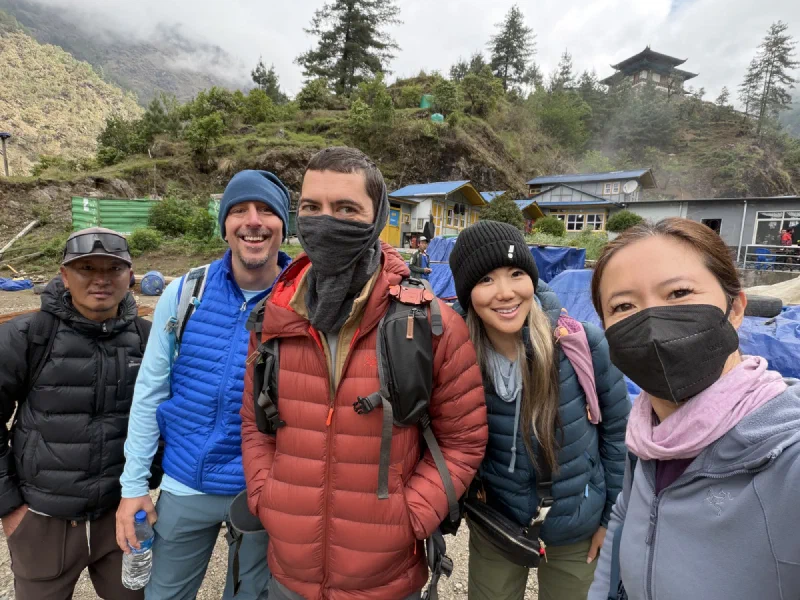
The group bundled up, waiting outside the foggy Surke settlement, taking a selfie
The whole crew, waiting for a helicopter that may or may not have existed.

The fog got thicker. Nicholas started doing the grim math and landed on “we are staying another night.” A reasonable conclusion. The valley was closing up.

And then the same pilot came back. The one who’d ditched us at dawn. He set the helicopter down, leaned out, and said, “Okay, we’re going back to Kathmandu before it gets any worse.”

It was not the helicopter we were supposed to take. At this point I did not care which helicopter it was. We piled in.

The flight is about 45 minutes, and we spent most of it dodging clouds, the pilot trying very hard to stay VFR all the way. Then the clouds thinned, the valley opened up, and there it was. Kathmandu. Pavement. Buildings. The end of the mountain.
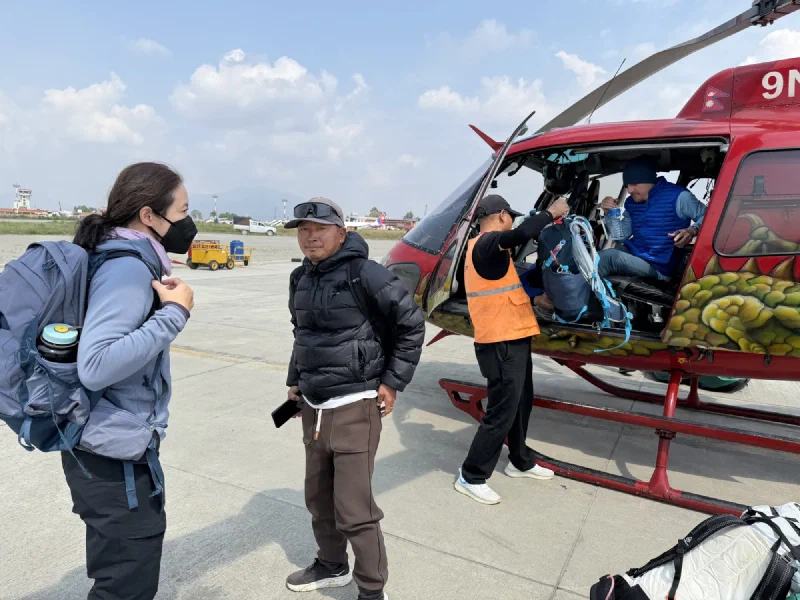
The group unloading gear from a red helicopter on the tarmac in Kathmandu
Wheels down in Kathmandu. Unloading the bags onto actual pavement for the first time in two weeks.
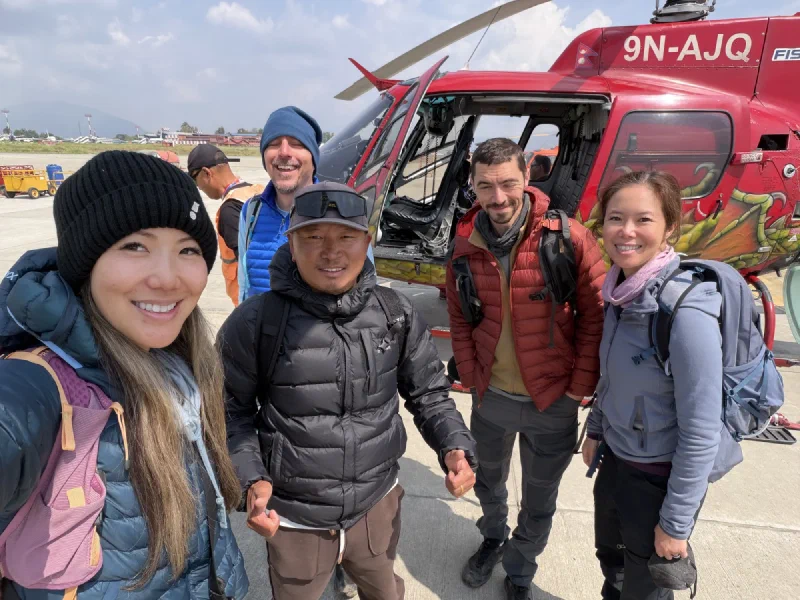
The crew posing for a happy selfie in front of the red helicopter on the Kathmandu tarmac
Everybody alive. Everybody off the mountain. Everybody about to eat their body weight in dumplings.

First order of business in Kathmandu: food. We reunited with Alice, who had escaped Surke a day ahead of us on that one sketchy seat and was, reassuringly, also alive. Then we found a place with a giant momo platter.
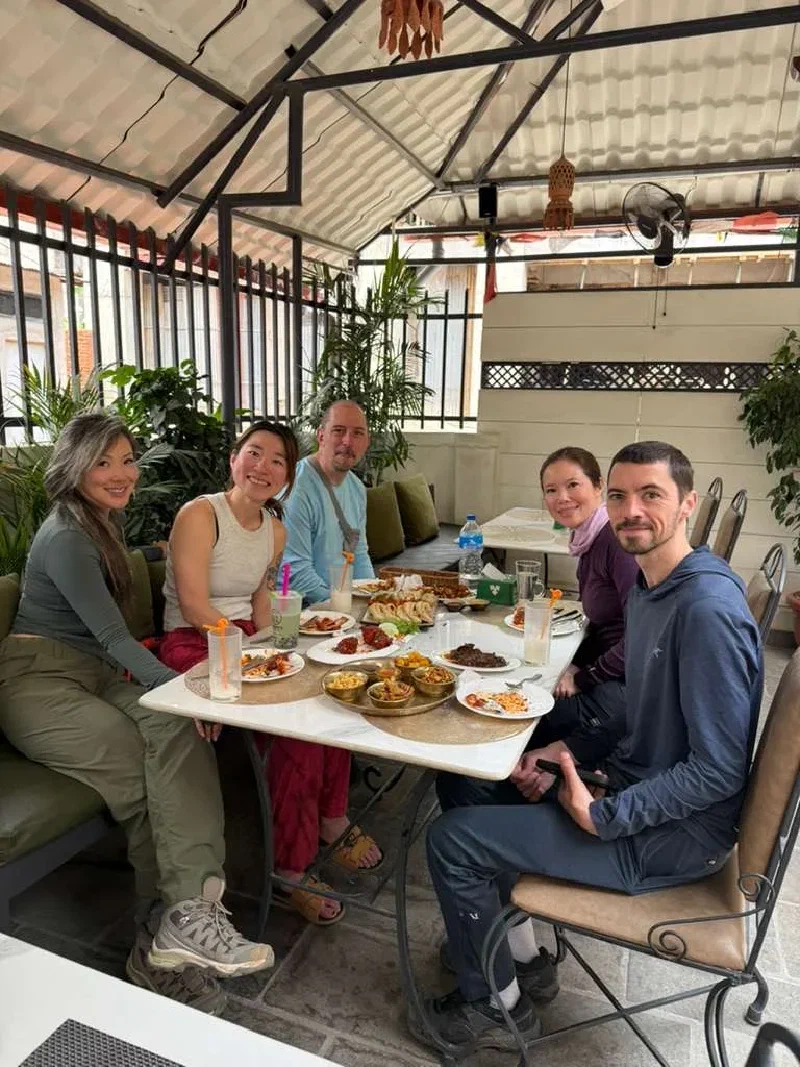
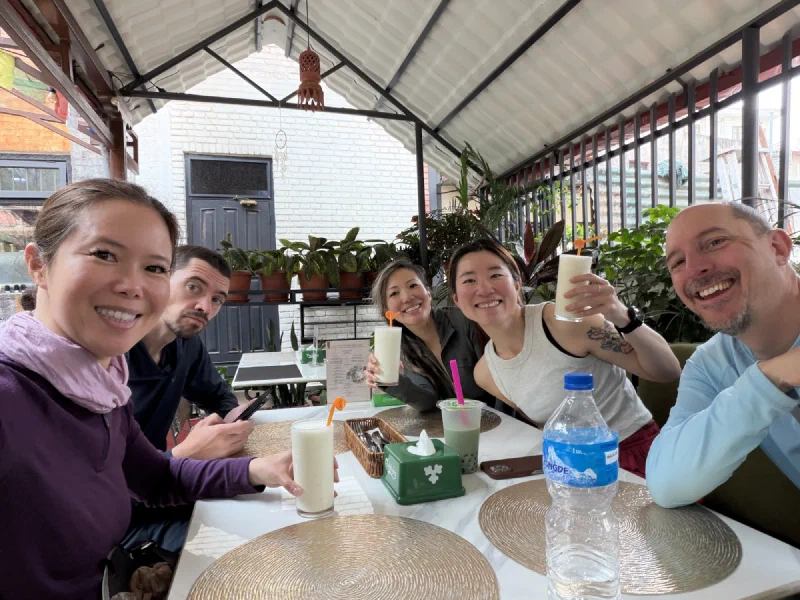
A Kathmandu restaurant interior
The momo headquarters.

The group seated at the Kathmandu restaurant

You already know how everyone feels about momos. Pokin had been ordering them at every single stop on this trip, and now there was a nice plate of them waiting in Kathmandu. Do they make chocolate momos? No? Then I’ll wait.
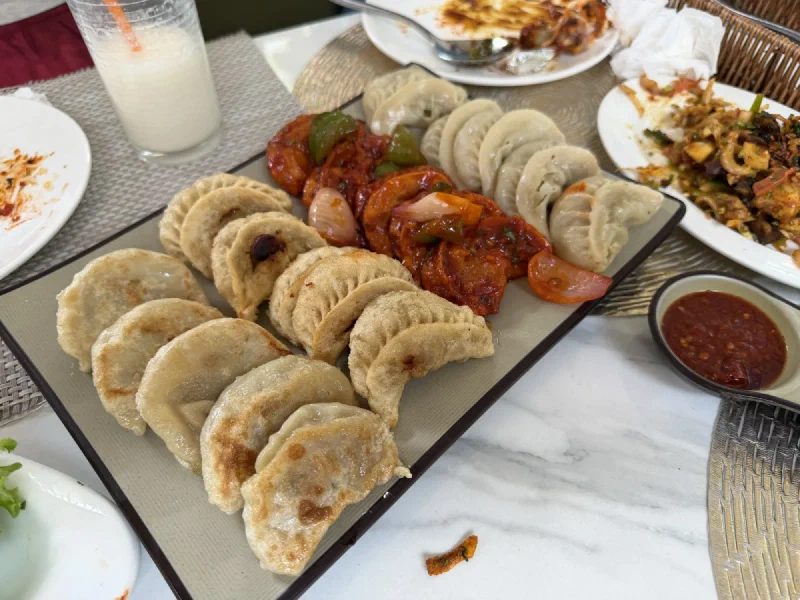
A large platter of Nepali momo dumplings
The momo platter.

That night, D.B. and Manoj took us out for a proper sendoff. A dinner with a cultural show, Nepali dances and music performed on a stage in front of a painted mountain backdrop. The kind of “cultural experience” you have to brace yourself for.
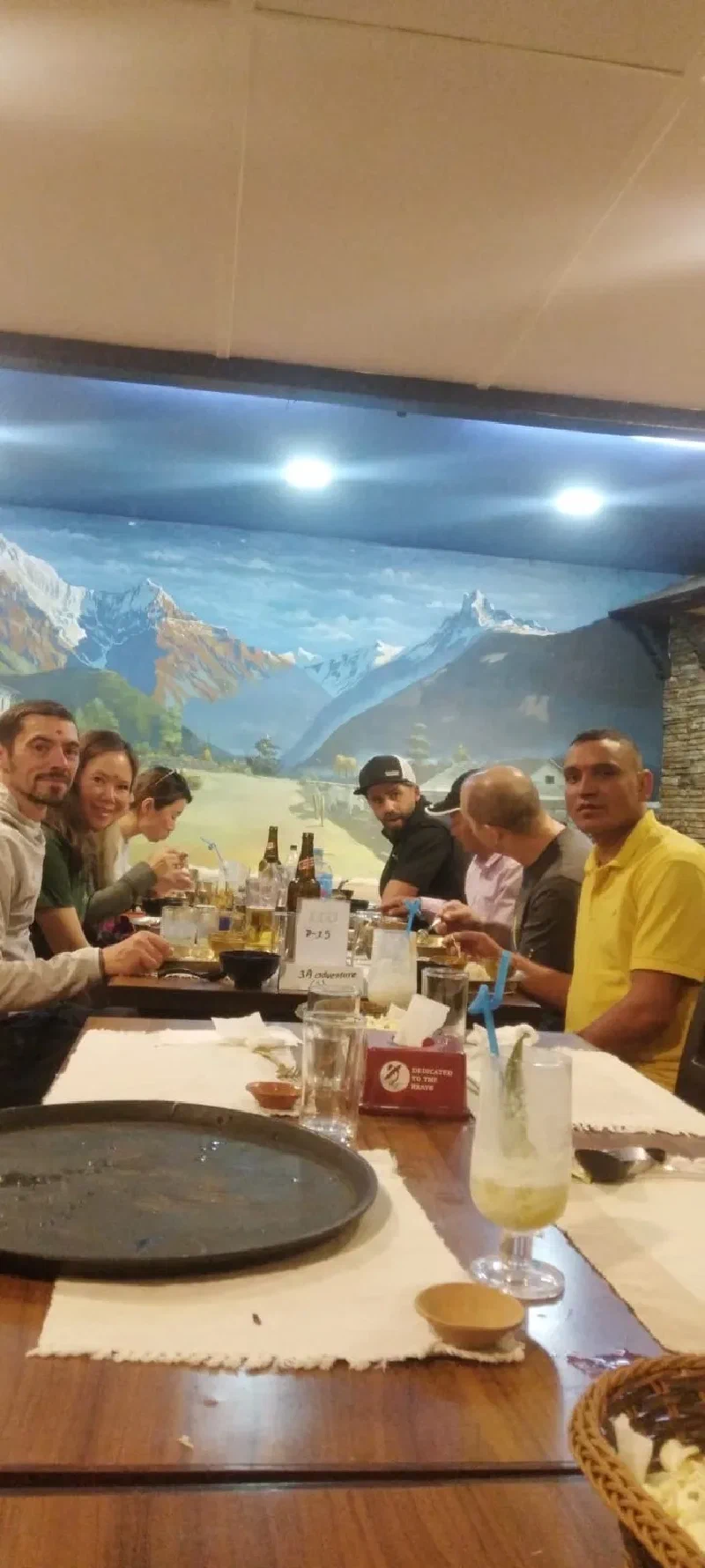
The cultural dinner-and-show restaurant with a stage and mountain backdrop
Dinner and a show. The backdrop was a painting of the mountains, in case two weeks of the real ones hadn’t been enough.

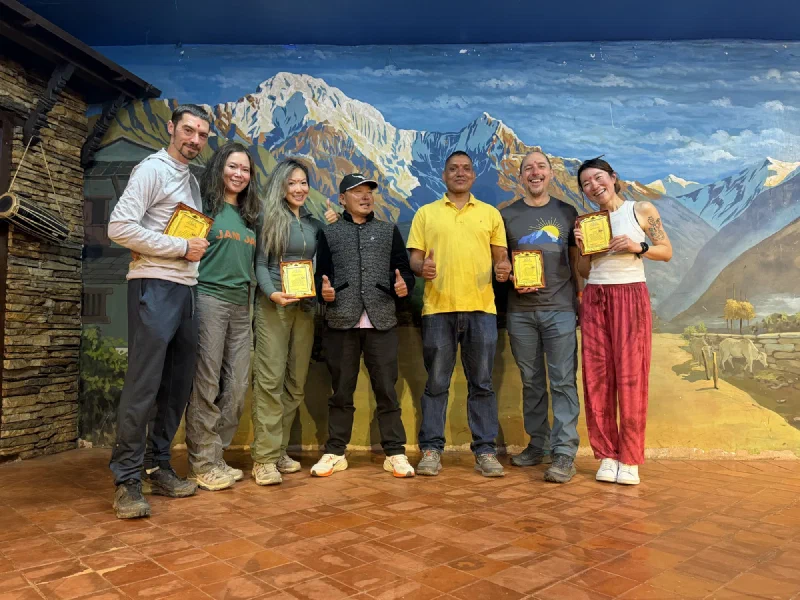
After dinner, D.B. handed out awards. Actual framed plaques, for completing the trek. Or, in some of our cases, for attempting the trek, which I think is the more honest wording given how many horses, helicopters, and hospitals were involved in our particular “completion.”
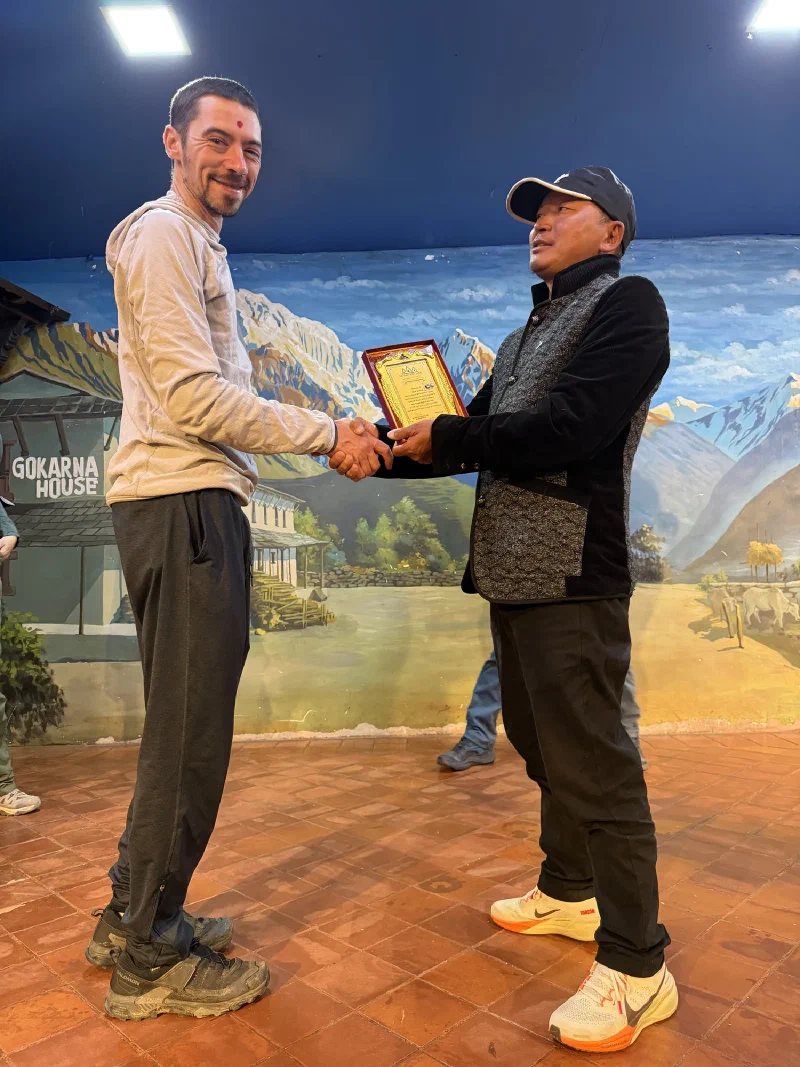
D.B. presenting Nicholas with a framed plaque on the stage, both with red tika marks on their foreheads
D.B. presenting Nicholas with his plaque. Tika on the forehead, certificate in hand, fully decorated for surviving.
The whole group lined up on stage holding their framed trek completion plaques
The whole crew with their hardware. We attempted a mountain. We have the paperwork to prove it.

D.B. was leaving the next morning for another trek, with another group of people who had no idea what they were in for. We had one final day in Kathmandu before we headed to the airport ourselves.

We’d made it off the mountain. Barely, and not on the helicopter we planned, but off.

Denied Departure

The trek was officially behind us. We’d said the goodbyes, handed out the red envelopes, eaten the farewell dinner under the golden dragon ceiling. All that was left was the easy part. Pack up, walk over to the Lukla airport, climb into our helicopter, and float back to Kathmandu in time for a hot shower and a soft bed. After two weeks on the mountain, we had earned the lazy exit.

Then we woke up and looked outside. Rain.

Here is the thing nobody tells you about flying in the Himalayas. The helicopters and the little planes can only fly VFR. That stands for Visual Flight Rules, which is exactly what it sounds like. The pilot flies by looking out the window. No flying through clouds, no trusting the instruments to thread you between two mountains you cannot see. If it is socked in, you do not go. And I can fly, so I am allowed to be smug about knowing this.

So a rainy morning at Lukla is not a delay. It is a maybe.

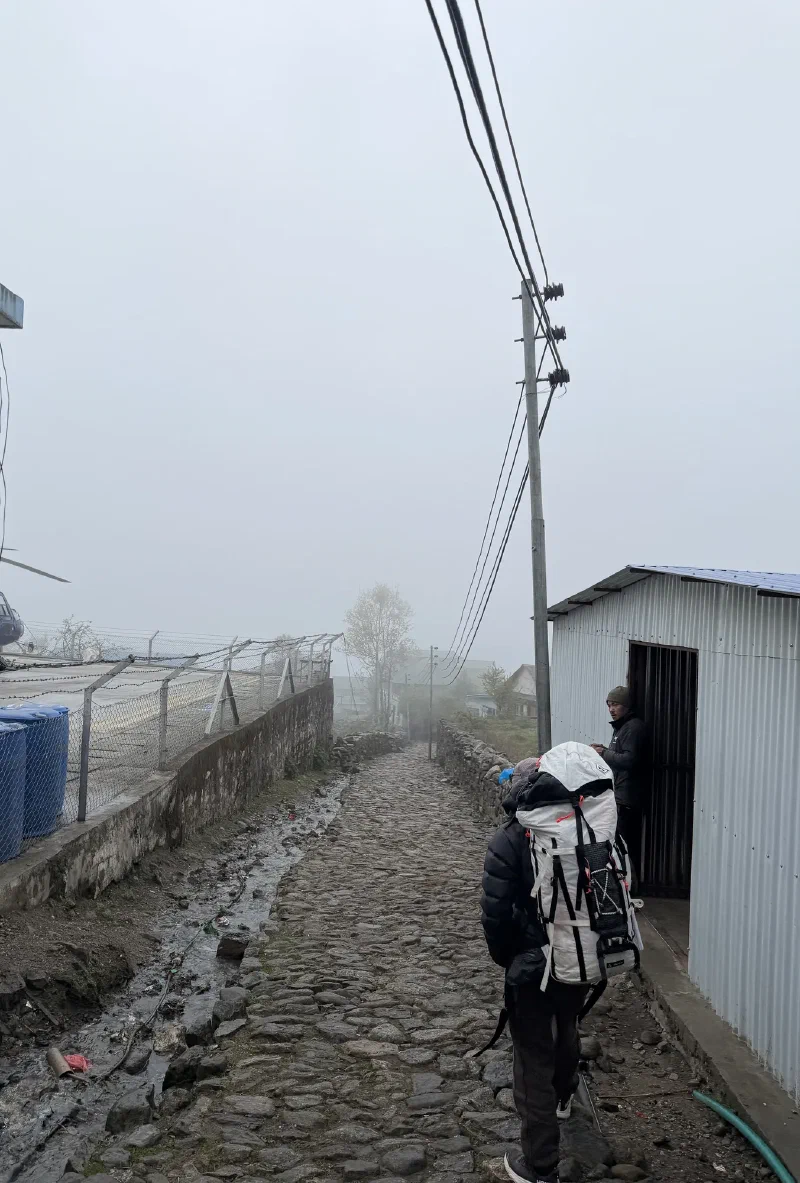
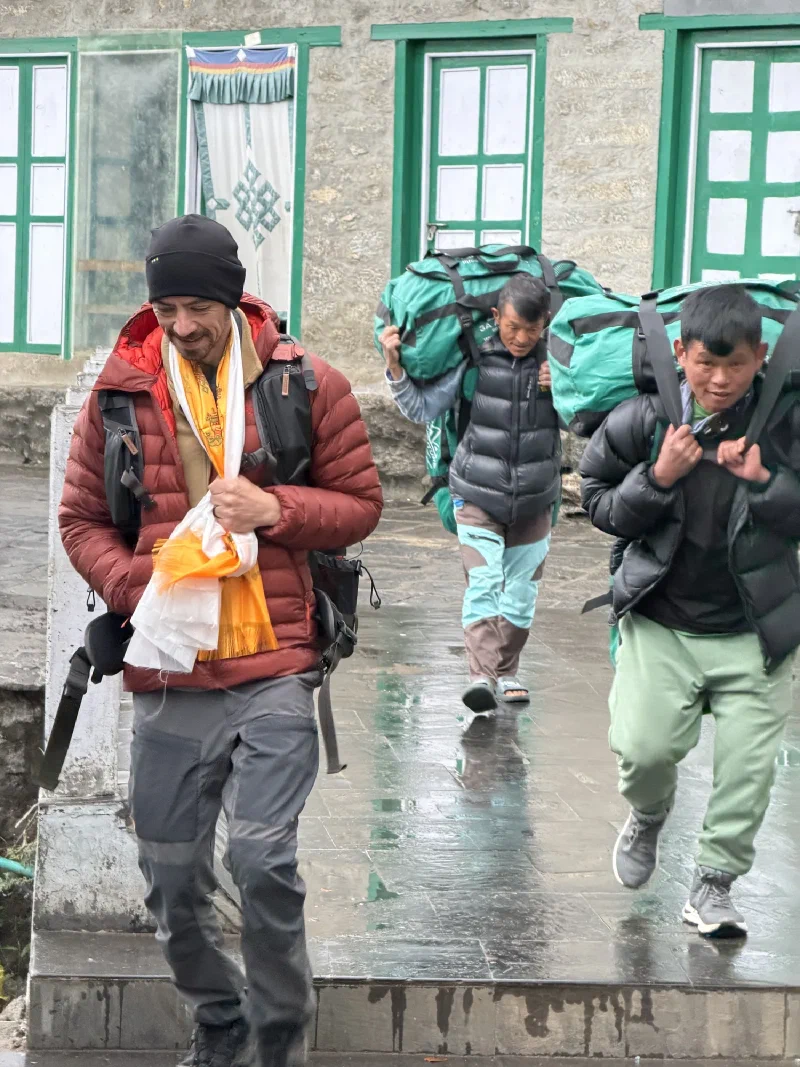
Nicholas and porters walking on a wet path in the rain toward the airport
Walking to the airport in the rain. Already a bad sign, and we hadn’t even gotten there yet.

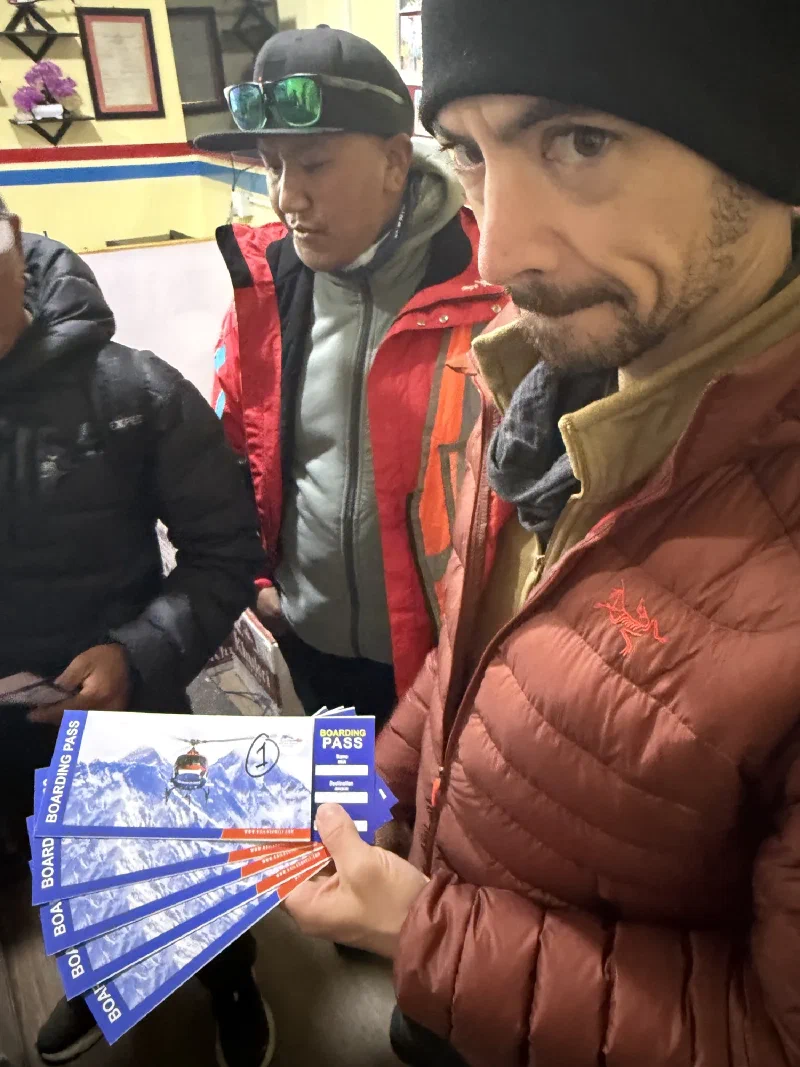
We went anyway, because the airport tells you to come anyway. They handed Nicholas a fan of boarding passes for a helicopter that was not there and might never be.

Nicholas indoors holding several helicopter boarding passes, looking skeptical
Nicholas holding tickets for a flight that did not exist yet. He is doing the face. You know the face.

Just wait a little, the airport said. The sun might come out. The helicopters might make it up. We looked out the window. The sky was getting foggier, not clearer.

After about thirty minutes, D.B. explained how this actually works. The cloud layer settles down into the valley as the day goes on. Mornings are clearest. So the longer you wait at Lukla, the worse your odds get, not better. But there was a move. If we left right now and hiked straight downhill for an hour and a half, we could reach the next town, which sits low enough that the clouds were still above it. The helicopters could land there. We could still get out today.

The catch with simply waiting it out: if the weather goes bad, everyone who was supposed to fly today is stuck in Lukla too. Then tomorrow there are twice as many people fighting for the same flights. A few bad days in a row and you get a genuine traffic jam of trekkers with no way down. There is always walking, of course. That only takes about two weeks. Or you can take a jeep from the next town, which is two days across the kind of washed-out dirt roads that are somehow less safe than flying through clouds.

So we made the call. Book it downhill on foot and try to beat the weather to the next helipad. A race against the sky.

A guide leading the group down a foggy rocky path past the airport fence
D.B. leading us past the Lukla airport and down the trail to Surke. The opposite direction from the one we wanted to be going.

Nicholas and Pokin did not look convinced that the weather was going to be any better down the hill. Pokin especially, who was still sick and now hiking again instead of sitting on a helicopter like a normal recovering person.

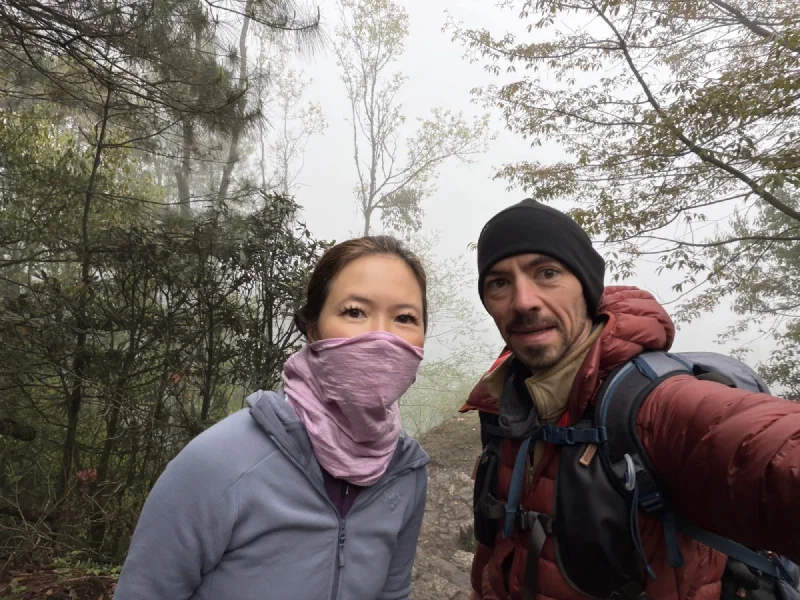
Nicholas and Pokin on a foggy forest trail, Pokin wearing a pink mask
Two people doing the math on whether this gamble was smarter than just waiting. The masked one had bronchitis and a strong opinion.

The skies did not improve. They committed to the bit.

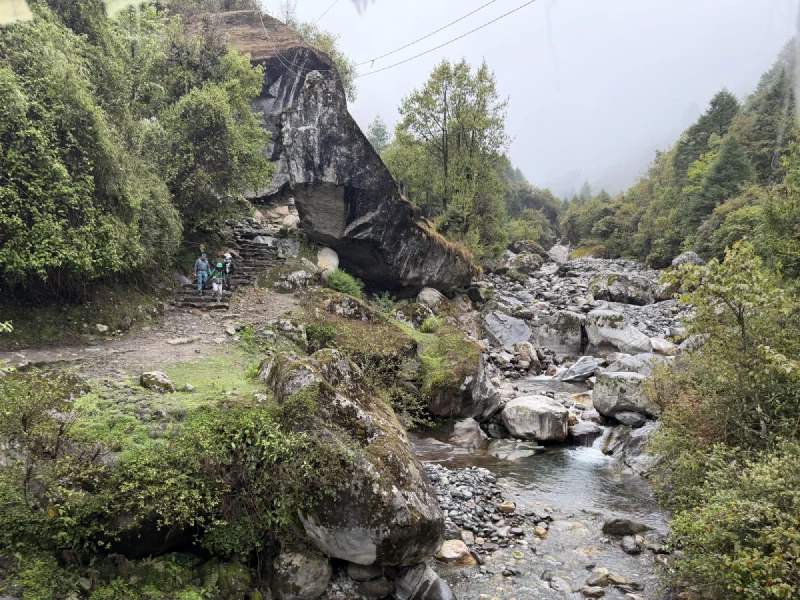
A rocky trail beside a stream under heavy gray sky
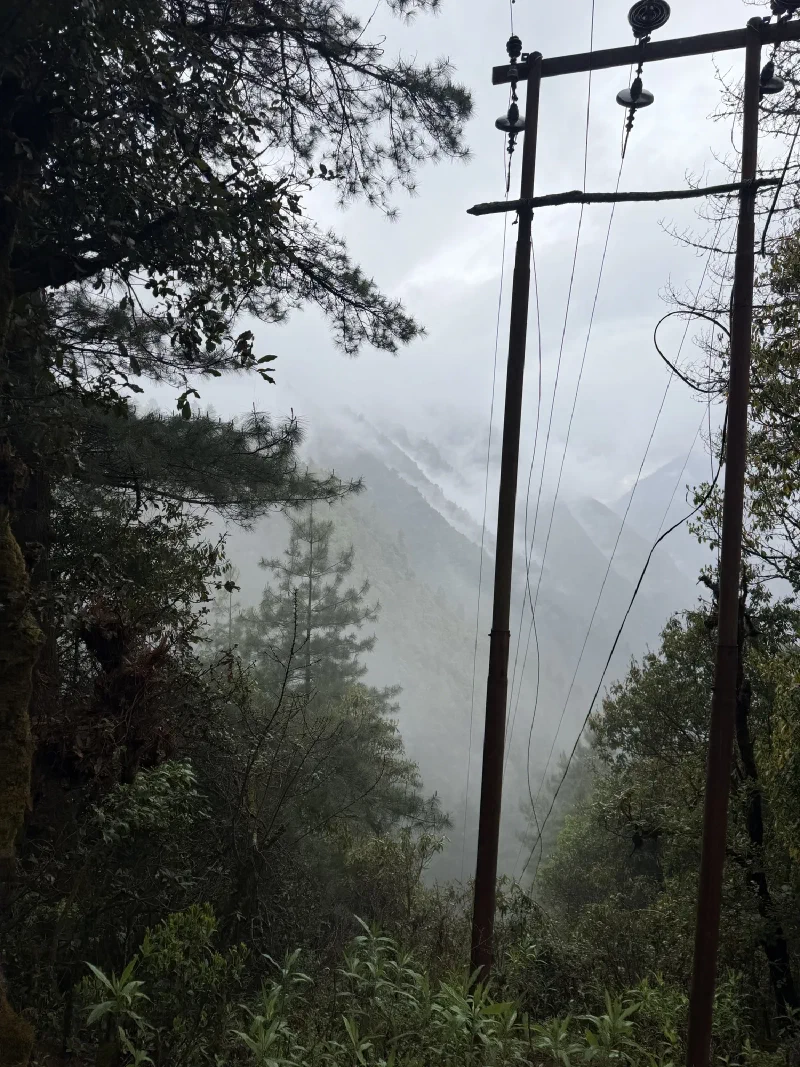
A misty slope seen through utility poles, sky completely gray
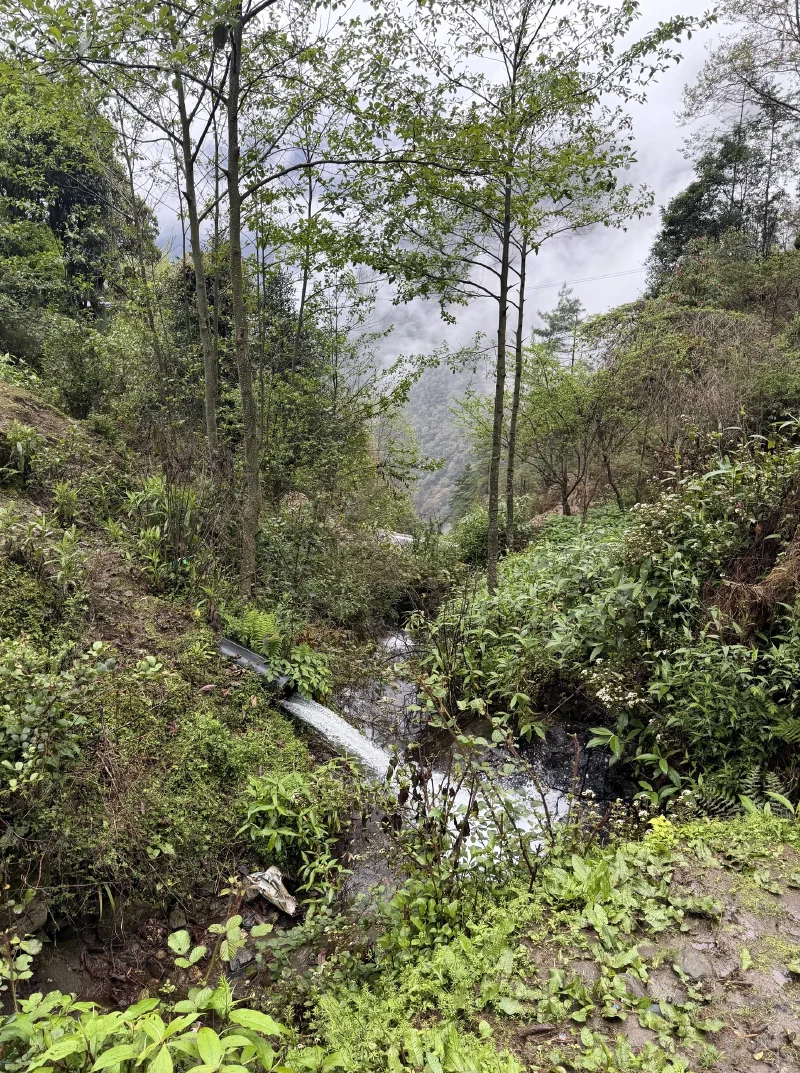
A muddy section of trail with a small drainage stream, gray skies above

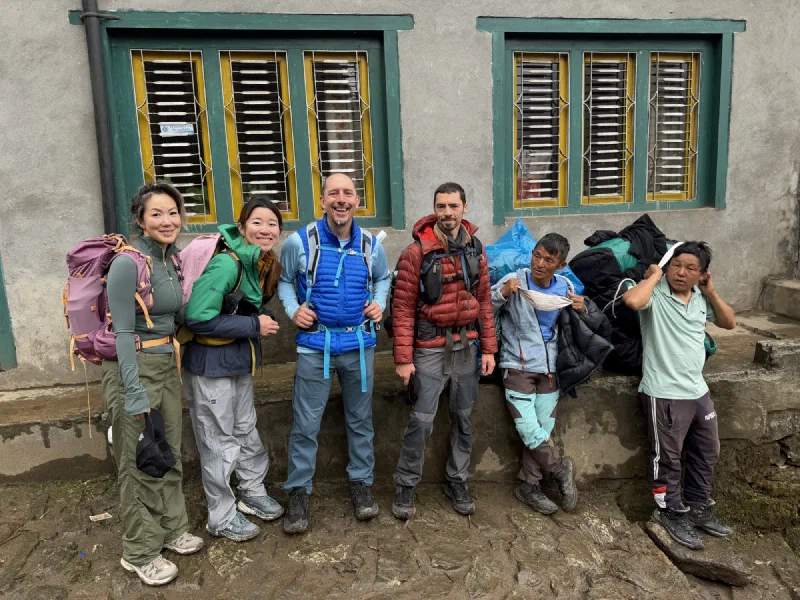
Halfway down, the crew stopped at a trail hut to regroup and practice looking optimistic. Po On, Alice, Steve, Nicholas, and the guides, all wearing the specific expression of people who have decided that smiling at the weather might help.

The group posing in trekking gear outside a concrete trail hut
Optimism, performed. The sky did not care.

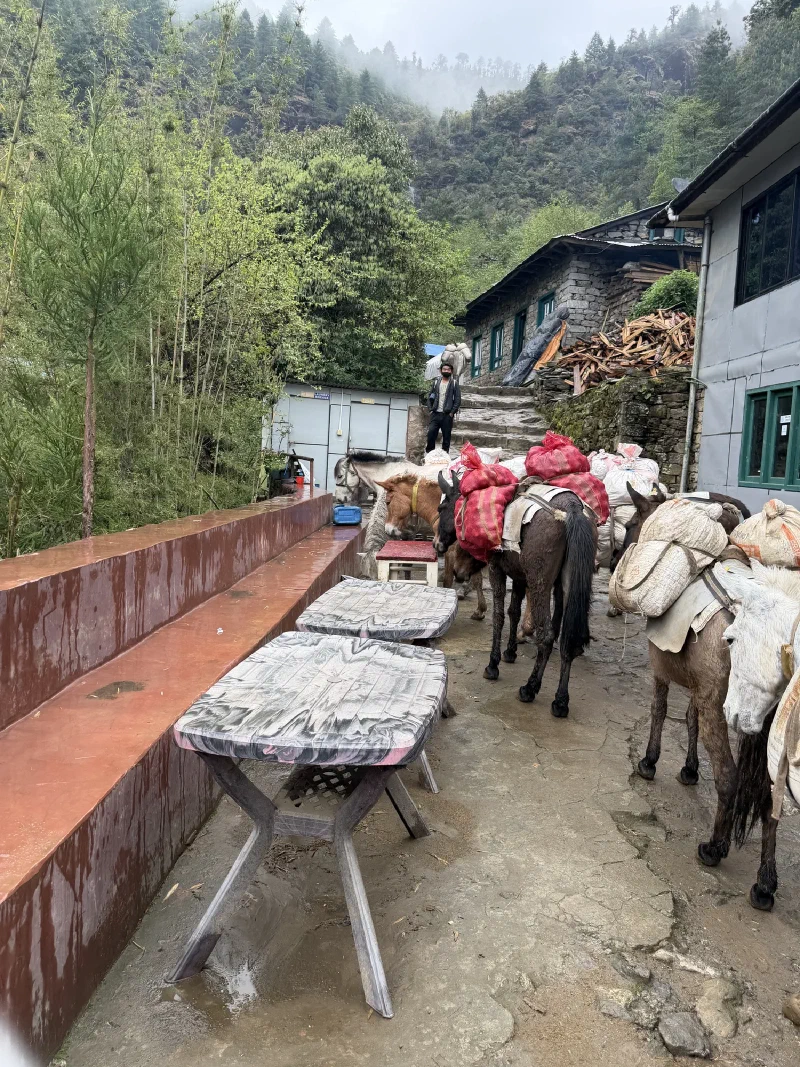
We passed loaded pack mules and the trail got properly rugged. This was not the gentle victory-lap descent anyone had pictured.

Loaded pack mules outside a stone building on a gray trail
A rugged dirt trail through forest, hikers descending under gray skies

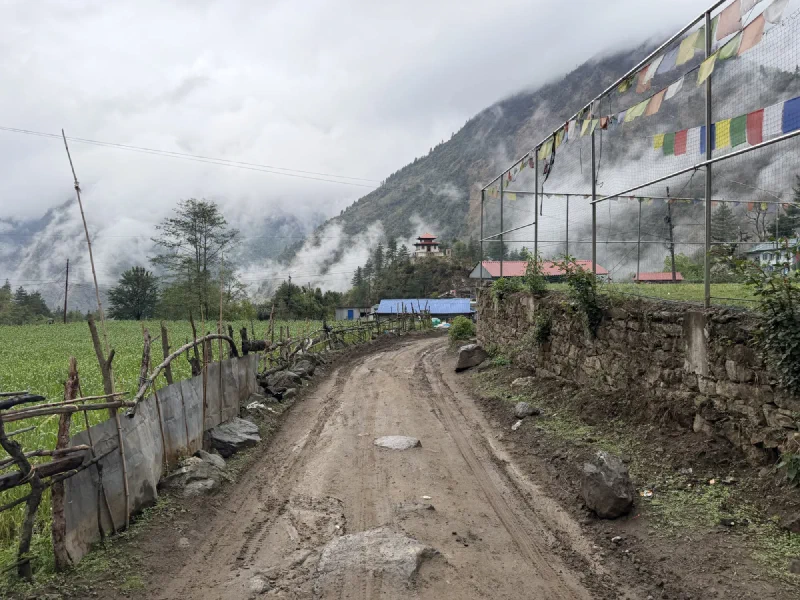
Then Surke came into view, a village with a half-built monastery on the hill above it. Somewhere down there was the helipad that was going to save us. In theory.

Approaching Surke village on a muddy road, prayer flags and a monastery on a misty hill
Coming into Surke. The monastery on the hill is still under construction, which felt appropriately on-theme for a day that was also not finished.

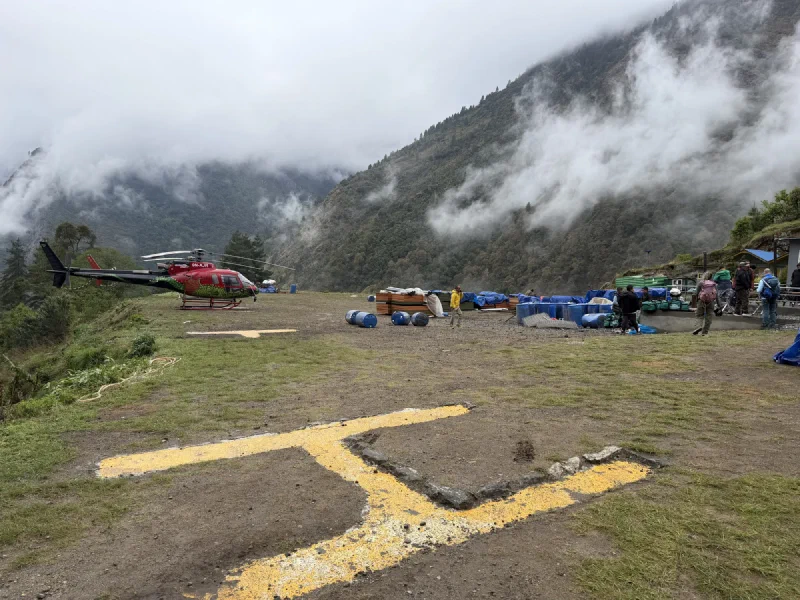
We got to the airport. I use the word loosely. It is a couple of helipads, a little terminal-slash-restaurant run by a Sherpa, and a whole lot of weather. Two helicopters were on the pad when we arrived. One of them lifted off almost immediately, empty, bolting for the valley before the clouds dropped any further and taking none of us with it. The clouds were not above us anymore. They were around us. There was no version of this that counted as VFR.

A grassy helipad with a yellow H, one red helicopter parked, low clouds on every mountain
The Surke ‘airport.’ A painted H, the second helicopter still on the deck, and clouds everywhere. The first one had already bolted, empty. Not encouraging.

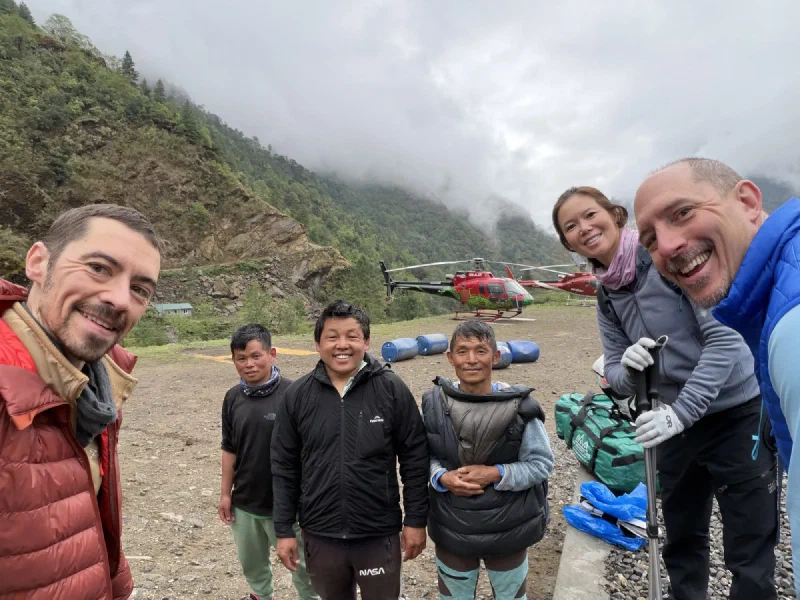
The porters peeled off here too. We’d already given them the proper send-off back in Lukla, dinner and tips and cookies, so this was just the practical goodbye. They were catching jeeps home from Surke, and they were not about to stand around in the fog waiting on our flight that clearly was not coming.

The group with porters near parked helicopters in heavy cloud
The last wave-off, clouds photobombing. The real thank-you happened the night before. This was just where the trail and the porters actually parted ways.

Here is where it got interesting. That second helicopter, the one still sitting on the pad, was not ours either. Ours, like most of the others, had tried to come up and been forced to turn back. But this pilot was about to make his own run for it, ducking out under the clouds toward Kathmandu before things got worse. He had room for exactly one more passenger.

That seat had originally been D.B.’s. With the rest of us grounded, he offered it up. Alice took it.

And off Alice went, alone, into a sky that was, in my professional aviation opinion, absolutely not fit for flying. The pilot swore it was clear down low and he had a line of sight out. Maybe. I am a bear who can fly under my own power, and I would not have braved that. But Alice has more nerve than sense, which I respect, and she made it.

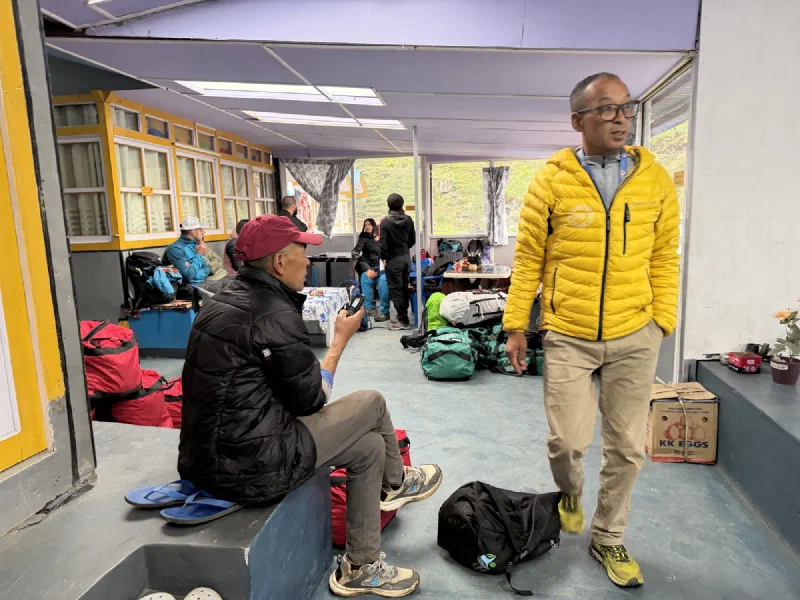
The rest of us went inside to wait. The man running the terminal, a Sherpa who clearly does this every season, promised the sun would burn off the fog and our helicopter would land in just a little bit.

The Sherpa who runs the terminal, in a yellow jacket, inside the rustic airport waiting room
The Sherpa who runs the whole operation. He had seen this weather a hundred times and was very calm about it. We were not.

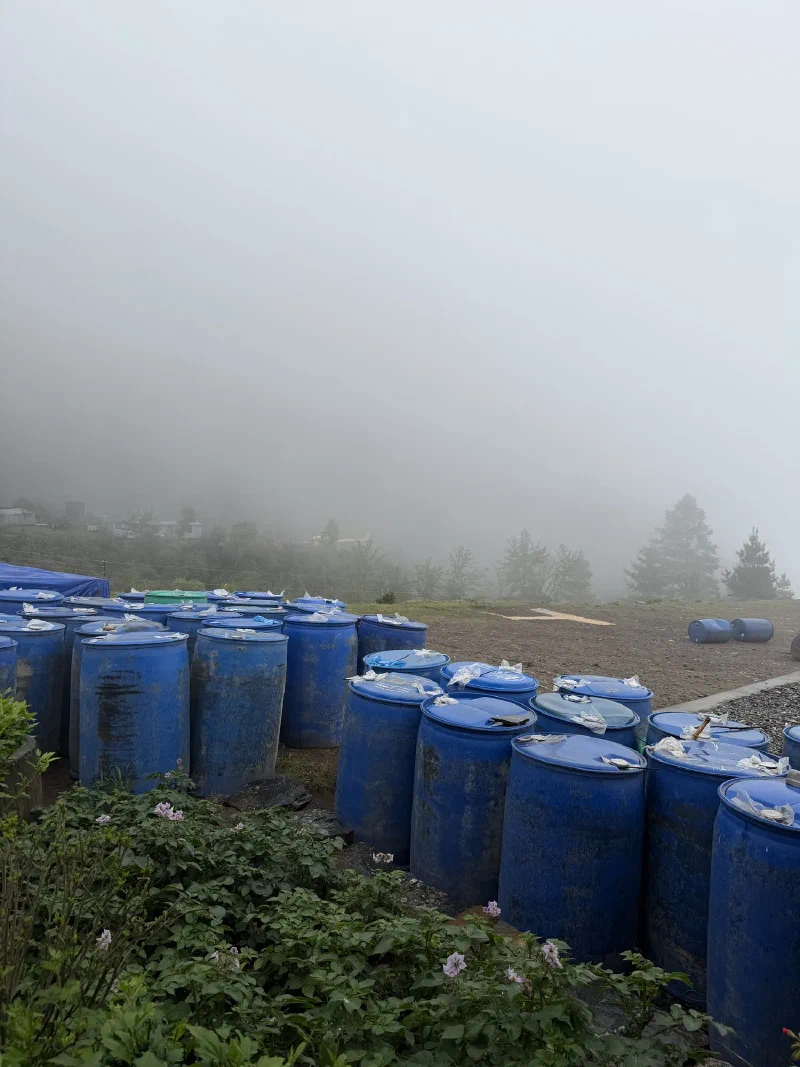
It did not.

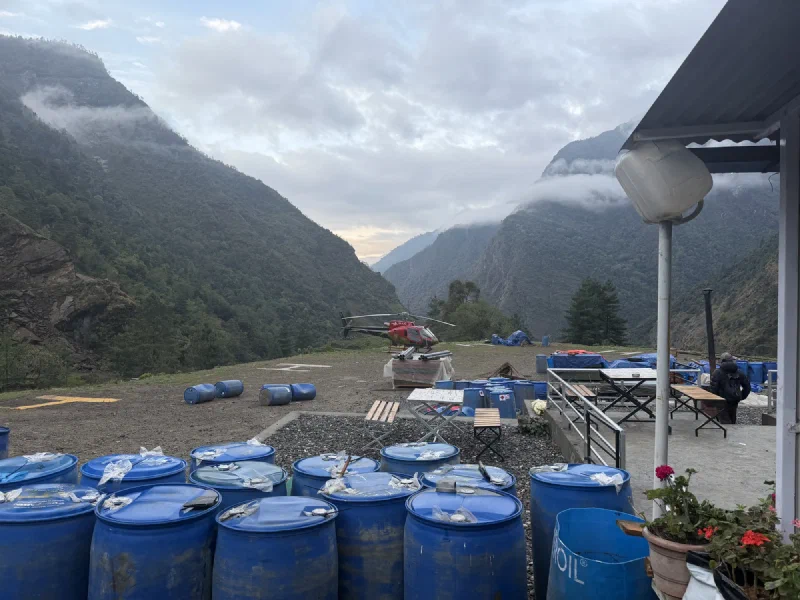
Looking out at the foggy helipad with blue barrels, no helicopter, very thick fog
The view out the window, on repeat, all day. Blue barrels. No helicopter. Fog doing fog things.

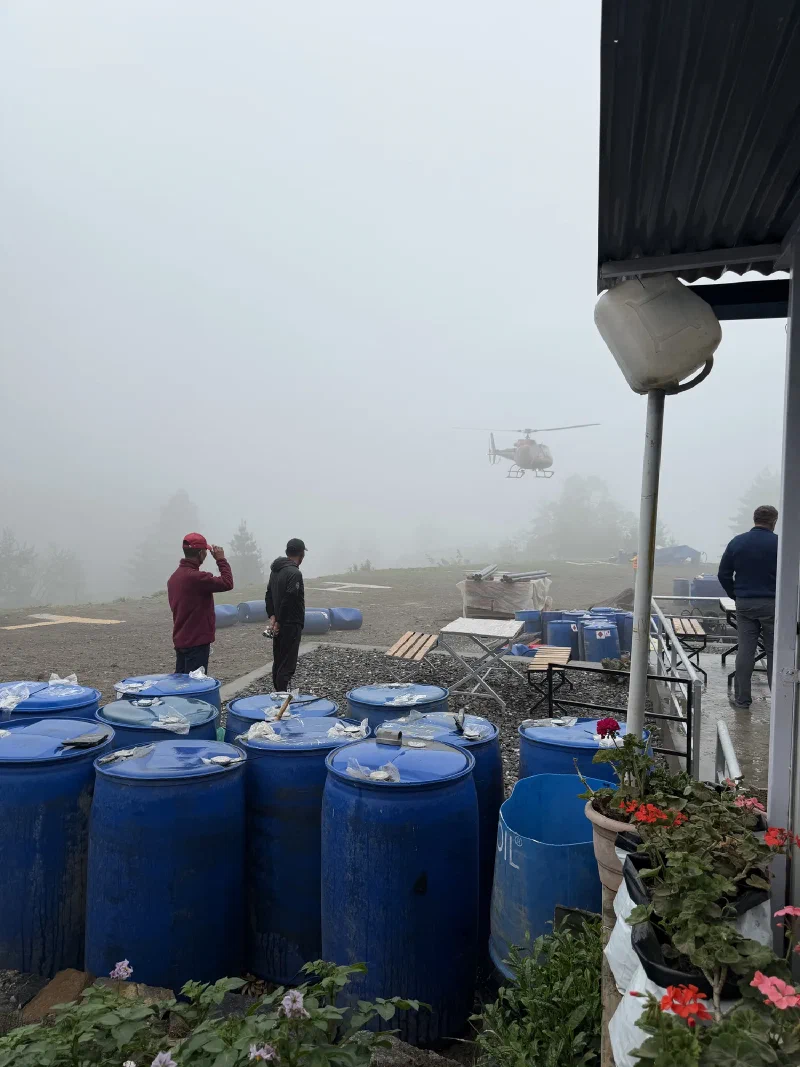
We got drinks. We got lunch. We kept looking outside. At one point we heard a helicopter, which we should not have, and a Fishtail chopper somehow came down out of the murk and landed. Not ours. He dropped some people off, took one look at the sky toward Lukla, and parked. Too foggy to climb back up. D.B. immediately booked him to take us out instead the moment things cleared.

A Fishtail helicopter descending into extremely heavy fog over the barrel-strewn helipad, men watching
The Fishtail materializing out of nothing. Look at that visibility and tell me that is Visual Flight Rules. I rest my case.

Spoiler: things did not clear.

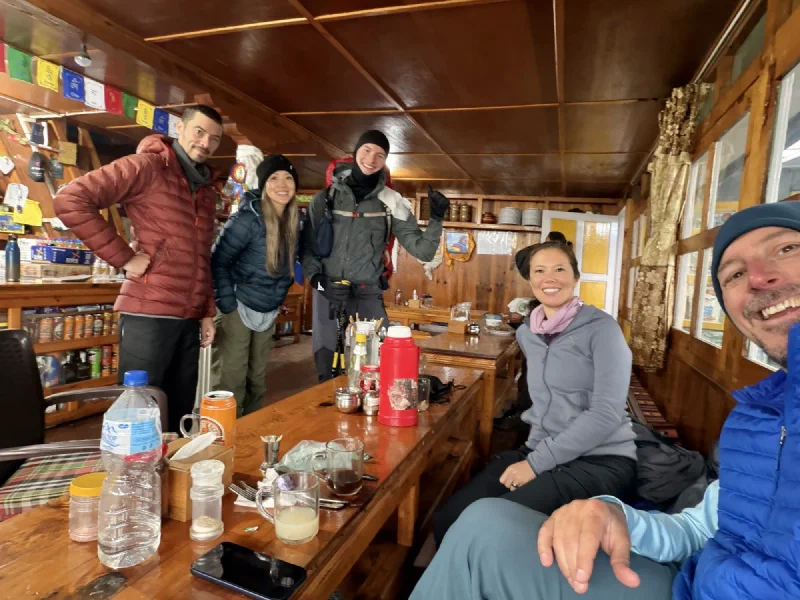
Our buddy Sven from the trail turned up too, also bumped from a canceled flight, also stuck, on his way to attempt the two-day jeep escape. He stopped in to say hello to the rest of the grounded.

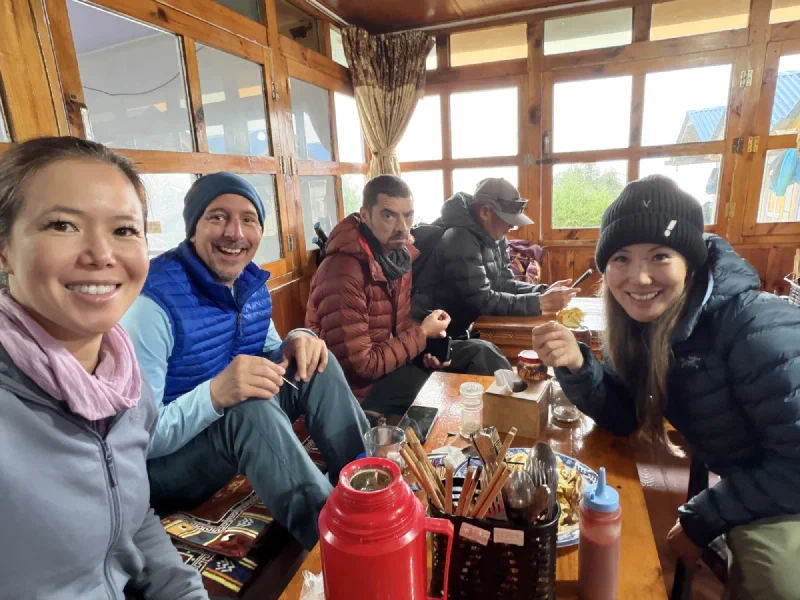
Sven and the group posing together in the wooden airport restaurant
Sven, reunited with us under the worst possible circumstances. Misery does love company.

So we sat. And sat. The fog whited out the windows. Nicholas stopped pretending to be cheerful about it.

The group around a table in the foggy restaurant, Nicholas looking displeased
The crew, several hours into the wait. Nicholas has fully given up on the optimistic face.

There is a hard cutoff. Around three in the afternoon, the last flight has to leave with enough daylight to reach Kathmandu safely. By then the fog had only thickened. The pilot of the parked helicopter made the call: he was camping at the airport overnight and trying again in the morning.

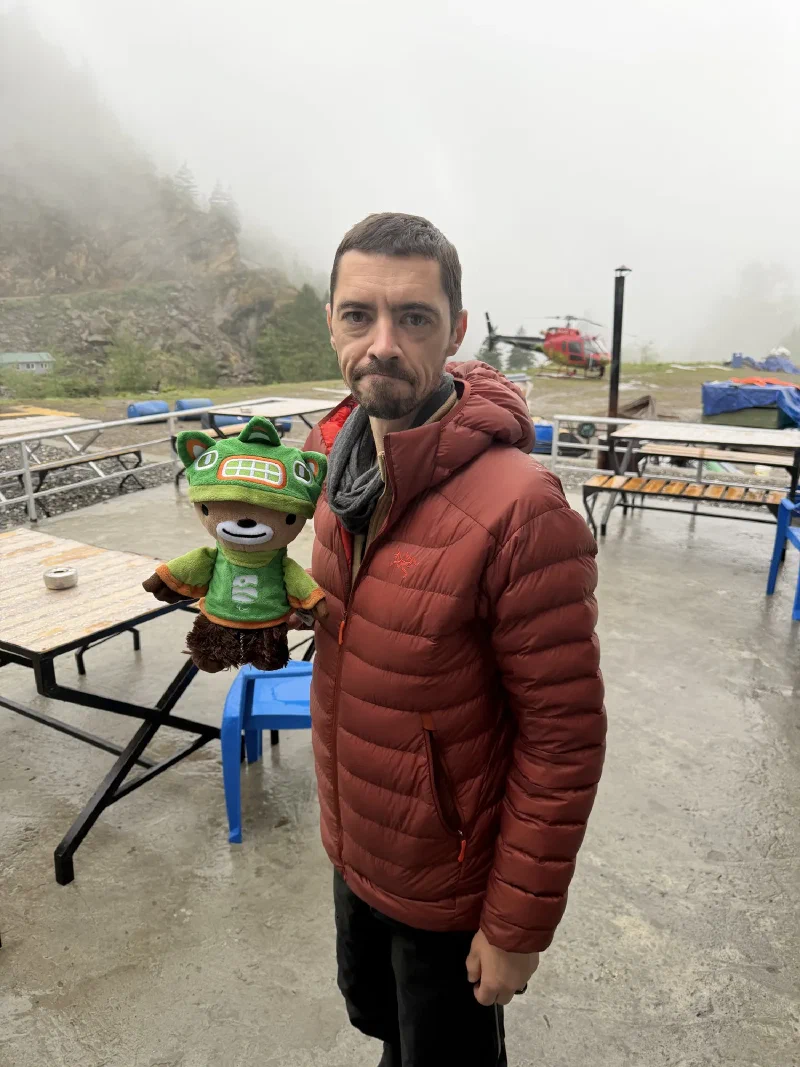
Nicholas holding Sumi the bear with a fogged-in red helicopter behind them at the helipad
Last call. Me and Nicholas and the helicopter that was going precisely nowhere. You can see the fog. There was a lot of fog.

So that was that. We could hike three hours back up to Lukla to try our luck there in the morning, except that is three hours uphill and Pokin was in no condition for it. The weather down here was the better bet anyway, even if the forecast for the next few days looked, in the technical meteorological term, grim. Our porters had already left with the jeeps, so we had no way to move the bags even if we wanted to.

Which left the Surke airport’s accommodation. Two beds in a box. The most basic rooms I have ever lowered my standards into.

Looks like we were camping a little longer than planned.


Farewell to the Porters

Our last full day in Lukla.

On the way in, Nicholas and Pokin never actually saw the town. They were sick, we took a helicopter straight to Phakding, and Lukla went by as a blur of “please let the rotors keep spinning.” So today we wandered. Properly. Up and down the back alleys, no duffel bags, no agenda.

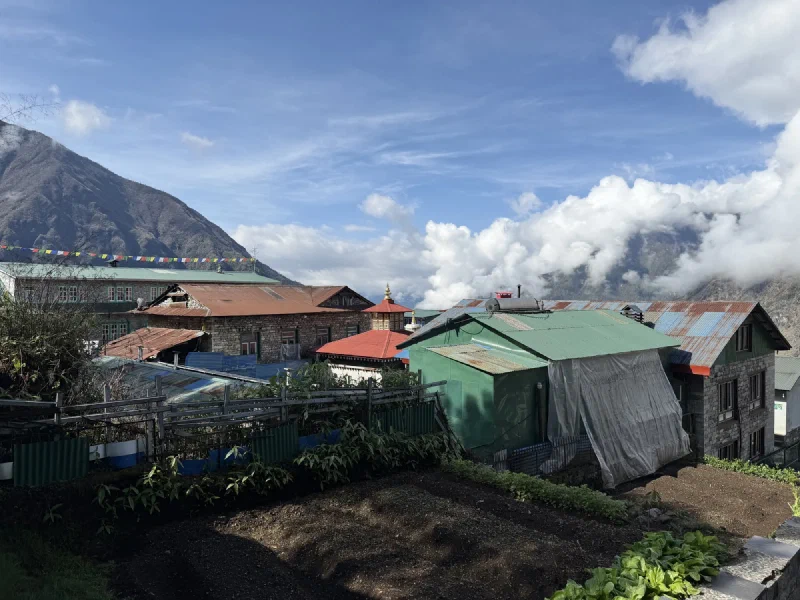
A back alley of Lukla town with prayer flags and mountains behind

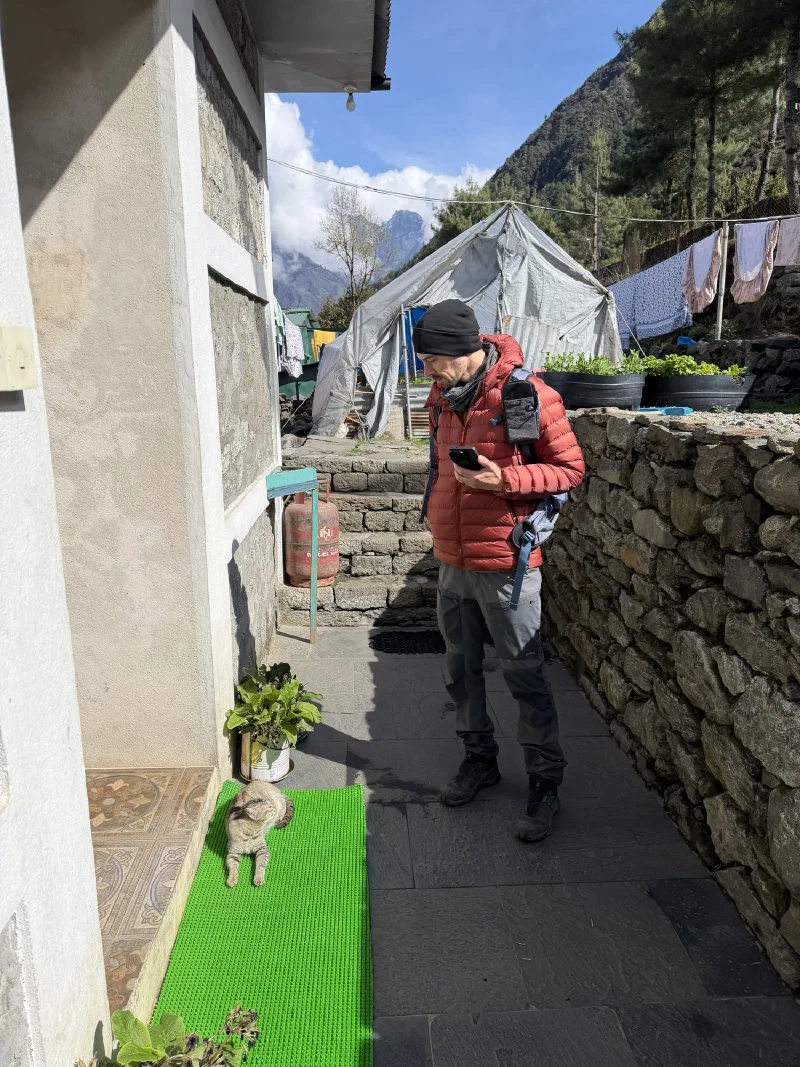
Nicholas standing near a tabby cat sunbathing on a green mat
Nicholas found a cat sunbathing on a mat and immediately entered a standoff with it. The cat won by not caring.

The Most Dangerous Airport in the World
#

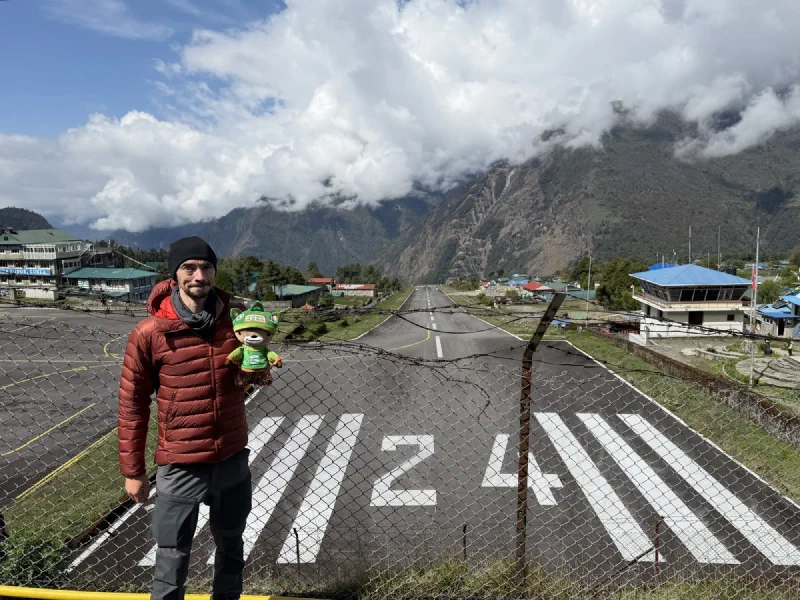
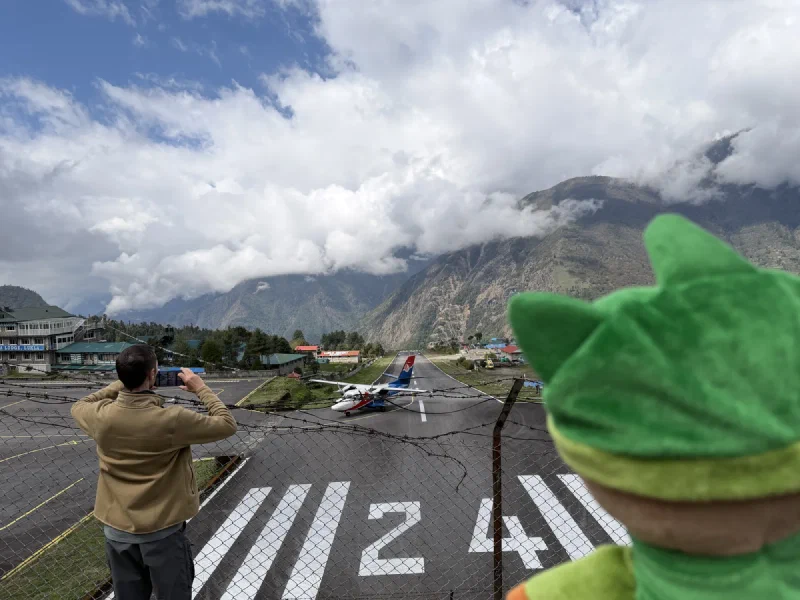
Lukla Airport has a reputation. Short runway, hard slope, a cliff at one end and a mountain at the other, and a habit of showing up on every “scariest airports” list ever written. We went and watched a few planes land on it, which is a deeply strange thing to do for fun.

Nicholas holding Sumi at the fence overlooking the sloped Lukla Airport runway
Runway 24. It points downhill at a cliff. This is considered normal here.

A small plane on the Lukla Airport runway with cloud-covered mountains behind

Good news for me: we’re flying out by helicopter tomorrow, not by one of those. Apparently a helicopter is the safer option here, which tells you everything you need to know about the planes.

Shopping, and a Basket Situation
#

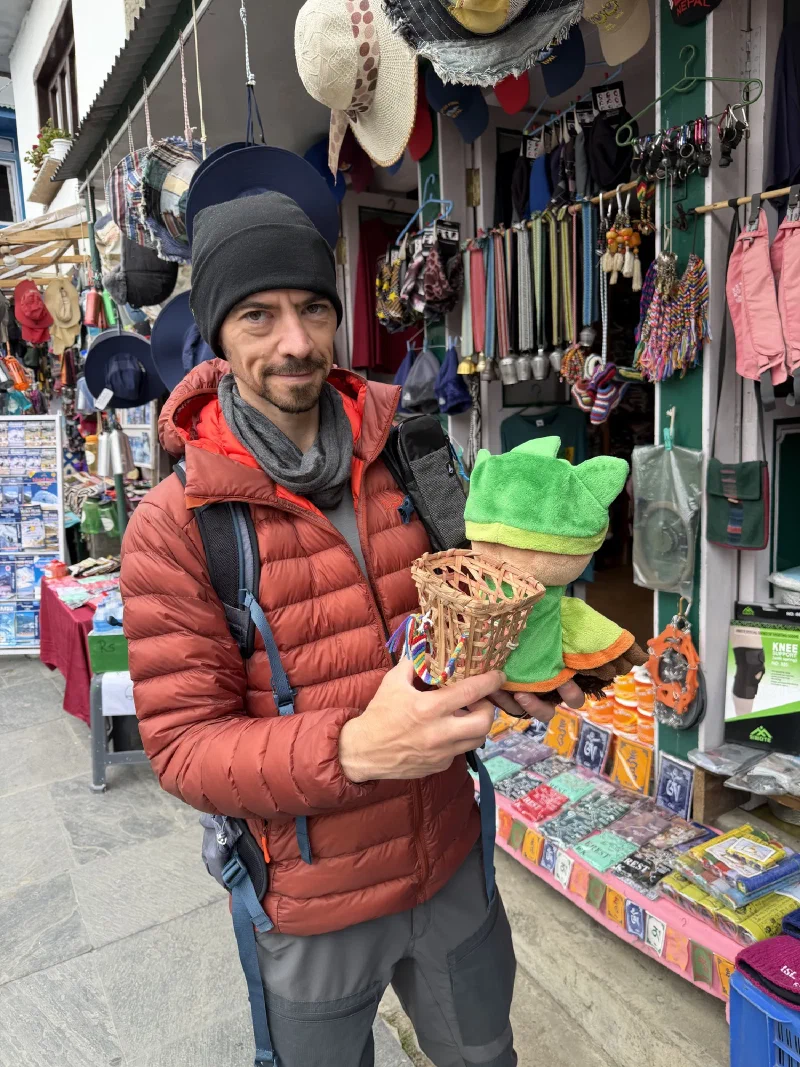
We did some shopping around town, and this is where it got serious. Someone had woven one of the traditional head-baskets, a doko, in a size that was suspiciously, perfectly, me-sized.

Nicholas holding up a small woven doko basket next to Sumi for size comparison
Nicholas held it up to my back to check the fit. It fit. There was no further discussion. It came home with us.

Naturally we had to get it. I am a bear of refined taste and I now own a tiny artisanal Himalayan basket. I have no plans to ever carry anything in it. That is not the point.

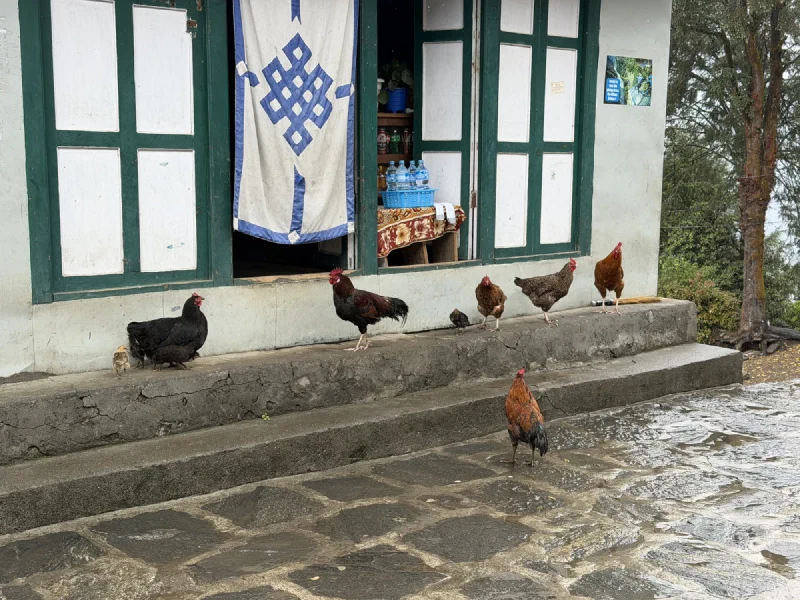
Chickens and baby chicks on stone steps in front of a village building

We also passed a bunch of chickens and a pile of tiny chicks, which was more interesting than it sounds. Lukla is about as high as chickens go. Any higher and they don’t make it, so all the chickens on the trek live down here at the bottom. The whole way up the mountain, no chickens. Come back down, and suddenly poultry everywhere. Nature has opinions about altitude.

The Goodbye Dinner
#

Then it was time for the real reason today mattered. The farewell dinner for the crew.

These porters hauled our gear up and down a mountain for three weeks. Our duffel bags, the food, the boxes of fruit, all of it, on their backs and headstraps, while we struggled to carry ourselves. Tonight was the thank-you.

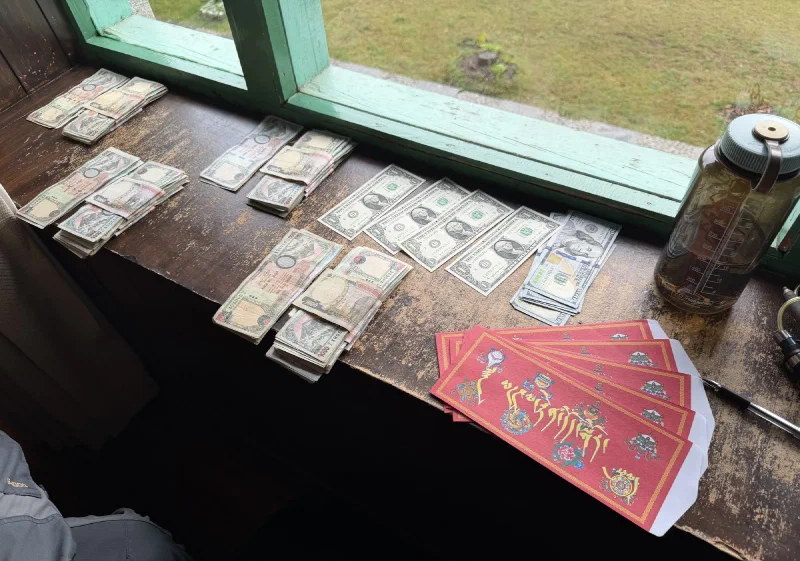
Stacks of Nepalese rupees and US dollars on a windowsill next to red envelopes
The tips. Cash, stacked, ready to load into lucky red envelopes.

Nicholas spent a good chunk of the afternoon counting out tip money into red pockets. There were stacks of rupees and dollars laid out on the windowsill, and at one point he looked less like an engineer on vacation and more like a small-time crime boss doing his books.

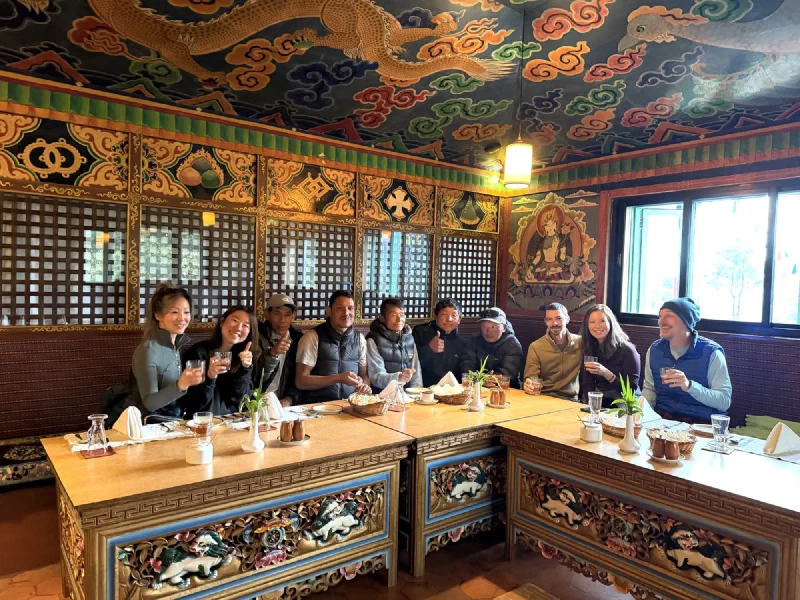
The full crew of eleven raising glasses at the farewell dinner under a golden dragon ceiling
The whole crew, under a golden dragon ceiling. Three weeks of work, one very good dinner.

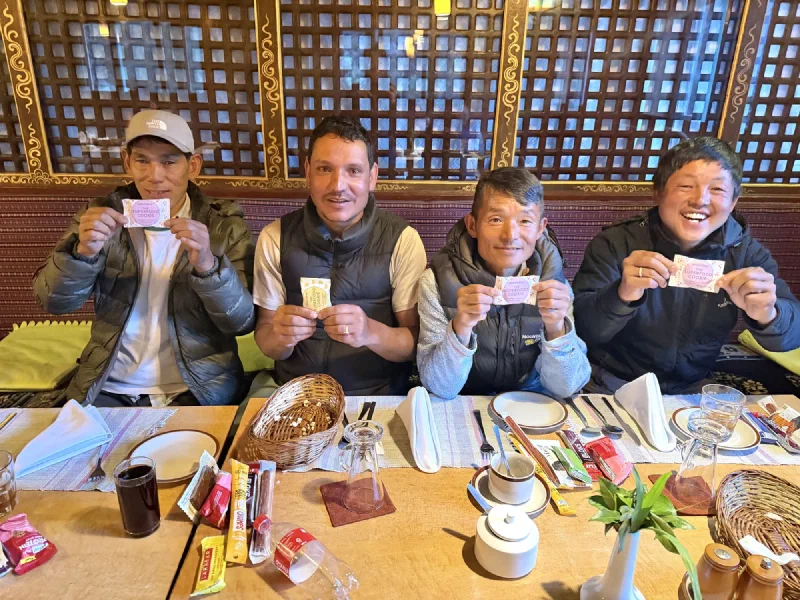
We brought treats too. A friend of ours owns a cookie company, so we’d hauled a stash of her cookies all the way to Nepal, and the porters got plenty. They seemed genuinely pleased about it, which is the highest praise a cookie can earn from people who carry sixty kilograms uphill for a living.

Four porters smiling and holding up packets of cookies at the dinner table
Cookie distribution. A success on all fronts.

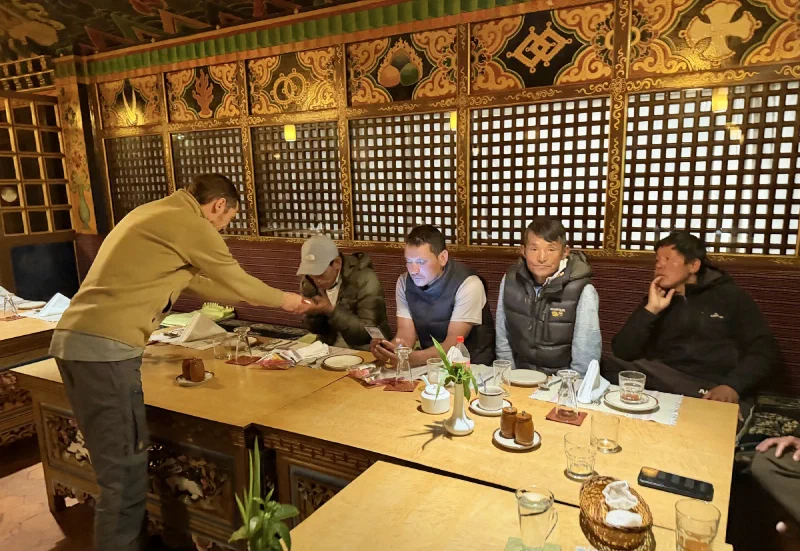
And then the part they’d actually earned: the red envelopes.

Nicholas handing red envelopes of cash tips to the seated porters
The handoff. Cookies are nice. This was the real thank-you.

It was a good night. Everyone fed, everyone tipped, everyone in one piece after three weeks of mountain.

Tomorrow morning, the helicopter back to Kathmandu. The trek part was officially behind us.

So I did what any reasonable bear does at the end of a long expedition. I claimed the best bed in the room and went to sleep.


Horse to Lukla

Time to say goodbye to the Gurkha Inn.

The plan was simple. Hike from Phakding back up to Lukla, get there early, and have a buffer day before Steve and Alice rolled in. We didn’t want to be cutting it close on the last leg, so an early start it was.

One problem. Nicholas and Po On were finally, fully better. Pokin was not. She’d been the one who couldn’t shake it, and she still sounded terrible. Some people just don’t recover at altitude, and she was firmly in that camp.

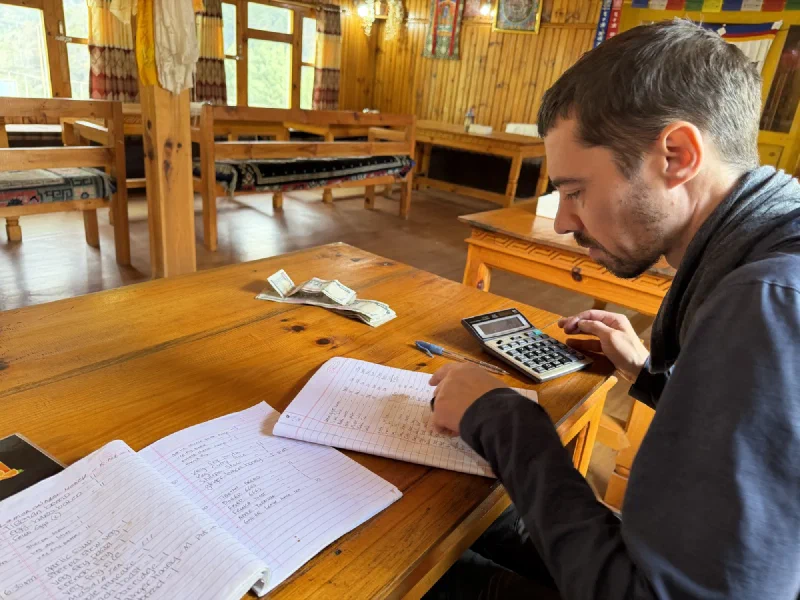
Nicholas at a wooden table using a calculator and notebooks to total up the food bill
Nicholas settling the final bill. Pages and pages of veg fry pasta. I have seen the ledger. It was mostly noodles.

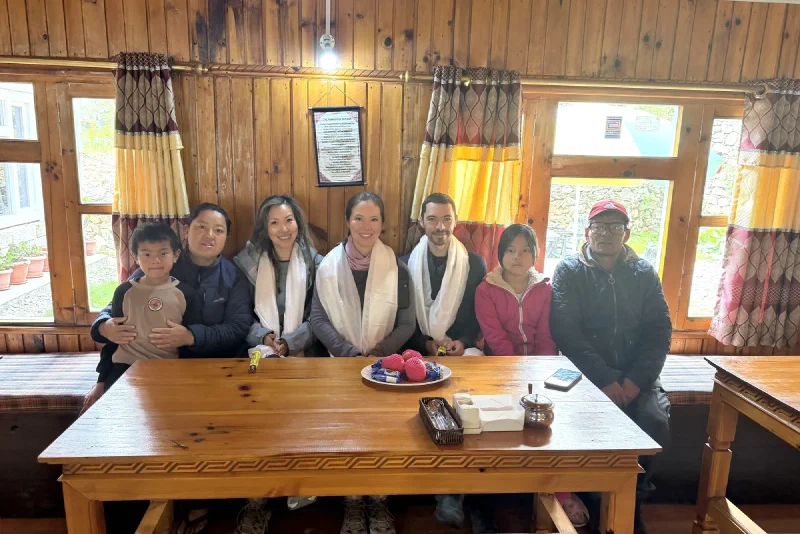
While Nicholas did math at the breakfast table, the porters started hauling our gear into the courtyard and packing it down. After all the days we’d spent at the Gurkha Inn, the family gave us a proper send-off. Scarves, photos, the whole ceremony.

The Gurkha Inn family draping white khata scarves on the trekkers in the dining room
White khata scarves. A real farewell. We’d basically moved in, so this was earned.

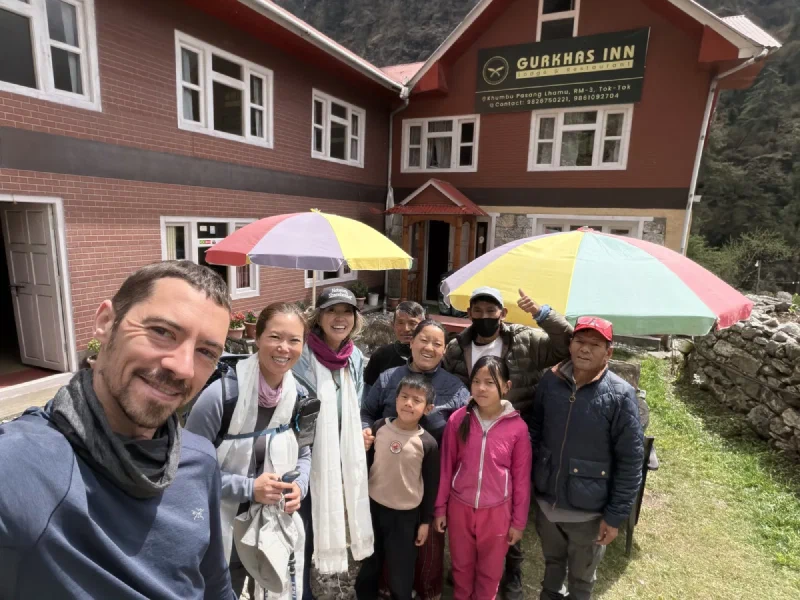
The Gurkha Inn family and trekkers posing outside the lodge

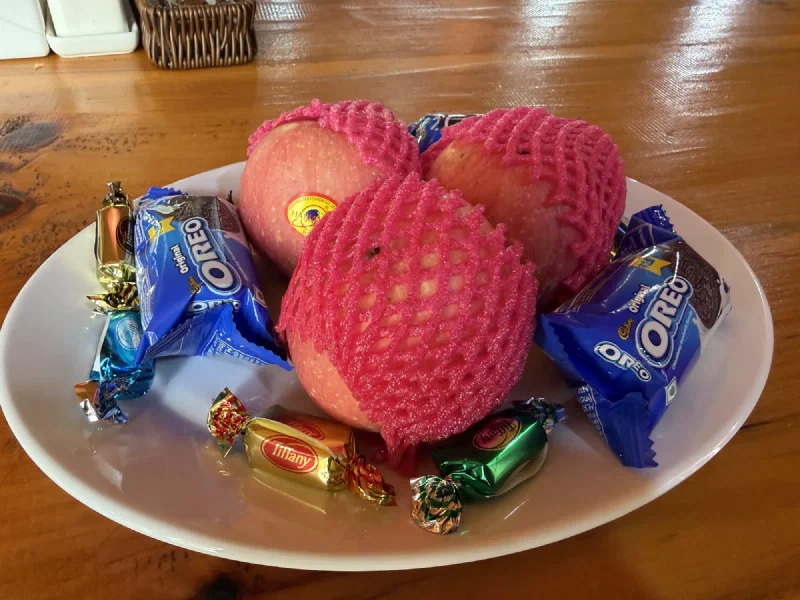
They also handed over a farewell treat plate. I assume the apples were for the horses. The Oreos and the small pile of wrapped candy, however, were clearly meant for me.

Farewell treat plate with apples in foam nets, Oreos, and wrapped candy

Then we geared up and headed out.

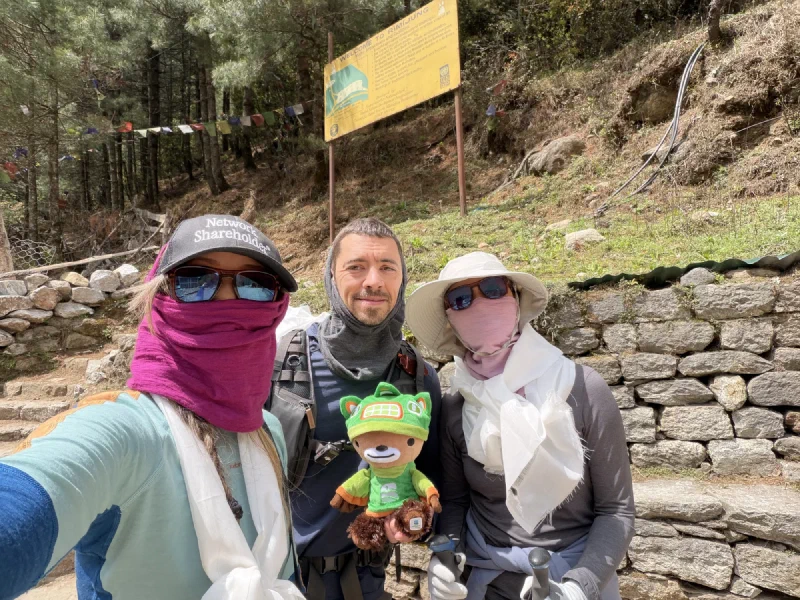
Nicholas, Pokin, and Po On posing at the trailhead, Sumi held in front
The crew, ready to go. Pokin in full mask-and-sunglasses armor. She was not feeling great and the outfit said so.

The Bridge, The Donkeys, The Usual
#

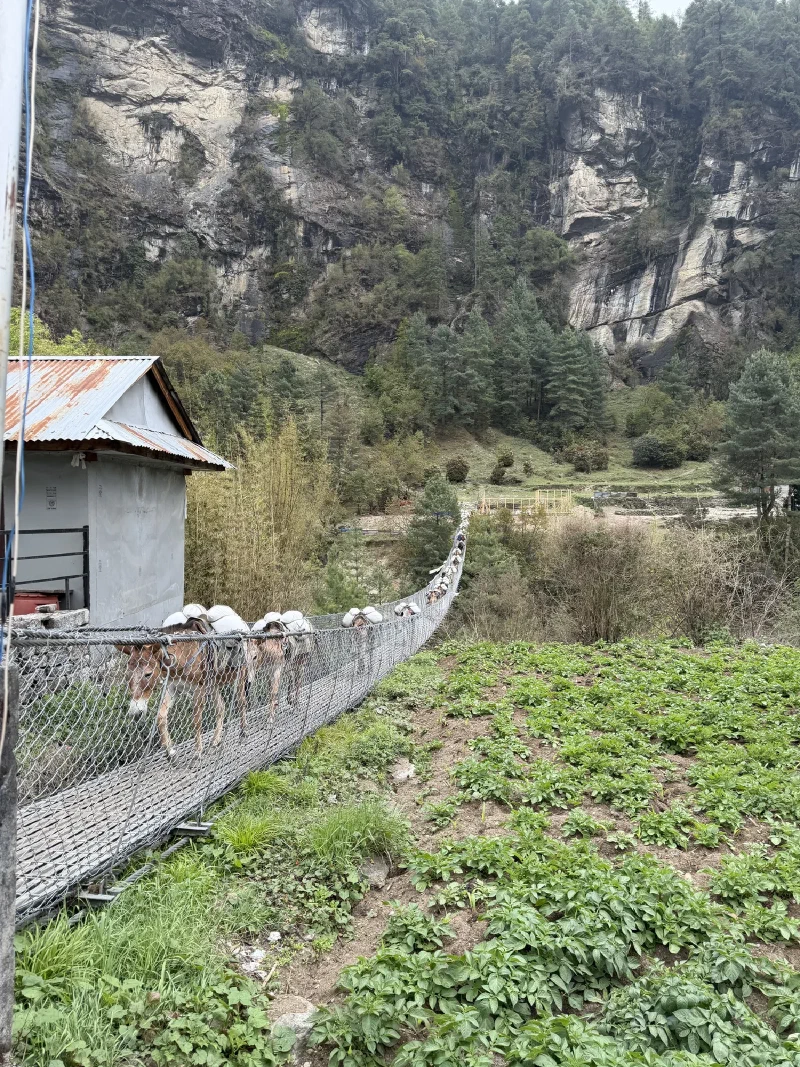
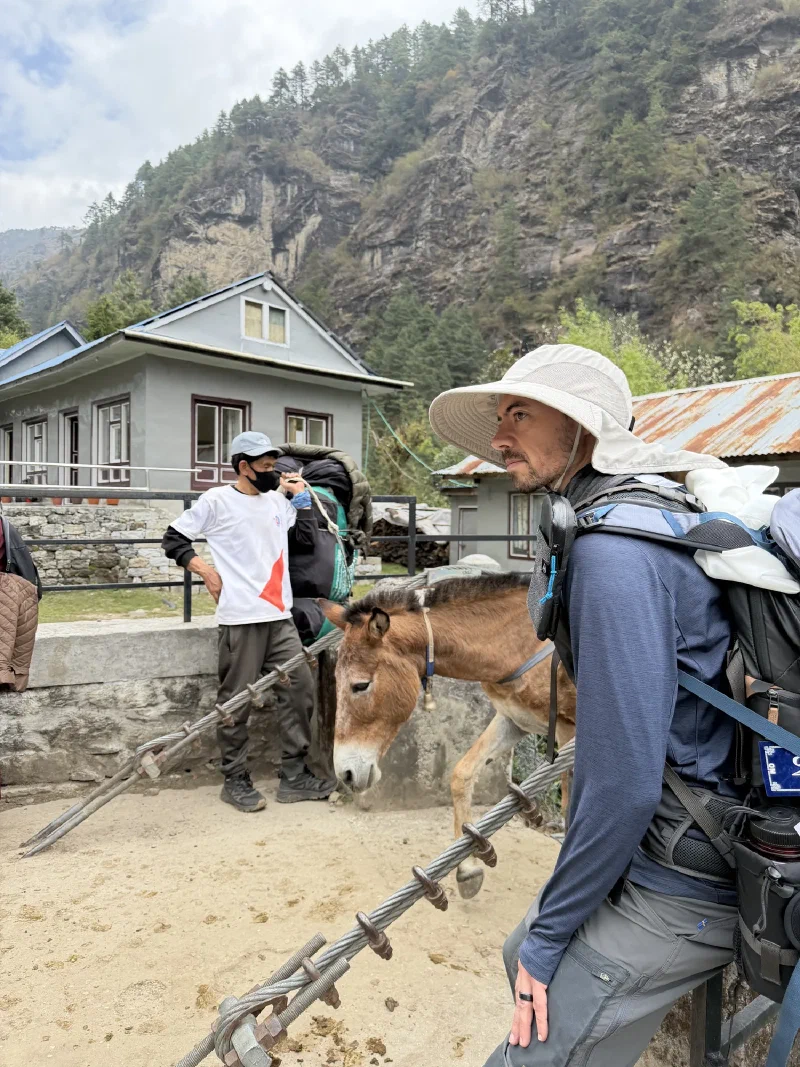
The way out of town crossed one of the big suspension bridges, which meant the usual ritual: stand there and wait while a cargo train of donkeys decides whether or not it’s their turn.

A line of cargo donkeys crossing a suspension bridge over the valley

A trekker leaning on the bridge cable next to a local man and a waiting mule
Right of way on these trails is decided by the animals. You wait. They cross. That is the system.

After that it was just trail. Down, then up, then more up. Lukla sits higher than Phakding, so the last stretch back is a climb, not a stroll.

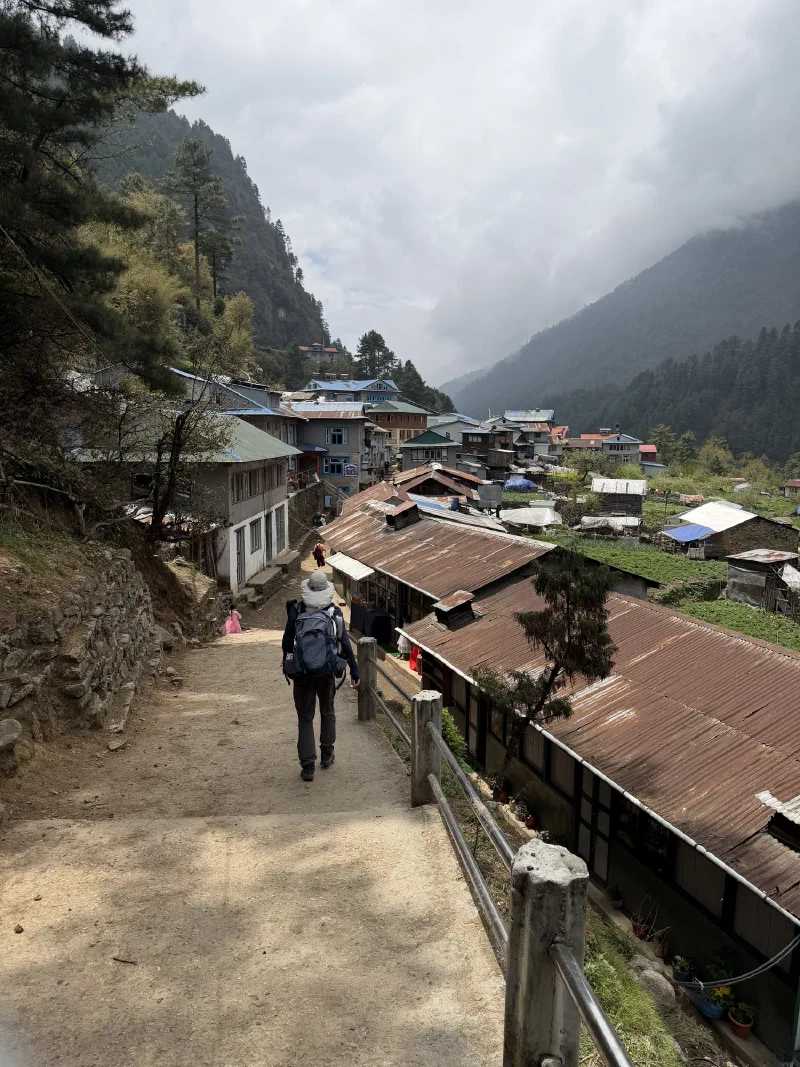
A trekker descending a dusty village path with mountains in the cloud behind

This is the part where I have to bring up the horse situation.

Pokin vs. The Horse
#

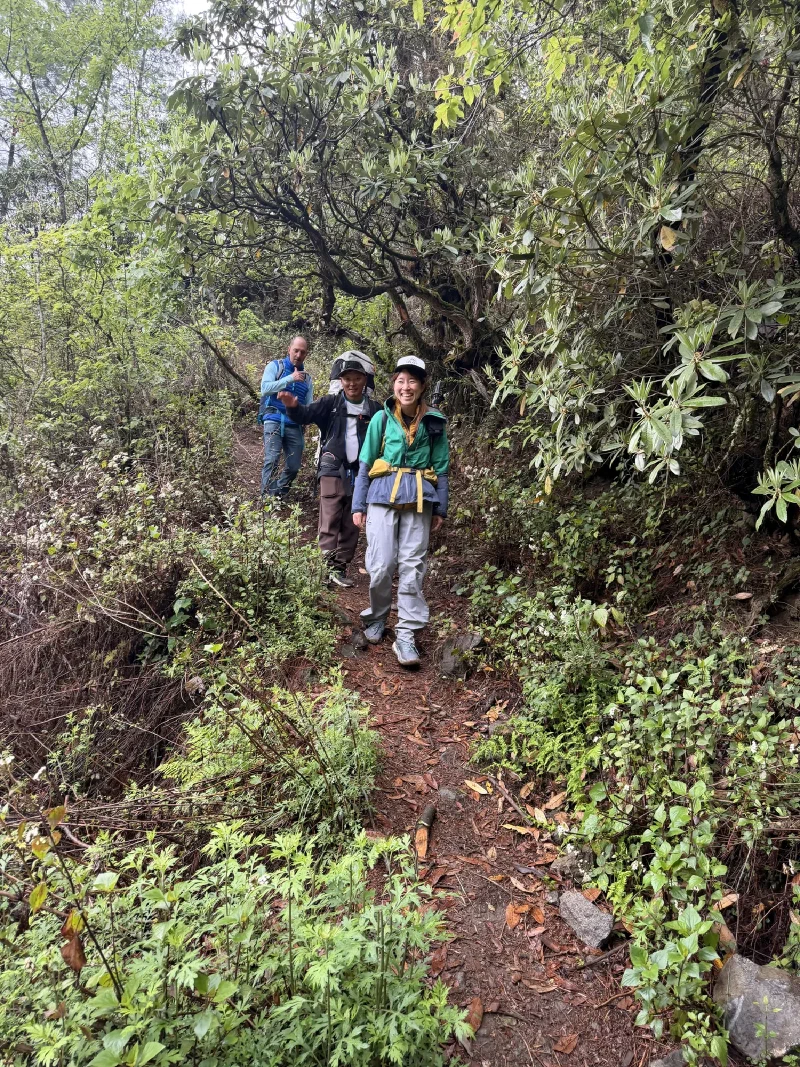
Here is the thing you need to know. This entire trip, every single time a horse came up as an option, Pokin refused. Flatly. She watched Po On ride one back to Tengboche days earlier. Saw it work perfectly. Still said no. She wanted to do the whole thing on her own legs, which is an admirable instinct right up until your legs and your lungs disagree with you.

I never understood this. I make my bud carry me everywhere and it’s fantastic. I have no notes on the system. The system is perfect.

So we’re maybe two hours of solid uphill from Lukla, and Pokin starts coughing in a way that isn’t “I have a cold” so much as “I might fold up on this trail.” Real fits. The kind where you stop walking because you have to.

Nicholas watched it for a bit and told her, flat out, that he was getting a horse. You’d think that would settle it. It did not. Pokin just kept walking, having quietly decided that if she could outwalk the horse, she wouldn’t have to ride it. The horse did not even exist yet and she was already racing it.

So Nicholas went back, found Nilman, negotiated the horse anyway, and then caught up to her on the trail. By this point Pokin had thrown so much energy into outrunning a hypothetical, not-yet-purchased horse that she’d completely wrecked herself. She was now too tired to walk back to where the horse actually was.

So the horse came to her. She lost a race against an animal that hadn’t been hired when the race started. Chestnut, somewhere back in Las Vegas, just felt a great disturbance and has no idea why he’s suddenly so happy.

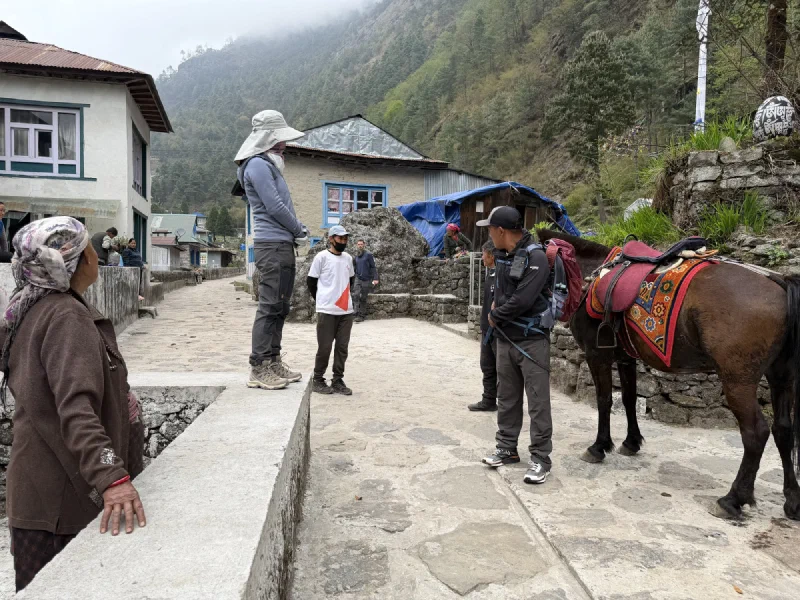
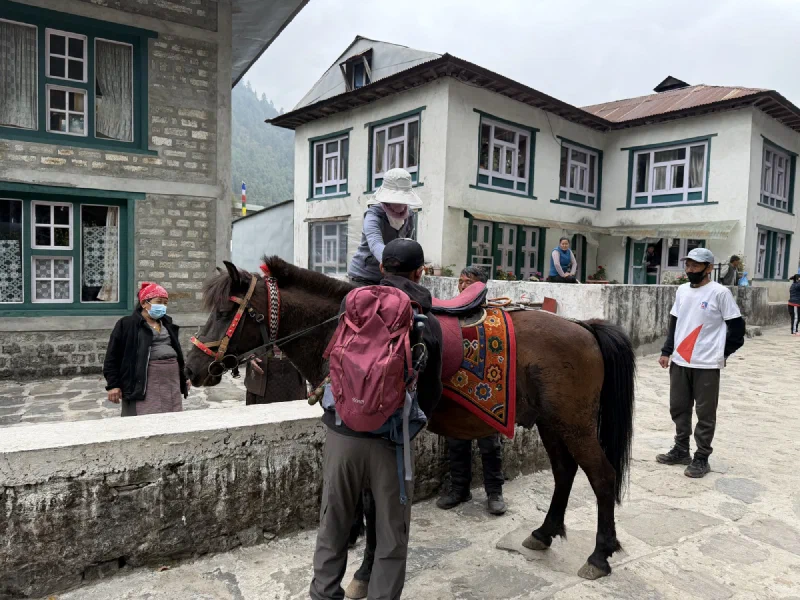
A saddled horse waiting on a village path while locals stand nearby
Nilman found a local, the local found a horse. Negotiations happened in a language that was not ours.

The horse that showed up was big. Not pony big. Intimidatingly, structurally big. His name was Rocky, which felt about right. He looked at the trail ahead like it had personally wasted his time.

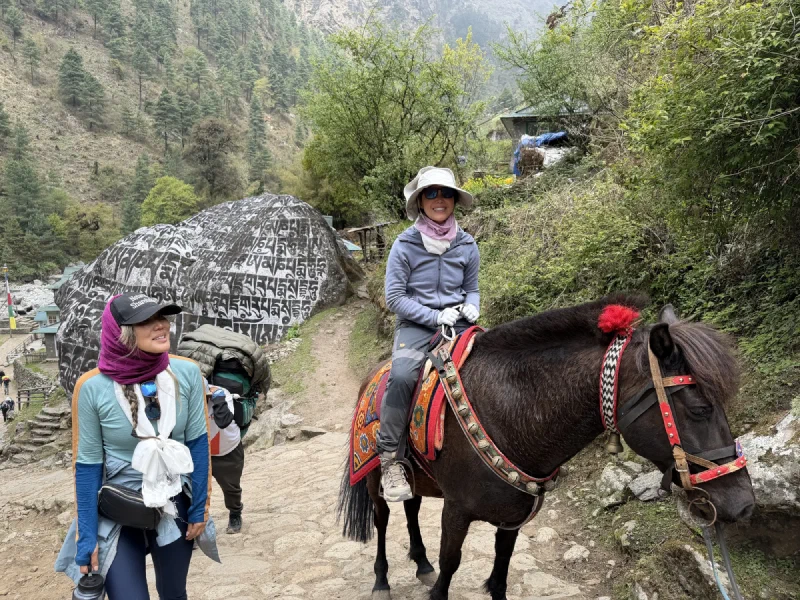
Pokin being helped up onto the dark brown horse in a village square
Mounting up. This took some doing. The horse did not care either way.

And then something annoying happened. She felt better immediately.

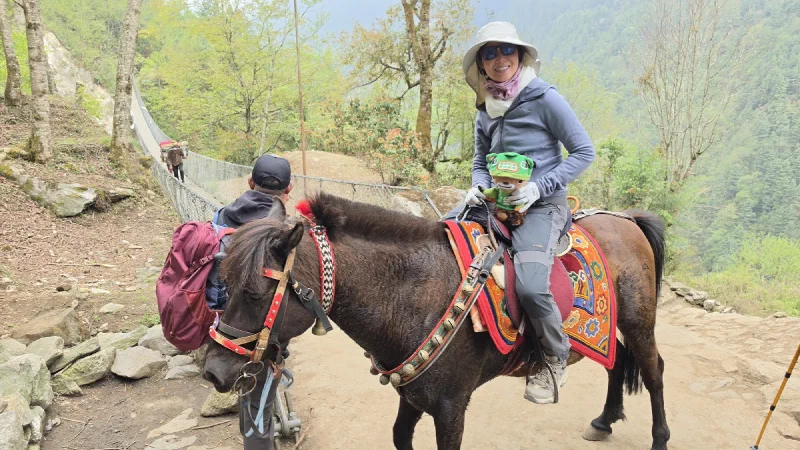
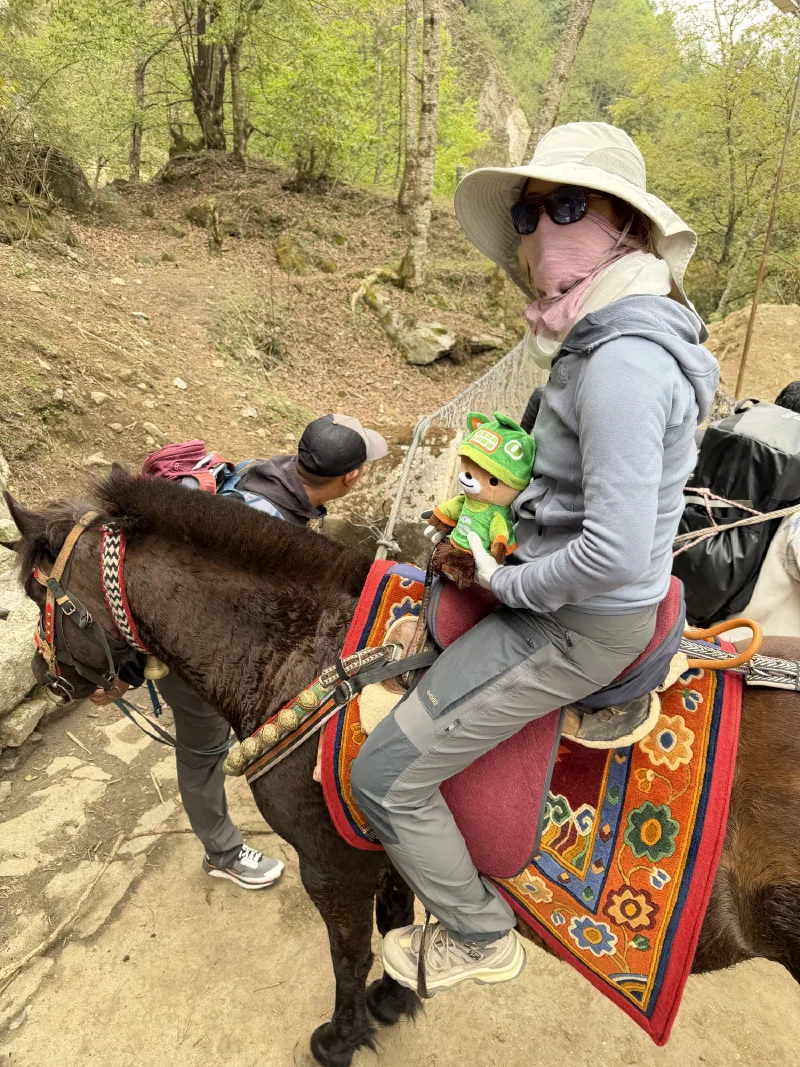
Pokin smiling on horseback holding Sumi, suspension bridge in the valley behind
The face of a woman who fought this exact outcome for the entire trip. Note who got to ride up there with her. Obviously I supervised.

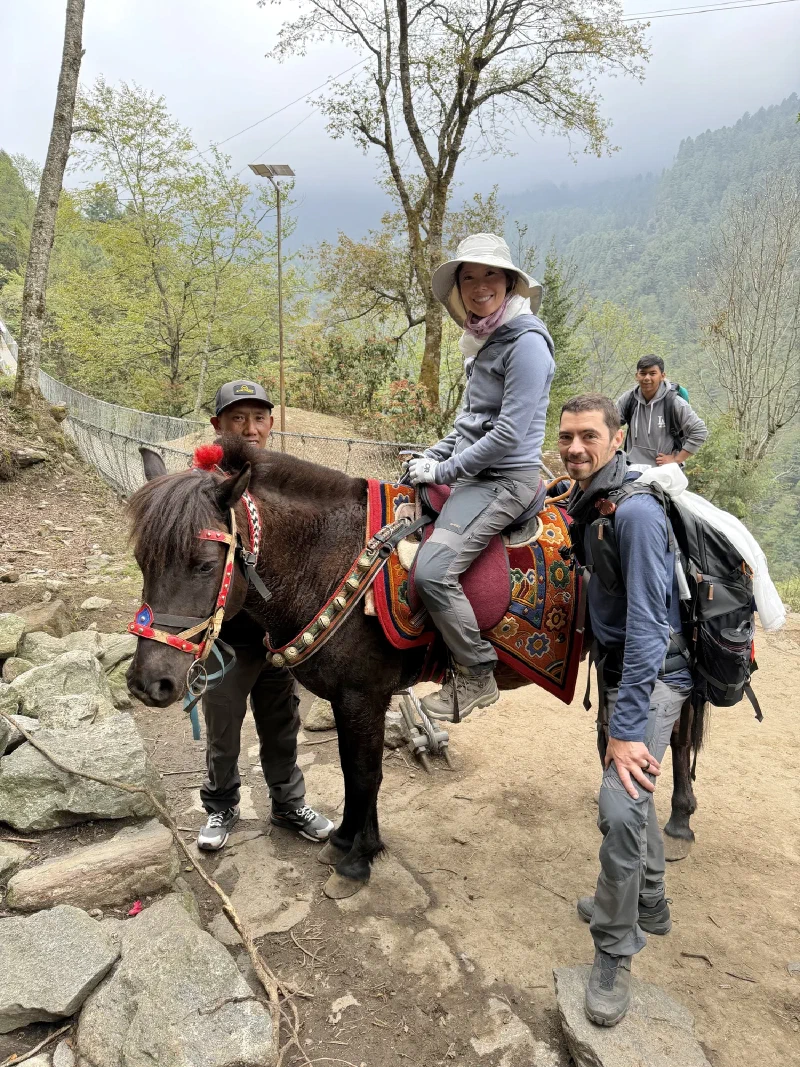
You could see the relief from the ground. One minute she’s coughing herself inside out, next minute she’s up on this enormous animal cruising toward Lukla like she’s leading a parade. I rode shotgun for part of it, purely in a supervisory capacity.

Pokin smiling on the horse beside a large boulder carved with Tibetan script
Past the mani stones, looking suspiciously cheerful for someone who lost an argument.

The horse hauled her up that mountain like the elevation didn’t exist. The rest of us scuttled along behind on foot, trying to keep pace with a creature that climbs Himalayan trails for a living. We lost.

Pokin riding the horse on the trail with the group walking behind, bridge in the distance

Pokin and the group nearing Lukla, forested hills behind

Lukla, and the Hotel That Was Too Fancy to Feed Us
#

We made it into Lukla without any further drama, which after this trek felt almost suspicious. Checked into our hotel, which was very nice. Too nice, it turned out. The kind of nice where the restaurant is more interested in looking good than feeding you.

So we went next door to a place called the Yak Hotel. Everyone assumed it would be a downgrade. They said the food was excellent, but I’m still not convinced it wasn’t just relief that they’d survived another hike.

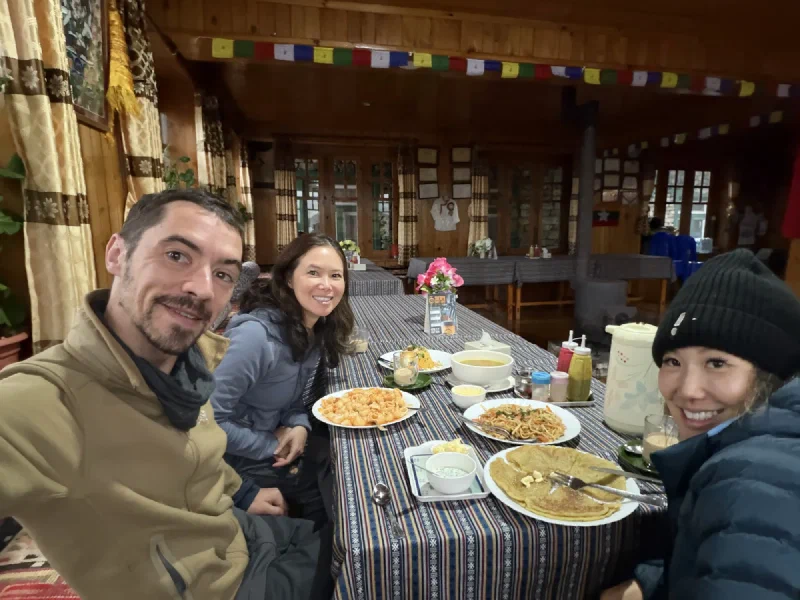
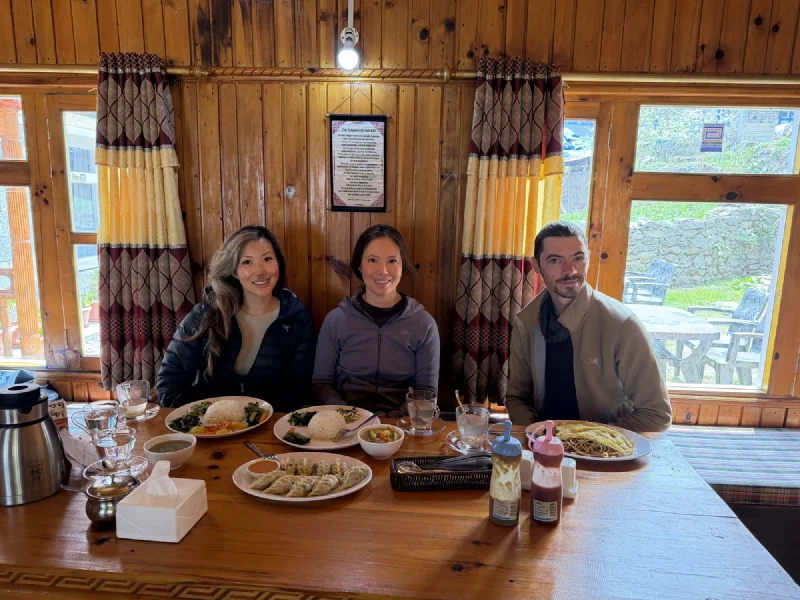
Nicholas, Pokin, and Po On smiling around a full table of food at the Yak Hotel
Nicholas, Pokin, and Po On at the Yak Hotel. Three people who expected a sad dinner and got the opposite.

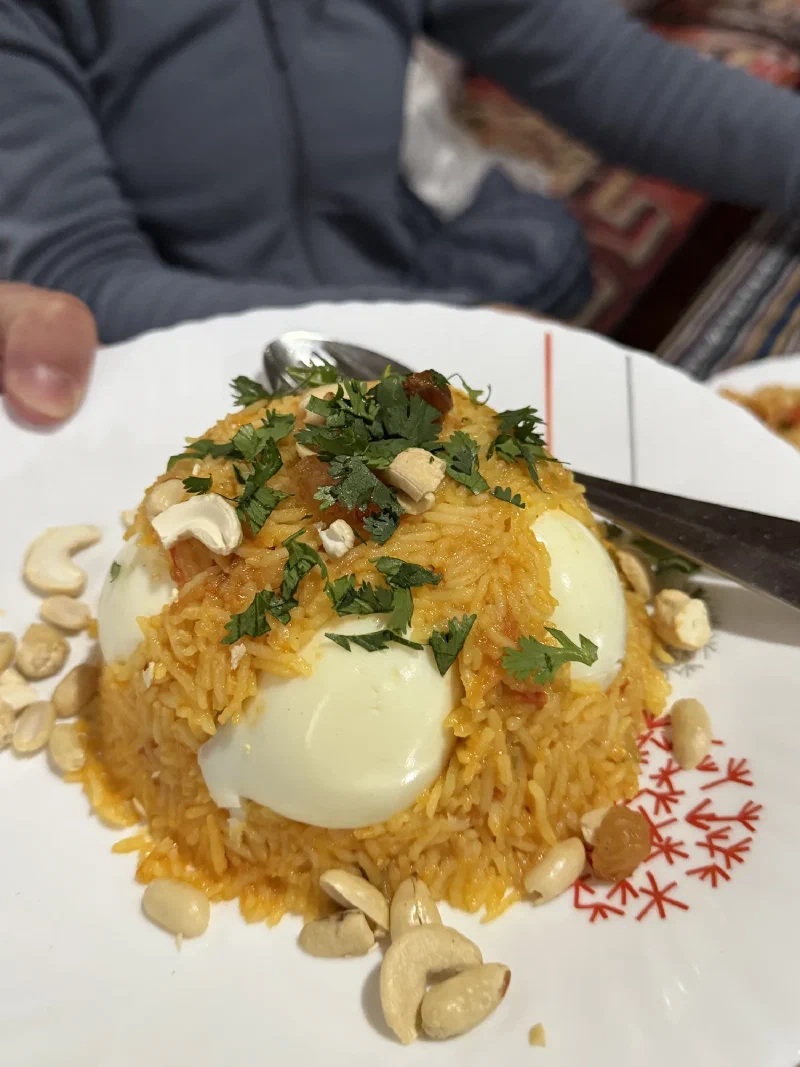
There were noodles, pancakes, a mountain of rice with eggs and cashews stuck in it. I did not partake. None of it was cocoa. None of it was chocolate. I observed, judged, and approved of their enthusiasm from a safe distance.

A plated rice dish with hard-boiled eggs, cashews, and herbs at the Yak Hotel

And that was the day. We made it to Lukla, settled in, and decided to hunker down for the night and wait for Steve and Alice to arrive in the morning.

One more night up here. One more round of goodbyes coming, to the porters, the crew, to D.B., and then the helicopter back to Kathmandu.

The mountain was almost done with us. We were almost done with the mountain. Pokin, for the record, finished the last leg in the saddle, and I will be bringing it up forever.


The Unmarked Monastery

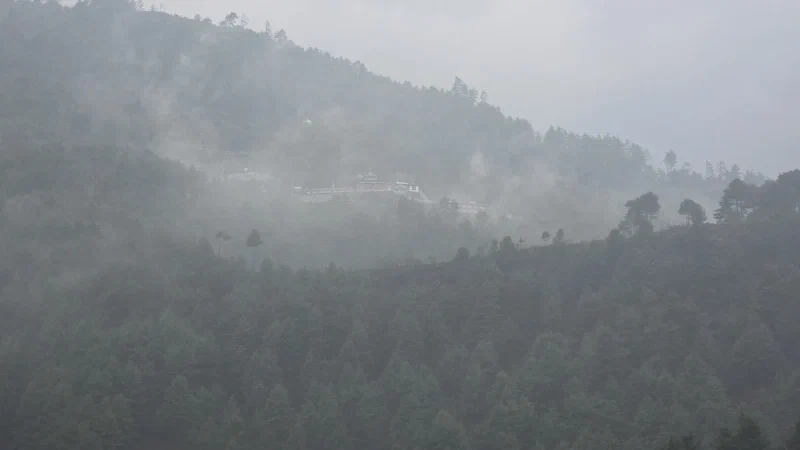
Remember this? A speck of a monastery floating in the mist on a far ridge above the village, a whole valley away. Back when we first spotted it, it was barely a smudge in the fog, the kind of place that looks like it’s deliberately not wanting to be found. Nicholas took one look and decided it was a main quest he absolutely had to complete.

A tiny monastery barely visible in heavy mist on a distant forested hillside
The view from the village. That smudge in the middle is the entire objective. Good luck.

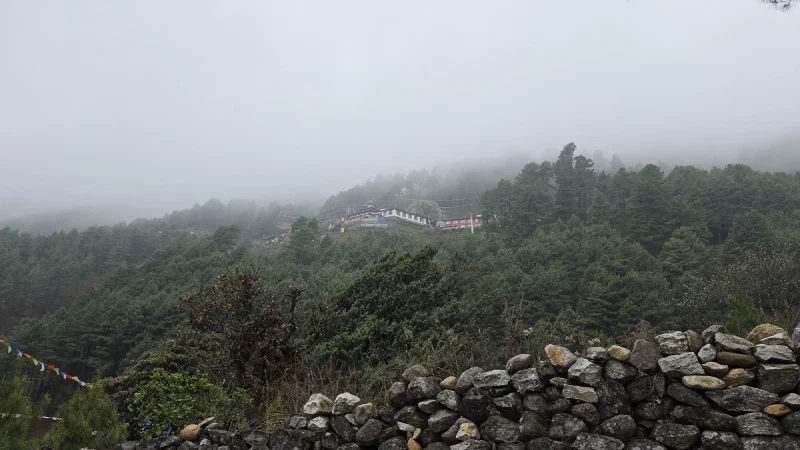
He was still sick, still coughing, and the smart move was to rest. So obviously he went looking for a way up instead. And he reached it, eventually, three-quarters of the way up the hill before the building finally stopped hiding and resolved into something real.

A monastery complex on a distant misty hilltop above a forested valley
The same monastery, now most of the way up the climb. Much closer. Much more pleased with himself.

But getting there is the whole story, so let’s back up.

The Hunt
#

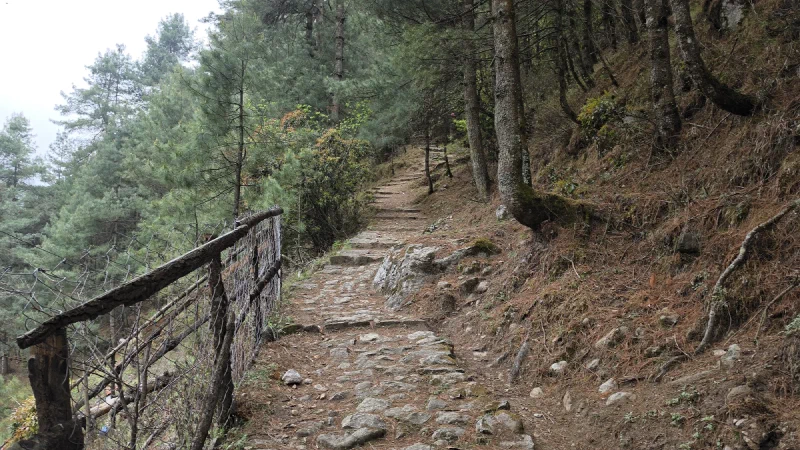
Here’s the problem: there was no marked trail. Just a hillside full of paths that all looked promising and then dead-ended, or split, or wandered off toward someone’s potato field. Nicholas spent the rest days doing reconnaissance. Up one route, back down. Up another, back down. Slightly higher each time, mapping the hill by trial and error like he was clearing fog off a minimap.

A winding stone and dirt path climbing through dense pine forest
One of roughly four hundred paths that looked like the path and was not the path.

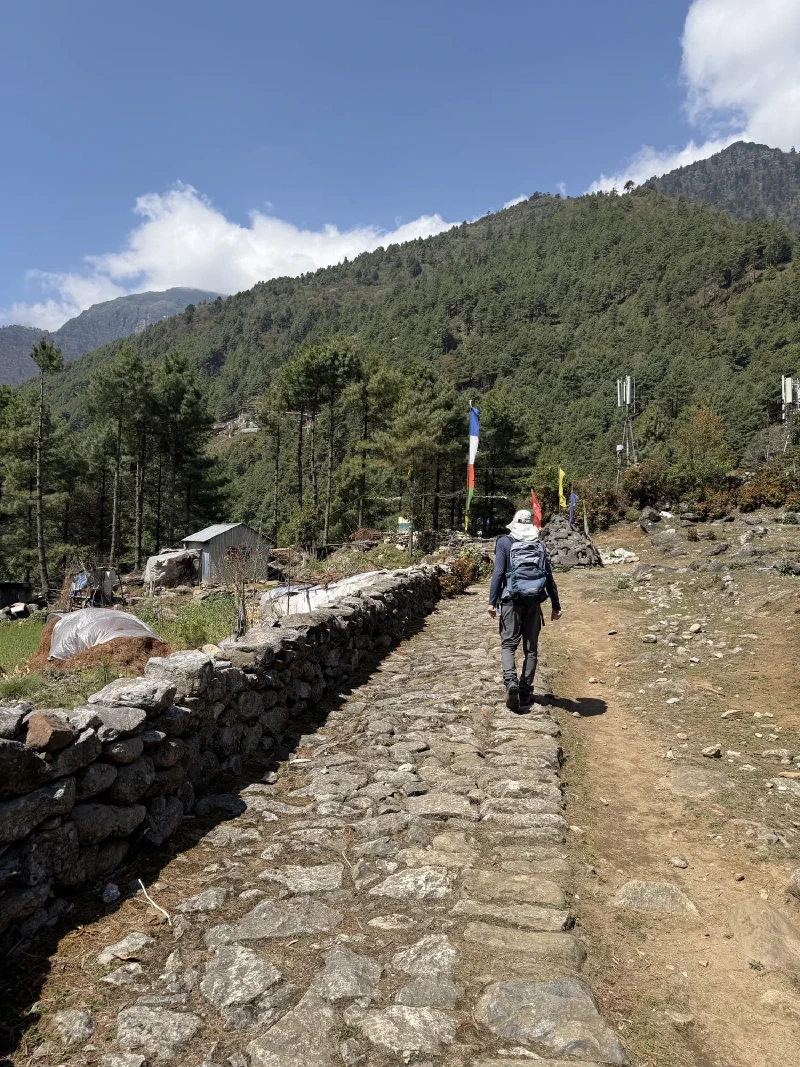
Eventually he found one that kept going. Up through the pines, past stone walls and prayer flags, higher than any of the false starts. This was the one.

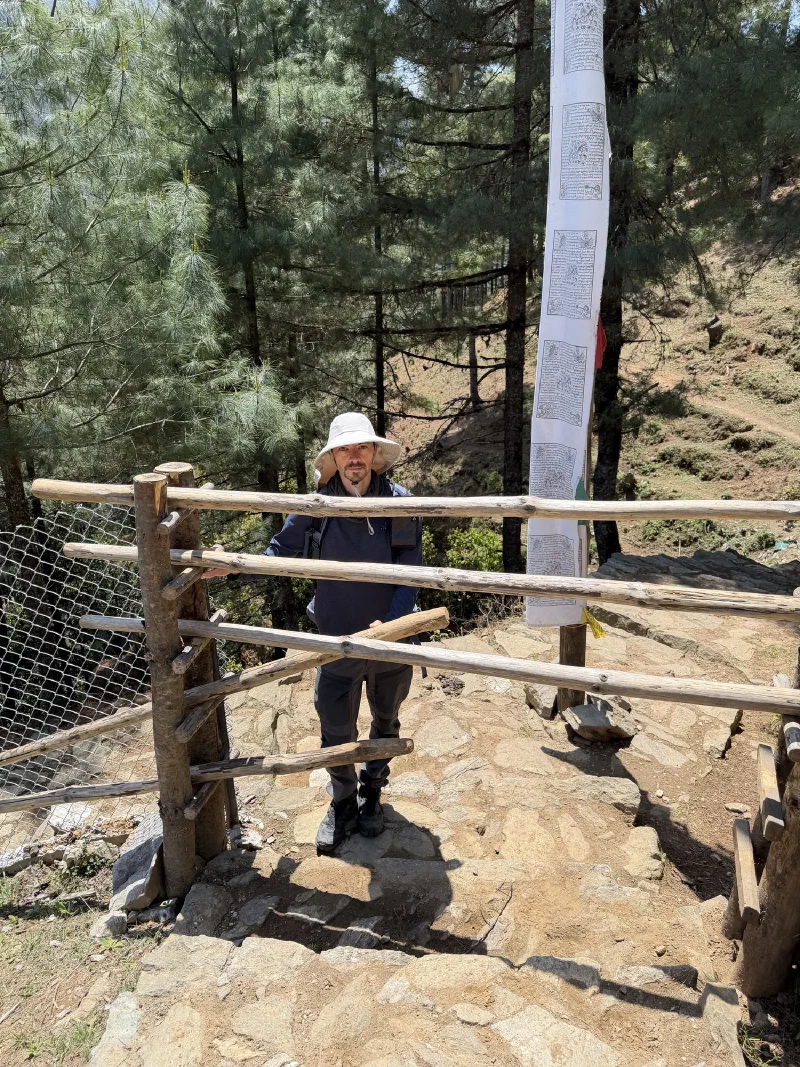
And then he hit the gate. And the gate won.

Nicholas standing behind a rustic wooden livestock gate on the trail, hands resting on the bars
The boss that defeated him on the first attempt: a fence. He stood here, looked at it, decided the monastery must be closed, and turned around.

He climbed all that way, found the right path at last, and ran straight into this thing: a few wooden bars laid across the trail. And he stopped. He looked at it, concluded the monastery was closed, and walked back down the mountain.

It’s a cow gate. It is the lowest-effort obstacle a Himalayan hillside can produce. The bars just slide out and lift away. Its entire job is to inconvenience livestock, who are, on average, smarter about it than he was that day. A wall of sticks meant for cows successfully repelled Nicholas like a confused heifer.

He only figured it out later that you can just move the bars. Slid them out, walked through, slid them back, because he’s not an animal. (For the record, I was in the backpack the whole time, judging. Both times.)

Getting There
#

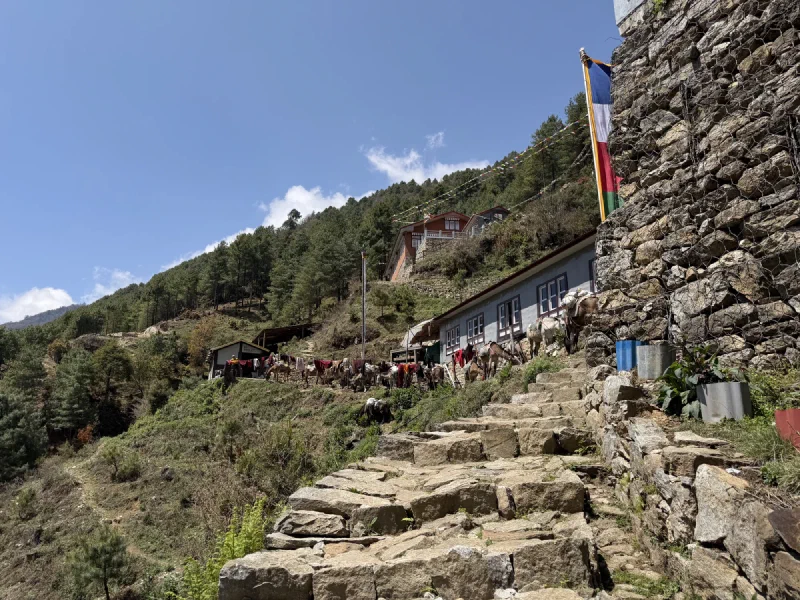
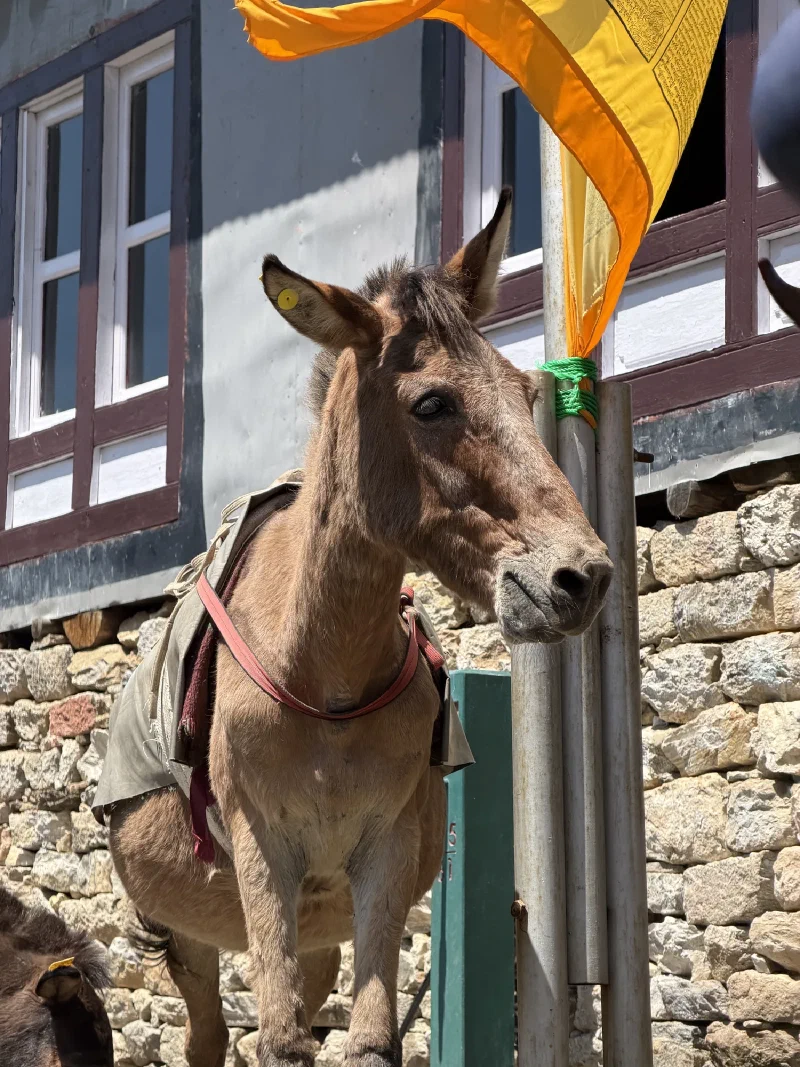
There were ponies working the village, hauling supplies around. The cows, on the other hand, mostly just wandered the trails getting in the way. (More on the cows later.)

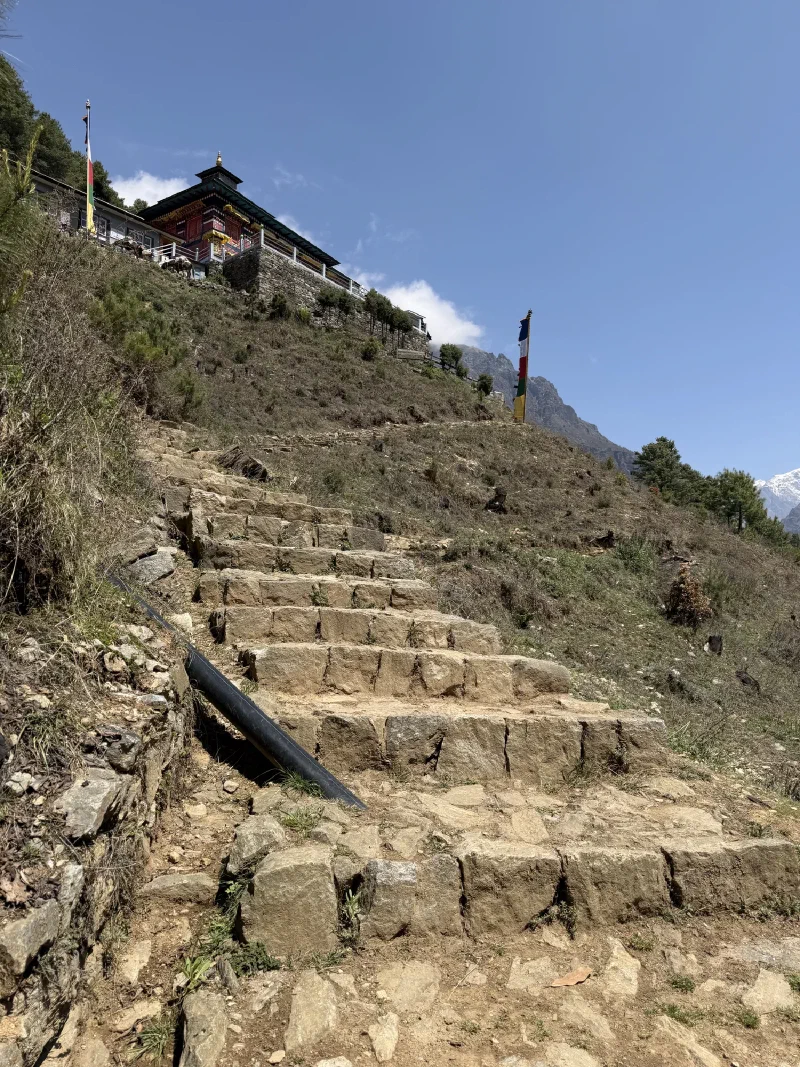
And then the steps. The final approach is a staircase of rough stone climbing straight up to the building, because of course the reward for finding the unmarked path is more climbing.

Steep stone steps leading up to a large ornate monastery building on the hillside
The last push. The monastery, finally, not hiding anymore.
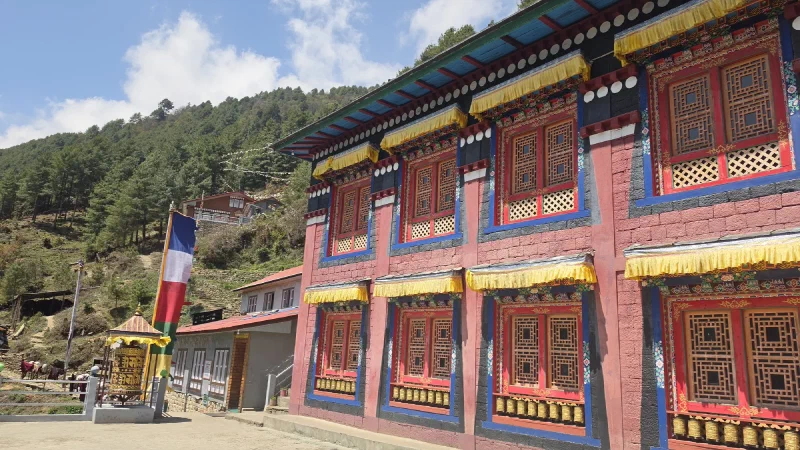
Ornate monastery building with red walls, gold trim, blue roof and a prayer wheel out front
Red walls, gold trim, a prayer wheel, the works. Worth the four hundred wrong turns? Nicholas says yes. Nicholas also can’t feel his legs.

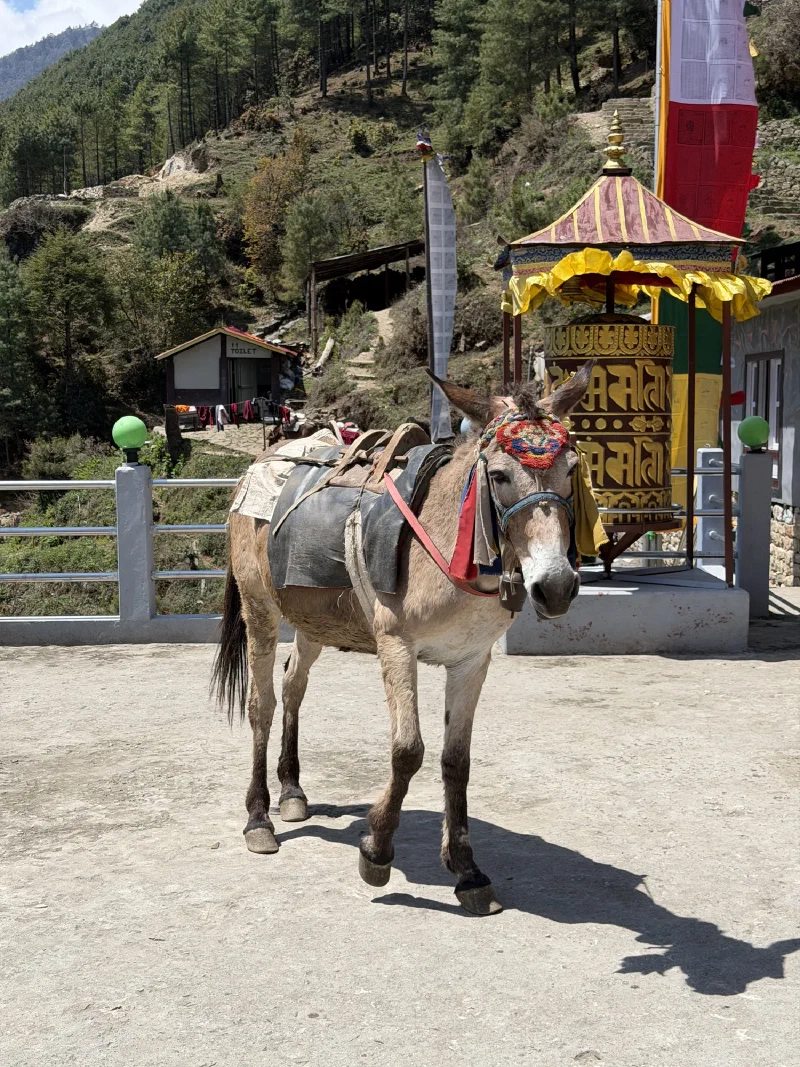
There’s a large, beautifully painted prayer wheel, and directly behind it, a sign for the toilet. The sacred and the practical, sharing a wall. Even monasteries have priorities.

A large colorful prayer wheel beside a building, with a small TOILET sign visible behind it
Spin for enlightenment. Facilities to your right.

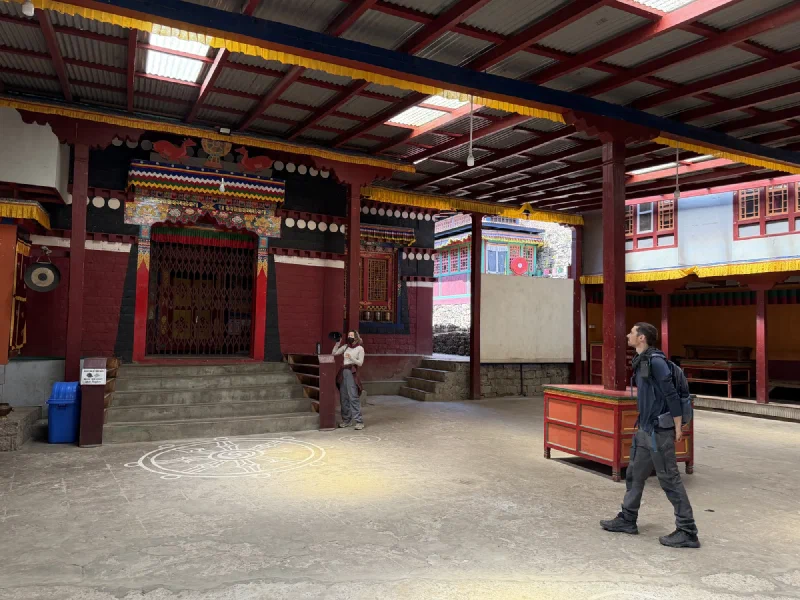
Inside, a covered courtyard with a mandala painted right into the floor, leading toward the prayer hall. I stayed in the bag for this part. You don’t bring a bear out in a working temple. It’s disrespectful, and I have a reputation to maintain.

Nicholas walking through a covered monastery courtyard with an intricate mandala design on the floor
Nicholas in the courtyard. On his best behavior, which for him means walking slowly and not touching anything.

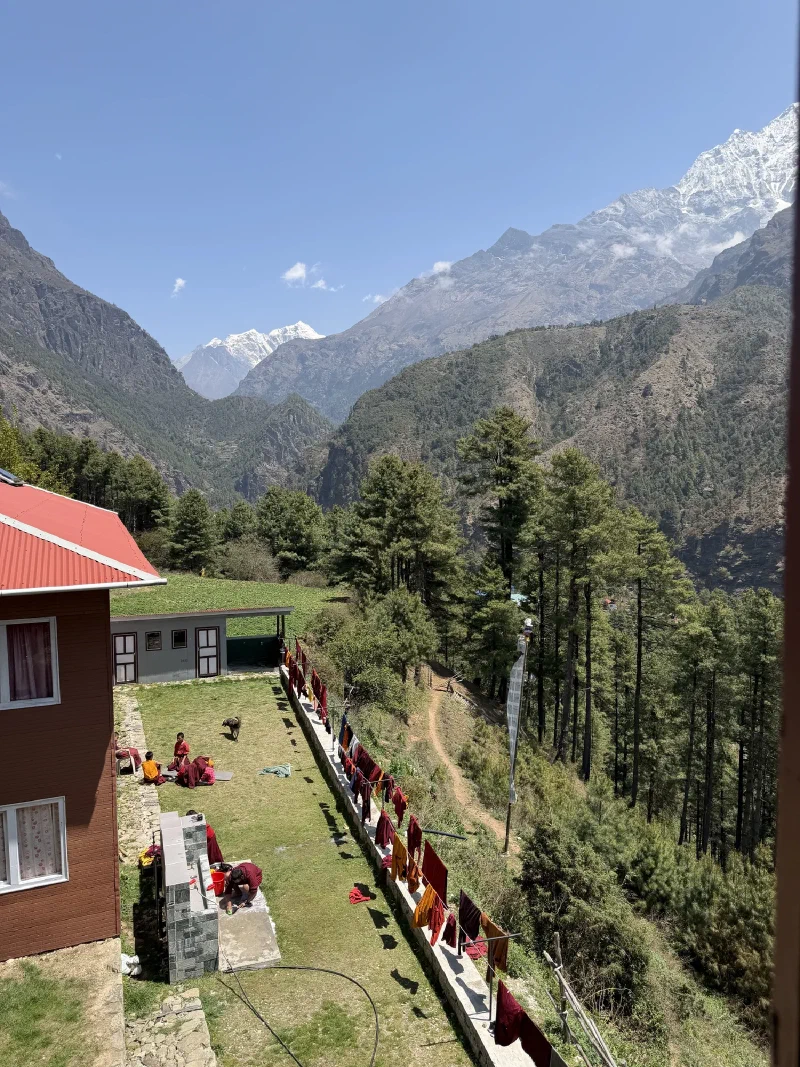
Young monks were out on the lawn, robes drying on a line, a dog supervising. Regular life, at altitude, with the entire Himalaya as a backyard.

Young monks in maroon robes on a grassy lawn outside monastery buildings with snow peaks behind
Laundry day at the monastery. The view from their clothesline is better than the view from anywhere I have ever lived.

Bringing the Girls
#

Pokin and Po On had heard all about the monastery and were, understandably, jealous. So once they started feeling stronger, Nicholas became a guide.

It didn’t happen all at once. Pokin was still weak, so it was a build. A little higher one day. A little higher the next. Until the day they both made it all the way up.

The climb also produced the cow incident. Somewhere on the way up, Po On vanished. Five minutes pass. Nicholas is standing there going where the heck is Po On, and finally trudges back down the trail to find her frozen in place, held hostage by cows. A few of them had claimed the path and she was too scared to push past, with no idea you can simply tell a cow to move. So it stood there. And so did she. Indefinitely. A standoff she was losing.

Nicholas groaned, walked up, went “sha! sha!”, slapped a few rumps, and the cows grudgingly shuffled aside about three steps, exactly enough for Po On to scurry through. Then he made fun of her the entire rest of the way up for getting held captive by cows. Correct response. They’re cows.

Two trekkers squeezing past two cows on a narrow village trail through forest
The enemy. Roughly the threat level of a parked sofa. Po On was held at this exact checkpoint until Nicholas came back to negotiate her release.
Nicholas, Pokin, and Po On taking a selfie in front of the ornate monastery building
They made it. The whole crew at the top. No cows were consulted.

The viewpoint at the top is the payoff, and it does not disappoint. Mountains on one side, the whole forested valley dropping away on the other, and the village they’d been staring up at it from now a cluster of dots far below. From up here, the smudge was looking down on everything else. Role reversal. I respect it.

Nicholas, Pokin, and Po On posing at a viewpoint with snow-dusted mountains behind
Earned it, the slow way.

Evening Prayer and the Third Monastery
#

Nicholas went back up alone that evening, because of course he did. This was now his fifth or sixth lap of the same hill. He sat and listened to the monks chant for a while, and recorded some of the music they made up there.

Afterward, someone mentioned there was a second monastery. Higher up. Secret. And the directions to it were the kind of vague that gets a tourist hopelessly lost on a mountain in the dark.

Rather than wander somewhere he wasn’t supposed to be, Nicholas asked if someone could actually show him. One of the young teenage monks volunteered and led him up the hill to it.

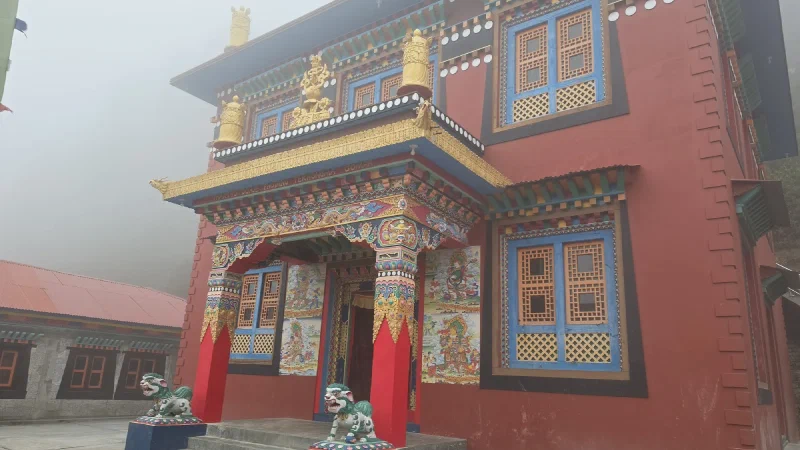
An ornate monastery entrance flanked by two carved stone lions, with a plainer building beside it
The secret one. Stone lions guarding the door, a lookout platform, and an inside that nobody got to see.

This one was a platform with an outlook, the entrance guarded by a pair of carved stone lions. No monks living there yet. The interior was being rebuilt, so that part stayed off limits, which honestly only made it better.

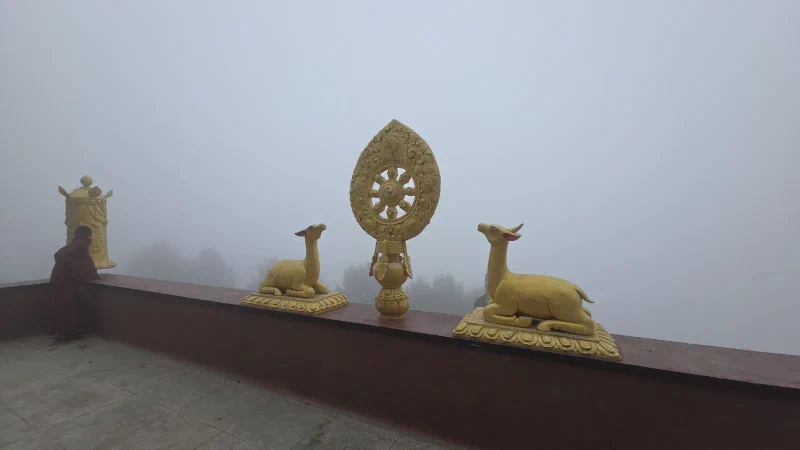
The payoff was the viewpoint itself. Golden deer flanking a dharma wheel along the parapet, the young monk who’d brought him up there leaning on the wall beside them, and beyond all of it, nothing. The mist had rolled all the way in and swallowed the entire valley. You couldn’t see the mountains, you couldn’t see the village, you couldn’t see anything. Just two golden deer, a guide in maroon robes, and a wall of white.

Two golden deer statues flanking a golden dharma wheel on a monastery parapet, a young monk standing at the wall looking out into thick mist
The lookout. Golden deer, a dharma wheel, a young monk, and a view of absolutely nothing because the fog had eaten the whole valley. Somehow that made it better.

So the main quest, the smudge in the fog he’d stared at from the village and refused to let go of, turned out to have a hidden second stage. A half-finished secret monastery on a mountaintop, reachable only if a teenager decides to take pity on you, with a viewpoint that showed you nothing at all. You don’t find that by resting when you’re sick. You find it by being too stubborn to.


The Gurkha Inn

A few more nights in Phakding. The plan: let Pokin and Po On finish recovering before we head down to Lukla, meet back up with Steve and Alice, and catch the helicopter out to Kathmandu.

DB picked us a place run by a friend of his, a Sherpa family who own the Gurkha Inn. Big vegetable garden, cozy courtyard, and a mom named Nima Sherpa who cooks every single thing herself. Nicholas declared it the best food of the entire trip, and he said it with the specific reverence of a man who’d been eating dal bhat at altitude for two weeks.

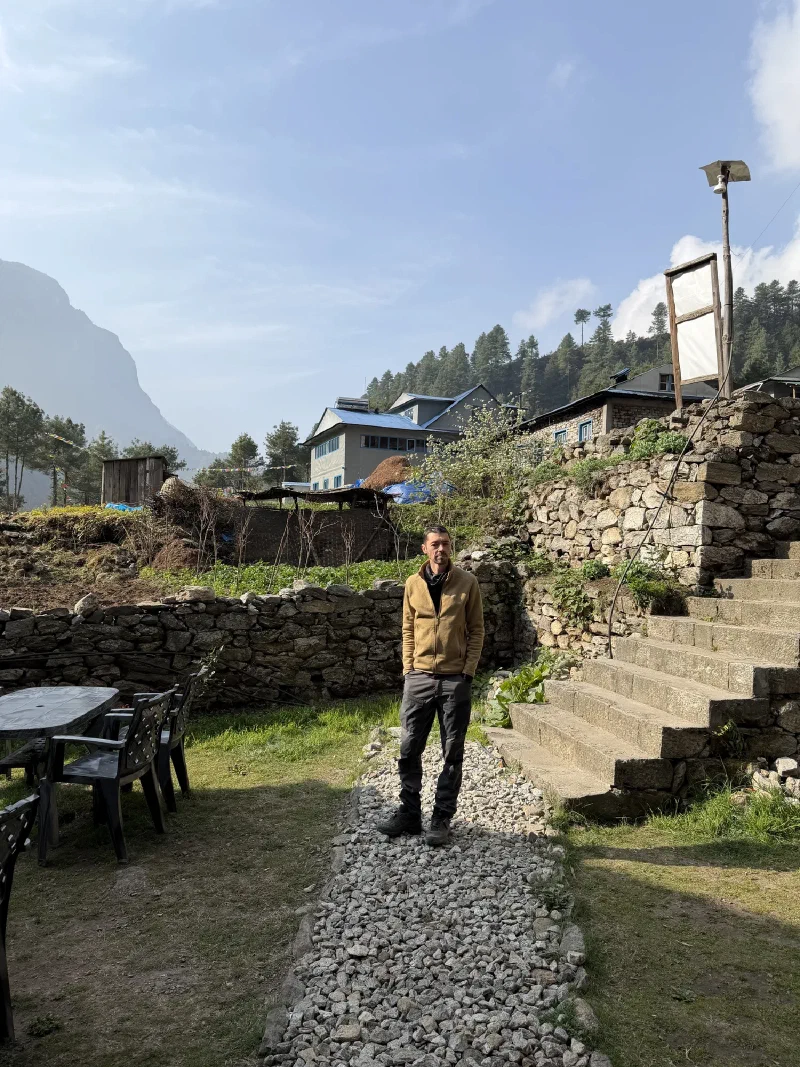
Nicholas standing in a stone courtyard with outdoor dining tables, green hillside and a mountain peak behind
The courtyard. A few tables and a mountain in the background.

Specialty Dunked Salad
#

We’ll start with the salad, because it was the most dramatic thing that happened to a vegetable all week.

The whole trip, everyone was careful about food. The rule on a trek like this is you don’t eat fresh washed vegetables raw, because the water they’re rinsed in can wreck you. And wrecking your stomach when half the group is already sick is not the move.

So Nima, rightfully proud of her garden, brought out a beautiful salad. Big fresh lettuce leaves. Still wet from washing.

Pokin, Nicholas, and Po On all made eye contact. The silent “uh oh.” You can’t refuse it, that’s rude, and she grew it herself. But eating it raw was a real gamble.

Pokin’s solution was quietly tactical: she ordered a pot of hot water for “tea.” Then, every time Nima turned her back, the three of them dunked their lettuce into the boiling water in their glasses, fished it out, and ate it as fast as possible. Praying it killed whatever needed killing.

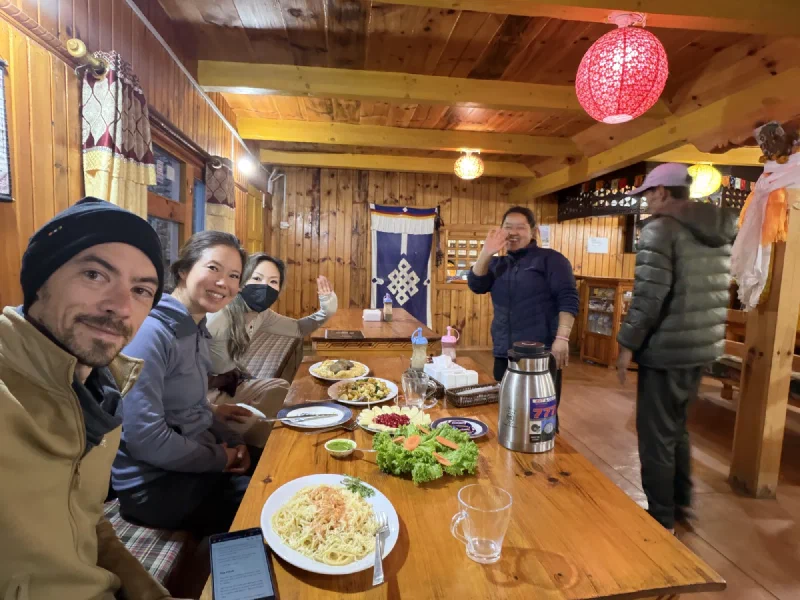
Nima Sherpa serving a big spread of food to the smiling group at a long wooden table under red lanterns
Salad front and center. Three adults in this photo are about to blanch their lettuce in a teacup. Nima suspects nothing.

Nobody got sick. The specialty dunked salad was a success, and I’m only telling you about it now because we’re safely off the mountain.

The Rest of the Food
#

Here’s the thing about the upper mountain: there are basically no vegetables. Everything is hauled up by porter or yak, so the higher you go, the more your diet narrows to rice, potatoes, and whatever survives the trip. Coming back down to a place with an actual garden meant Nima was pulling things out of the ground and putting them on the table the same day.

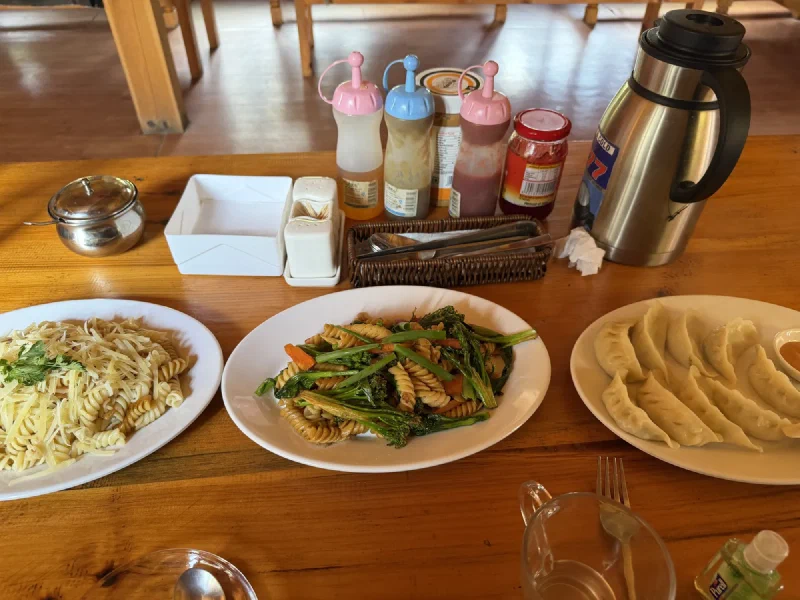
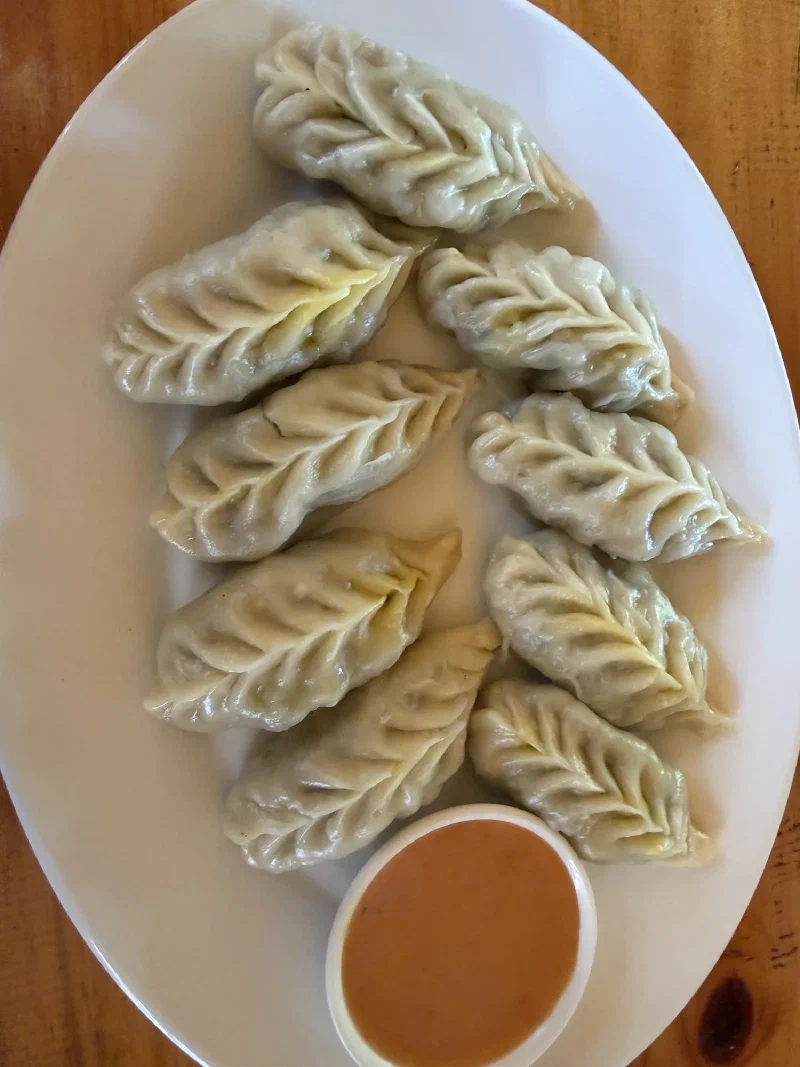
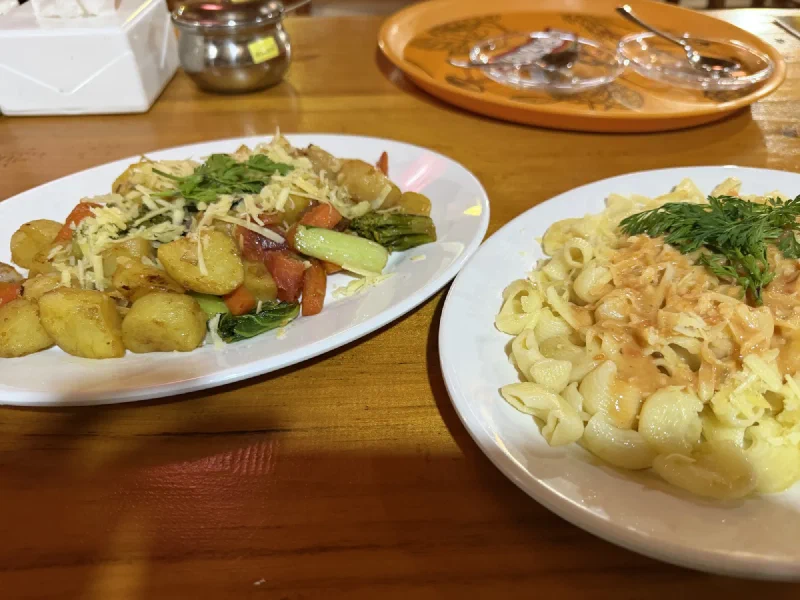
Momos with vegetables, obviously. Pasta with veggies, potatoes done several ways, even homemade fries. The veg fried pasta was the clear winner. We ordered it enough times that Nima probably thought we couldn’t read the rest of the menu.

Two plates of pasta, one plain with cheese, one with broccoli and vegetables, plus a plate of momos with dipping sauce
The veg fried pasta. Our undisputed favorite. We ordered it enough times that I’m fairly sure Nima thought we were broken.

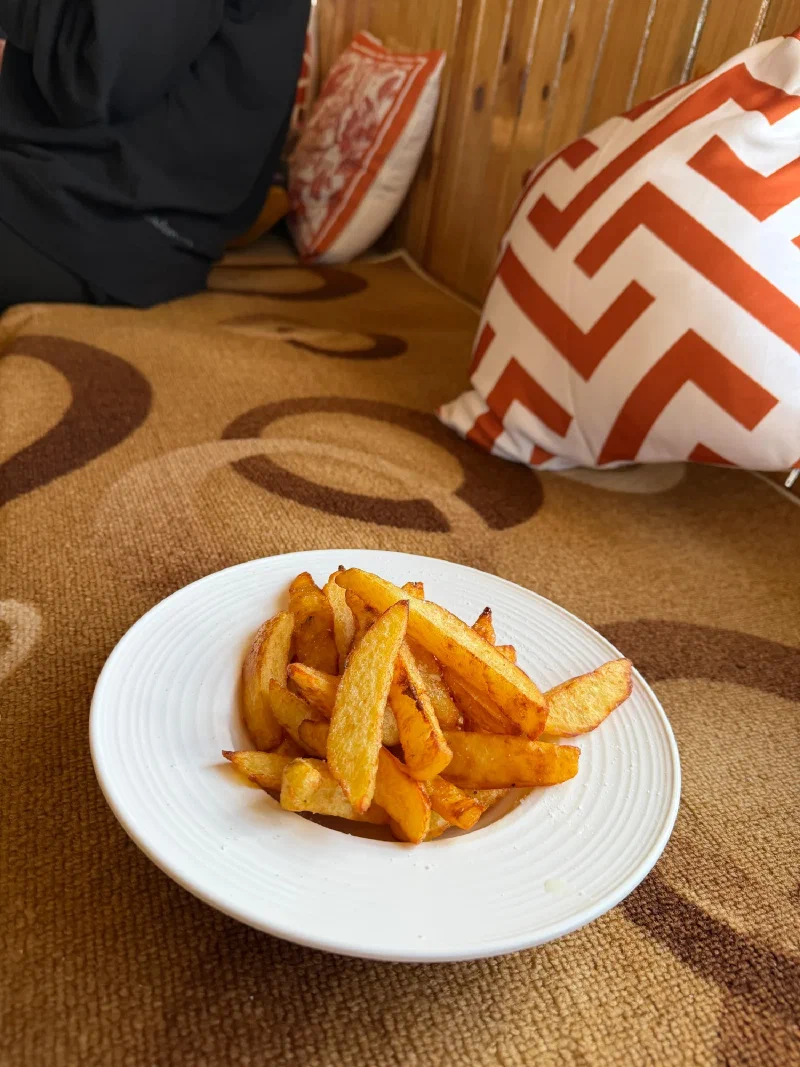
The fries were homemade from the garden potatoes. Po On declared them life-changing and proceeded to order them at every single meal for the rest of our stay. Between her fries and the veg fried pasta, Nima had two standing orders she could set her watch by.

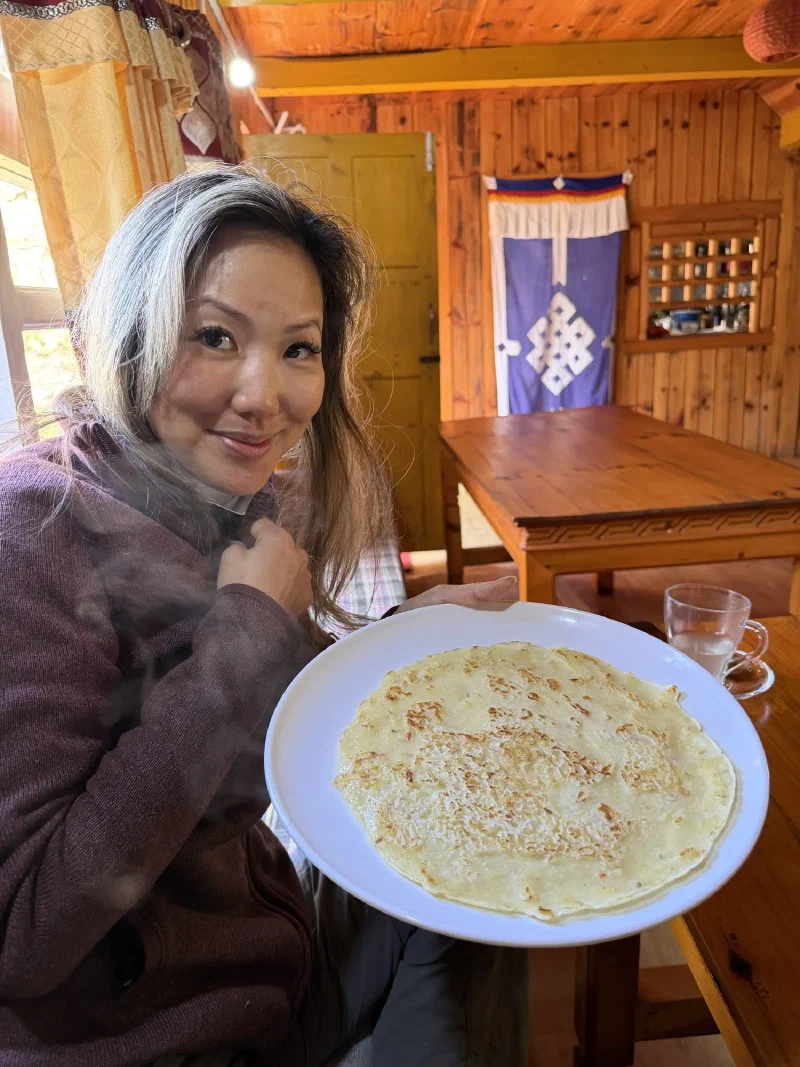
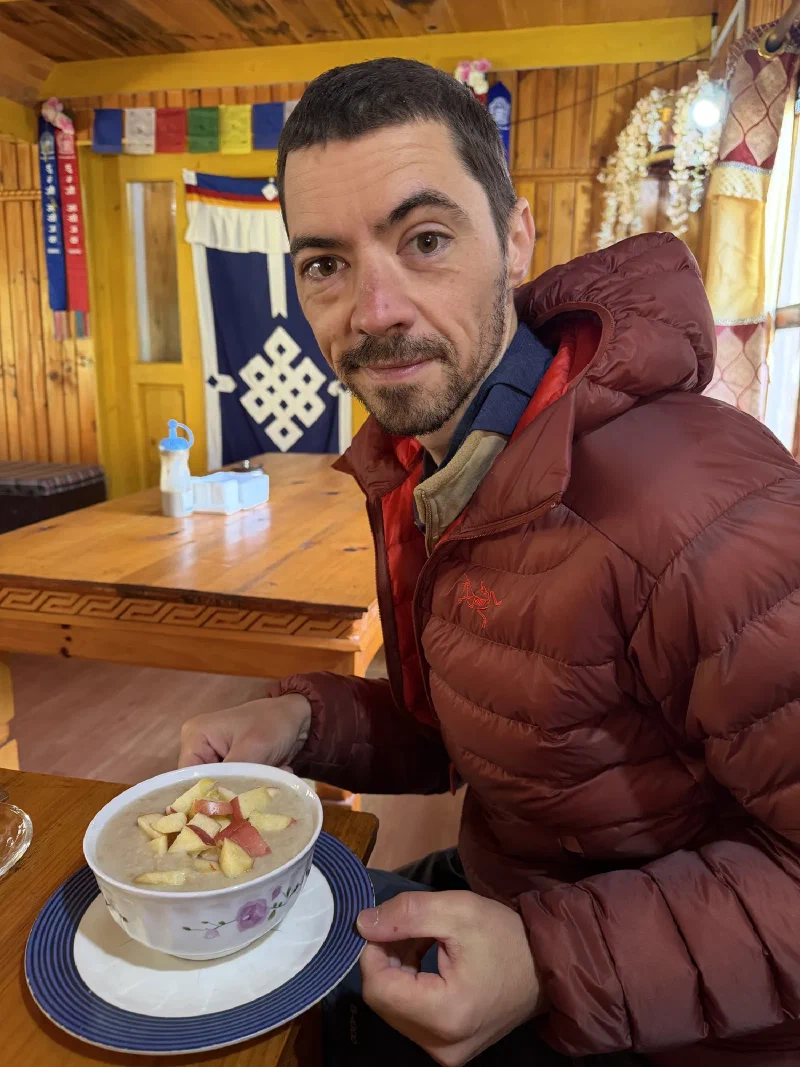
Po On got a crepe. Nicholas had apples in his oatmeal, which is really just Chestnut’s order. Chestnut is a horse. Apples are basically his version of pillow chocolates, and he gets very invested in making sure they show up.

Kerman Makes a Namlo
#

During the downtime, Kerman decided Nicholas needed proper initiation into being a real porter. You may remember Nicholas already borrowed a namlo on the way up to Thukla and carried his own bag for four hours, which apparently earned him an apprenticeship he didn’t ask for.

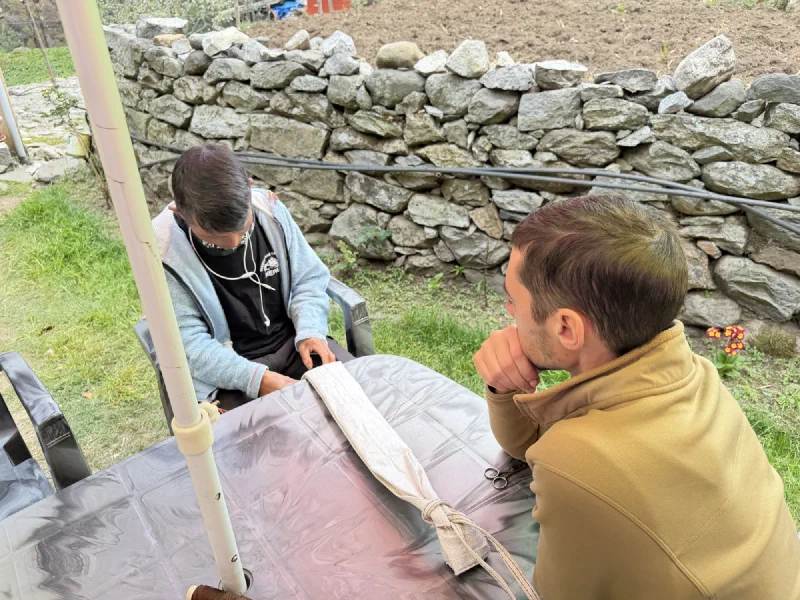
So Kerman found an old rice bag, cut it into strips, and then produced a sewing needle and thread out of thin air, the way porters seem to produce any tool they need from nowhere, and sewed Nicholas a real, custom namlo by hand.

Porter Kerman sewing a head strap from a cut rice bag at an outdoor table while Nicholas watches
Kerman sewing. Nicholas watching.

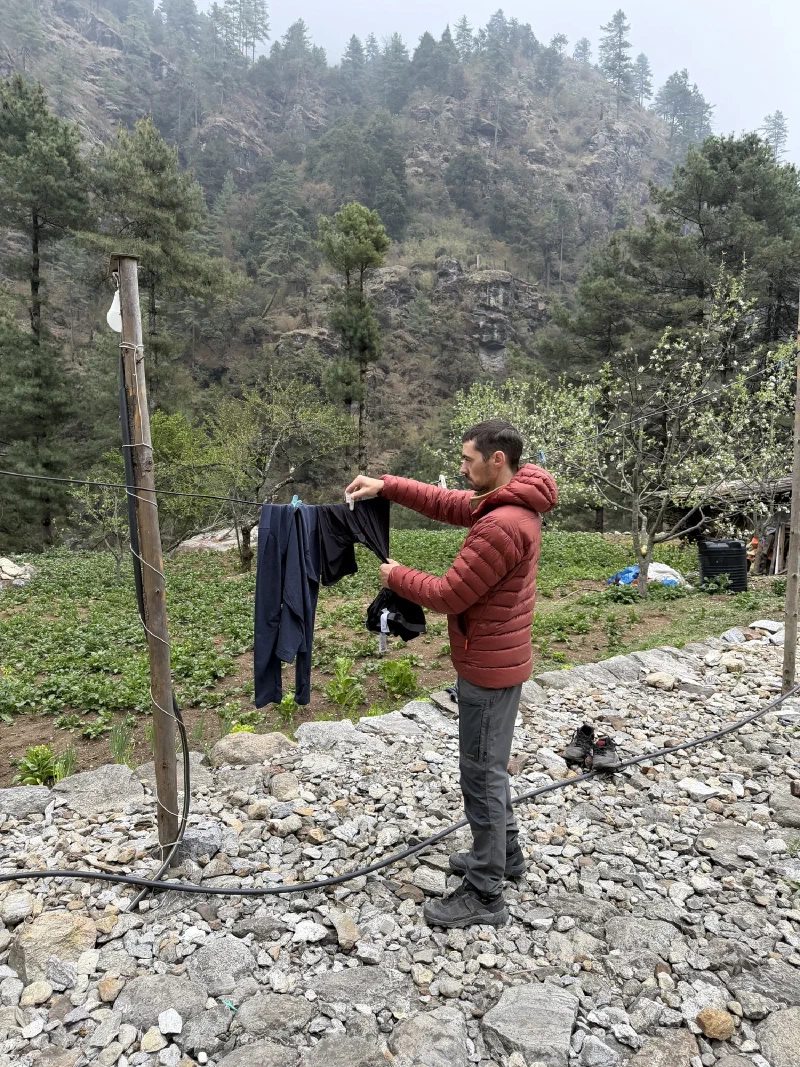
Meanwhile, Nicholas handled the other half of porter life: laundry, by hand, strung up on a line with a whole valley behind him.

Nicholas hanging dark laundry on a clothesline with a misty pine-covered hillside behind
Hand laundry with a Himalayan backdrop.

The Sixty-Pound Pine Branch Heist
#

This one was ridiculous, and I mean that as the highest compliment a story can earn.

One morning we woke up and Kerman and Nilman were gone. Nima said they were “out doing work.” Fine. Porters often help around the farm on off days to earn their keep, so we figured they were doing chores somewhere.

They were gone a long time.

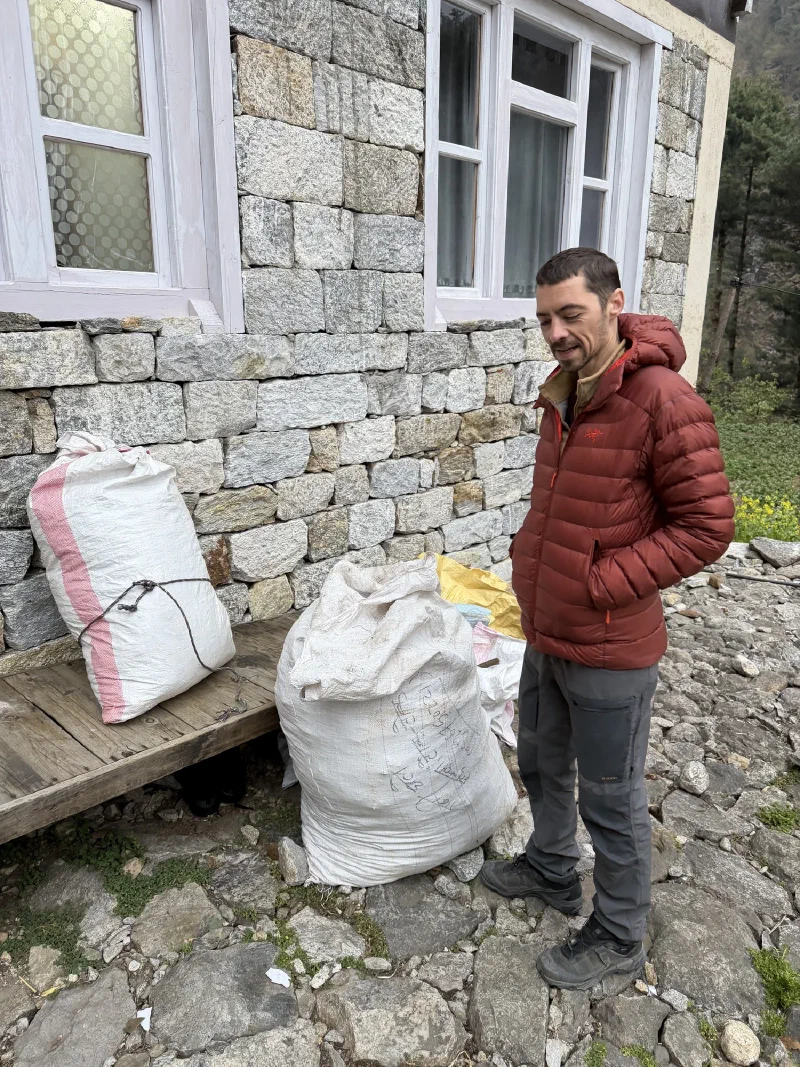
When they finally came back, they were each hauling a MASSIVE white sack. Easily sixty pounds. Bulging. We assumed they’d done a supply run, hauled up food and goods for the inn.

Nicholas standing beside two huge bulging white sacks tied with cord against a stone wall
Nicholas inspecting the haul. Two enormous sacks. We were sure it was supplies. Flour, maybe. Rice. Something that made sense.

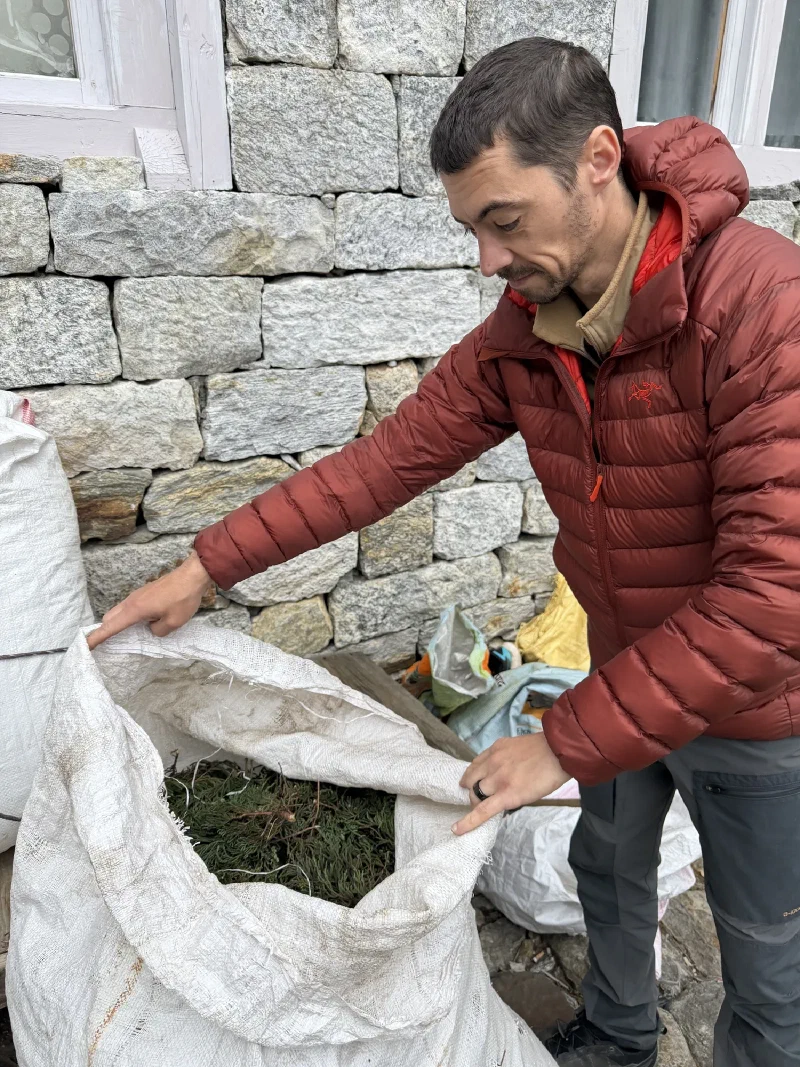
Then Nicholas looked inside.

Branches. Just… branches. What looked like plain old pine branches.

“Did you guys go out and pick pine branches?”

“Yes. Way up in the mountains.”

Nicholas leaning into one of the white sacks, revealing it is full of green leafy branches
The big reveal. Sixty pounds of foliage. They climbed for hours, used chains and ropes on the steep bits, and carried this back down on their heads.

Turns out DB had called them and sent them on an epic hike straight uphill toward Kongde, a trail steep enough that parts of it need a chain and rope to get up and down. Six hours of climbing just to get to the top. They were gone all day. To pick branches.

For context, Kongde sits up around 4,000 meters on the ridge across the valley, well over a kilometer of vertical above Phakding. That’s not a stroll to the corner store. People take entire acclimatization days just to go up and look at it. The porters did the climb, harvested a small forest, and then came back down the same chains and ropes with sixty pounds strapped to their foreheads. On a day off.
And the branches weren’t pine. They were sage. Specifically the pure high-altitude mountain sage that the monks burn every morning for prayer, and that families burn too. Apparently this stuff is ceremonial grade, the “good stuff,” and it doesn’t grow down where you can just buy it cheap.

Later, while Nicholas was on the phone with DB sorting out logistics, he asked: “Did you make the guys bring back a hundred pounds of branches?”

“Haha, yes,” DB said. “I’ll bring it back to my family and friends to burn for the year. We can truck it back, otherwise it’s very expensive.”

So either DB is running a quiet artisanal sage-harvesting operation, or he just really likes good sage. I cannot tell which. Either way, two men hiked six hours up a chain-and-rope mountain trail to bring back a tree, and that is the most Himalayan thing I witnessed all week.


Astro Preview

People have been asking about the astrophotography.

Fair enough. We’ve spent the last several posts talking about Nicholas destroying his body for these shots. Three consecutive nights at extreme altitude. Zero sleep. Getting sick. Sleeping on a literal mountain. All for photos that are still sitting on an SD card in a camera bag in a Himalayan lodge.

We don’t have a computer up here. The Z9 files are massive and there’s no way to properly edit them on a phone. But Nicholas pulled one frame off the camera, opened it on his phone, and did a quick color grade so you can at least see what all the suffering was about.

This is not the final edit. This is a phone preview of a raw file. It’s going to look a little blown out, a little rough around the edges. The real versions will come when we’re home with actual monitors and actual software.

But even rough, it’s something.

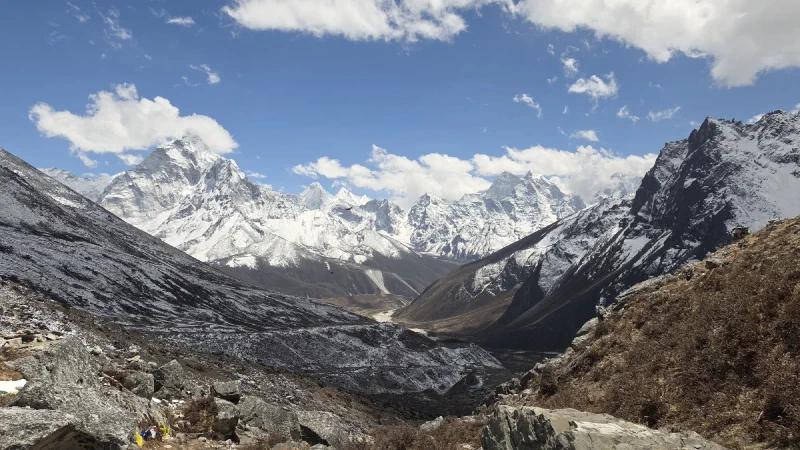
First, here’s what the location looks like during the day. This is the Sherpa Memorial at Chukpi Lhara, near Lobuche. Nicholas scouted it during the afternoon hike and immediately started planning the night shoot.

Panoramic daytime view from the Sherpa Memorial near Lobuche, showing a glacial valley ringed by snow-covered Himalayan peaks under a deep blue sky
The view from the Sherpa Memorial by day. Pyramidal peak on the left, valley funneling toward the glacier, snow-covered summits all the way across the horizon. Not a bad spot.

And here’s what it looks like at 3 AM.

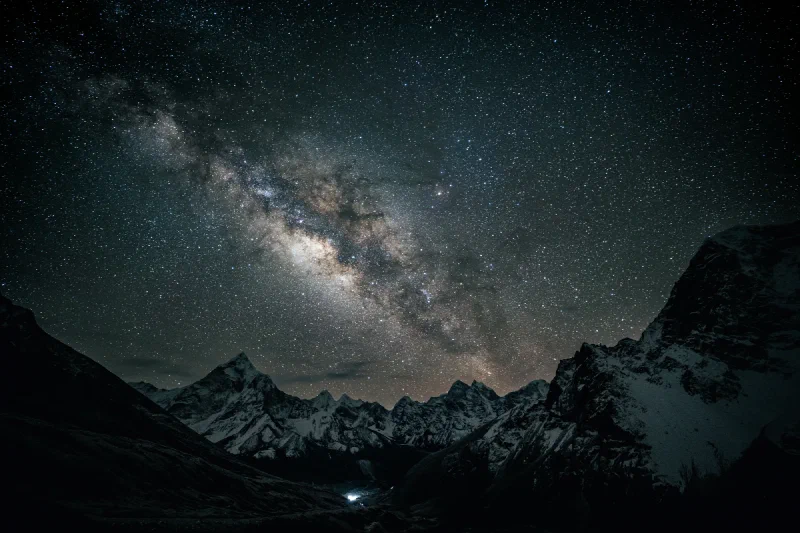
The Milky Way arcing over snow-covered Himalayan peaks as seen from the Sherpa Memorial near Lobuche, with the Galactic Center glowing above the valley
The Milky Way over the Himalayas. Shot from the Sherpa Memorial. This is a quick phone edit of one frame from the timelapse. The real versions are coming.

The Milky Way. The Galactic Center. Arcing over the entire Himalayan skyline, with the snow on the peaks still faintly visible in the starlight. Thousands of stars, dust lanes, nebular structure. The valley below disappearing into darkness with a single point of light from Dingboche far below.

This is one frame from one night. There are three more nights of timelapses on that SD card.

The full edits are coming when we get home. For now, this preview will have to do.


The Skyrim Village

Rest day in Phakding. Pokin and Po On are recovering. Nicholas is about 40% better but still coughing. Everyone’s supposed to be taking it easy.

So naturally, Nicholas went for a walk.

He came back an hour later and said, “Sumi, this village is a video game.”

He wasn’t wrong.

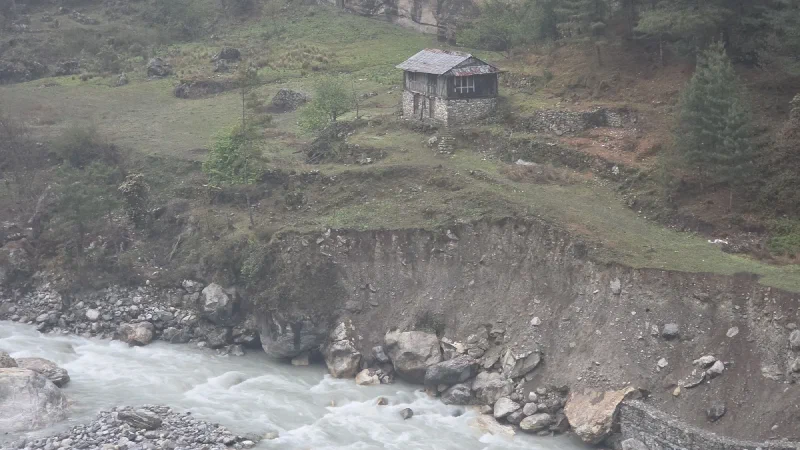
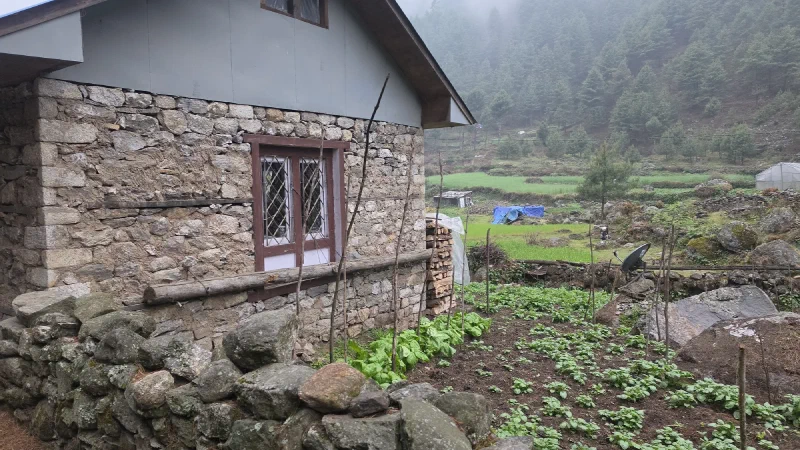
A solitary stone and wood cabin perched on a steep riverbank above a rushing glacial river
This is where a quest NPC lives. You find this cabin, talk to the old hermit inside, and he sends you to retrieve something from the bottom of the river. You die three times trying.

I’ve played a lot of games. Skyrim. The Witcher. Every open-world RPG where you wander into some village and every building looks like it was placed there by a level designer who wanted you to feel something. The stone walls. The handmade wooden fences. The mysterious hut on the cliff that’s definitely hiding a side quest.

Phakding is that village. Except nobody designed it. People just built it this way because that’s how you build things when you’re in a Himalayan river valley with no power tools and a lot of rocks.

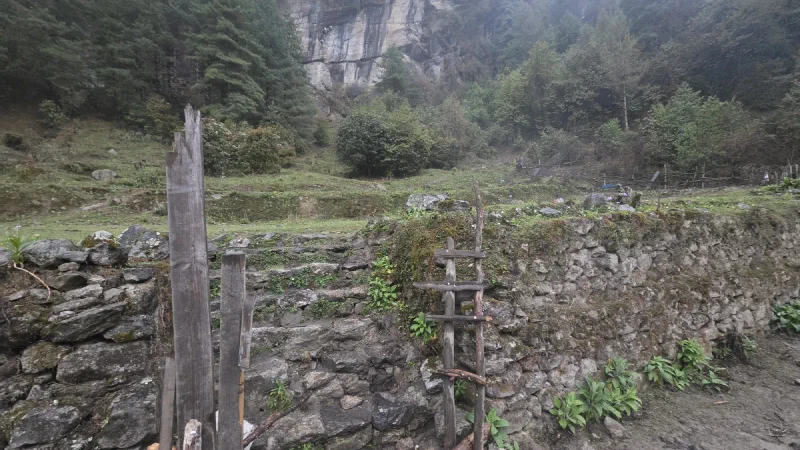
Terraced farm plots with handmade wooden ladder and branch fences on a hillside, cliff face in background
Starter area farm. Handmade ladder for +2 Agility. Branch fence crafted from local materials. The cliff in the background definitely has a cave you’re supposed to explore later.

The farm plots have handmade wooden ladders propped against stone walls. The fences are built from branches. Not treated lumber. Not hardware store posts. Actual branches lashed together. It looks exactly like what happens in a game when you visit a village in the first act before you have access to any real materials.

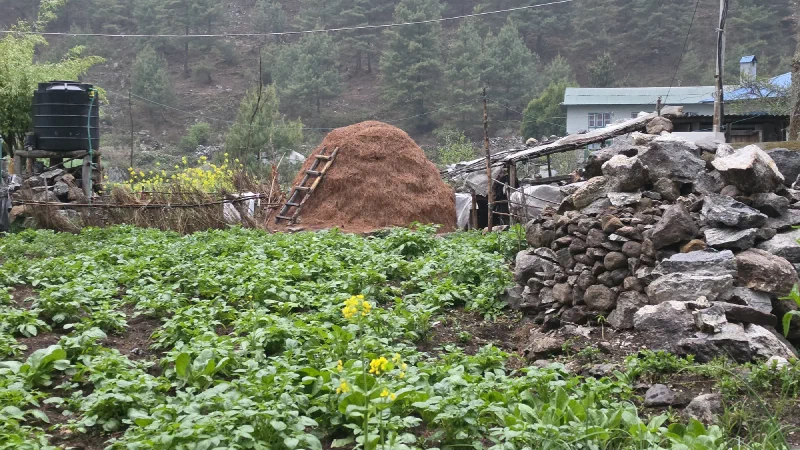
Farm plot with haystack, wooden ladder, and piled stones surrounded by green crops and mustard flowers

An old stone house with a small cultivated garden, stacked firewood, and misty forested hillside behind
Herbalist’s house. 100%. You knock on this door and an old woman sells you potions. There’s a vegetable garden out front because of course there is.

Then Nicholas found the crafting district.

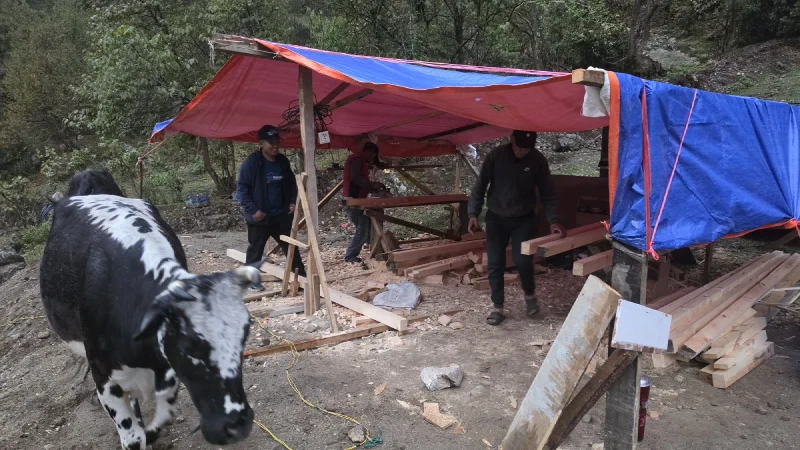
Men working under tarps processing lumber by hand with stacks of cut boards, a cow walking past in the foreground
The Lumber Mill. NPCs processing logs into planks. The cow is either a quest marker or part of the ambient wildlife system. Hard to tell.

People were hauling raw logs down from the forest, bringing them to this open-air camp under tarps, and hand-turning them into boards. With hatchets. No table saws. No planers. No power tools of any kind. Just hatchets, hands, and chisels. Then they were building a house with the boards they just made. From trees they just cut. The entire supply chain was visible in one frame.

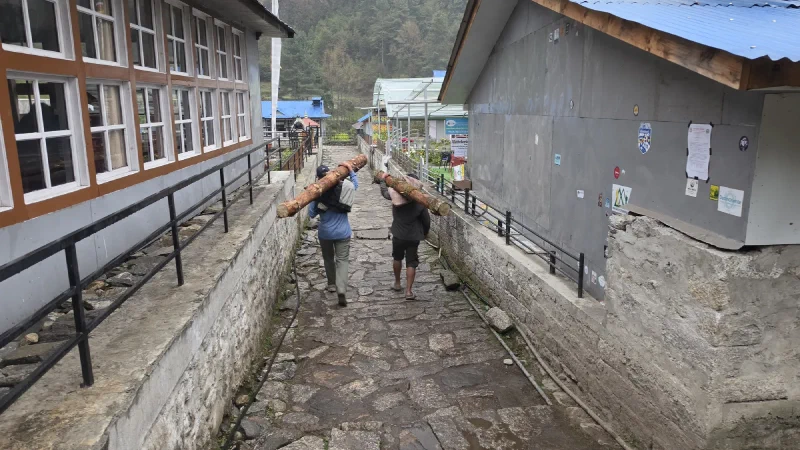
Two men carrying large raw logs on their shoulders through a narrow stone village alley
Log delivery. Manual fast travel. These two are carrying full tree trunks through a village alley like it’s a normal Tuesday errand.

And the quarry.

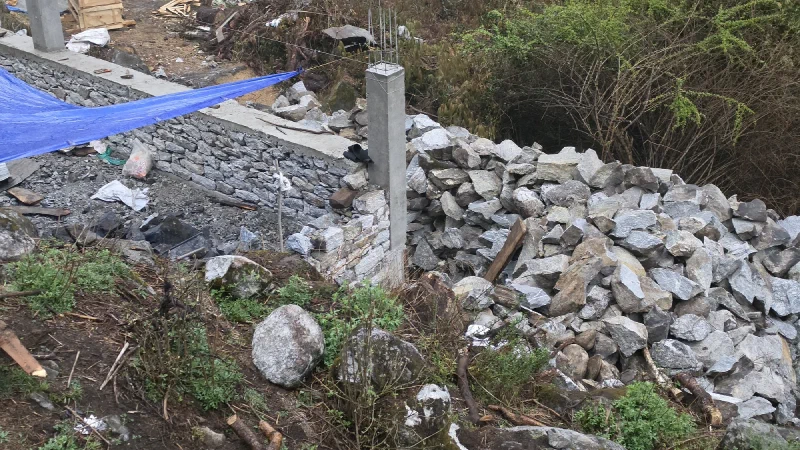
A construction site with partially built stone walls, concrete columns with exposed rebar, and piles of broken quarried stone
The Stonecutter’s camp. Hauling rocks up from the mountain, breaking them with sledgehammers, stacking them into walls. This is how buildings get built here. No cranes. No forklifts. Just people and hammers.

Someone was hauling boulders up from the riverbed, and another person with a sledgehammer was smashing them into building-sized stones. Then they’d stack those stones into walls by hand. An entire house, built from rocks you broke yourself from bigger rocks. If this were a game, this would be a crafting minigame that reviewers would call “surprisingly satisfying.”

Then Nicholas looked up and spotted these:

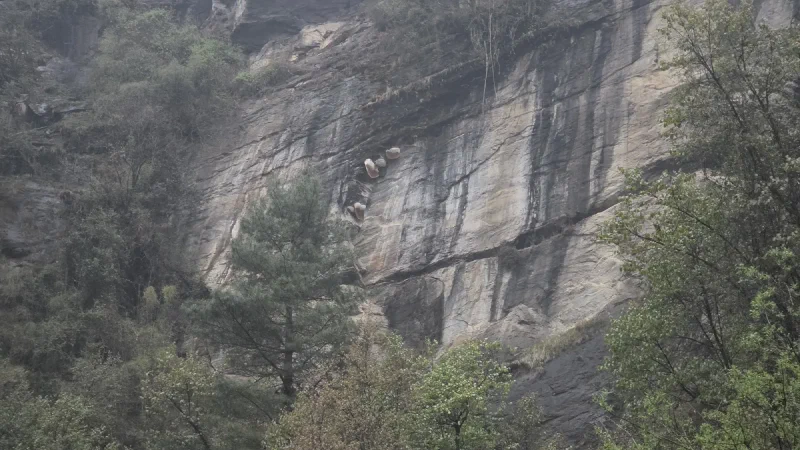
Giant wild beehives hanging from a sheer cliff face high above the ground
Wild beehives. Hanging from a cliff. In a game, you’d need to climb up there to gather Rare Honey for a cooking quest. In real life, same thing, except the bees are also real and they’re enormous.

Giant wild beehives, clinging to a sheer cliff face. Unreachable without climbing gear or a very questionable decision. In every RPG I’ve ever played, there’s a moment where you see a collectible on a ledge and think, “I can definitely get up there.” This is that ledge. Except the collectible fights back.

And just when you think it can’t get more video game:

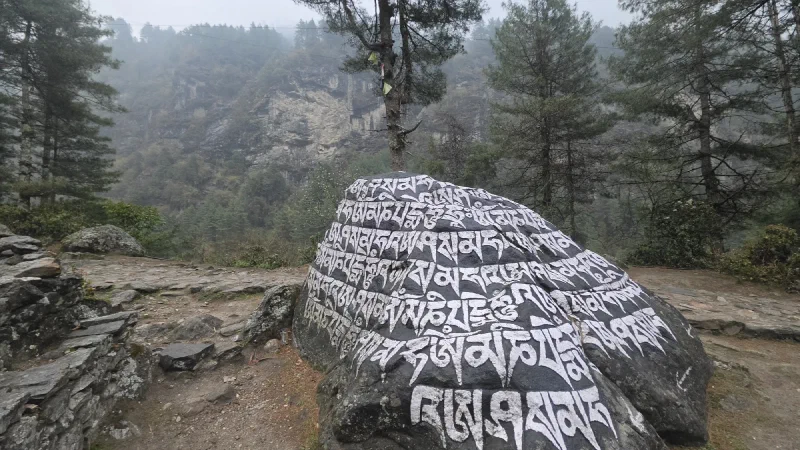
A large dark boulder carved with white Tibetan script and prayer flags in a misty forest clearing
The Runestone. Walk up to it and press A to absorb ancient power. Or just read the Tibetan inscription, which is probably ‘Om Mani Padme Hum,’ which is basically the same thing.

A carved mani stone in a misty forest clearing. Prayer flags draped from the trees. Tibetan script painted in white across the dark rock. If you stumbled onto this in Skyrim, you’d hear a choir start singing and a skill tree would light up. Here it just sits quietly in the fog, which honestly makes it more powerful.

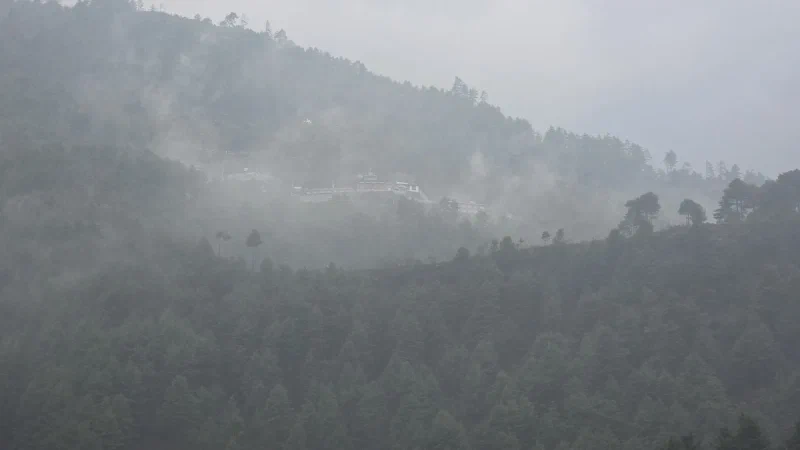
A large monastery complex visible through mist on a steep forested hillside with no obvious path
The Monastery. Up in the mist. On a cliff. With no visible way to get there. This is either end-game content or a Crouching Tiger, Hidden Dragon set piece. Either way, you’re not getting up there at Level 1.

A monastery. On a cliff. In the mist. With no discernible path to reach it. In a game, this would be the area you can see from the starting zone but can’t access until you’ve unlocked flying or completed a 40-hour questline. It just sits up there, reminding you that you’re not ready yet.

If you’ve seen a more video game village than Phakding, let me know. I’ve been to 30+ countries. I’ve been to actual medieval towns in Europe. None of them hit like this. This place has handmade ladders, cliff beehives, runestones in the fog, a lumber mill staffed entirely by people with hatchets, and a floating monastery.

Phakding isn’t a rest stop on the EBC trek. It’s a starting zone in the greatest RPG nobody’s made yet.

Someone should really get on that.


Helicopter to Phakding

Nicholas spent the evening listening to Pokin cough.

Tengboche is at 3,860 meters (12,664 feet). Lower than where they’d been, and the heated room at The Himalayan was the best lodge on the trek. But the fluid in Pokin’s lungs wasn’t clearing. HAPE doesn’t get better at altitude. It gets better at lower altitude. And 3,860 meters is still very much altitude.

The next stop down would be Namche Bazaar at 3,440 meters (11,286 feet). Still high, and the hike to get there is a full day of steep, grueling trail. There was no way Pokin was doing that hike. Po On wasn’t in much better shape after her own respiratory infection.

So Nicholas called in air support.

A helicopter would fly into Tengboche in the morning, pick everyone up, and take them down to Phakding at 2,610 meters (8,563 feet). The very first town they’d stopped at on Day 1 of the trek, back when Nicholas and Pokin had arrived by helicopter with fevers and spent the night at the Sherpa Shangri-La wondering if the trek was over before it started. Full circle. Quiet, low, and warm. Perfect for recovery.

But as a treat, Nicholas booked the helicopter to do a flyover of Everest Base Camp and a landing at Gokyo Lake on the way down. If Pokin couldn’t make it to these places on foot, she’d see them from the air. Po On had wanted to see Gokyo Lake, the last part of the original Three Passes route that got scrapped. This way she’d at least get a look.

First, though: goodbyes.

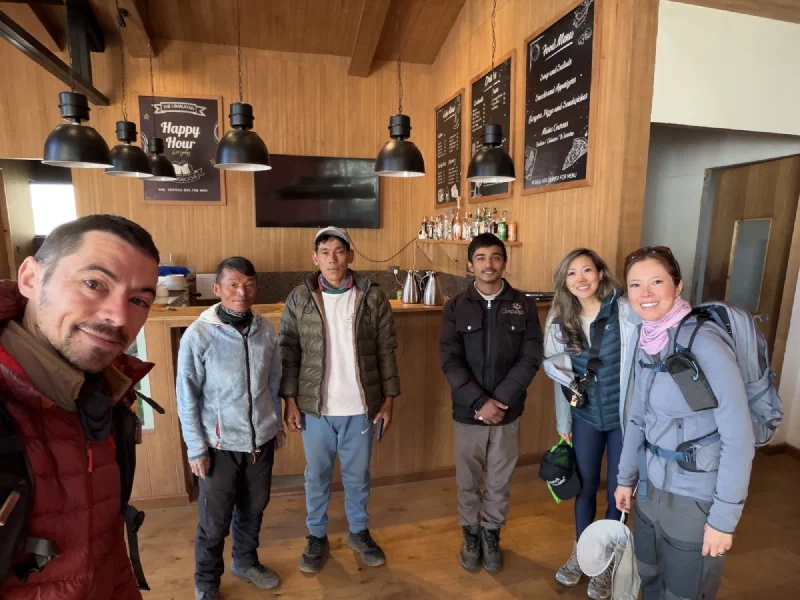
Group photo inside a lodge with warm wooden walls, six people smiling together
The crew at The Himalayan. Po On, Pokin, Nicholas, the two porters Kerman and Nilman, and one of the lodge staff who really looked after Pokin during her recovery. Kerman and Nilman were about to leave for the seven-hour hike down to Phakding carrying all the bags. These guys don’t stop.

The porters had headed out earlier that morning, carrying all the duffels down the trail by hand. Kerman and Nilman, doing what they do. Meanwhile, we took the lazy way.

Nicholas hiking uphill on a rocky trail with a red jacket and large backpack, mountains behind
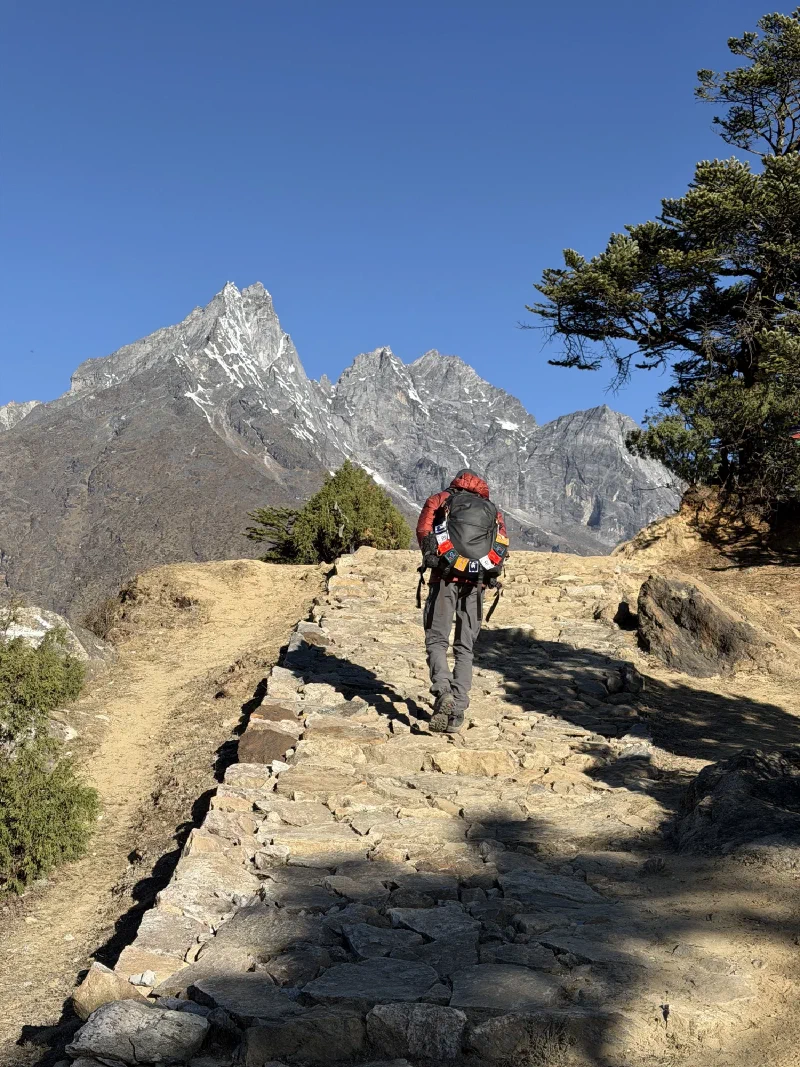
The walk to the helicopter pad. Uphill. Because of course the helicopter pad is uphill.

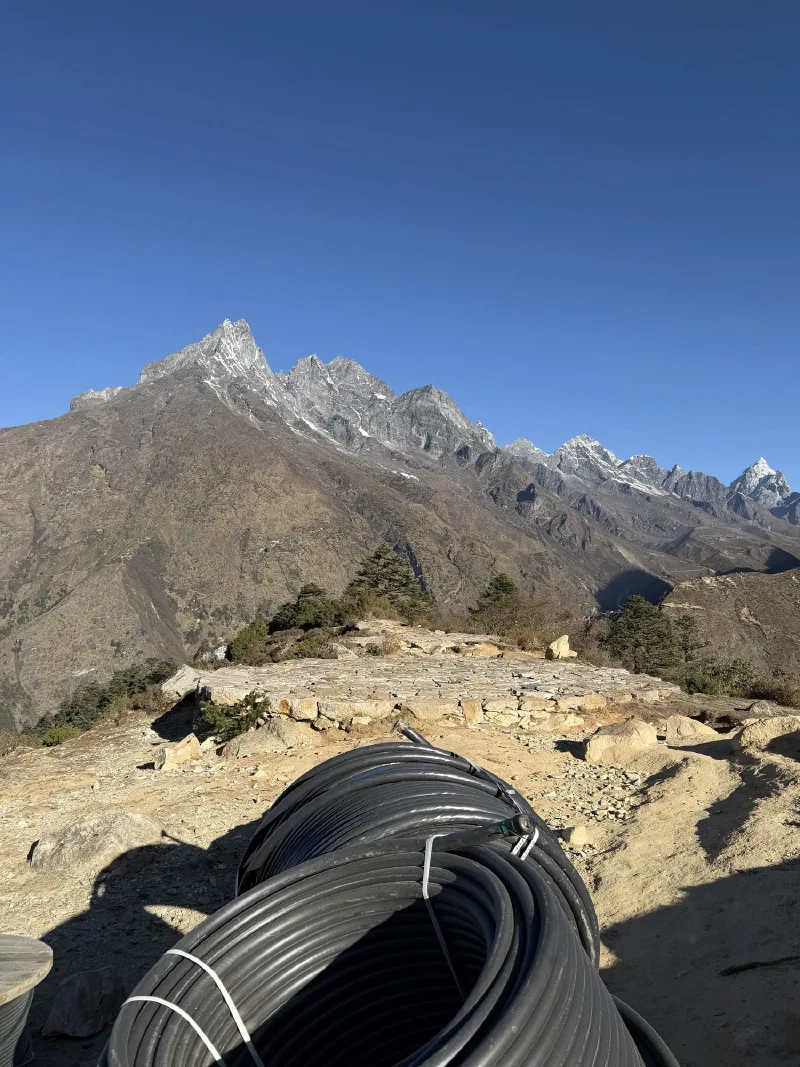
The “helicopter pad” in Tengboche is a loose stone circle on a hill behind the village. No terminal. No windsock. Just some rocks arranged in a vaguely circular pattern and a pile of construction piping.

Mountain landscape from the helicopter landing area with coiled piping in the foreground

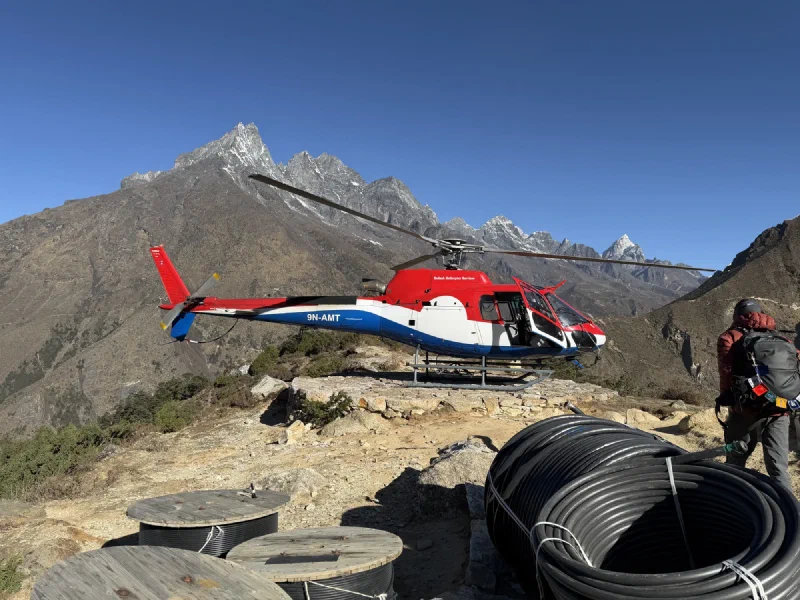
Red white and blue helicopter parked on a rocky mountain helipad with dramatic Himalayan peaks behind
There she is. Our ride out of the mountains.

We piled in. Headsets on. Doors shut. And then we were up.

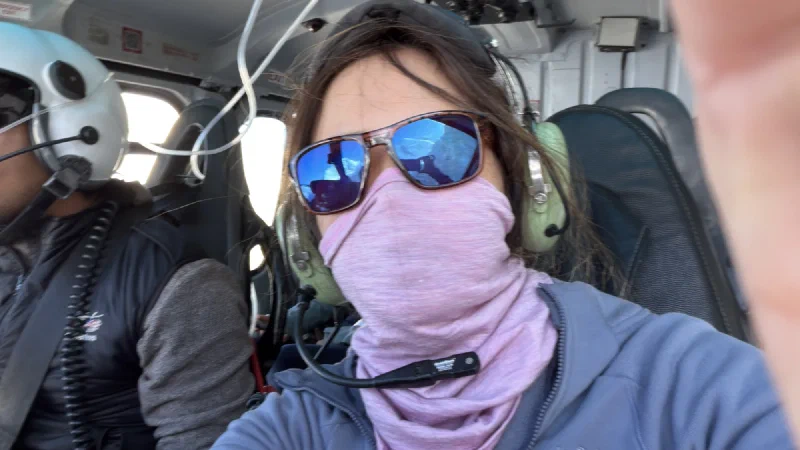
Pokin and Po On inside a helicopter wearing aviation headsets
Pokin riding shotgun.

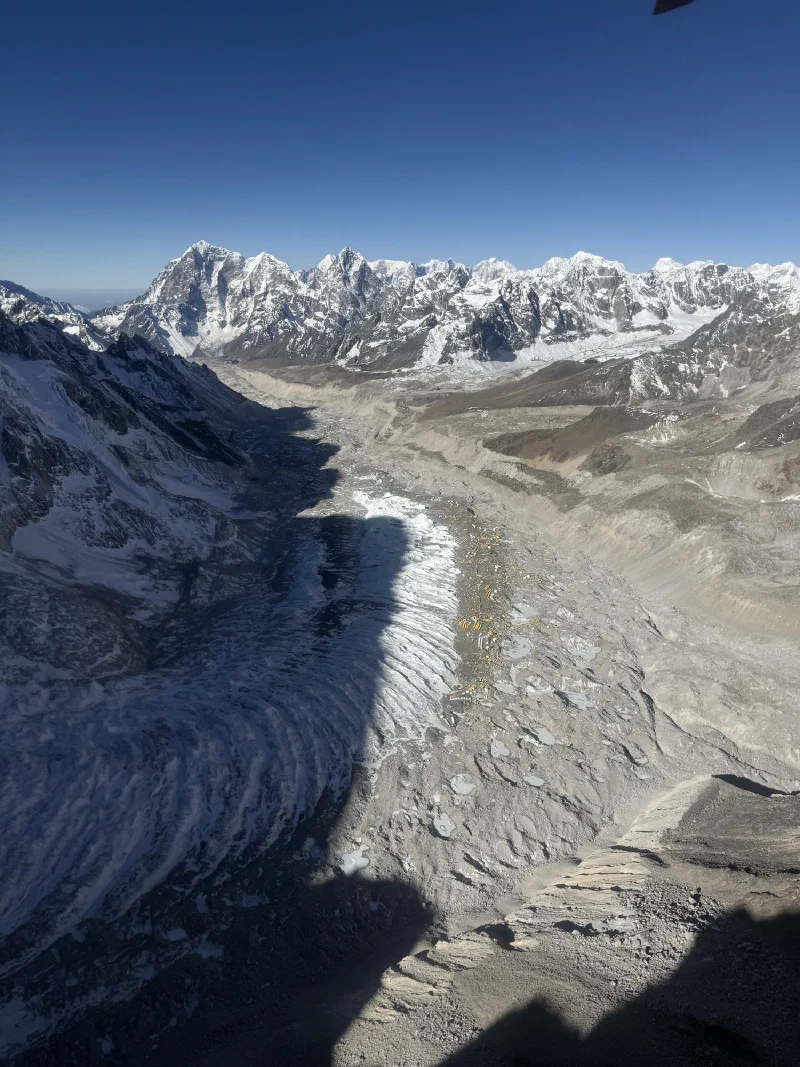
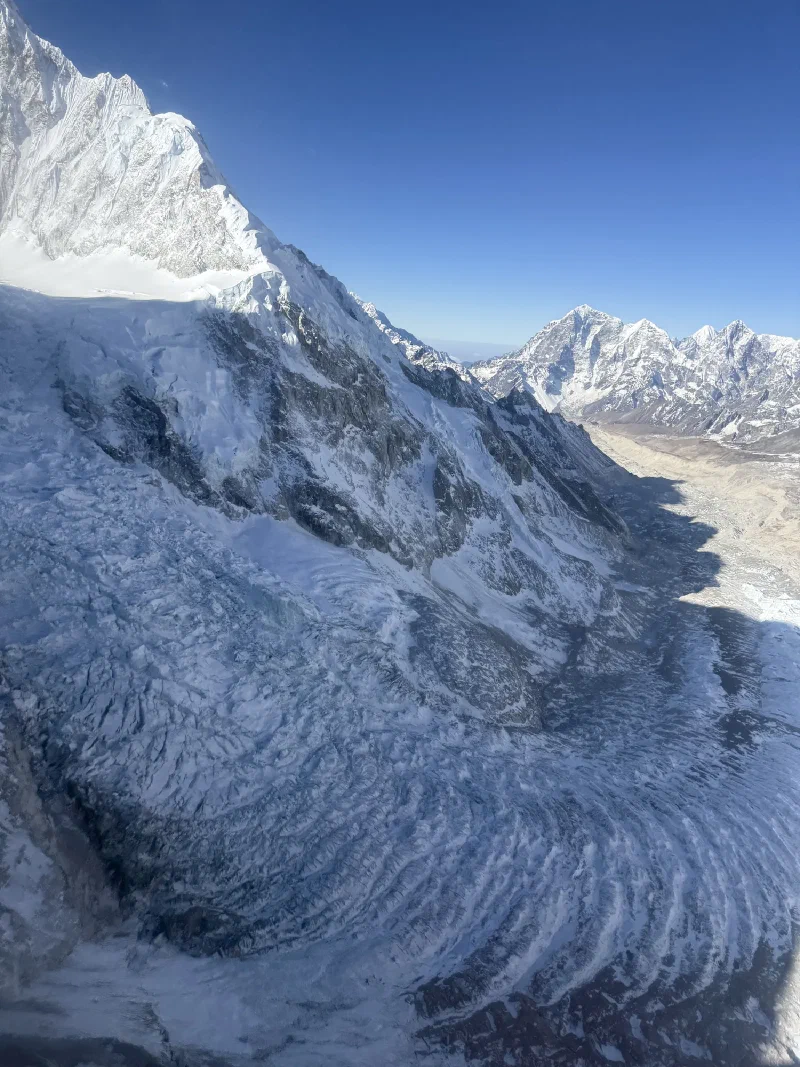
The pilot took us north, threading through the valleys toward Everest Base Camp. From the air, you can see the entire Khumbu Glacier, the tent clusters at Base Camp, and the peaks that Nicholas had been staring at from ground level for the past two weeks. It’s a completely different perspective. Everything that took days to hike past takes about four minutes in a helicopter.

Aerial view of the Khumbu Glacier and Everest Base Camp tents from helicopter, with the helicopter shadow visible on the moraine
The Khumbu Glacier and Base Camp from above. All those yellow specks are expedition tents. The helicopter shadow gives you a sense of how high up we are.
Aerial view of the Khumbu Icefall showing chaotic blue-white glacial ice, crevasses, and steep mountain walls
The Khumbu Icefall. This is where the glacier breaks apart into a maze of ice towers and crevasses. It’s one of the most dangerous sections of the Everest climbing route, and from up here you can see why.

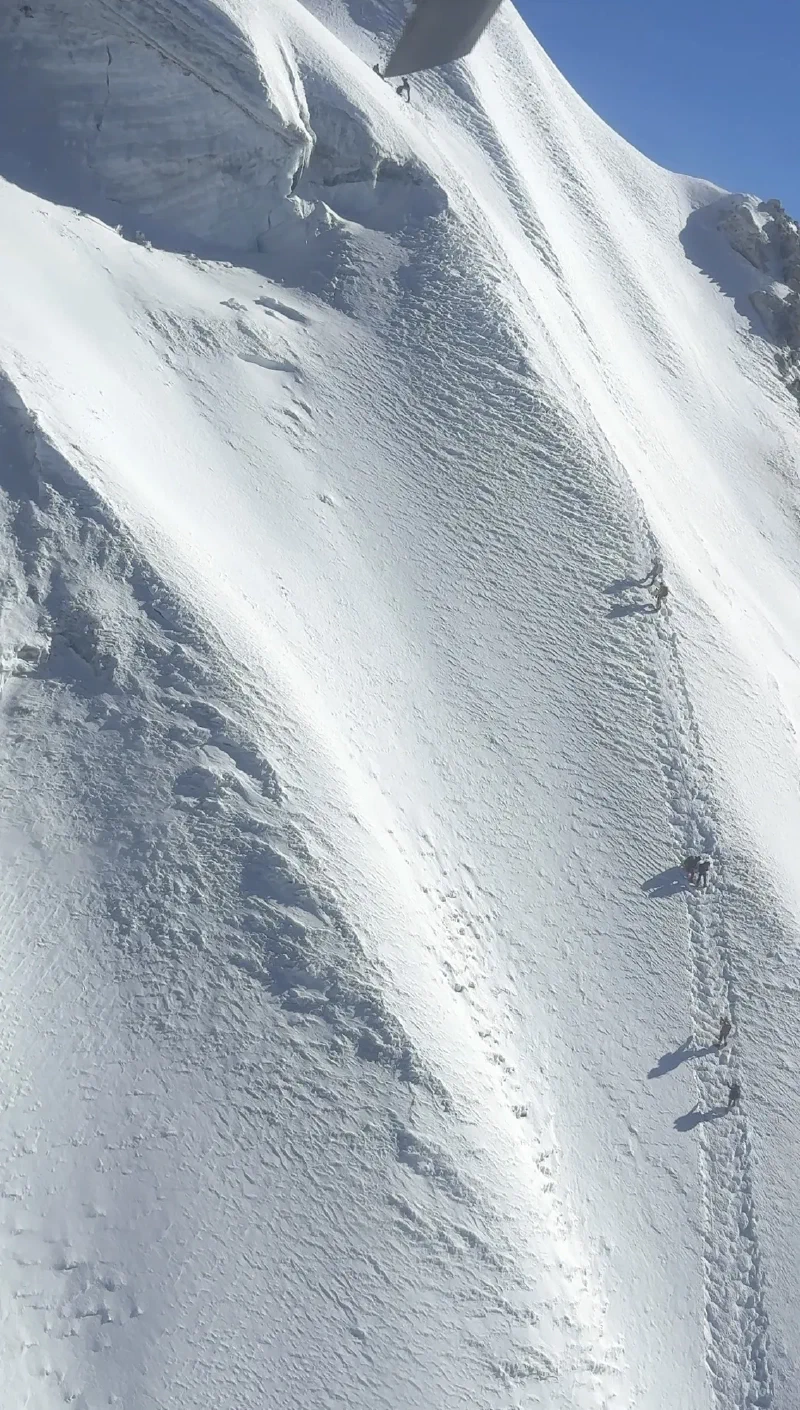
On the way over, we spotted climbers on Lobuche Peak. Tiny figures in a line, working their way up a steep snow face.

Climbers ascending a steep snow slope on Lobuche Peak, seen from a helicopter
Climbers on Lobuche Peak. Single file up the snow. From the helicopter they looked like ants on a wedding cake.

Then we banked west toward Gokyo.

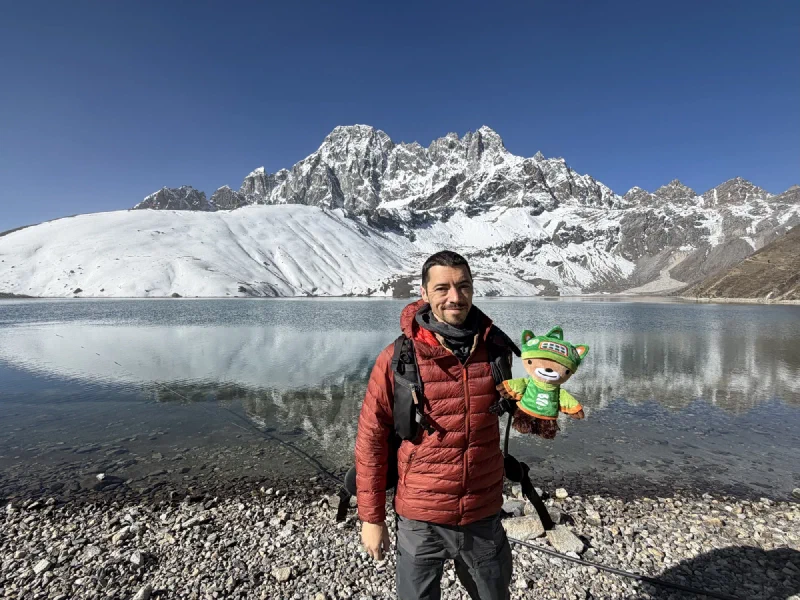
Nicholas holding Sumi at Gokyo Lake with snow-capped mountains perfectly reflected in the still water
Gokyo Lake. 4,750 meters. The mountains reflected in the water like someone pasted in a stock photo background. Except it’s real.

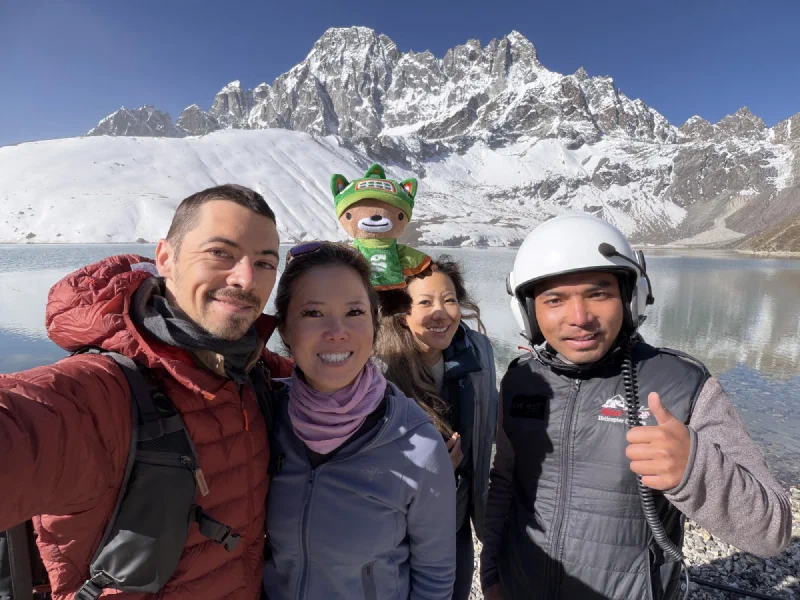
The helicopter landed right at the lake. We got out, stretched our legs on the rocky shoreline, and took in the view. The water was perfectly still. The mountains reflected in it like glass. Po On finally got her Gokyo Lake moment, even if she arrived by helicopter instead of over Cho La Pass.

Group selfie with helicopter pilot giving thumbs up at Gokyo Lake, snowy mountains behind
Group shot with the pilot. He seemed genuinely stoked to be there, which tracks. This is his office view.

Back in the helicopter. Headsets on. Time for the actual destination.

In-flight selfie with headsets during the flight from Gokyo

Here’s where it got interesting.

The pilot wasn’t told we were going to Phakding. He thought we were going to Lukla, which is the normal helicopter destination in the region. Lukla’s got the airport, the infrastructure, the helipads. Phakding is a tiny village with no obvious reason for a helicopter to go there.

So when we landed in Lukla, the ground crew looked at the passengers, looked at the paperwork, and said: “No, no. They’re supposed to go to Phakding.”

Pilot: oh.

Back in. Five more minutes of flying. Landed in Phakding.

Two trekkers stepping away from a red helicopter on a rocky helipad with forested hillside behind
Touchdown in Phakding. For real this time.

But here’s the thing nobody mentioned: there are multiple helicopter pads in Phakding. DB had booked us a family-run inn right next to the pad near the Sherpa Shangri-La, the same area where Nicholas and Pokin had been dropped at the very beginning of the trek. That’s where the family was waiting for us.

The pilot dropped us at a completely different pad. Somewhere we had never seen before. In the middle of what appeared to be someone’s farm.

The helicopter took off. We stood there.
Three trekkers standing on a forest path looking slightly lost after being dropped at the wrong helicopter pad
This is not where we’re supposed to be. The helicopter is gone. We are standing in a forest.
No obvious path out. No signs. Just us, some farm plots, and a lot of trees. We stood around looking confused until a very old woman wandered through the farm, sized us up, and wordlessly motioned for us to follow her. She led us through her property and out to the main trail.

Walking through terraced farmland and village homes after the wrong helicopter drop

Phakding village homes with corrugated roofs and small vegetable gardens between stone buildings

A trekker walking through a narrow stone alley between buildings in Phakding
Navigating the back alleys of Phakding. We’re a mile from the lodge and nobody knows we’re here.

We checked the map. We were about a mile from where we were supposed to be. Uphill and downhill. The family that runs the inn had been waiting at the other helicopter pad for two hours wondering where we were.

We messaged DB. He tried to reach the family. We started walking at whatever pace the girls could manage. After a while, a woman came running down the path toward us. “Are you from DB?” We said yes. She laughed. “My father has been waiting at the helicopter pad! He’s been there for two hours!” She led us back up to the lodge.

A trekker walking down a stone path toward a lodge with red roofs in a dramatic valley setting
Almost there. The lodge tucked into the valley ahead.

The inn is basic. Family-run, small, homemade food. But it’s warm, it’s low, and the family is genuinely kind. We settled in and decided to just stay for a few days and see how everyone feels.

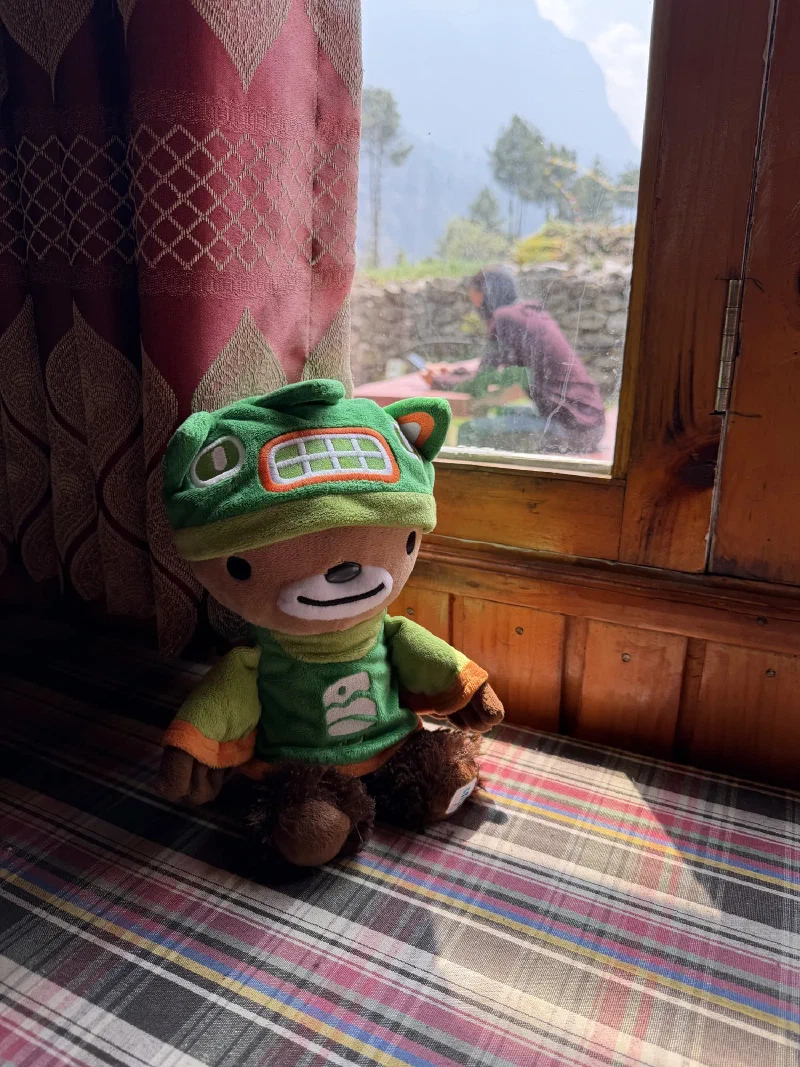
Sumi the spirit bear sitting on a plaid bench by a window at the lodge in Phakding
Claimed my spot. Window seat. Sunlight. This will do just fine.

Tengboche to Gokyo Lake to Everest Base Camp flyover to Lukla to the wrong helicopter pad in Phakding to an old woman’s farm to a mile-long walk to a family inn.

Not exactly how anyone planned it. But we’re at 2,610 meters, the three of us are settled in, and the coughing might actually stop now. Steve, Alice, and DB are still up in the mountains doing the Three Passes. We’ll see them on the other side.

Rest time. For real this time.


Back to Tengboche

Nicholas came straight off the mountain to breakfast. No shower. No change of clothes. Sleeping bag rolled up, camera packed, ready to go. The plan was always to head down today — back to Tengboche, back to Pokin, back to lower altitude where humans can breathe without having to think about it.

But there was a problem he didn’t know about yet, because he’d been sleeping on a mountain.

Po On was not doing well. She’d been struggling for a couple days, but overnight it got worse. Not just the altitude anymore. She was getting genuinely sick on top of the altitude sickness. DB took one look at her that morning and made the call: she was not going over any more passes. She was done. She’d be heading down to Tengboche with Nicholas and me.

The question was whether she could actually hike it.

She didn’t think so. So what did we do?

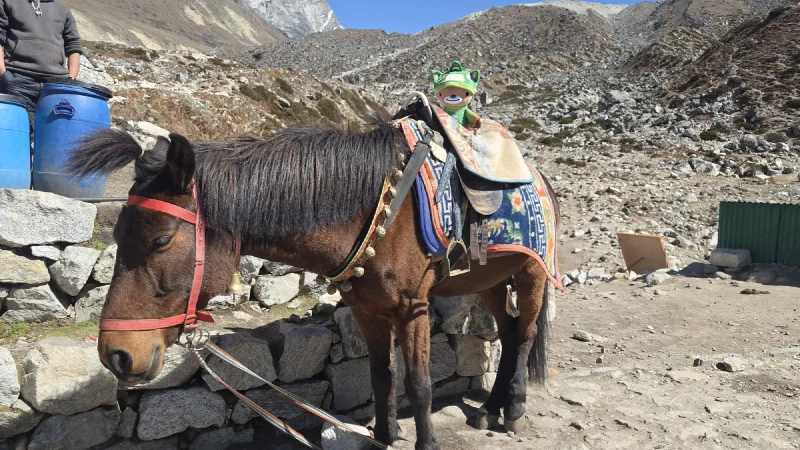
We rented a horse.

Sumi the spirit bear sitting on a horse saddle with brass bells and a colorful blanket on a rocky mountain trail
Obviously I had to test it first. Safety inspection. Very official.

Chestnut is probably back in Las Vegas right now beaming. “I’m so proud! Horses are so helpful! One of my fellow equines out there helping Po On in her time of need!” He’d be insufferably optimistic about the whole thing. He always is.

The horse’s name was Sunny. Or Suni. Or Soy. Or Soya. Honestly, every time the guide said it, it came out slightly different. We asked him to write it down. What he wrote had no obvious relationship to anything he’d been saying out loud. So the horse’s name remains a mystery. I’m going with Sunny because it makes the most sense.

But first — a look at what Nicholas was leaving behind.

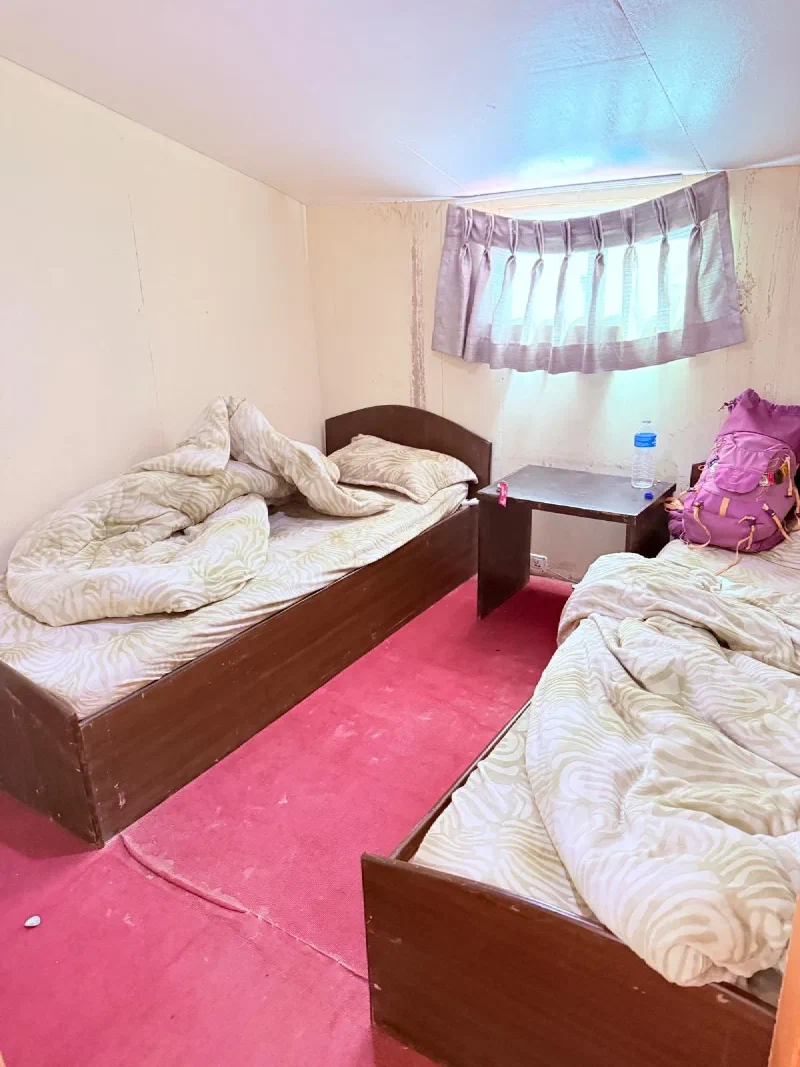
Thukla lodge room with two beds and a purple backpack

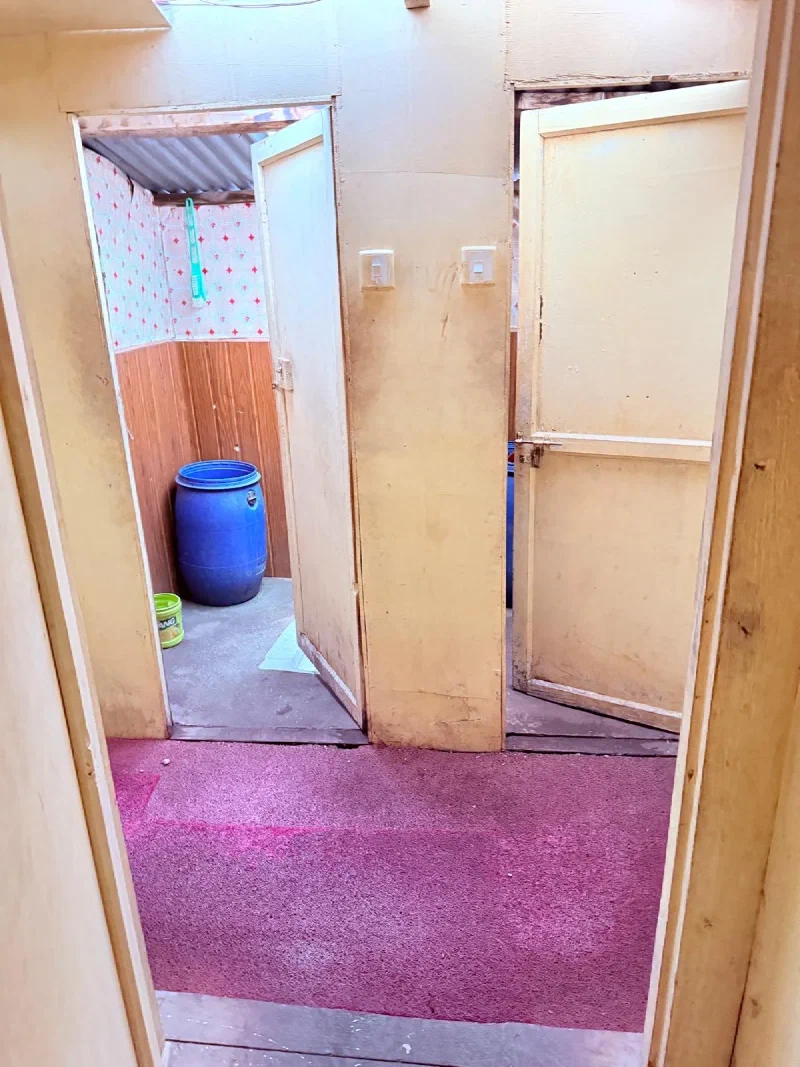
Lodge hallway showing shared bathroom with blue water barrel

This was the room at the lodge in Thukla. Shared squat toilet. Blue water barrel. The works. Given the state of things in there, Nicholas was actually glad he’d spent the night outside on a mountain instead. Better stars. Better air. Fewer things you don’t want to think about.

Meanwhile, back in Tengboche:

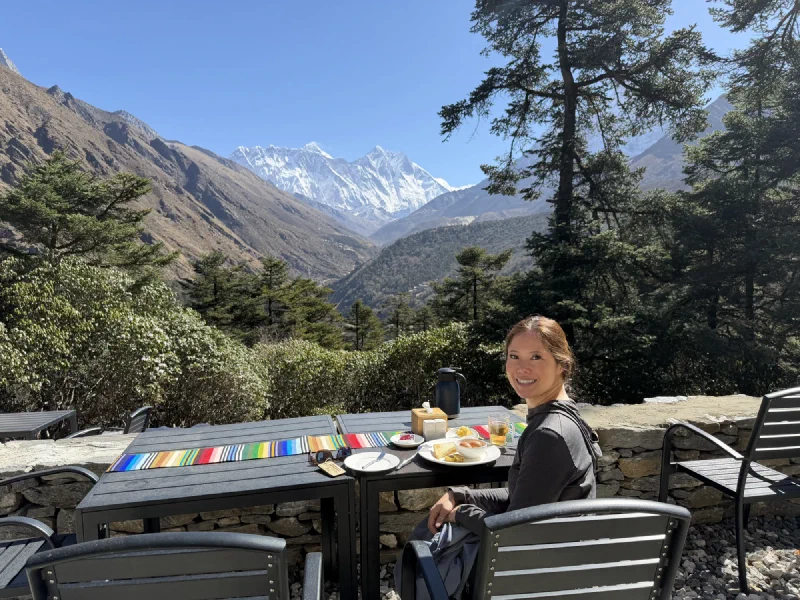
Pokin sitting at an outdoor terrace table with a full breakfast spread and snow-capped Himalayan peaks in the background
Pokin at her heated lodge in Tengboche, having breakfast with a view of the entire Himalayan range. Some people really do have it figured out.

Yeah. Two very different mornings.

So the new plan: instead of going straight to Tengboche, they’d swing back through Dingboche on the way down. Nicholas had already visited the doctor there twice with Pokin, so why not make it three for three? Same clinic, same doctor, new sister.

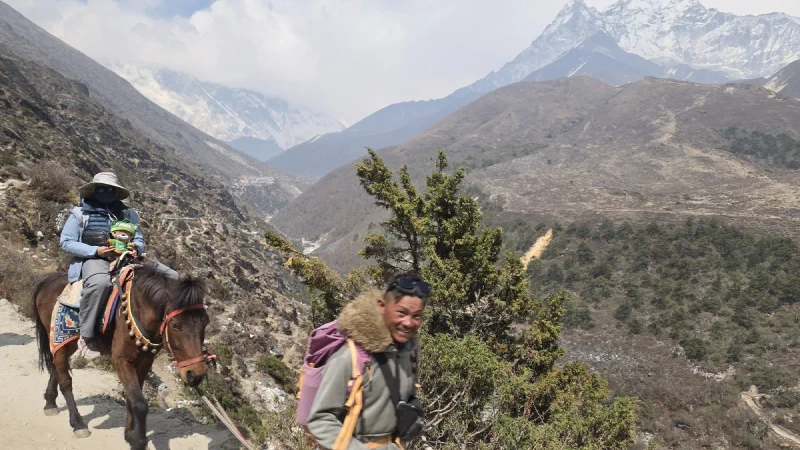
Po On riding a horse on a mountain trail with a guide walking alongside and snowy peaks in the distance
Po On and me on Sunny. I already did the safety inspection, so naturally I stayed on for the ride. Someone has to supervise.

Po On rode. Nicholas walked behind with the porters. Down through the valley, past the settlements, retracing all the steps he’d been speed-running upward just a few days ago. The whole thing was a lot more pleasant going downhill, aside from the part where everyone was sick or becoming sick.

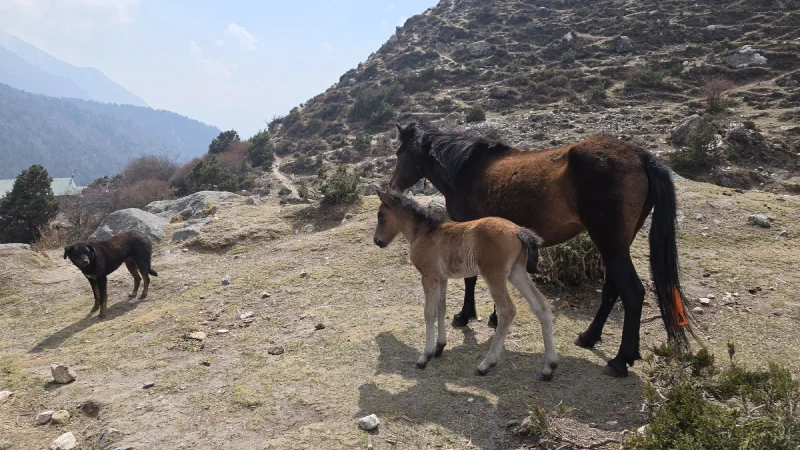
A horse and foal standing on a rocky trail with a black dog nearby
Trail committee. Horse, baby horse, and a dog who looked like he was in charge of both of them.

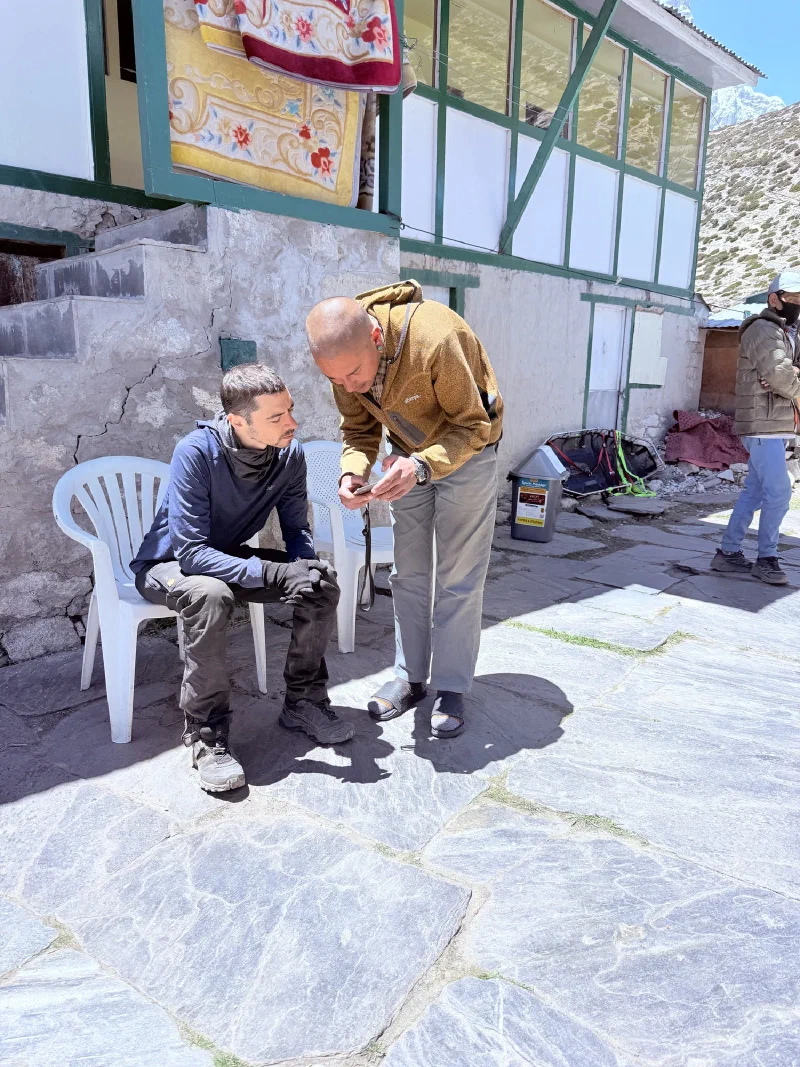
They made it to the doctor in Dingboche. Nicholas walked in and said, “Hey, I’m back. With the other sister.”

Nicholas sitting exhausted at a lodge while another man shows him something on a phone
Nicholas at the doctor’s. He looks exactly like a guy who slept on a mountain, speed-ran EBC, and then hiked all day with a horse.

Po On’s diagnosis was similar to Pokin’s. Respiratory infection, probably from the altitude and cold. Same antibiotics. The good news: no HAPE. No fluid in the lungs. Less severe than Pokin’s situation. The bad news: she still needed to go down. No more high altitude for her.

So they kept going. Down from Dingboche, through the valley, up the final climb to Tengboche.

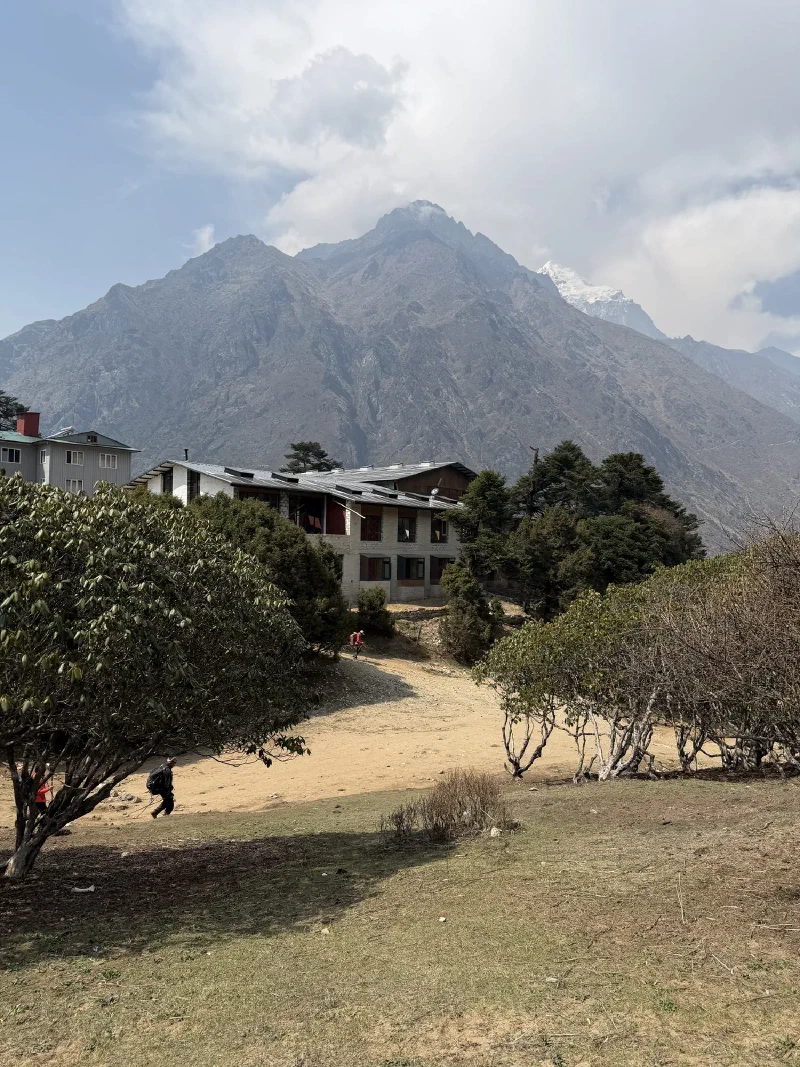
A lodge nestled among trees with a massive craggy mountain peak looming behind it
Almost there. Tengboche appearing through the trees.

That last stretch into Tengboche is deceptive. You’re descending for most of the day, everything feels like it’s winding down, and then the trail goes straight up. Steep switchbacks through the forest, right when your legs have already decided they’re done.

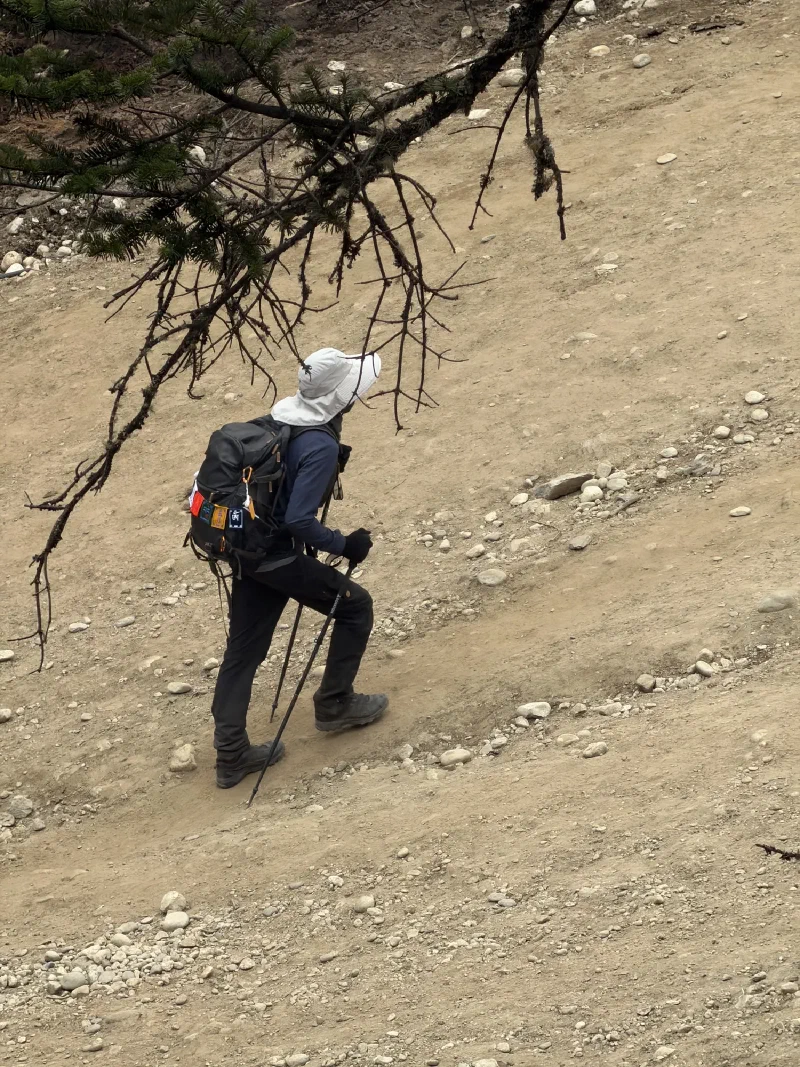
Nicholas climbing a steep trail with trekking poles and a full pack

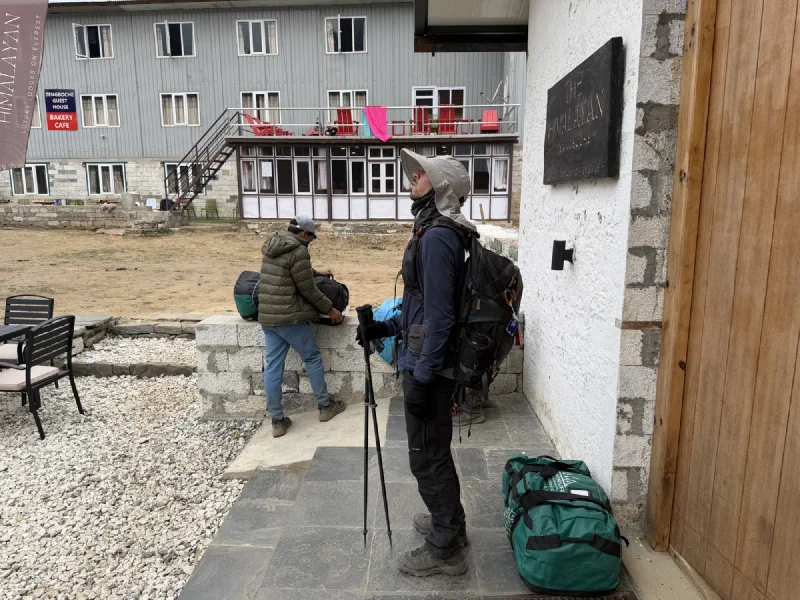
Nicholas standing on lodge steps with his pack, looking weary, under a sign reading The Himalayan Tyangboche
Made it. The sign says ‘The Himalayan.’ Nicholas’s face says ‘I need to sit down for approximately three days.’

Pokin spotted them coming up the trail from her patio. Reunion at the lodge. Everyone alive, mostly functional, varying degrees of sick.

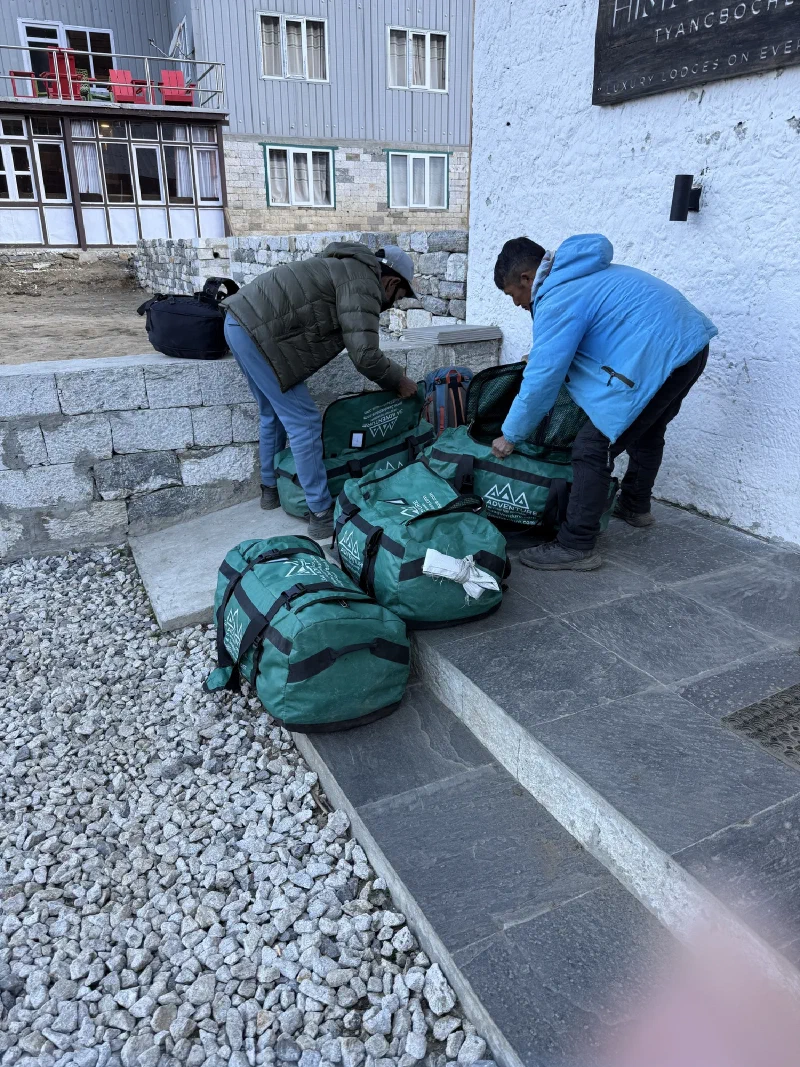
Two porters sorting through green duffel bags on a stone patio at a Tengboche lodge
The porters unloading at Tengboche. Kerman and Nilman, as always, making it look easy.

So here we are. Back at The Himalayan in Tengboche. Pokin has her heated room. Po On has antibiotics. Nicholas has a cough that’s getting worse and a body that’s finally catching up with three nights of no sleep at extreme altitude.

But the three of them are back together. Steve, Alice, and DB are still up there doing the Three Passes route, but this crew is reunited. That counts for something.

Rest time.


1 2 3 4 … 51